Tarmac driveway cleaning is one of the most common jobs we get called out for across Greater Manchester, and it's also one of the most misunderstood. Homeowners sometimes assume a quick blast with a hire machine will sort it, or they're not entirely sure what they've got on their driveway in the first place. Getting it wrong can cost more than getting it right from the start, so it's worth taking a few minutes to understand what's actually involved before anything happens to the surface.
This guide covers how to identify your surface, why tarmac attracts dirt and growth so readily in the North West, what a proper clean involves, and what it genuinely can and can't fix. There's also some honest advice on cost and on when DIY stops being sensible. If you just want a price, the fastest route is always a couple of photos over WhatsApp — but read on if you want to understand what you're dealing with first.
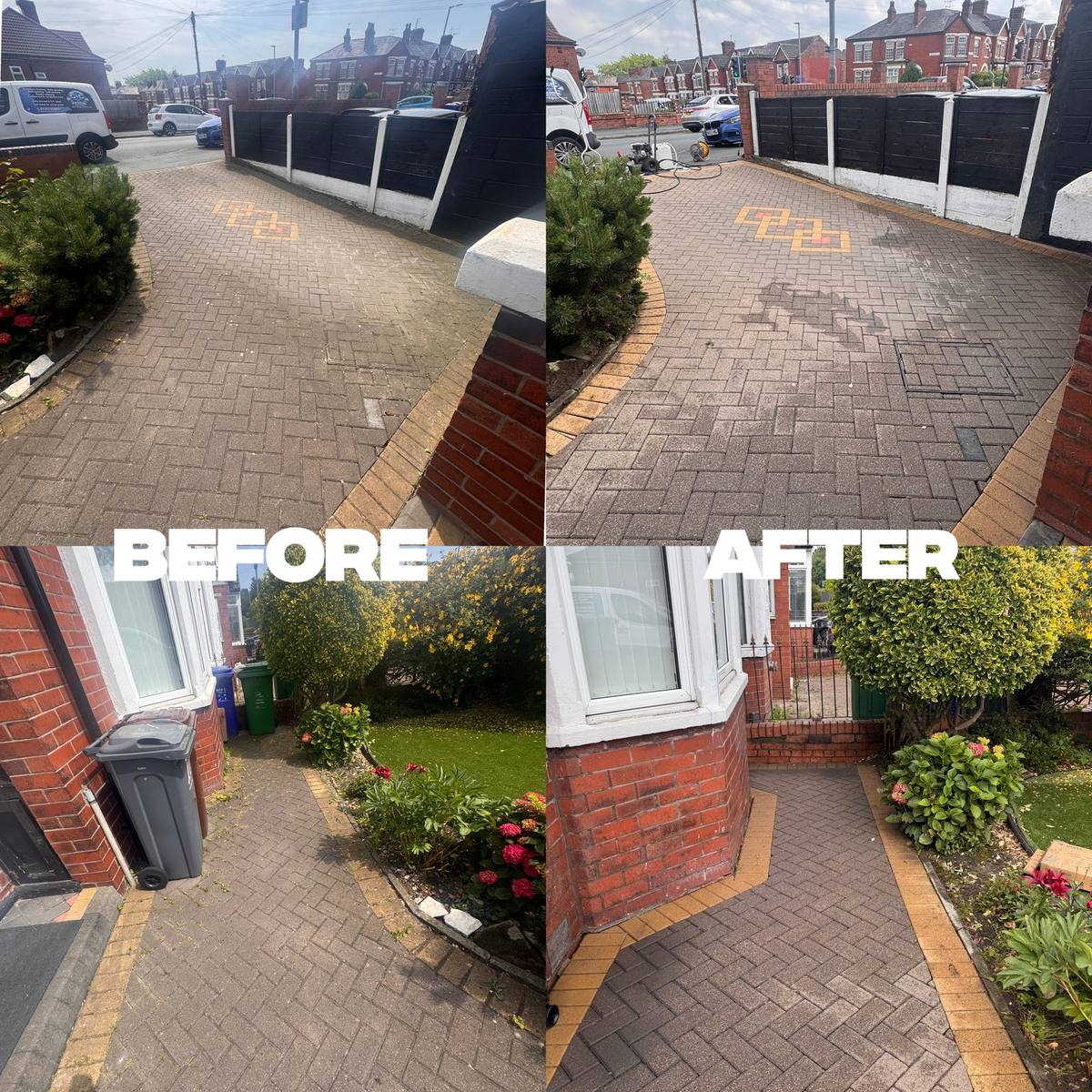
Before and after tarmac driveway cleaning — the difference a proper clean makes.
Quick answer: Tarmac driveway cleaning involves removing algae, moss, oil stains and general grime using controlled pressure washing — typically with a rotary surface cleaner to avoid surface damage. Done correctly, it restores grip, improves kerb appeal and extends the life of the tarmac without lifting or cracking it.
Is Your Driveway Actually Tarmac?
More driveways than you'd expect turn out not to be tarmac at all. True tarmac — tarmacadam — is a dark, slightly flexible surface with a gritty, bound aggregate texture. It's common on older driveways across Oldham, Rochdale and much of Greater Manchester, often laid decades ago and still serviceable if it's been reasonably maintained. What trips people up is that concrete, asphalt, and pattern-imprinted concrete can all look similar when they're covered in moss and grime.
Concrete is harder and typically lighter in colour beneath the dirt. Pattern-imprinted or stamped concrete has moulded joints and a rigid feel underfoot, and it needs a different cleaning approach — closer to what's described in our guide on concrete driveway cleaning done right. Asphalt is chemically similar to tarmac but often smoother and more uniform. The distinction matters because pressure, chemical choice and technique all need to be matched to the actual surface — getting that wrong can cause real damage.
If you're not sure, look at the edges of the driveway where it meets a kerb or grass border. Tarmac tends to have a slightly crumbled or rounded edge and a granular surface texture. When in doubt, send a photo — it takes about thirty seconds to identify from a clear image.
Why Tarmac Gets Dirty So Quickly
Tarmac's dark colour and slightly porous surface make it almost hospitable to biological growth. Algae spores settle on it, find enough moisture and organic matter to take hold, and within a season you can have a visible green or black film across the whole driveway. Greater Manchester's climate doesn't help — we get more than our fair share of damp, overcast weather, and surfaces in shadier spots or under trees can be wet for days at a time. That's close to ideal growing conditions for algae and moss.
Oil and rubber deposits add to the problem. Driveways where a car sits for most of the day pick up slow drips from engines and brake dust from wheels. These dark, greasy patches attract further dirt and make the surface look degraded even when the underlying tarmac is structurally sound. Leaf tannins — particularly from birch or sycamore — stain the surface over winter and can be stubborn to shift if they're left to break down into the texture of the tarmac over multiple wet seasons.
The net result is that a tarmac driveway in a typical Greater Manchester garden, left without any maintenance, can go from clean to visibly neglected within two years. That's not a reflection of poor quality tarmac — it's just the environment we live in.
The Right Way to Pressure Wash Tarmac
The single most important thing to understand about tarmac driveway cleaning is that pressure needs to be lower than most people assume. Concrete is hard enough to tolerate a more aggressive approach — tarmac isn't. Use too high a PSI or hold a lance too close and you'll strip the fine aggregate from the surface, leaving it looking scoured and speeding up its deterioration. A rotary surface cleaner — a spinning head that keeps consistent distance and distributes pressure evenly — is almost always the right tool for tarmac. A direct lance is not.
Pre-treatment matters as much as the cleaning itself. Applying a biocide or appropriate degreaser and allowing proper dwell time before any water goes on breaks down biological growth and loosens oil contamination at the surface level. Skipping this step and going straight in with pressure means you're physically removing dirt rather than treating it — it works to a degree, but the results don't last as long and you can end up working harder than necessary. Dwell time varies by product and condition, but typically fifteen to thirty minutes is needed for biological treatments to do their work.
Post-clean, a dilute biocide residual treatment slows regrowth considerably. It won't stop algae returning indefinitely — nothing does in this climate — but it gives the surface a fighting chance over the following months. For a fuller picture of how professional driveway cleaning works across different surface types, that page covers the detail.
What Tarmac Driveway Cleaning Can and Can't Fix
A professional clean removes biological growth — algae, moss, lichen — along with surface dirt, light rubber deposits and moderately embedded grime. Done properly, it can transform the appearance of a tarmac driveway that looks years past its best. That's a realistic outcome for most surfaces that have been neglected for a year or two in normal Greater Manchester conditions.
What it won't do is repair structural problems. Cracks, potholes, crumbling edges and patches where the surface is breaking up need a tarmac repair contractor, not a pressure washer. Cleaning a badly cracked surface can actually make things worse if water is forced into existing fractures. Deep-set fuel stains — particularly from years of slow diesel or petrol leaks — can be significantly lightened but are rarely fully eliminated. The same goes for very old oil contamination that has had time to cure into the surface. Setting that expectation upfront is important: the job might look dramatically better without looking perfect, and that's an honest result.
If your tarmac driveway has visible cracks wider than a few millimetres, or areas where the surface is lifting or crumbling, get those assessed and repaired before booking a clean. Water forced into structural damage during pressure washing can accelerate the deterioration — a clean surface that's breaking up underneath is still a surface that needs replacing sooner than it should.
How Much Does Tarmac Driveway Cleaning Cost?
Pricing for tarmac driveway cleaning depends on size, current condition and how established any biological growth is. A standard single driveway in good to moderate condition — say forty to sixty square metres — typically comes in at a straightforward rate per square metre, with the overall price reflecting the actual area rather than a flat call-out fee. Heavy moss or algae that has been left for several seasons takes longer to treat and shift, which is reflected in the price.
As a reference point, our driveway cleaning pricing starts from around £3.50 per square metre for a basic clean, rising to £4.25 per square metre where chemical pre-treatment is included as part of the process. Those figures apply across Greater Manchester and give a reasonable starting point, though the fastest way to get an accurate number for your specific driveway is to send a photo. Surface condition, access and any particular problem areas all affect the final figure, and it's not something that can be quoted accurately without seeing what's there.
For context on how long results typically last — and what affects that — the guide on how long a driveway clean actually lasts is worth a read before you book anything.
When to Call a Professional Instead of DIing It
Hire machines from a local tool hire company can put out pressure figures that sound reassuring — 150 bar, 200 bar — but that power applied incorrectly to tarmac causes real damage. The surface layer of tarmac is bound aggregate and bitumen, and at high pressure with a lance held close, that bond can be physically disrupted. You end up with a loose, scoured surface that looks worse than before and is now more susceptible to frost damage and further deterioration.
Beyond the pressure question, DIY cleaning without appropriate pre-treatment chemical just moves the dirt around and leaves the biological growth largely intact below the surface. Within a few weeks, algae that wasn't fully treated re-establishes itself. It can feel like the clean didn't work, when really the issue was that the root cause wasn't addressed. C&C Precision carries commercial-grade equipment and the right chemical treatments for tarmac, and we're fully insured to £1,000,000 public liability — which matters if something does go wrong on your property.
If your tarmac is aged, showing surface deterioration, or has existing cracks, a professional eye before any cleaning starts is particularly valuable. What looks like a cleaning job occasionally turns out to be a surface that needs to come up rather than be cleaned, and knowing that before you spend money on cleaning saves a wasted job.
Keeping Your Tarmac Driveway Cleaner for Longer
The single most effective habit is clearing leaves promptly in autumn. Leaf debris holds moisture against the surface and the tannins leach into tarmac over winter, leaving dark staining that becomes progressively harder to shift. A quick sweep or blow every week or two during October and November makes a genuine difference to how the driveway looks the following spring.
Oil drips are best tackled immediately rather than left. A small leak from a parked car seems minor but over months it saturates an area of tarmac that then acts as a dirt magnet. Absorbent granules or a dedicated oil remover applied while the stain is fresh give a much better result than trying to treat something that's been there for a year. Parking on the same spot every day concentrates both oil risk and rubber deposits — if you have the option to vary where a vehicle sits, it's worth doing.
Booking a professional clean every one to two years — before growth gets well established rather than after it does — keeps the job straightforward and the cost lower than letting it go to the point where heavy moss removal is needed. A periodic biocide treatment between cleans slows regrowth further. Some homeowners in areas like Chadderton and Simister, where shaded drives under older trees are common, find annual cleaning makes sense given how quickly growth comes back — our guides on driveway cleaning in Chadderton and driveway cleaning in Simister cover local conditions in more detail.
Frequently asked questions
Can you pressure wash tarmac without damaging it?
Yes, but pressure and technique matter a lot. Tarmac requires lower PSI than concrete and a rotary surface cleaner rather than a direct lance — which can gouge or stripe the surface. In poor condition or on older tarmac, a professional should assess it first before any water goes on.
Will pressure washing remove oil stains from a tarmac driveway?
Light and relatively fresh oil stains can be significantly reduced with a specialist degreaser pre-treatment followed by hot or high-pressure cleaning. Deep-set or old stains — particularly from years of slow leaks — are much harder to fully remove and may only be lightened rather than eliminated.
How often should a tarmac driveway be cleaned professionally?
In a climate like Greater Manchester's, most tarmac driveways benefit from a professional clean every one to two years to stay on top of algae and moss growth. Leaving it longer doesn't just look worse — it lets biological growth work into the surface and makes the job harder and more expensive when you do get round to it.
Do you serve tarmac driveways across Greater Manchester?
Yes — C&C Precision covers Oldham, Rochdale, Bury, Bolton, Manchester, Tameside, Stockport and surrounding towns. The quickest way to get a price is to send a couple of photos of your driveway over WhatsApp and we'll come back to you fast.
Want a Fast Quote for Your Tarmac Driveway?
Send a couple of photos over WhatsApp and we'll give you a straight price — usually within the hour.