If you've been searching for driveway cleaning Chadderton, chances are you've already looked at your driveway and decided it's past the point where a bucket and brush will make much difference. That's a fair assessment. Chadderton's climate and street layout create conditions where driveways deteriorate faster than most homeowners expect, and what looks like a surface problem is usually something more deeply embedded by the time anyone gets round to dealing with it.
This guide covers what builds up on driveways in this part of Oldham, how different surface types behave, what a proper clean actually involves, and when it makes sense to call someone in rather than hiring a pressure washer for the weekend. The aim is to give you enough information to make a sensible decision — not to talk you into anything.
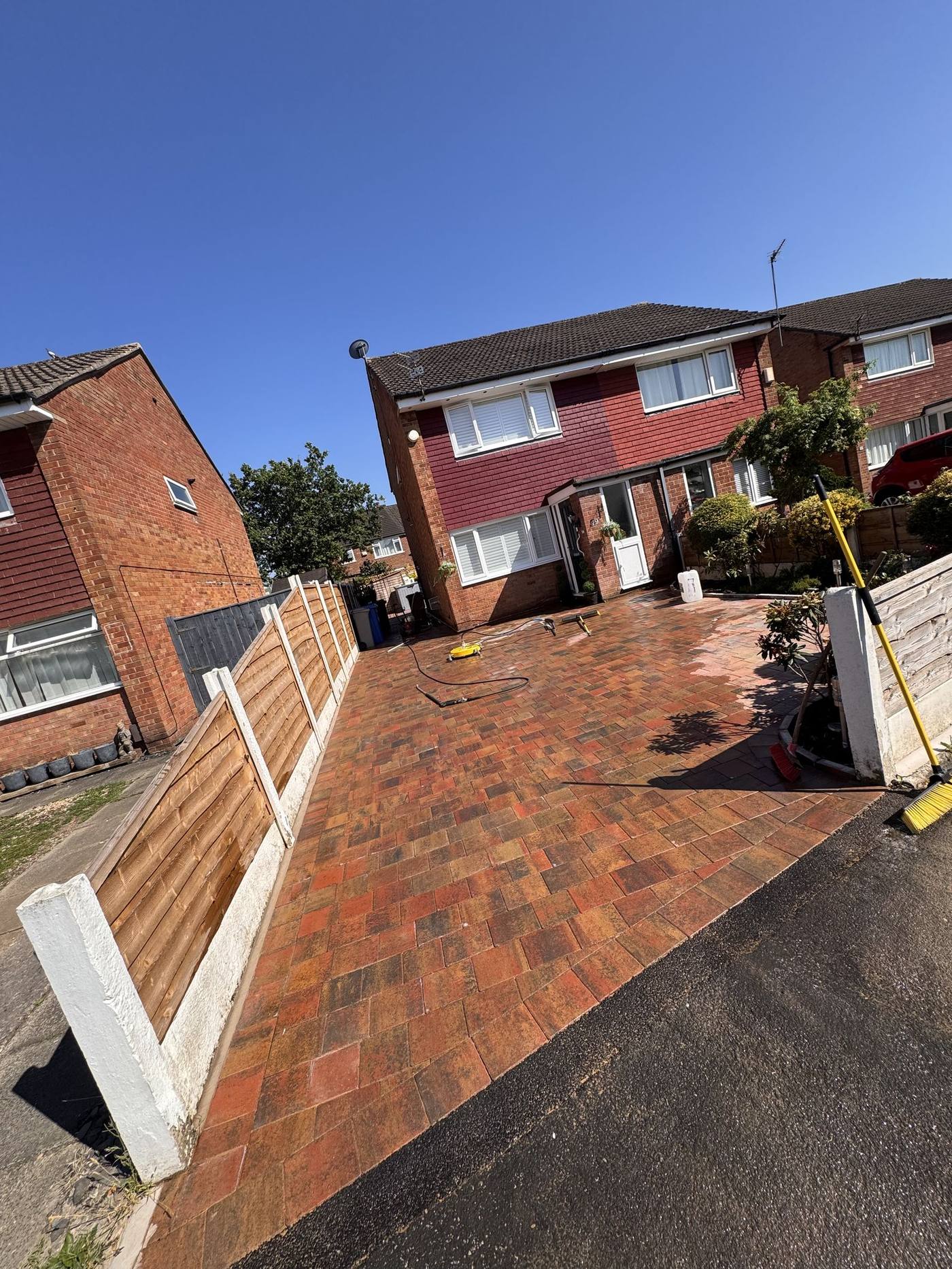
Block paving on a Chadderton semi — cleaned and colours fully restored.
Quick answer: Driveway cleaning in Chadderton typically costs £80–£250 depending on size and surface type. The area's damp climate, clay soil and street tree coverage means driveways build up heavy moss, algae and compacted dirt fast — most benefit from a professional clean every one to two years.
Why Chadderton Driveways Get Dirty Faster Than You'd Expect
Greater Manchester sits in one of the wetter parts of England, and Chadderton doesn't get any favours from its geography. Annual rainfall here regularly exceeds 800mm, and the prevailing south-westerly winds push damp air across the area for much of the year. That persistent moisture is the main reason algae and moss establish so readily on outdoor surfaces — they don't need much more than a reliably damp surface and a bit of shade.
Chadderton's soil is predominantly clay-heavy, which means poor drainage beneath driveways. Water sits longer on block paving joints and in the pores of concrete than it would in sandier areas, and that extended damp creates ideal conditions for biological growth. Add in the mature street trees common across the older residential streets — lime, sycamore, horse chestnut — and you get a steady deposit of leaf tannins, seed debris and sticky aphid residue that stains paving and accelerates organic growth underneath it.
Compared to somewhere drier like the south-east, a Chadderton driveway can go from freshly cleaned to noticeably green in a single winter. That's not unusual, and it doesn't mean something is wrong with the surface — it's just the environment doing what it does.
The Most Common Driveway Surfaces in Chadderton
On a typical day of driveway cleaning Chadderton jobs, you see a predictable range of surfaces depending on the age and type of property. The 1980s and 1990s semis that make up a lot of the housing stock in areas like Firwood Park and Foxdenton tend to have block paving — clay or concrete blocks laid over a sand bed, with kiln-dried sand in the joints. These have usually been down for twenty or thirty years, so the jointing sand is largely gone, the surface is stained and the blocks may have shifted slightly.
Older terraced properties, particularly on the streets closer to Chadderton town centre, often have tarmac — either original or re-laid. Tarmac is fairly forgiving to clean, but oil drips from parked vehicles soak in over time and don't always come fully out. Bungalows and earlier builds frequently have plain concrete, which tends to show green algae prominently across shaded sections. More recently, pattern imprinted concrete and large-format porcelain slabs have appeared on newer homes and extensions — both require more careful handling than standard block paving because the sealant on imprinted concrete can be damaged by the wrong equipment or technique, and porcelain needs a consistent approach to avoid surface marking.
Each surface responds differently to cleaning. Block paving, for example, can handle a rotary surface cleaner at higher pressure because the blocks themselves are robust — but the joints are vulnerable. Porcelain, on the other hand, needs lower pressure and the right detergent to avoid disrupting grout lines or leaving streaks. Understanding what's underfoot before starting is part of doing the job properly.
What Builds Up on a Chadderton Driveway Over Time
The accumulation on a neglected driveway is usually layered. The most visible layer is green algae — a thin, slippery film that appears first in shaded spots and gradually spreads across the surface as spores migrate with rainwater. Beneath that, or in areas that get more weathering, you'll often find black spot lichen: small, dark, crusty growths that grip the surface tightly and are considerably harder to shift than algae. Lichen doesn't just sit on the surface — it secretes acids that etch into block paving and concrete over time.
In the joints of block paving, moss is the main problem. Once the original jointing sand has eroded, moss moves in quickly. It holds moisture, accelerates frost damage and, when it dies back, leaves the joints open to weed colonisation. Near dropped kerbs and where vehicles manoeuvre, oil drips are common — these soak into porous surfaces and tend to be among the more stubborn stains to treat. And underneath trees, compacted leaf debris leaves dark, tannin-based staining that a garden hose will barely scratch. A domestic hose simply doesn't produce enough pressure or flow to lift any of this properly, and without a pre-treatment chemical, the organic material just redistributes rather than being removed.
What a Professional Driveway Clean Actually Involves
The process starts before any water goes down. A proper driveway clean begins with a pre-treatment — usually a detergent or biocide suitable for the surface type, applied and left to dwell. Dwell time matters: giving the chemical ten to twenty minutes to penetrate and break down algae, moss and surface grime means the pressure washing stage lifts material rather than just moving it around. Skipping pre-treatment and going straight to pressure is a common DIY mistake that gets visually acceptable results on the day but leaves the biology in place to regrow faster.
The main cleaning stage uses a rotary surface cleaner — a spinning head that covers the surface evenly and avoids the striped marks that an open lance leaves on block paving and concrete. The rotating jet gets under debris and lifts it consistently across the whole area. After the main pass, edge detailing with a hand lance picks up what the surface cleaner can't reach along walls, steps and borders. The whole area is then rinsed down thoroughly so no residue is left behind.
For block paving specifically, the job doesn't end there. You can find a detailed breakdown of what's involved in block paving cleaning work, but in short — cleaning always removes jointing sand, and that needs addressing before the job is finished. Similarly, if you have a patio rather than a driveway, the process is comparable but surface material — sandstone, porcelain, concrete slabs — changes what chemicals and pressures are appropriate.
Block Paving Re-Sanding: Why It Matters After Cleaning
This comes up on almost every block paving job, so it's worth being direct about it. Pressure washing flushes kiln-dried sand out of the joints — that's unavoidable. The sand isn't decorative; it's what locks the blocks together, transfers load between them and prevents the kind of movement that leads to rocking blocks and uneven surfaces. Once it's gone, the structure of the paving is compromised.
Without fresh sand in the joints, weeds establish within weeks. Weed roots aren't just cosmetically irritating — they physically displace blocks as they grow, and once a joint is open and colonised, it's much harder to restore properly. Block paving re-sanding with fresh kiln-dried sand, brushed and compacted in properly, closes that window. It's not an upsell — it's the part of the job that makes everything else last. Pricing for re-sanding sits at around £2.00/m² on its own; as part of a full clean and restoration the combined cost typically runs to around £5.50/m².
Kiln-dried sand must go onto a dry surface to bed in and lock correctly. If rain is forecast within a few hours, it's worth delaying that part of the job — the cleaning can be done regardless, but re-sanding into a wet surface means the sand won't settle properly and the result won't last.
When to Call a Professional Rather Than DIY
Hiring a domestic pressure washer for the weekend works well for rinsing garden furniture or cleaning a small area of paving that's lightly soiled. It starts to cause problems on driveways in more specific situations. Block paving is the most common example — an open lance used at the pressure needed to shift embedded dirt will strip every trace of jointing sand from a block paving drive in an afternoon. The surface might look cleaner, but it's now structurally looser and open to immediate weed regrowth. The same issue applies to older pointed concrete, where high-pressure water can blow out mortar from expansion joints that then need repointing.
Pattern imprinted concrete is another surface where DIY regularly causes damage. The sealant coat that gives the surface its colour and protects the pattern is vulnerable to high-pressure lance work at close range — it strips or clouds, and resealing an imprinted concrete drive is an expensive fix. For a guide on how this plays out with similar porous surfaces, the piece on pressure washing Indian sandstone covers the kind of damage that the wrong approach causes.
The other limitation of DIY is chemical treatment. Without a proper biocide pre-soak and the right detergent for the surface, algae spores can spread across the driveway on the water runoff, and biological material that isn't treated will regrow faster than it grew originally. For anything beyond a lightly soiled, straightforward concrete or tarmac surface, professional equipment and pre-treatment make a genuine difference to how long the result lasts. C&C Precision Precision Pressure Washing covers Chadderton and the wider Oldham area and can usually give a quote based on a few WhatsApp photos without needing a site visit first.
It's also worth being honest about expectations: some oil stains that have been soaking into porous block paving for years will lighten considerably but may not disappear entirely. A professional clean will get the best result the surface allows — but no cleaning process removes every trace of every stain on every surface, and anyone who tells you otherwise isn't being straight with you.
Keeping Your Chadderton Driveway in Better Shape Between Cleans
The most effective thing you can do between professional cleans is deal with leaf fall quickly. In Chadderton, the combination of street trees and damp autumns means leaves compact fast — within a few weeks they're wet enough to bond to block paving and begin staining. A quick sweep or blower session in October and November prevents the majority of tannin staining that builds up over winter. It's a small amount of effort relative to what it prevents.
Keeping block paving joints topped up with kiln-dried sand is worth doing if you notice gaps appearing. You can buy bags of it from builders' merchants — sweep it in dry, compact it lightly with a brush and it closes off the joint before weed seeds get established. It's not a permanent fix in the same way a professional re-sand is, but it extends the time between major interventions. For oil drips, a proprietary driveway degreaser applied quickly — before the oil has time to soak in — significantly improves the chances of getting it out. Left for months, oil becomes part of the surface rather than something sitting on it.
As for how often to get a proper professional clean done — in this part of Greater Manchester, every one to two years is realistic for most properties. The guide on how long a driveway clean lasts covers this in more detail, but the short answer is that a shaded drive with heavy tree coverage will need annual attention, while an open, south-facing driveway might go two years without significant regrowth. Treating it as a recurring maintenance task rather than a one-off job keeps the cost manageable and the surface in much better long-term condition. Driveway cleaning Chadderton is one of those jobs that costs more the longer it's left — embedded lichen and compacted organic debris take considerably more work to shift than fresh growth that's dealt with promptly.
Frequently asked questions
How much does driveway cleaning cost in Chadderton?
Most driveways in Chadderton come in between £80 and £250 depending on size, surface type and how heavily soiled they are. A small block paving drive on a terraced house is at the lower end; a large pattern imprinted concrete drive on a detached property with re-sanding would be at the top. Send us a couple of photos on WhatsApp and we'll give you a straight price.
Do you need to re-sand block paving after pressure washing?
Yes, in almost every case. Pressure washing flushes out the kiln-dried jointing sand that holds the blocks stable and keeps weeds out. If it's not replaced, the blocks start to shift and weeds are back within weeks. We use fresh kiln-dried sand and brush it in properly as part of the job.
How long does a driveway clean take in Chadderton?
A typical semi-detached driveway takes around two to three hours from start to finish. Larger driveways, heavily soiled surfaces, or jobs that include re-sanding will take longer. We'll give you a realistic time when we quote so you know what to expect on the day.
How often should a Chadderton driveway be professionally cleaned?
Every one to two years is realistic for most Chadderton properties given the rainfall and tree coverage in the area. Shaded driveways or those under heavy tree canopy may need attention annually. Leaving it longer than two years usually means more embedded staining and heavier moss that takes more work to shift.
Want a price for your Chadderton driveway?
Send a couple of photos over WhatsApp and we'll come back to you with a straight price — usually same day.