If you've just had your driveway cleaned and you're wondering how long it will stay looking good, the honest answer is: it depends. How long does driveway cleaning last is one of the most common questions we get asked, and the range — anywhere from one to three years — is wide enough that it's worth understanding what sits at each end of it. Surface type, shade, the local climate, and what's done after cleaning all play a part. This isn't something where a single number fits every situation.
Greater Manchester's weather doesn't help. We're wet for a good portion of the year, which means biological growth — algae, moss, lichen — has exactly the conditions it needs to come back. That's not a cleaning failure; it's just how things work in the North West. What a proper professional clean does is reset the clock, remove the established growth, and — when the right aftercare steps are taken — slow down how quickly the clock runs again.
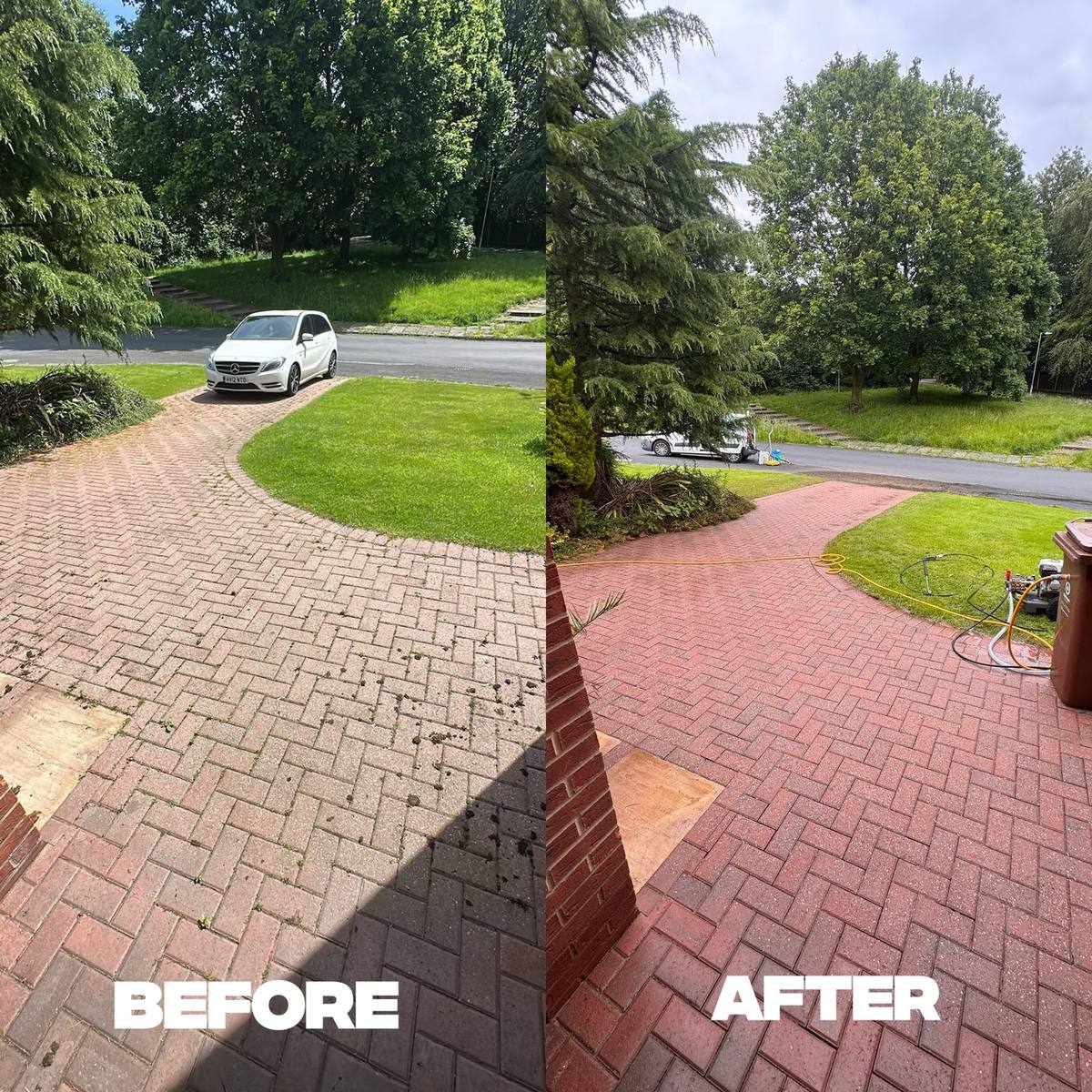
Block paving cleaned by C&C Precision in Greater Manchester — colours fully restored.
Quick answer: A professionally cleaned driveway typically stays clean for 1 to 3 years, depending on the surface type, local weather, and whether it's sealed afterwards. Block paving and concrete in shaded or damp spots will green up faster. Sealing after cleaning is the single best way to extend results.
The Short Answer: 1 to 3 Years for Most Driveways
A professionally cleaned driveway will typically stay in good condition for one to three years before visible regrowth or soiling becomes noticeable enough to warrant another clean. That's the realistic window. The lower end — where a drive starts greening up within 12 months — usually comes down to a combination of factors: a porous surface, heavy shade, poor drainage, or skipping aftercare steps like re-sanding and sealing. The upper end is achievable, but it generally requires a thorough clean followed by proper treatment and some basic maintenance habits.
It's also worth being clear about what "lasting" means here. The surface won't look freshly cleaned indefinitely — dust, tyre marks, and general use mean it changes day to day. What we're really talking about is how long before biological growth and deep soiling return to the point where another professional clean is genuinely needed. That's a different question from whether the drive looks spotless on a given Tuesday morning.
How long driveway cleaning lasts is ultimately a question about biology as much as pressure washing. Algae and moss spores are always present in the air. They settle on any surface and begin colonising wherever there's moisture and a foothold. A clean removes the existing growth; aftercare reduces how quickly the next generation establishes itself.
Surface Type Makes a Big Difference
Not all driveways behave the same after cleaning. Block paving and natural stone — particularly sandstone — are porous, which means they absorb water and give algae and moss somewhere to anchor. These surfaces tend to recolonise faster than sealed or non-porous materials. If you've got a block paving driveway that keeps going green, that's partly just the nature of the material. It's manageable, but it does mean the maintenance cycle is shorter than it might be on a dense concrete or tarmac surface.
Imprinted concrete — sometimes called pattern imprinted or decorative concrete — falls somewhere in the middle. It's less porous than block paving, but the surface texture still gives biological growth somewhere to settle. Tarmac tends to resist algae reasonably well when it's in good condition, though it has its own problems with oil staining and surface degradation over time. Indian sandstone is among the most demanding in terms of maintenance; if you're dealing with that material, our separate guide on pressure washing Indian sandstone covers the specifics in more detail.
The key point is that cleaning technique needs to match the surface. Too much pressure on sandstone or soft stone causes surface damage that actually makes future regrowth worse, because the micro-texture becomes rougher and holds more moisture. The right approach is lower pressure with appropriate pre-treatment, not blasting everything at maximum power.
Shade, Damp, and North-Facing Drives
A north-facing driveway in Greater Manchester is about as favourable a condition for moss and algae as you can get. Limited direct sunlight, persistent moisture, and the general dampness of the North West climate combine to create exactly what biological growth thrives on. If your drive is also under or near trees, leaf matter adds organic material that accelerates the process further. These driveways can start showing green within six months of a clean, even a good one.
This isn't something a cleaning company can fully overcome — it's biology responding to environment. What it does mean is that for shaded driveways, the aftercare steps matter more, not less. A biocide treatment applied after cleaning, and potentially an appropriate sealant, can meaningfully extend the clean period even on a heavily shaded surface. Without those steps, the results simply won't last as long, and expecting otherwise sets up an unfair comparison.
Keeping gutters clear also has a direct impact. Overflowing gutters deposit a constant stream of water and organic debris onto the paving below. It's one of the more overlooked factors — if you're in Bury or the surrounding area, there's a separate guide on gutter clearing that explains how quickly a blocked gutter can undo good work on the surface below.
Does Sealing After Cleaning Help — and by How Much?
Sealing is the most effective single step you can take to extend how long a driveway clean lasts. A quality sealant closes the surface pores that algae and moss anchor into, and on block paving and imprinted concrete especially, it can realistically double the interval before a reclean is needed. That's a significant return on a relatively modest additional cost. If you're curious why some sealed driveways still seem to fail quickly, the guide on why driveway sealer fails covers the common reasons in detail.
There are different sealant types — wet look, natural finish, colour enhancing — and the right choice depends on the surface and what result you're after. What matters more than the finish type is that the surface is properly cleaned and dry before sealing. Sealing over damp paving or residual organic growth is one of the most common reasons sealants fail early. The preparation is the job; the sealing is just the final step.
It's also worth noting that sealing isn't a permanent solution. It extends the clean period, reduces weed growth in joints, and protects surface colour — but it will eventually need reapplying, typically every two to four years depending on traffic and exposure. Think of it as part of a maintenance cycle rather than a one-time fix.
Re-Sanding Block Paving: Why It Matters for Longevity
Pressure washing strips the kiln-dried sand from block paving joints. That's unavoidable — the water has to go somewhere, and it takes the sand with it. Without re-sanding after a clean, the joints are left open, which creates two problems: weeds and moss establish themselves in the gaps very quickly, and the blocks themselves lose some of their structural stability. Most people skip re-sanding because it seems like an optional extra. It isn't, really — it's the step that makes the results last.
Kiln-dried sand is hydrophobic once set, which helps resist weed germination and reduces moisture retention in the joints. Re-sanding typically adds around £2.00 per square metre to the job, and it's worth every penny in terms of how long the clean lasts. A full restoration including cleaning, chemical treatment, and re-sanding comes to around £5.50 per square metre. Block paving re-sanding done properly — with the right sand brushed in dry and compacted — makes a noticeable difference to how quickly the surface starts to look neglected again.
The sand also acts as a barrier in the joint that makes it harder for algae spores to take hold at the surface level. It's a small thing, but across several square metres of paving, it adds up to a meaningful delay in regrowth. Combined with a sealant, it's the most effective combination for extending results on block paving specifically.
When Should You Call a Professional Instead of Just Hosing It Down?
A garden hose moves surface dirt around. It won't remove embedded algae, lichen, or black spot — the dark grey-black staining that develops in paving over time and is actually a form of algae colony, not just grime. If your driveway has visible green, orange, or dark biological growth, or if the surface feels slippery underfoot, hosing it down will make it look slightly better for about a week before everything settles back to where it was. It doesn't reset anything.
A professional driveway cleaning service using the right pre-treatment — typically a biocide applied with appropriate dwell time before any pressure washing begins — actually breaks down the biological matter at the surface, rather than just dislodging the top layer. The dwell time matters: a chemical pre-treatment needs time to penetrate and work before the surface is washed. Rushing that step produces worse results. If you're also dealing with oil staining alongside the general biological growth, there's a practical guide on oil stains on driveways that's worth reading before assuming everything will come out with pressure alone.
C&C Precision Pressure Washing handles exactly this kind of work across Oldham and Greater Manchester — a fast quote via WhatsApp photo, fully insured to £1,000,000 public liability, and a 5.0 Google rating built on doing the job properly rather than just making it look done. If the surface has got beyond what a basic clean will shift, it's worth a conversation before assuming the worst about the paving itself.
Practical Tips to Make Your Driveway Clean Last Longer
Leaves are the enemy of a clean driveway in the autumn months. They break down into a damp organic layer that accelerates algae and moss growth underneath. Brushing them off promptly — even just a quick sweep once a week during October and November — makes a real difference to how quickly biological growth re-establishes itself. It takes five minutes and costs nothing.
The single most effective habit after a professional clean is keeping organic debris — leaves, soil tracked in from borders, bird droppings — off the surface as promptly as possible. Biological growth needs organic material to feed on. Remove that, and you slow the whole process down without spending anything extra.
Beyond that, making sure drainage is working correctly around the drive helps considerably. Water pooling on or running across paving creates persistent damp patches that green up faster than the rest of the surface. If you notice areas that stay wet long after rain has stopped, that's worth addressing — it could be a gutter issue, a grading problem, or blocked drainage channels. Fixing the cause will always outlast treating the symptom.
Booking a clean before heavy growth gets established is also worth considering as a strategy rather than waiting until the drive looks obviously bad. A maintenance clean on a surface that's just beginning to show early signs of greening is quicker, uses less chemical, and produces better results than trying to shift growth that's had two or three years to anchor in. How long driveway cleaning lasts is partly about the clean itself, but it's also about when in the growth cycle you intervene.
Frequently asked questions
How often should I have my driveway professionally cleaned?
For most driveways in Greater Manchester, every 1 to 2 years is a sensible interval. Shaded or heavily trafficked drives may need annual attention, while a sealed driveway in a sunny spot could comfortably go 2 to 3 years. Booking before heavy growth sets in means the job is quicker and cheaper.
Will my block paving go green again quickly after cleaning?
It will eventually, yes — algae and moss spores are always present in the air and thrive in the UK's damp climate. However, re-sanding the joints with kiln-dried sand after cleaning and applying a quality sealant significantly slows regrowth. Without those steps, you could see green returning within 6 to 12 months.
Does sealing a driveway make the cleaning last longer?
Yes, noticeably so. Sealing closes the surface pores that algae and moss anchor into, making it harder for biological growth to take hold. On block paving and imprinted concrete especially, a properly applied sealant can realistically double the time before a reclean is needed.
Is it worth cleaning a driveway if it's just going to get dirty again?
Everything gets dirty again eventually — that's not a reason to avoid cleaning it. A clean driveway improves kerb appeal, removes slip hazards caused by algae and moss, and protects the surface from long-term staining and joint deterioration. The goal is to extend the clean period as long as possible, not to achieve something permanent.
Want to Know How Long Your Driveway Clean Would Last?
Send a photo of your driveway on WhatsApp and we'll give you a straight answer along with a fast, no-fuss quote.