If you've been searching for driveway cleaning in Simister, you're probably looking at a surface that's gone from clean to green faster than expected. That's not unusual in this part of Greater Manchester — the combination of rainfall, shade, and relatively low footfall on residential driveways means algae and moss establish quickly and spread quietly until the whole surface looks dark and tired. It's not a reflection on how well you look after your property; it's just the climate doing what it does.
This guide covers what actually works for the most common driveway surfaces in and around Simister, why some cleaning approaches cause more problems than they solve, and what's involved in a proper job from start to finish. The aim is to give you enough detail to make a sensible decision — whether you end up doing it yourself, hiring someone, or leaving it another season.
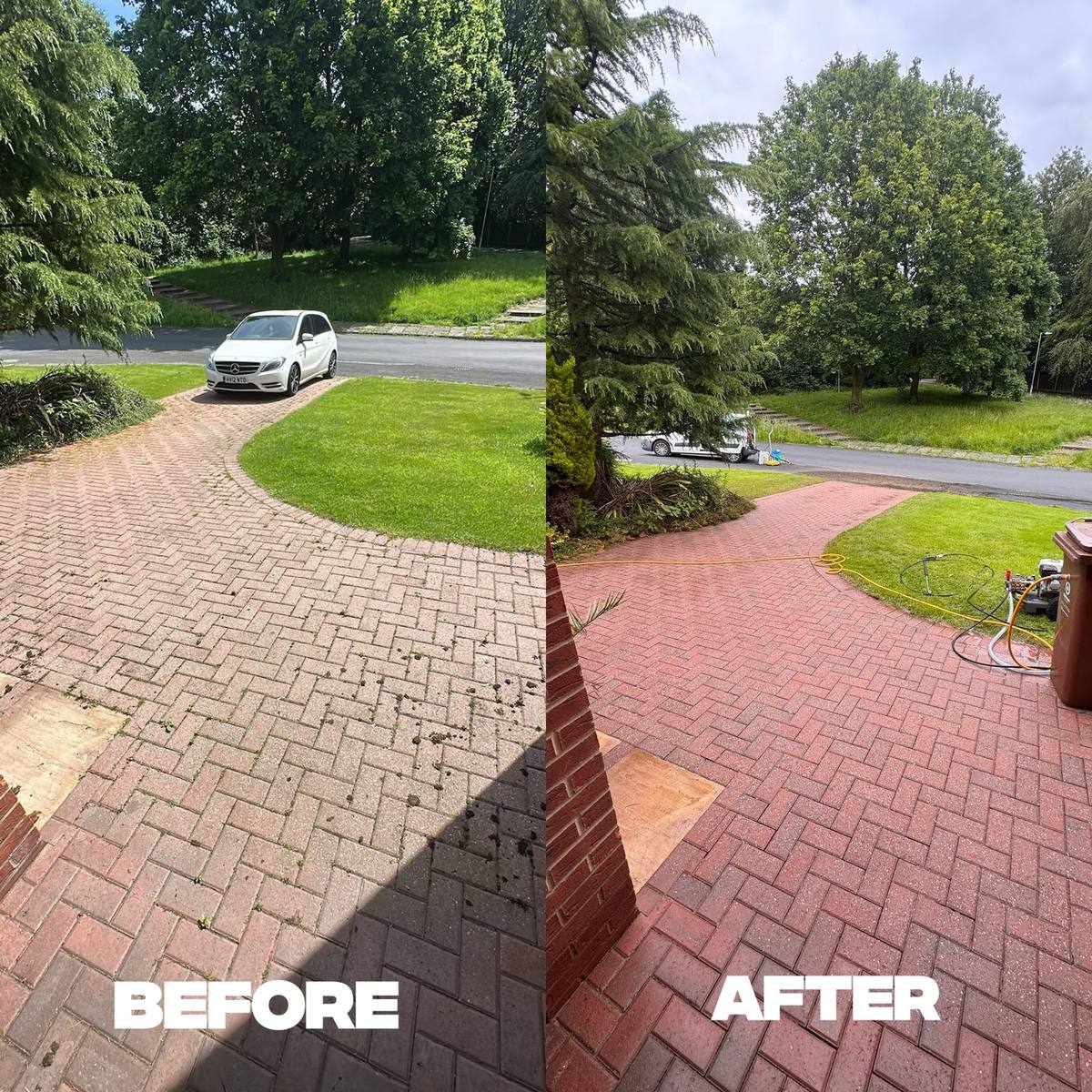
Block paving driveways respond well to professional cleaning — colours restored, joints cleared.
Quick answer: Driveway cleaning in Simister typically involves pressure washing block paving, tarmac, or concrete to remove moss, algae, and staining. Results depend heavily on the surface type and how long growth has been left. A professional clean restores the original colour and prevents long-term surface damage.
What Driveways Look Like in Simister
Simister sits between Whitefield and Middleton, in that stretch of Greater Manchester where housing stock ranges from 1970s semis through to newer executive-style detached properties. The driveways reflect that mix. Block paving is the most common surface — often the original herringbone-laid brindle or charcoal from when the estates were built, some of it now thirty or forty years old. Tarmac turns up on older properties, and pattern imprinted concrete became popular through the 2000s on larger homes.
Each of those surfaces behaves differently under pressure, responds differently to chemical treatments, and ages in its own way. What works well on a concrete driveway can be actively harmful to block paving joints, and imprinted concrete needs a completely different approach again. Getting the surface type right before anything else happens is the starting point for any decent clean.
Why Driveways Get Dirty So Fast in This Part of Greater Manchester
The North West gets more rainfall than most of England and significantly less direct sun. Surfaces stay damp longer between showers, and when biological growth gets a foothold — algae first, then moss, then the black spot that's actually a species of lichen — it spreads across a driveway in a single season if conditions are right. North-facing driveways are worst affected, but even south-facing ones will green over if there's a hedge, wall, or fence cutting off afternoon light.
Simister's tree-lined residential streets add another layer to this. Leaf debris breaks down into organic material that sits in the joints of block paving and feeds weed growth. Overhanging branches keep the surface in shade and deposit sap, which attracts further biological growth. By the time a driveway looks visibly bad, the growth is usually well established beneath the surface layer as well — which is why a quick rinse rarely does much.
For anyone who's had a clean done and found the green comes back quickly, it's worth reading our guide on how long a driveway clean actually lasts — there are things you can do after cleaning to slow regrowth considerably.
Block Paving: The Most Common Surface and How We Clean It
Block paving needs a pre-treatment before any pressure is applied. Applying a biocide or detergent solution and allowing it proper dwell time — typically fifteen to thirty minutes depending on the product and the level of growth — breaks down the biological material so it can be lifted cleanly rather than just pushed around or driven deeper into the joints. Going straight in with a pressure lance skips that step and usually means worse results on the biological staining, plus the added problem of blasting out the jointing sand that holds the whole surface stable.
A rotary surface cleaner rather than a wand is the right tool for block paving. It keeps the pressure even across a consistent area, avoids the tram lines that a lance leaves, and is gentler on the joint edges. The difference in finish between a surface cleaner and a lance pass is significant and immediately visible. For heavily soiled driveways, a second pass is sometimes needed, but the pre-treatment does most of the heavy lifting.
For more detail on what's involved in a full block paving clean, the block paving cleaning page covers the process from pre-treatment through to re-sanding.
Tarmac and Concrete Driveways: Different Approach Required
Tarmac is more forgiving in some respects — there are no joints to damage and it handles pressure well — but it can be marked or scoured if pressure is too high or applied too close to the surface. Old or degraded tarmac is more vulnerable still. The surface should be treated with an appropriate detergent to lift grime and biological growth before pressure is applied, and the lance kept moving at a consistent height throughout. Letting a hired jet wash linger in one spot, even briefly, can leave a visible mark.
Concrete driveways are durable and handle pressure well, but they show oil staining badly, and oil doesn't respond to pressure washing alone. A degreaser needs to be applied, given time to penetrate, and then agitated before the rinse — skipping that step means the oil stain lightens slightly but doesn't go. It's worth being honest here: old, deep-set oil stains on concrete may lighten significantly without ever fully disappearing. Our guide on concrete driveway cleaning done right goes into more detail on what's realistic.
Neither surface should be cleaned with a standard wand in a single pass without pre-treatment. That approach is quick but the results don't last and on concrete especially, the streaking is immediately obvious.
Pattern Imprinted Concrete: Cleaning Without Wrecking the Seal
Imprinted concrete driveways have a resin or polyurethane topcoat applied over the stamped and coloured concrete base. That seal is what gives the surface its colour and gloss. Over time it dulls from UV exposure and traffic, and if aggressive pressure washing is used it can strip the seal unevenly — leaving patches that are visibly different in tone, or lifting the seal at the edges of the pattern.
The right approach is a lower-pressure clean to remove surface contamination and biological growth, followed by assessment of the seal condition. If the seal has degraded significantly, resealing after cleaning is the only way to restore the colour properly rather than just shifting surface dirt. A fresh coat of sealant also gives the surface meaningful protection against water ingress over the following few years. Cleaning alone on a badly faded imprinted concrete driveway will improve it, but won't bring it back to how it looked when it was laid — that requires the sealing step.
When It's Worth Calling a Professional for Driveway Cleaning in Simister
Hired jet washes are typically high-pressure and low-control — they're designed to shift paint and heavy industrial grime, not to clean a residential driveway carefully. The pressure is often higher than a professional would use on a domestic surface, and the wide lance tip is difficult to keep consistent. On block paving, that means jointing sand gets stripped. On imprinted concrete, sealant gets lifted or scoured. On tarmac, prolonged exposure in one area can gouge the surface.
If a driveway has been neglected for more than a full season, if moss is coming up through the joints, or if there's established black spot lichen, a professional clean will reach further into the surface and last considerably longer than a DIY attempt. Pre-treatment chemicals available to trade are also more effective than consumer products. C&C Precision covers Simister and the surrounding areas of Whitefield, Middleton, and Prestwich — a photo sent over WhatsApp is enough to get a straight quote without needing a visit first.
If you're also dealing with moss on a roof or algae on a rendered wall at the same time, it makes sense to have everything assessed together — our softwashing service is the appropriate method for render and roof surfaces where pressure washing would cause damage.
If you're getting quotes for driveway cleaning, check whether re-sanding is included or priced separately. A clean without re-sanding leaves block paving unstable and more vulnerable to weed regrowth — the two steps belong together on any surface where the joints have been disturbed or were already depleted.
What to Do After Your Driveway Is Cleaned
Block paving needs to be fully dry before kiln-dried sand is brushed in to refill the joints. Kiln-dried sand is used specifically because it flows into the joints easily and compacts properly once it's in — regular sharp sand or building sand won't behave the same way and can introduce moisture that causes problems later. The re-sanding step stabilises the blocks, which prevents rocking and differential settlement, and the filled joints significantly reduce the space available for weed seeds to germinate. Pricing for block paving re-sanding as a standalone service starts from around £2.00/m², or it can be combined with a clean as part of a full restoration.
For imprinted concrete, a fresh seal every three to five years is a reasonable maintenance interval depending on traffic and exposure. It's not a job that needs doing every year, but leaving it indefinitely means the surface becomes porous, the colour flattens, and the cleaning job gets harder each time. Sealing after a professional clean is the logical moment to do it, when the surface is already fully prepared.
On any surface, applying a biocide treatment after cleaning slows biological regrowth significantly. It doesn't stop growth permanently — nothing does in this climate — but it extends the interval before the next clean is needed. In Greater Manchester's conditions, once every one to two years is a realistic maintenance cycle for most driveways, and staying on that schedule means each visit is quicker and cheaper than allowing growth to become established again.
Frequently asked questions
How much does driveway cleaning cost in Simister?
Most standard driveways in Simister come in between £80 and £200 depending on size, surface type, and how bad the build-up is. Block paving re-sanding after cleaning is charged separately. Send us a photo on WhatsApp and we'll give you a straight price without needing to visit first.
How long does a driveway clean take?
A standard block paving or tarmac driveway usually takes two to four hours including pre-treatment dwell time. Larger driveways or badly neglected surfaces with heavy moss and weed growth can take longer. We'll give you a realistic timeframe when we quote.
Will pressure washing damage my block paving joints?
It can if it's done wrong — a wand held too close will blast out the jointing sand. We use a rotary surface cleaner and controlled pressure to avoid this. If the joints do need topping up afterwards, we can re-sand with kiln-dried sand as part of the same job.
How often should I have my driveway cleaned in this area?
In Greater Manchester's climate, once every one to two years is realistic for most driveways. North-facing surfaces or anything under tree cover may need attention annually. Staying on top of it means each clean is quicker and cheaper than letting growth get established.
Want a fast quote for your Simister driveway?
Send a couple of photos over WhatsApp and we'll come back to you with a straight price — usually same day.