Concrete driveway cleaning is one of those jobs that looks straightforward until you get it wrong. The surface looks hard and tough — and in many ways it is — but concrete is more porous and variable than most people realise, and the North West climate does it no favours. Between the persistent damp, the algae that builds up through autumn and winter, and the oil and grime that accumulates on any working driveway, a concrete surface can go from presentable to grim faster than you'd expect in Greater Manchester.
This guide covers how concrete driveways are cleaned properly, what can go wrong when the technique isn't right, and what you can realistically expect in terms of results. There's no single answer that fits every driveway — age, finish, contamination type and condition all matter — but understanding the basics will help you make better decisions about whether to tackle it yourself or bring someone in.
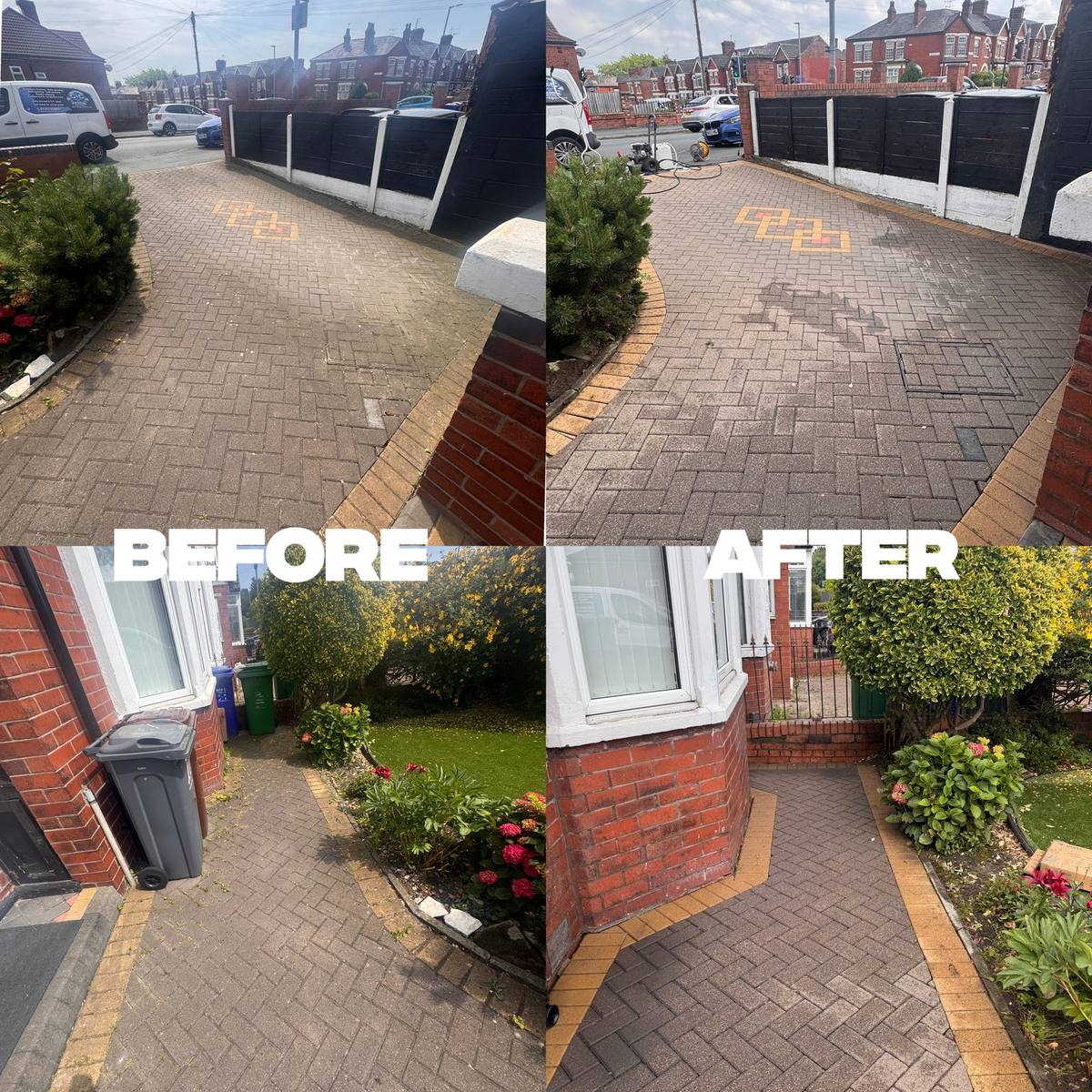
Before and after: concrete driveway cleaning — Greater Manchester job by C&C Precision.
Quick answer: Concrete driveways should be cleaned using a rotary surface cleaner at controlled pressure (typically 1500–2500 PSI), often with a pre-treatment solution to lift ingrained dirt, algae and oil. High-pressure fan jets used incorrectly can etch or pit the surface. The right method preserves the concrete rather than stripping it.
Why Concrete Driveways Need a Different Approach
Concrete isn't a uniform material. Even two driveways laid a few years apart can behave differently under a pressure washer, depending on the mix, the finish, how it was cured, and how much weathering it's seen. The outer layer — the cement paste — is what gives concrete its smooth, relatively sealed appearance. That layer is also the most vulnerable part of the surface, and once it's stripped back, you're exposing the aggregate underneath in a patchy, uneven way that can't be reversed.
This is one reason why concrete driveway cleaning requires more care than people assume. Block paving, by contrast, has defined individual units with joint gaps — pressure washing one block too aggressively affects that block, but doesn't necessarily compromise the whole area in the same visual way. With a poured concrete slab, inconsistent technique leaves marks that run across the entire surface and are immediately obvious. You can read more about how driveway cleaning differs by surface type on the main services page.
The porosity of concrete also means it absorbs staining more readily than denser materials. Oil soaks in. Algae roots into the surface rather than just sitting on top. Rust from metal furniture or drain covers works its way into the paste. Each of these requires a different approach, and some — particularly deep oil contamination on older concrete — will lighten significantly but may not disappear entirely, regardless of how much pressure you apply.
The Main Cleaning Methods Explained
There are three realistic options for cleaning a concrete driveway: a rotary surface cleaner, a fan or lance jet, and chemical pre-treatment alone. A rotary surface cleaner — the spinning disc attachment you'll see professionals use — is the correct tool for the job. It distributes water pressure evenly across a consistent circular path, which prevents the striping and etching that a directed lance causes. On a concrete driveway of any real size, a surface cleaner is what produces an even result.
A fan or lance jet — the handheld wand most people picture when they think of a pressure washer — does have its uses, but it's a risky tool on concrete. The pressure concentrates in a narrow band, and if you hold it too close or move too slowly, you cut into the surface. Hired domestic pressure washers are particularly inconsistent in their output, and most people underestimate how quickly surface damage occurs. That said, a lance is sometimes the right choice for spot-treating stubborn stains before a surface cleaner pass, or for rinsing off pre-treatment chemicals.
Chemical pre-treatment alone — applying a biocidal or cleaning solution and allowing dwell time without any mechanical action — is appropriate for situations where pressure washing isn't possible or where the growth is light and the surface is fragile. It won't remove heavy contamination on its own, but it's a legitimate part of most professional cleans rather than an either/or choice.
Pre-Treatment: Why You Can't Just Blast and Go
Pre-treatment is the step most DIY attempts skip, and it's one of the main reasons professional results look different. Algae, moss and lichen aren't just sitting on the surface — they're rooted into it. Blasting them with water dislodges the visible growth but leaves the root structure and spores behind. Regrowth tends to come back faster because the surface has been opened up. A biocidal pre-treatment — either a dedicated exterior biocide or a diluted sodium hypochlorite solution — kills the organism properly before the pressure washing starts. This is the same principle behind softwashing, which relies on chemistry rather than pressure to do the primary work.
For oil and fuel staining, the pre-treatment is different: an alkaline degreaser applied to the affected area and left to dwell for ten to twenty minutes before the surface cleaner goes over it. Alkaline degreasers break down hydrocarbon contamination at a chemical level, which means you're cleaning the stain rather than trying to blast it out mechanically. Mechanical pressure alone on an oil stain often pushes it deeper into the pore structure rather than removing it.
The practical benefit of pre-treating properly is that it reduces the pressure needed during the wash stage. Lower pressure means less risk to the surface, and it means a better finish — you're cleaning the concrete rather than just abrading it.
Dwell time matters. Apply your pre-treatment and leave it to work — usually ten to twenty minutes depending on the product and contamination level — before you start the pressure wash. Rinsing it off too soon significantly reduces how well it works, particularly on biological growth.
Pressure and PSI: What's Actually Safe for Concrete
For most concrete driveways, working pressure in the range of 1500 to 2500 PSI through a rotary surface cleaner is appropriate. The exact figure depends on the condition and age of the surface — older or already weathered concrete warrants the lower end of that range. These figures are lower than people often expect, and well below what some hired machines deliver at the lance when used at close range.
Distance and nozzle angle affect impact as much as the raw PSI figure. Holding a lance at 15 degrees to the surface concentrates the force significantly compared to a perpendicular angle, which is part of why fan jet cleaning produces those characteristic etch lines. A rotary surface cleaner sidesteps this problem by keeping a consistent distance and angle automatically as it spins, which is why it's the industry-standard tool for flat surface work.
For comparison: softer natural stone like limestone warrants much lower pressure and usually chemical cleaning only, which is covered in more detail in the guide on whether you can pressure wash Indian sandstone. Concrete is harder, but that doesn't mean it's immune to pressure damage — it just sets a different threshold.
Common Mistakes That Wreck Concrete Driveways
The most common mistake is using a narrow fan jet too close to the surface and moving too slowly. This cuts visible lines into the concrete that remain permanently. Once the cement paste is gone from a strip, the exposed aggregate is a different colour and texture to the surrounding surface, and no amount of re-cleaning will even it out. It's the kind of damage that's only obvious after the driveway has dried.
Cleaning in or around frost is another mistake worth flagging. If the surface temperature is close to zero, or if there's frost in the joints or pores, pressure washing drives water deeper into the structure. When that water freezes, it expands, which accelerates surface spalling. The North West doesn't get prolonged freezes, but overnight frosts in October through to March are common enough that timing matters.
Imprinted or pattern-imprinted concrete — which has a surface sealant pressed into it during laying — is a specific case where standard pressure washing technique can cause real damage. High-pressure fan jets can lift, blister or cloud the sealant, particularly on older driveways where the original sealer has degraded. Exposed aggregate concrete is similarly unforgiving: the aggregate itself is fine, but the cement holding it can be eroded if the pressure strips it unevenly. If your driveway has a decorative finish of any kind, that changes the approach significantly.
When to Call in a Professional Instead of DIYing It
Hired equipment from a tool hire shop is almost always a lance-only setup, which puts the control — and the risk — entirely with the operator. For a straightforward concrete slab with moderate algae growth and no decorative finish, a competent DIYer with a rotary surface cleaner attachment can do a reasonable job. But for anything more involved, the margin for error narrows quickly. Imprinted concrete, exposed aggregate, heavily stained surfaces, and any driveway that's already showing signs of surface wear are all situations where the wrong approach causes damage that costs more to address than the original clean would have.
Large areas are also worth thinking carefully about. Inconsistent technique across a big concrete driveway leaves tide marks and uneven patches that are hard to fix after the fact. A professional working with commercial-grade equipment and consistent technique is more likely to produce an even result across the whole area. If you'd like to see the kind of results that are realistic, the reviews page gives a fair picture of what customers in Greater Manchester have experienced. C&C Precision Pressure Washing covers the whole of Greater Manchester — Oldham, Rochdale, Bury, Bolton, Stockport, Tameside and Manchester itself — and a WhatsApp quote from a couple of photos is free and usually turned around the same day.
It's also worth reading the guide on how long a driveway clean actually lasts before deciding whether professional cleaning is worth it for your situation — results vary depending on the surface, aftercare, and local conditions.
After the Clean: Keeping Concrete Looking Good Longer
Sealing is the most effective thing you can do to extend the results of a clean. On concrete, a penetrating silane-siloxane sealer soaks into the surface and reduces water and contamination absorption without changing the appearance significantly. Film-forming sealers — which sit on the surface and give a sheen — are an option too, but they require more maintenance and can look patchy if they start to wear unevenly. The right choice depends partly on the finish you want and partly on how much wear the driveway sees. The guide on why driveway sealer fails covers this in more detail, particularly around application timing and surface preparation.
In Greater Manchester, algae and moss regrowth is primarily driven by moisture and shade. A north-facing driveway under trees will need attention more often than an open, south-facing one. Realistically, a professionally cleaned and sealed concrete driveway in this part of the North West will look good for one to two years before biological growth becomes noticeable again, with the sealed surface performing better at the longer end of that range. Between professional cleans, a light brush-over with a stiff broom in autumn to clear fallen leaves — which hold moisture against the surface — makes a meaningful difference to how quickly it deteriorates.
There's no maintenance approach that eliminates regrowth entirely in a climate like ours, but keeping on top of leaf fall, ensuring good drainage across the surface, and resealing every few years after a proper clean will significantly extend the intervals between needing a full clean.
Frequently asked questions
Can I pressure wash my concrete driveway myself without damaging it?
You can, but the risk is higher than most people expect. Hired consumer pressure washers often deliver uneven or excessive pressure through a fan lance, which can etch lines and strip surface cement from concrete. If you do it yourself, use a rotary surface cleaner attachment, keep pressure below 2000 PSI, and pre-treat any algae or oil stains first.
How do I remove black algae and green moss from a concrete driveway?
Pre-treatment with a biocidal wash or diluted sodium hypochlorite solution is the most effective first step — it kills the organism at the root rather than just blasting the surface growth away. After a dwell period, a rotary surface cleaner removes the loosened contamination cleanly. Skipping pre-treatment and going straight to pressure washing often just spreads spores around.
How much does professional concrete driveway cleaning cost in Greater Manchester?
Pricing depends on the size of the driveway, its condition, and whether pre-treatment or post-clean sealing is needed. The quickest way to get an accurate figure is to send a couple of photos on WhatsApp — C&C Precision can usually turn a price around the same day without needing a site visit first.
Will pressure washing damage an imprinted or pattern concrete driveway?
It can do if the wrong method is used. Imprinted concrete has a surface sealant that high-pressure fan jets can lift or blister, especially on older or already weathered driveways. The correct approach is a gentler rotary clean combined with re-sealing afterwards to restore protection and bring back the colour. This is a job best left to someone who knows the surface.
Want a price for your concrete driveway?
Send a couple of photos over WhatsApp and we'll come back to you with a fast, honest quote — no fuss.