If you've noticed green algae creeping across your driveway, black streaking down the side of your render, or a patio that's turned from buff to dark grey, you're not imagining things getting worse faster than they used to. Pressure washing Salford properties has become more in demand over recent years, and the reasons are straightforward — persistent damp, urban grime and the kind of overcast weather that rarely gives surfaces a proper chance to dry out. This guide covers what's actually involved in exterior cleaning across Salford, what results are realistic, and where the limits of DIY kit are.
Whether it's a block paving driveway in Eccles, a sandstone patio in Worsley or a rendered semi in Swinton that's gone green, the approach isn't one-size-fits-all. Different surfaces need different methods, different chemicals and different pressures — and getting that wrong can cause real damage. What follows is a straightforward explanation of how exterior cleaning works in practice.
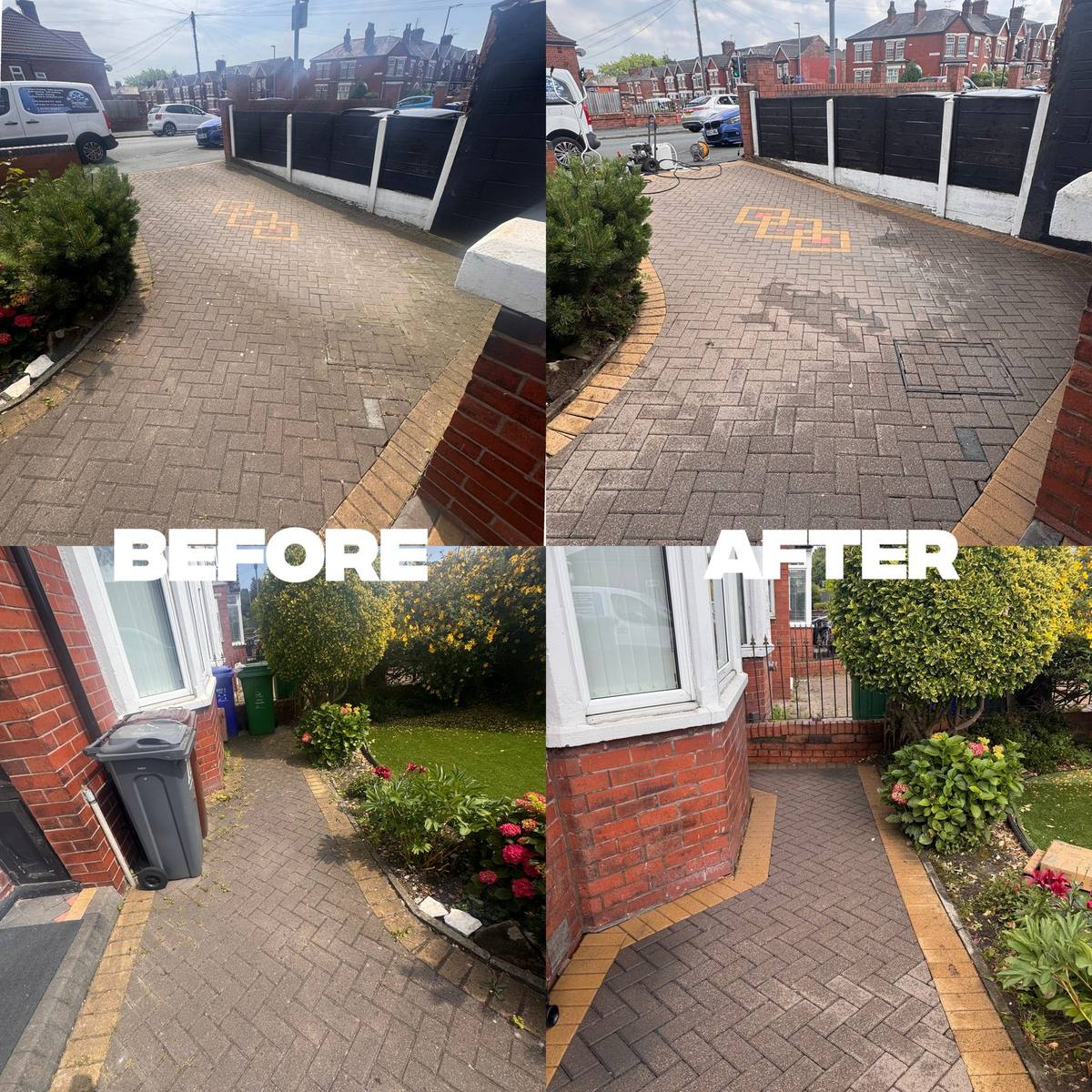
A wide driveway cleaned by C&C Precision — the kind of result common across Salford properties.
Quick answer: Pressure washing in Salford removes algae, moss, staining and grime from driveways, patios, render and paths using professional-grade equipment. Most jobs take half a day and cost between £80 and £350 depending on surface type and size. Softwashing is used where high pressure would damage render or roofing.
Why Salford Exteriors Get Dirty So Quickly
Greater Manchester sits in one of the damper parts of England, and Salford is no exception. Rainfall is spread throughout the year rather than concentrated in a distinct wet season, which means driveways, patios and render rarely get the sustained dry spells that would slow down biological growth. Algae, lichen and moss thrive in exactly these conditions — cool, moist surfaces with limited direct sunlight, particularly on north-facing aspects or areas shaded by fencing and hedges.
Urban pollution adds another layer. Traffic fumes, airborne particulates and general atmospheric grime settle on horizontal and vertical surfaces alike. On render, this combines with algae to produce that streaky grey-green discolouration that's common on houses built from the 1990s onwards. On driveways and patios, it accelerates black spot — a tightly bonded form of algae that can't simply be rinsed away. The wet weather guide on how wet weather destroys your driveway faster goes into more detail on exactly how this process works over time.
None of this is a criticism of how properties are maintained. It's simply the climate. A driveway that was jet washed two summers ago can look heavily soiled again by now, especially if it wasn't treated with a post-clean biocide or sealer to slow re-growth.
Driveway Cleaning in Salford: Block Paving, Concrete and Tarmac
The most common driveway surfaces across Salford are block paving, plain concrete and tarmac. Each is cleaned differently. Concrete and tarmac generally respond well to a rotary surface cleaner — a spinning bar head that delivers consistent, even pressure across the surface without the striping you get from a hand lance. The result is a much more uniform clean. On heavily soiled areas, a pre-treatment with a traffic film remover or alkaline cleaner applied before the pressure wash helps break down oil contamination and biological matter before the machine goes over it.
Block paving requires more care. The jointing sand between the blocks is vulnerable — too much direct pressure and you'll blast the sand out, leaving open joints that let weeds establish and blocks that shift underfoot. The correct approach is to pre-treat with a specialist cleaner or biocide, allow proper dwell time, then clean with either a surface cleaner or careful hand-lancing at an appropriate angle. You can read more about the full process on the block paving cleaning service page. Pricing typically starts from around £3.50/m² for a straightforward clean, rising to around £4.25/m² where a chemical pre-treatment is needed for heavy black spot or biological contamination.
After cleaning block paving, re-sanding the joints is usually necessary. The cleaning process — even when done carefully — removes some of the original jointing sand, and leaving joints unfilled invites weeds and allows blocks to become unstable. Kiln-dried sand is swept in and compacted into the joints; it sets firm and stabilises the surface. Block paving re-sanding as a standalone service runs from around £2.00/m², or around £5.50/m² as part of a full clean-and-restore package. The block paving cleaning guide for Rochdale covers this in more detail if you want a closer look at the process.
Patio and Path Cleaning: Getting Outdoor Spaces Usable Again
Patios across Salford cover a wide range of materials — Indian sandstone, porcelain tiles, concrete slabs, natural slate and old brick paths. What builds up on them is broadly the same: algae, moss, dirt and in sheltered spots a thick layer of lichen that takes real effort to shift. The difference is in how each material tolerates cleaning. Full details on approaches and pricing are on the patio cleaning page, but the general principle is worth understanding here.
Porcelain is dense and non-porous, so it tolerates moderate pressure well and tends to come up very cleanly. Indian sandstone is far more porous and needs a gentler approach — high pressure can open the surface and leave it more susceptible to future contamination. A chemical pre-treatment with a suitable alkaline or biological cleaner, left to dwell for ten to fifteen minutes before rinsing at lower pressure, will shift biological growth without damaging the stone. Blasting it hard and fast often leaves the surface looking patchy, particularly on softer buff or silver grey sandstone.
Concrete slabs and brick paths sit somewhere in between. They're generally robust enough for a surface cleaner pass, but any existing cracks or loose pointing should be checked beforehand — pressure washing can open them further. Be realistic about what's achievable: some older concrete slabs have ingrained discolouration from decades of weathering that will lighten significantly but may not return to a uniform colour. Setting that expectation before work starts avoids disappointment.
If your patio hasn't been cleaned in several years and has visible lichen — those flat, crusty grey or orange patches — budget for a chemical pre-treatment rather than a straight pressure wash. Lichen has a root-like structure called a holdfast that anchors it to the surface. Pressure alone displaces the top growth but leaves the holdfast behind, and the lichen regrows within months. A biocide applied with proper dwell time kills it at the root and gives you a significantly longer-lasting result.
Render and Softwashing: Why Pressure Washing Isn't Always the Answer
This is the area where DIY attempts most often go wrong — and where the damage can be expensive to repair. Modern renders — K-rend, monocouche and similar thin-coat systems — are designed to be breathable and slightly textured. That texture catches dirt and biological growth, which is why rendered properties in Greater Manchester often look streaked or patchy within a few years. The instinct is to pressure wash it, but that's the wrong tool for the job. High pressure can blow the render surface, open hairline cracks and push water behind the coat, leading to damp issues that weren't there before.
The correct method is softwashing — applying a diluted sodium hypochlorite solution to the render surface, allowing it to dwell and penetrate the biological matter, then rinsing at low pressure. The chemistry does the work rather than the force. Sodium hypochlorite kills algae, red algae, moss and lichen at the cellular level rather than just displacing surface growth. Once the organic matter is dead, it rinses away cleanly. The softwashing page explains the process in more detail, and the render cleaning guide for Oldham covers some of the specifics relevant to Greater Manchester properties. Pebbledash and exposed aggregate finishes follow the same principle — low pressure, chemical-led cleaning.
Results on render vary depending on how long the growth has been present and whether there's any underlying staining from rust or mineral deposits in the surface. Most render cleans well in a single treatment; in some cases a second application a few weeks later is needed to deal with heavier contamination. That's an honest assessment — it won't always be a one-visit job.
Roof Cleaning and Moss Removal in Salford
Moss on pitched roofs is extremely common on Salford properties, particularly on older clay or concrete tiles and on north-facing slopes. Left unchecked, it retains moisture against the tile surface, works under tile edges and accelerates weathering. On flat felt roofs and conservatory polycarbonate or glass roofs, algae and moss present similar problems — reduced light transmission, retained moisture and in severe cases blocked outlets and standing water.
The softwash process applies here too. Walking on roof tiles to scrape or brush moss off is risky for the person doing it and damaging to the tiles — particularly older plain concrete tiles which can crack under foot pressure, or interlocking tiles where breakage along the edges is common. A properly diluted sodium hypochlorite solution applied from roof level kills the moss, and over the following weeks it dies back and washes away naturally with rainfall. A low-pressure rinse at the end removes the bulk. More detail on the full process is on the roof cleaning and moss removal page.
Expectations should be realistic here too. Immediately after treatment, the roof won't look dramatically different — the moss will still be there but it's dead. Over the following four to eight weeks, rainfall does the rinsing work and the roof gradually lightens. Customers who expect an immediate transformation are sometimes surprised by this timeline, so it's worth knowing upfront.
When to Call in a Professional Rather Than Hire a Jetwash
Hire machines from a tool hire shop are tempting — they look similar to trade equipment and the day rate seems reasonable. In practice, they're significantly underpowered compared to professional plant, they come with a standard lance rather than a rotary surface cleaner, and they have no capacity for safe chemical application. For lightly soiled concrete or a small path, they'll do a basic job. For anything more demanding — heavy black spot, biological growth on block paving, any kind of render or roof work — they're the wrong tool.
The more significant risk is technique. Block paving sand is easy to blast out if the angle and distance are wrong. Render can be damaged in seconds. Pointing between natural stone can be opened up. Softer stones like sandstone can be eroded. These aren't scare stories — they're the kind of call-backs that tradespeople see regularly after customers have had a go themselves. If there's any doubt about the surface or what's involved, it's genuinely cheaper in the long run to get a professional assessment first.
C&C Precision Precision Pressure Washing covers the full Salford area and offers fast quotes based on photos sent over WhatsApp — no need for a site visit before getting a figure. For anyone weighing up DIY versus professional, it costs nothing to find out what the job would actually cost.
What to Expect When You Book Pressure Washing in Salford
The process starts with photos. Send clear images of the area via WhatsApp — driveway, patio, render, roof, whatever needs doing — and a quote comes back quickly. Measurements help where possible, but photos alone are usually enough for a ballpark. Once agreed, jobs are booked in and you'll be given a realistic time window rather than an all-day wait.
On the day, clear the area of furniture, pots and vehicles where possible. Access to a cold water tap is needed for most jobs. The work itself varies in length — a standard double block paving driveway takes around two to four hours including dwell time and re-sanding. Larger or more heavily soiled areas take longer. You'll be told upfront what to expect rather than being surprised on the day.
After cleaning, surfaces often look slightly different when wet versus dry. Block paving and concrete can look very light immediately after cleaning and darker again once they've dried fully — this is normal. The final colour settles within twenty-four to forty-eight hours in dry conditions. In wetter weather it takes longer. If sealing is something you're considering after a driveway or patio clean, the guide on driveway sealing after cleaning is worth reading before making that decision — it covers the genuine pros and cons honestly rather than just pushing a upsell.
Frequently asked questions
How much does pressure washing cost in Salford?
Most residential jobs in Salford fall between £80 for a small path or patio and £350 for a large driveway with block paving re-sanding. Render or roof softwashing is priced separately depending on the size of the property. The fastest way to get an accurate figure is to send photos on WhatsApp — we turn quotes around quickly.
Can you pressure wash render on Salford houses?
Not with high pressure — modern renders like K-rend and monocouche are porous and can be blown off or cracked by a jet wash. The correct method is softwashing: applying a diluted sodium hypochlorite solution that kills the algae and organic matter at the root. The surface then rinses clean without any physical force that could cause damage.
How long does a driveway cleaning job take in Salford?
A standard single or double block paving driveway typically takes two to four hours including pre-treatment dwell time, pressure washing and re-sanding if needed. Larger driveways or those with heavy moss and weed growth will take longer. We'll give you a realistic time estimate when you send your photos through.
Do you cover all of Salford, including Eccles, Worsley and Swinton?
Yes — we cover the full Salford area including Eccles, Worsley, Swinton, Walkden, Irlam and Pendleton, as well as the wider Greater Manchester region. If you're unsure whether your postcode is in our range, just drop us a message and we'll confirm straight away.
Got a driveway, patio or render that needs sorting in Salford?
Send a couple of photos on WhatsApp and we'll come back to you with a straight price — usually the same day.