Anyone who has lived in the North West for more than a season or two knows what persistent wet weather does to outdoor surfaces. What starts as a slightly greener driveway or a few weeds pushing up between the blocks tends to be dismissed as cosmetic — something to deal with later. The trouble is that wet weather driveway deterioration in the UK is rarely just surface deep, and by the time the damage is obvious, the repair bill is already climbing. Understanding what is actually happening beneath and within your driveway surface is the first step to doing something sensible about it.
This guide covers the real mechanics of how rain, frost and biological growth combine to break down driveway surfaces in this part of England, what the warning signs look like before damage becomes structural, and what can genuinely be done to slow the process down. The advice here applies equally to block paving, concrete, tarmac, imprinted concrete and natural stone — each material has its own vulnerabilities, but the underlying causes are largely the same.
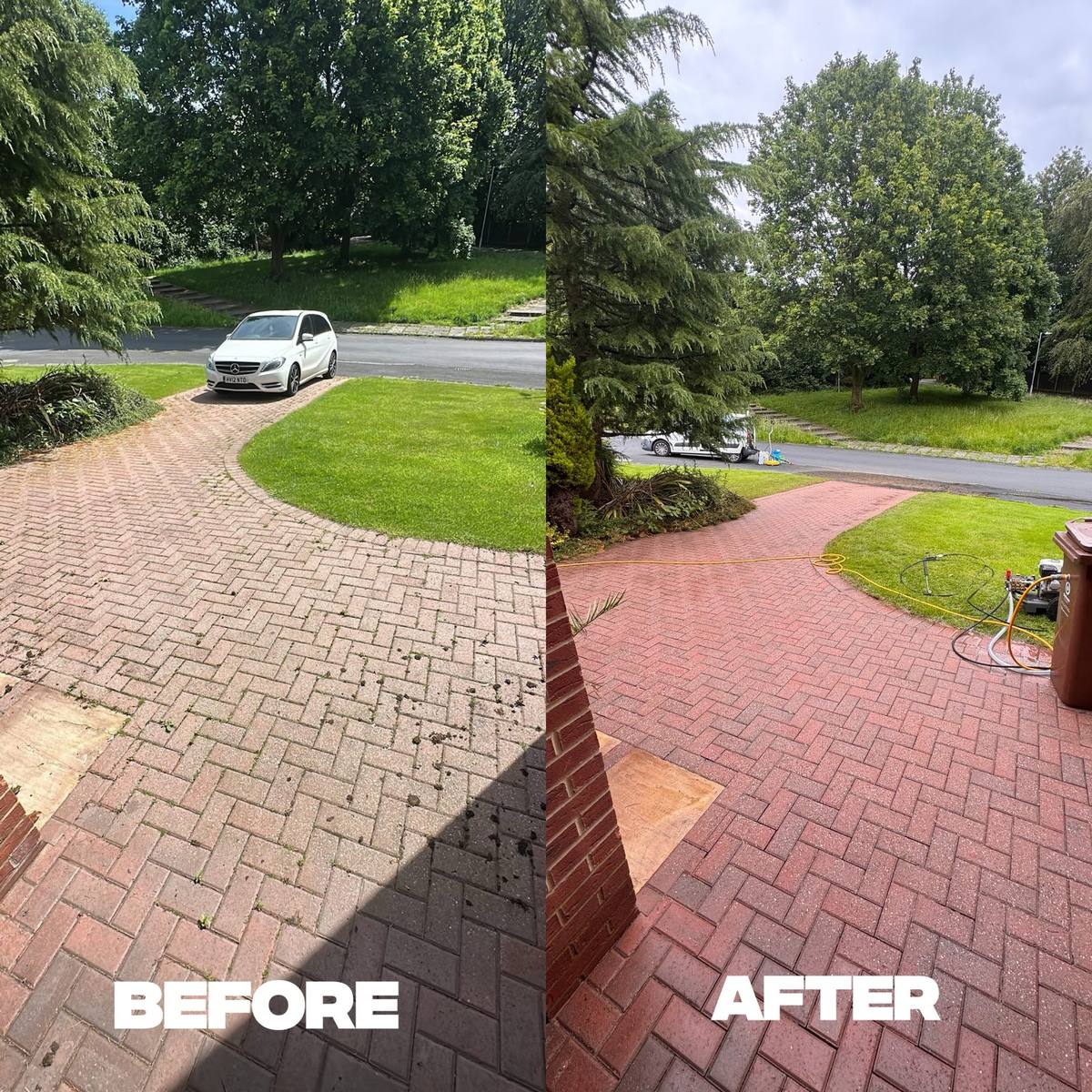
Before and after: red block paving driveway cleaned by C&C Precision — the kind of deterioration Greater Manchester's wet climate causes over a few seasons.
Quick answer: Wet weather accelerates driveway deterioration by driving water into surface cracks, promoting algae, moss and weed growth, washing out jointing sand, and causing freeze-thaw damage in winter. Greater Manchester's above-average rainfall makes these problems worse and faster than in drier UK regions, shortening the lifespan of block paving, concrete and tarmac driveways.
Why Greater Manchester Gets It Worse Than Most
Greater Manchester receives somewhere in the region of 800 to 900mm of rainfall per year on average, which is already comfortably above the UK mean of around 700mm. But that headline figure understates the situation for towns on the eastern fringe of the conurbation. Oldham, Rochdale and the Pennine-facing parts of the region sit at higher elevation and directly intercept the prevailing westerly weather systems rolling in off the Atlantic. Those systems lose moisture rapidly as they hit rising ground, and the result is that places like Saddleworth, Milnrow and the Royton hills can see meaningfully more rainfall than the national average — sometimes considerably more in a wet year.
The effect on outdoor surfaces is cumulative. It is not that any single rainstorm does dramatic damage; it is that driveways in this part of England rarely get a long dry spell. Surfaces stay damp. Biological growth never fully dries out and dies back. Water sits in cracks and low spots for days at a time rather than hours. Compared with driveways in drier parts of England — East Anglia, the East Midlands, much of the South East — surfaces here are under measurably more stress, year round.
This geographic context matters because advice written for the UK in general tends to underplay how quickly surfaces in Greater Manchester can deteriorate if left unattended. What might be a five-year problem in Cambridge can become a two-year problem in Oldham.
How Water Actually Gets Into Your Driveway Surface
Most people think of their driveway as a solid, impermeable layer. In reality, almost every common driveway material is porous to some degree, and even genuinely impermeable surfaces develop routes for water ingress over time. Concrete and tarmac both develop hairline cracks as they age and flex under vehicle weight. Block paving relies on compacted jointing sand to lock the blocks together and keep surface water moving in the right direction — but those joints are open by design, and water passes through them freely. Natural stone is often highly porous from the outset, absorbing water directly through its face as well as its joints.
Standing water after heavy rain is rarely just an inconvenience. Every time water pools on a driveway surface and then slowly soaks away, some of it is finding its way into whatever micro-gaps exist in the material. In block paving it washes fine sand particles out of joints with each passing storm. In cracked concrete or tarmac it seeps into the sub-base, softening it and undermining the structural layer that gives the surface its load-bearing capacity. In natural stone it saturates the material itself. None of this is immediately visible, which is part of why wet weather driveway deterioration in the UK tends to creep up on people.
Drainage design compounds the problem in older properties. Many driveways in the Greater Manchester area were laid or resurfaced without adequate falls to channel water away efficiently. Water pools in low spots, dwells there, and gets to work. If gutters or downpipes are also directing roof water onto the driveway rather than into a drain, the volume of water hitting the surface is even greater than rainfall alone would suggest.
Freeze-Thaw Cycles: The Hidden Winter Damage
Water expands by roughly 9% when it freezes. That figure is worth sitting with for a moment, because it is the mechanism behind a huge proportion of the structural damage that driveways suffer in Northern England. Water finds its way into a hairline crack in a concrete slab or a slightly open joint in block paving, and then the temperature drops below zero. That small volume of water becomes ice, and as it expands it pushes outward in every direction — widening the crack slightly, loosening the surrounding material, breaking the bond between aggregate particles in the surface layer.
A single freeze-thaw cycle causes limited damage. The problem in Greater Manchester is that winters here rarely deliver sustained hard frosts. Instead, temperatures hover around zero for weeks at a time — freezing at night, thawing during the day, freezing again the following night. This pattern can repeat thirty or forty times in a single autumn and winter. Each cycle does a little more work. A hairline crack that was barely visible in October can be a significant fracture by March, and a joint that was tight in block paving can be visibly open and losing sand by spring.
This is one of the least-understood aspects of wet weather driveway deterioration in the UK. People tend to blame visible damage on vehicles or heavy use, when in many cases the underlying cause is simply water getting in and then freezing, repeatedly, over several winters. The damage is cumulative and largely invisible until it crosses a threshold where it becomes obvious.
Moss, Algae and Weeds: Wet Weather's Biological Attack
Greater Manchester's damp, mild climate is close to ideal for moss, algae and weed growth on hard surfaces. Moss in particular thrives in the conditions that characterise this region — persistent moisture, relatively low direct sunlight in shaded areas, and temperatures that rarely get cold enough to kill it back properly in winter. Once established on a driveway surface, moss acts as a sponge, holding a layer of moisture directly against the paving material even during dry spells. This accelerates the freeze-thaw damage described above and prevents the surface from ever fully drying out.
Algae is a different organism but causes similar problems. It colonises porous surfaces rapidly in wet conditions and produces the characteristic black and green staining that many people assume is simply dirt. Algae makes surfaces dangerously slippery — far more so than most people realise until they have a near-miss in autumn. It also breaks down some sealers and surface treatments over time. Understanding why paving goes black in the UK is helpful context here, because the biological cause of that staining is often underestimated.
Weeds complete the biological assault. They colonise open joints and cracks, and their roots actively push paving apart as they grow. A weed seedling in a block paving joint is not just an eyesore — it is applying mechanical force to the surrounding blocks every time it grows. By the time the plant is visible above the surface, its root system has often already done measurable damage to the joint structure beneath. Removing the weed without treating the joint leaves the opening there, ready to be recolonised within a season.
Sand Washout and Structural Instability in Block Paving
Block paving driveways depend on kiln-dried jointing sand for their structural integrity. The sand fills the gaps between blocks, locking them together so they behave as a unified surface rather than a collection of individual units. When that sand washes out — which it does gradually but consistently in a high-rainfall climate — the blocks begin to move independently. They rock underfoot. They sink slightly under vehicle weight and then do not fully recover. The surface starts to look uneven even though no individual block is cracked or broken.
Sand loss is one of the most underestimated forms of wet weather driveway deterioration in the UK. It is not dramatic. There is no single storm that washes all the sand away overnight. It happens over months and years, a small amount leaving with each heavy rain event, until the joints are visibly open and the paving has lost its rigidity. Once the joints are open, weeds move in immediately, accelerating the process and making the eventual restoration more involved. A guide to how often block paving should be re-sanded gives a clearer picture of realistic maintenance intervals.
The practical consequence of sand washout is that a block paving driveway in Greater Manchester that was laid correctly and looked good in its first year or two will — without any maintenance — start to become structurally compromised within three to five years. The blocks themselves may be in perfectly good condition. It is the absence of sand in the joints that creates the instability. Block paving re-sanding addresses this directly and is significantly cheaper than relaying the surface once the sub-base has been undermined by years of movement and water ingress.
When the Damage Has Gone Too Far to Ignore — and When to Call a Professional
There are clear signs that a driveway has moved beyond routine maintenance territory. Rocking or sunken blocks that visibly shift underfoot suggest that either the jointing sand is long gone or the sub-base beneath has been compromised. Crumbling edges on concrete or tarmac, particularly near drains or at the boundary between the driveway and the road, indicate that water has been undermining the material from below. Deep cracking that follows consistent patterns across a surface — rather than isolated surface chips — points to sub-base movement or persistent freeze-thaw stress over multiple winters.
Heavy biological growth that has been left for several years — thick moss compacted into joints, black algae across the full surface — is not beyond recovery in most cases, but it does require professional treatment rather than a domestic pressure washer. A machine hired from a tool shop operated by someone unfamiliar with the surface type will often damage block paving edges, strip the surface from imprinted concrete, or cut lines into sandstone that cannot be removed. Professional driveway cleaning uses appropriate pressure for the surface, combined with chemical treatment where needed, to lift biological matter without causing additional damage. Block paving cleaning from around £3.50 per square metre, rising to approximately £4.25 with chemical treatment and £5.50 for a full clean and re-sand, reflects the difference in complexity between a light refresh and a proper restoration.
Where damage is genuinely structural — significant sub-base failure, large sections of lifting or cracked slabs, drainage problems that are causing water to pond and not clear — honest advice is to involve a reputable paving contractor as well as a cleaning company. A professional clean will improve the appearance but cannot fix a failed sub-base. C&C Precision Pressure Washing covers Greater Manchester and will tell you honestly when a surface needs more than cleaning, because sending someone out to re-sand a driveway that needs relaying is a waste of everyone's time and money. You can send photos over WhatsApp for a fast, no-obligation quote to get an initial read on what the surface actually needs.
Before re-sanding block paving joints, the surface must be properly cleaned and fully dry. Brushing kiln-dried sand into damp or dirty joints locks in moisture and organic debris, which undermines the sand's effectiveness and accelerates future weed colonisation. This step is often skipped by inexperienced operators, and it is why re-sanding done badly needs redoing within a year.
Practical Steps to Slow Wet Weather Driveway Damage
The single most effective habit for any driveway in Greater Manchester is a professional clean every one to two years, timed appropriately. For most surfaces, late spring or early summer works well — biological growth from the winter and autumn is at its most visible, conditions are starting to dry, and there is a full season ahead before the next freeze-thaw period. Leaving it until autumn means the surface goes into winter already compromised. Biennial cleaning is realistic for many households; annual cleaning makes more sense for north-facing driveways, heavily shaded surfaces, or areas that drain poorly.
Re-sanding open block paving joints before winter is one of the most cost-effective maintenance steps available. Sand in the joints reduces water ingress, limits weed colonisation and keeps blocks stable through the freeze-thaw season. At around £2.00 per square metre for re-sanding alone, it is considerably cheaper than the structural work that becomes necessary if joints are left open for several years. Similarly, sealing porous surfaces — block paving, imprinted concrete, some natural stone — after cleaning reduces water absorption and helps lock sand in place, slowing the rate of future deterioration. Sealers need reapplying every three to five years depending on traffic and product type, but they earn their cost in reduced maintenance frequency.
Gutters and downpipes are worth checking as part of any driveway maintenance routine. A blocked or poorly directed downpipe can direct significant volumes of roof water onto a driveway during heavy rain — far more than the driveway was designed to handle. Clearing gutters regularly and making sure downpipes discharge into drains rather than onto the surface eliminates a variable that many people do not consider when wondering why their driveway deteriorates faster than a neighbour's. Keeping organic debris — leaves, plant material, soil — swept off the surface promptly also matters. Decomposing organic matter retains moisture, feeds biological growth and, left long enough, begins to contribute acids that break down some surface materials.
Frequently asked questions
Does rain actually damage driveways or is it just cosmetic?
Rain causes real structural damage over time, not just surface staining. Water gets into cracks and joints, freezes in cold weather and expands — widening those cracks season by season. In Greater Manchester's wet climate this process is accelerated, and what starts as a cosmetic problem can become a costly structural one within a few years of neglect.
How often should a driveway in Greater Manchester be professionally cleaned?
For most driveways in this region, every one to two years is a sensible interval. Greater Manchester's rainfall and mild temperatures create near-ideal conditions for moss and algae regrowth, so leaving it much longer typically means the biological matter has had time to take a proper hold and cause more damage. Block paving driveways may also need re-sanding every couple of years as joints wash out.
Can sealing my driveway protect it from wet weather damage?
Sealing is genuinely useful for certain surface types — block paving, imprinted concrete and some natural stone — because it reduces how much water the surface absorbs and helps lock jointing sand in place. It's not a permanent fix and will need reapplying every few years, but as part of a proper cleaning and maintenance routine it does slow the rate of wet weather driveway deterioration significantly.
What's the difference between moss on a driveway and moss on a roof — does it cause the same damage?
Both are problematic but in slightly different ways. On a driveway, moss acts like a sponge, holding moisture against the surface and accelerating freeze-thaw damage, while its roots work into joints and lift paving. On a roof, moss physically lifts tiles and blocks gutters, leading to water ingress into the property itself. In both cases it's worth dealing with before it causes serious damage, not just when it looks bad.
Worried your driveway is already showing the signs?
Send a photo on WhatsApp and we'll give you a straight, fast quote — no sales pitch, no obligation.