If you've noticed your render turning green, streaky, or patchy, you're not alone — it's one of the most common problems we see on properties across this part of Greater Manchester. Render cleaning in Oldham is something we get enquiries about all year round, and for good reason. The combination of elevation, rainfall, and the sheer variety of render types on local housing stock means biological growth is almost inevitable over time. This guide covers what causes it, how it's treated properly, and what you can realistically expect from the process.
It's worth saying upfront that not every stain vanishes completely, and some surfaces respond better than others. We'd rather be straight with you about that now than have you disappointed after the job. What a proper softwash treatment will do is kill the biological growth at its source, remove the vast majority of visible staining, and significantly slow down the rate at which it returns. That's a meaningful result — just not always a miracle.
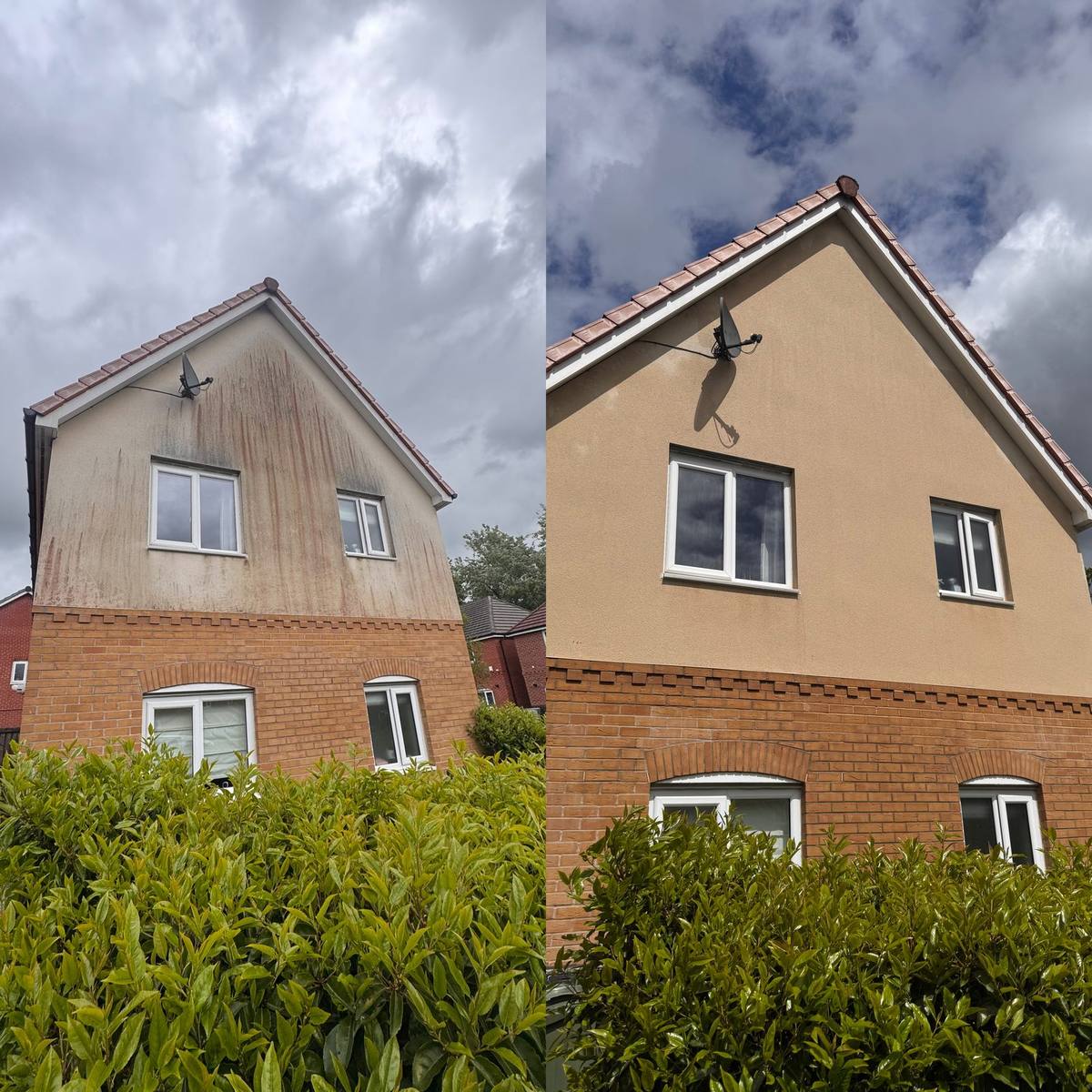
Before and after softwash render cleaning on a Greater Manchester home — red algae and black streaking fully cleared.
Quick answer: Render cleaning in Oldham removes black streaks, green algae, and red algae from rendered walls using softwashing — a low-pressure method with sodium hypochlorite solution. Oldham's wet climate and porous render types make organic growth almost inevitable, and softwashing is the only method that kills it at the root rather than just shifting it temporarily.
Why Oldham Render Gets So Dirty So Fast
Oldham sits at elevation on the western edge of the Pennines, and that geography matters. The town catches considerably more wind-driven rain than lower-lying parts of Greater Manchester, and the moisture doesn't dry out quickly — particularly on north and east-facing walls where sunlight barely reaches for months at a time. Render is a porous surface, and in a climate like this, it holds onto that moisture long enough for organic life to take hold.
Algae, mould, and lichen don't need much to get started — a bit of moisture, some airborne spores, and a rough-textured surface to grip onto. Pebbledash in particular gives them plenty to work with. What might take five or six years to develop visibly in a drier part of the country can appear within two or three years on an exposed Oldham property. The weather here simply accelerates the process.
The surrounding vegetation plays a role too. Properties near trees or hedging tend to recolonise faster, partly because of increased shade and partly because organic matter settling on the render provides an additional nutrient source for growth. It's not a failing of the render itself — it's just the environment working against you.
The Main Types of Render You'll See on Oldham Homes
Oldham's housing stock covers a wide range of eras and build types, and the render varies accordingly. Older semis and terraces from the 1950s through to the 1980s are often finished in sand-and-cement render, sometimes with a pebbledash texture. These surfaces are relatively robust but highly porous, which means they absorb moisture readily and tend to show green and black growth quite visibly. They're also more forgiving to work with, because the coating itself is thick and durable.
Newer properties and recent refurbishments are more likely to have K-Rend, Weber, or another monocouche through-coloured render applied. These are thinner, factory-blended coatings designed to be both decorative and weatherproof, and they require a careful approach to cleaning. They're not fragile, but they are sensitive to high-pressure washing — and some have manufacturer guidance specifying softwashing as the only approved cleaning method. Using a pressure washer on them risks voiding any coating warranty and can cause surface erosion that's both visible and difficult to repair.
Tyrolean and scraped finishes sit somewhere in the middle — older than monocouche but more textured than a plain sand-and-cement coat, which means contamination embeds itself into the surface profile and can be harder to shift completely. A second application of treatment is sometimes needed on these renders, and some deep-set staining may lighten rather than disappear entirely.
Black Streaks, Green Patches, Red Algae: What's Actually Growing on Your Walls
The black streaking you see running vertically down render is almost always the result of cyanobacteria or mould — typically originating from roof runoff, moss on gutters, or debris sitting in a blocked gutter. The water carries organic matter and spores down the face of the wall, and they colonise as the streak dries. It looks worse than green growth but often responds well to treatment, provided the source is dealt with separately.
Green patches are straightforward algae — the same family of organisms that turns a patio or driveway green. They feed on moisture and atmospheric nitrogen, and they spread across a render surface in a way that follows the moisture patterns of the wall. Shaded sections go green first; the rest follows over time. The treatment is the same regardless of coverage — a sodium hypochlorite solution applied at appropriate dilution, allowed to dwell, and rinsed off at low pressure.
Red or orange staining is a specific algae strain — Trentepohlia — that's particularly common on K-Rend and monocouche renders, especially in warmer months. It produces a vivid terracotta or rust-coloured bloom that can look alarming but is biologically the same problem. It responds to softwashing, though heavily embedded red staining on textured renders sometimes lightens significantly rather than disappearing completely — something worth knowing before you commit to any treatment.
Softwashing vs Pressure Washing: Why Render Needs a Different Approach
The instinct when something looks dirty is to blast it with a pressure washer, and on a concrete driveway or stone path that instinct isn't far wrong. Render is different. High-pressure water can fracture thin-coat renders, erode the surface texture of pebbledash, blast jointing mortar out from around the aggregate, and — most critically — drive water behind the render face. Water ingress behind render is a serious problem. It causes the coating to crack and delaminate, and in colder months it accelerates freeze-thaw damage in the substrate behind.
Softwashing sidesteps all of that. The water pressure used is low — comparable to a garden hose — and the cleaning work is done by the chemistry rather than by mechanical force. A sodium hypochlorite solution is applied to the surface and allowed to dwell for a period long enough to penetrate porous render and break down biological contamination at the root. Killing the organism rather than just removing its visible surface is what gives softwashing its longevity advantage over pressure washing. You can read more about the chemistry involved in our guide to softwashing.
The dwell time matters. Rushing a softwash job — applying the solution and rinsing immediately — won't achieve the kill depth you need, and the growth returns quickly. On textured or heavily contaminated render, a longer dwell or a second application is often the right call. It adds time to the job, but the results hold up for considerably longer.
What the Softwash Render Cleaning Process Actually Involves
The process starts before we arrive, with the photos you've sent over WhatsApp. They tell us the render type, contamination level, property aspect, and whether there's anything unusual — bay windows, porch overhangs, conservatories — that affects access or treatment. That means we arrive with the right dilutions mixed and the right equipment for your specific surface.
On the day, we protect plants, outdoor furniture, and any surfaces directly below the treatment area — sodium hypochlorite at working concentration can affect vegetation if it pools. We apply the solution to the render using a low-pressure sprayer, working systematically across the face of the building and ensuring even coverage. The solution is then left to dwell — typically between fifteen and forty-five minutes depending on contamination type and render porosity. On pebbledash with embedded green growth, a second pass is common, and we'll make that call on site rather than rushing to a finish that won't hold.
The rinse is at low pressure, removing dead biological material and residual chemical from the surface. On a typical three-bed semi, the full process takes three to four hours. The render continues to clarify over the following days as the dead growth weathers off and rain does its work — so the final result often looks better a week after the clean than it does immediately after we leave.
After a softwash, avoid pressure washing your render yourself for at least twelve months. It won't make it cleaner — it removes the residual biocide that's still working to inhibit regrowth, and on monocouche or K-Rend, it risks surface damage that can't be easily reversed.
When to Call a Professional Rather Than DIY
There are off-the-shelf algae and mould removers available from most DIY sheds, and some of them contain sodium hypochlorite in low concentrations. The problem is that they're typically diluted far beyond what's needed to penetrate porous render effectively, and they're often applied without sufficient dwell time because the label doesn't specify it. The result looks acceptable for a few months, then the growth comes back — often faster than before, because the surface has been wetted repeatedly without the contamination being killed at root level.
If your render is above ground floor, working at height introduces genuine risk that most homeowners shouldn't take on without proper access equipment and training. If the render is K-Rend or monocouche, incorrect treatment concentration or pressure can cause surface damage that's expensive to repair. And if the contamination is heavy or the property large, the volume of solution needed is simply beyond what consumer products provide cost-effectively. For render cleaning in Oldham on anything above a single-storey extension, a professional softwash is the safer and more reliable option. C&C Precision Precision Pressure Washing carry £1,000,000 public liability insurance and use trade-grade sodium hypochlorite at properly calibrated dilutions for the surface being treated.
It's also worth considering that some render warranties — particularly on newer monocouche systems — specify professional softwashing as the approved maintenance method. Using high-pressure equipment, even once, can be enough to invalidate that coverage. If you're unsure what your render type is or what its maintenance requirements are, send us a photo and we'll give you a straight answer before you touch it.
How to Keep Your Render Looking Clean for Longer After Treatment
The single biggest factor in how long your render stays clean after treatment is aspect. South-facing walls dry quickly and get UV exposure that inhibits algae — they can go four or five years before visible growth returns. North-facing walls stay damp for longer and recolonise faster; two to three years is a more realistic expectation on a heavily shaded north elevation in Oldham's climate. We'll give you an honest steer on this for your specific property rather than quoting a blanket figure.
A post-treatment biocide application — a dilute preventative solution applied after the main clean and rinse — can extend the clean period meaningfully, particularly on north-facing or shaded walls. It doesn't prevent regrowth indefinitely, but it creates an inhospitable surface for spores trying to establish, and it's worth considering on properties that have historically needed cleaning every two years or less.
Keeping gutters clear and ensuring roof runoff isn't channelling directly down the render face makes a practical difference too. If the black streaking on your render is originating from a blocked or overflowing gutter, cleaning the render without addressing that is only a temporary fix. It's the kind of thing we'll point out during the job — not because we want to add to your to-do list, but because it directly affects how long the result lasts. Our render cleaning service page covers more on what to expect, and if you're also dealing with organic growth on adjoining surfaces, our guides on why paving goes black and how wet weather accelerates surface deterioration are worth a read alongside this one.
Frequently asked questions
How much does render cleaning cost in Oldham?
Price depends on the size of your property, render type, and how heavily it's contaminated — a typical three-bed semi in Oldham or the surrounding area will usually fall in the range of £150–£350. The fastest way to get an accurate price is to send a few photos over WhatsApp; we can usually turn a quote around the same day.
Will softwashing damage my K-Rend or monocouche render?
No — softwashing uses very low water pressure, so there's no mechanical force to crack or dislodge specialist renders. The sodium hypochlorite solution is diluted to a concentration appropriate for the render type and does the work chemically rather than physically. It's actually the recommended cleaning method by most monocouche render manufacturers.
How long will my render stay clean after a professional softwash?
On most Oldham properties you can expect two to four years before biological growth becomes visible again, depending on the aspect of the wall, surrounding vegetation, and local weather exposure. North-facing and heavily shaded walls tend to recolonise faster. A post-treatment biocide application can extend that period.
Do you clean render across Greater Manchester or just Oldham?
We're based in Oldham but cover the wider Greater Manchester area including Rochdale, Bury, Bolton, Tameside, Stockport, and Manchester itself. If you're not sure whether you're in our area, just drop us a message on WhatsApp with your postcode and we'll let you know straight away.
Want to Know What Your Render Clean Would Cost?
Send a couple of photos of your render over WhatsApp and we'll come back to you with a straight price — no surveys, no fuss.