If you've just had your driveway cleaned and someone's suggested sealing it while they're there, it's a reasonable thing to consider — but it's worth understanding what you're actually paying for before you say yes. The phrase "driveway sealing after cleaning pros cons" gets searched a fair amount, and usually by people who've been quoted for both and aren't sure whether the sealing part is necessary, a good idea, or just extra margin for the contractor. The honest answer is that it depends entirely on the surface type, the condition it's in, and what you want from it long-term.
This guide covers the main surfaces, what sealing does and doesn't achieve, the genuine drawbacks that don't always get mentioned, and how to decide whether it's worth the cost for your specific situation. Greater Manchester's climate — overcast, damp, and rarely giving surfaces the extended dry spells that sealing needs — adds a practical layer to this that's worth understanding before you commit.
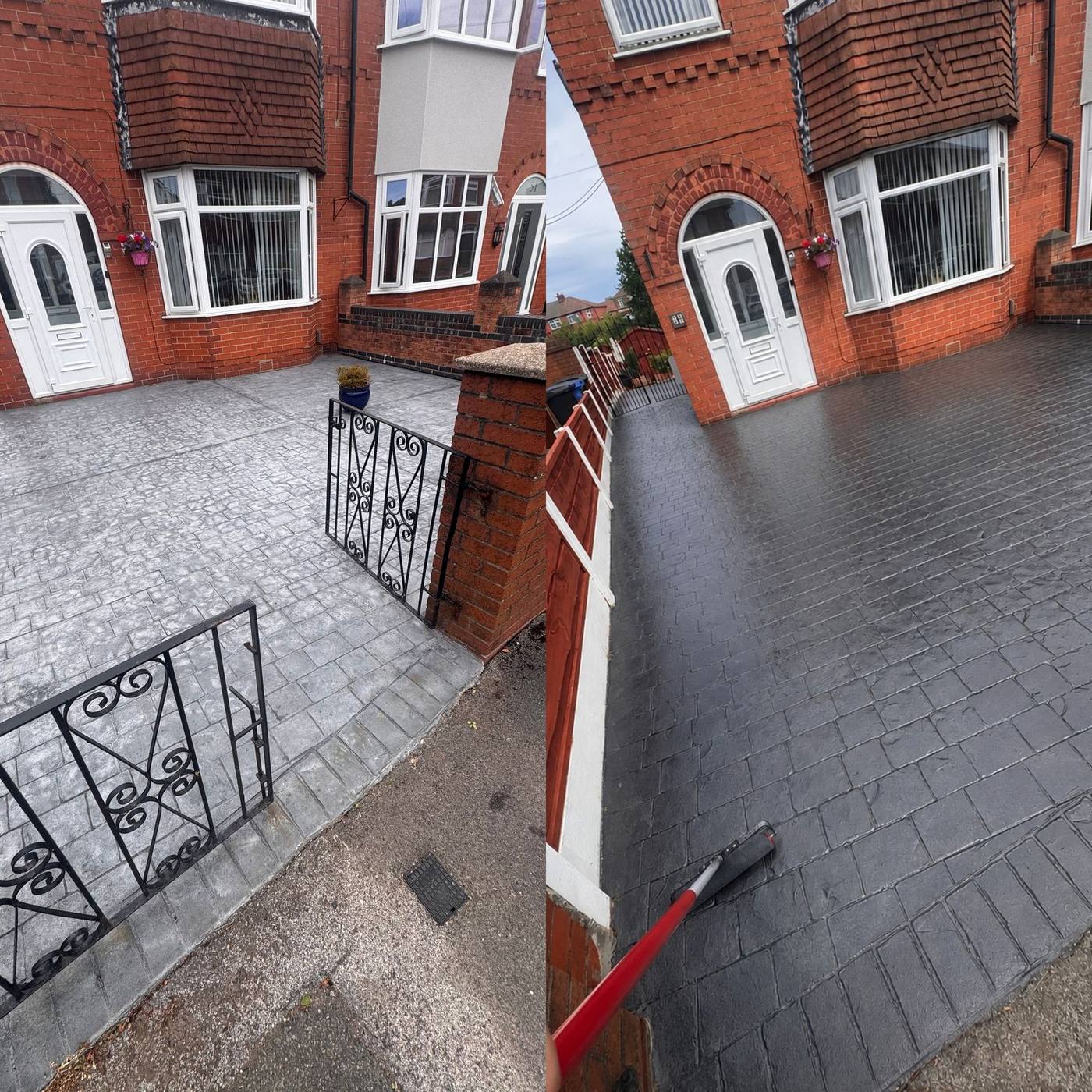
Imprinted concrete driveway cleaned and resealed — one of the surface types that genuinely benefits from sealing after a professional clean.
Quick answer: Sealing a driveway after cleaning extends the clean, slows weed and moss regrowth, and protects the surface from staining. However, it adds cost, requires proper drying time, and isn't always necessary — block paving, imprinted concrete, and tarmac benefit most, while some surfaces are better left unsealed.
What Does Driveway Sealing Actually Do?
A sealant forms a protective barrier over the surface of a driveway, reducing how much moisture, oil, and biological matter can penetrate. On a porous surface like block paving or imprinted concrete, untreated material soaks up rainwater, fuel drips, and organic debris — all of which accelerate the growth of algae, moss, and weeds, and make staining much worse over time. A sealant slows that absorption down considerably, which is why surfaces that have been sealed tend to stay cleaner for longer between washes.
The critical thing to understand is that sealing does not clean a surface. It preserves a clean surface. If a driveway goes down with algae still sitting in the joints, or before the cleaning chemical has had its full dwell time and been properly rinsed, the sealant locks all of that in. That's why the sequence matters: clean thoroughly, treat any biological growth with a biocide or sodium hypochlorite solution, rinse completely, allow full drying, and only then consider sealing. Any contractor suggesting they'll clean and seal on the same day in a northern English autumn should be questioned on how they're managing the drying window.
It also won't fix underlying structural issues. Cracked imprinted concrete, sunken block paving, or failing jointing compound won't be improved by a sealant — they'll just be preserved in their current state, flaws included.
Which Driveway Surfaces Can Be Sealed?
Imprinted or pattern-imprinted concrete is almost always a candidate for sealing, and arguably needs it more than any other surface. The colour in these driveways comes from a release agent applied during installation, and without a topcoat sealant to protect it, UV exposure and foot traffic gradually fade it. Most imprinted concrete installations include an initial sealant, but it wears off and needs reapplying every few years. Leaving it too long means the surface becomes increasingly porous and the colour starts to look washed out.
Block paving can be sealed, but it's more of a judgement call. If the paving is going to be re-sanded with kiln-dried sand after cleaning — which is the right approach after a full block paving cleaning job — sealing can go on top to lock the sand in and slow weed regrowth. Tarmac has specialist sealants designed for it, primarily to prevent oxidation and surface crumbling, though these are a different product entirely from concrete or paving sealants.
Natural stone — Indian sandstone being the most common in Greater Manchester gardens and driveways — generally should not be sealed with a surface sealant. Sandstone is naturally breathable, and trapping moisture beneath an impermeable layer can cause spalling and surface breakdown over time. Porcelain is essentially non-porous already, so sealing it serves little purpose. If you've got either of these surfaces and a contractor is pushing a sealant hard, it's worth asking exactly what product they're proposing and why.
The Real Pros of Sealing After Cleaning
When applied to the right surface in the right conditions, sealing after cleaning does deliver genuine benefits. The most significant one is that it slows the return of algae, moss, and weed growth — the things that make driveways look neglected within a year or two of cleaning. In Greater Manchester, where surfaces rarely get extended periods of sun and dry air, biological growth comes back quickly on untreated driveways. A sealant doesn't prevent it indefinitely, but it makes a noticeable difference to how long the cleaned surface stays looking clean. There's more on why growth returns so fast in our guide on how wet weather destroys your driveway faster.
For block paving and imprinted concrete, a quality sealant also enhances the colour — bringing out the tone in the paving and giving it a finish somewhere between a wet look and a satin sheen, depending on the product chosen. This is partly aesthetic, but it also means the surface is easier to clean in future because contaminants sit on the sealant rather than soaking into the material itself. Oil and fuel stains, which are a particular problem on driveways near the road, are much less likely to become permanent on a sealed surface.
For imprinted concrete specifically, sealing is close to essential maintenance rather than an optional extra. The dye in the concrete isn't deep — it's surface-level — and without a topcoat it will fade noticeably within a few years.
The Honest Cons of Sealing (That Some Traders Won't Tell You)
The first and most obvious downside is cost. Sealing adds to the price of a clean, and on a large driveway that addition can be significant. Whether that cost is justified depends on your surface and your situation, and anyone telling you every driveway should be sealed is oversimplifying.
The more serious risks are technical. Sealing over a damp surface — which in the North West is a real hazard given how rarely we get extended dry windows — causes the sealant to whiten, blister, or peel. This is not always recoverable without stripping the sealant back off and starting again, which costs more than the original job. Poor-quality sealants, or the wrong sealant for the surface, can also trap moisture beneath them and cause spalling or surface breakdown over time. There are a lot of cheap sealants available to the trade and to consumers, and not all of them are suited to block paving or imprinted concrete in a climate like ours.
On block paving specifically, sealing can complicate future maintenance. If the jointing sand settles or washes out over time and re-sanding is needed, a sealed surface makes it harder for the new sand to bed in correctly. Sealing also needs to be reapplied — typically every three to five years depending on product quality and traffic — so it's a recurring cost, not a one-time fix. Understanding the full process of block paving re-sanding is useful if you're trying to plan long-term maintenance.
If a contractor wants to clean and seal your driveway on the same day, ask them specifically how they're ensuring the surface is dry enough. On a grey October day in Oldham or Rochdale, a surface that looks dry to the eye can still hold enough moisture in the substrate to cause a sealant to fail. The 24 to 48 hour drying rule is a minimum, not a target.
How Long Does a Driveway Need to Dry Before Sealing?
In ideal conditions — warm, dry, with some direct sun — most cleaned driveway surfaces need a minimum of 24 to 48 hours before sealing. In practice, those conditions don't describe most of Greater Manchester for most of the year. Overcast skies slow evaporation significantly, and surfaces that have been pressure washed often hold more moisture in the substrate than is visible on the surface. In autumn and winter, or after prolonged wet periods, 48 to 72 hours is a safer minimum, and even then you'd want to check the forecast before committing.
Rushing this step is the most common reason sealing jobs go wrong. The sealant cures over the top while moisture is still present below, and within months the finish starts to cloud, lift, or peel at the edges. Some sealants are more moisture-tolerant than others — certain water-based acrylic products have a degree of flexibility — but none of them are designed to go down wet.
This is why many reputable contractors clean and seal on separate visits, particularly in the autumn and winter months. It adds a logistical step, but it's far better than a failed application that costs money to strip back.
When to Call in a Professional for Sealing
Sealing looks straightforward — it's essentially applying a liquid coating to a flat surface — but product selection and application technique make a significant difference to the outcome. Solvent-based sealants tend to give a richer, deeper colour enhancement but require more careful handling and adequate ventilation. Water-based products are easier to apply and more forgiving, but some are less durable under heavy traffic. Getting the choice wrong for your surface type or climate can result in a finish that looks patchy, weathers unevenly, or fails early.
Application technique matters too. Applying too thickly leaves puddles and lap marks. Too thin and you get uneven coverage. On textured surfaces like imprinted concrete, getting sealant into every recess without leaving pools in the pattern requires experience and the right equipment. A professional who cleans and seals as part of the same job — allowing for proper drying time between stages — is well-placed to control the conditions and ensure the application is done right. C&C Precision carries out driveway sealing as part of its full restoration service across Greater Manchester, and because we do the cleaning ourselves, we know exactly when the surface is ready.
If you're thinking about a full driveway cleaning and want to understand whether sealing makes sense for your surface, sending a few photos over WhatsApp is the quickest way to get a straight answer and a quote.
Should You Seal Your Driveway? A Practical Summary
For imprinted or pattern-imprinted concrete, sealing is close to essential. The surface needs a topcoat to protect its colour and keep it cleanable. If yours hasn't been resealed in more than three or four years, it's overdue. For block paving, sealing is worth considering if you want a lower-maintenance surface and you're prepared for the ongoing cost of reapplication every few years. Combined with proper re-sanding with kiln-dried sand after cleaning, it gives a good result in terms of weed and moss resistance.
For natural stone and porcelain, sealing is rarely necessary and in some cases counterproductive. If someone's quoting you for sealing an Indian sandstone patio or a porcelain driveway without a detailed explanation of the product and purpose, it's worth getting a second opinion. Our guide on why paving goes black in the UK covers some of the underlying reasons surfaces degrade, which gives useful context for deciding what maintenance approach makes sense.
The other practical consideration is how long you plan to stay in the property. Sealing adds upfront cost, and the benefit builds over time through easier maintenance and slower surface degradation. If you're planning to sell in the next year or two, a good professional clean may give you everything you need aesthetically without the additional sealing investment. If you're staying long-term, sealing the right surfaces after a thorough clean is generally money well spent.
Frequently asked questions
How soon after pressure washing can I seal my driveway?
You need to wait until the surface is completely dry — typically 24 to 48 hours in warm, dry weather. In the Greater Manchester climate, with overcast skies and dampness, 48 to 72 hours is safer. Sealing over a damp surface traps moisture and can cause the sealant to whiten, peel, or fail within months.
Does sealing a driveway stop weeds and moss coming back?
It slows them down significantly but won't stop them forever. A sealant closes the joints and surface pores that organic growth feeds through, so regrowth is much slower. On block paving, combining kiln-dried sand in the joints with a sealant gives the best long-term resistance to weeds and moss.
Is driveway sealing worth the extra cost?
It depends on the surface. For imprinted concrete, sealing is almost essential — without it, the colour fades and the surface becomes porous and harder to clean. For block paving, it's a personal choice based on how low-maintenance you want your driveway to be. For natural stone or porcelain, sealing is rarely necessary and can actually cause problems.
Can I seal my block paving driveway myself?
You can, but getting it wrong is easy and the results can look worse than not sealing at all. The surface must be spotlessly clean and fully dry, the right sealant must be chosen for the paving type, and it needs to be applied evenly. A botched DIY seal can leave a patchy, streaky finish or trap moisture under the surface — both of which are difficult and costly to fix.
Not sure if your driveway needs sealing?
Send a photo on WhatsApp and we'll give you an honest, fast quote with a straight recommendation on whether sealing is worth it for your surface.