If you've been looking into pressure washing in Prestwich, you'll already know how quickly surfaces green over in this part of Greater Manchester. The combination of mature tree cover, north-facing aspects on older streets, and the near-constant damp that rolls in from the Pennines means algae, moss, and general biological grime establish themselves faster here than in drier parts of the country. That's not a sales pitch — it's just the reality of living in the North West, and it affects everything from a terraced path to a rendered gable end.
This guide covers the main property types you'll find across Prestwich — Victorian terraces, interwar semis, and newer builds — and what exterior cleaning actually involves for each one. There's honest information here about what pressure washing can and can't achieve, where DIY is fine, and where the wrong approach causes damage that costs more to fix than the clean itself. If you're trying to work out what your property needs and what it's likely to cost, this should give you a straight answer.
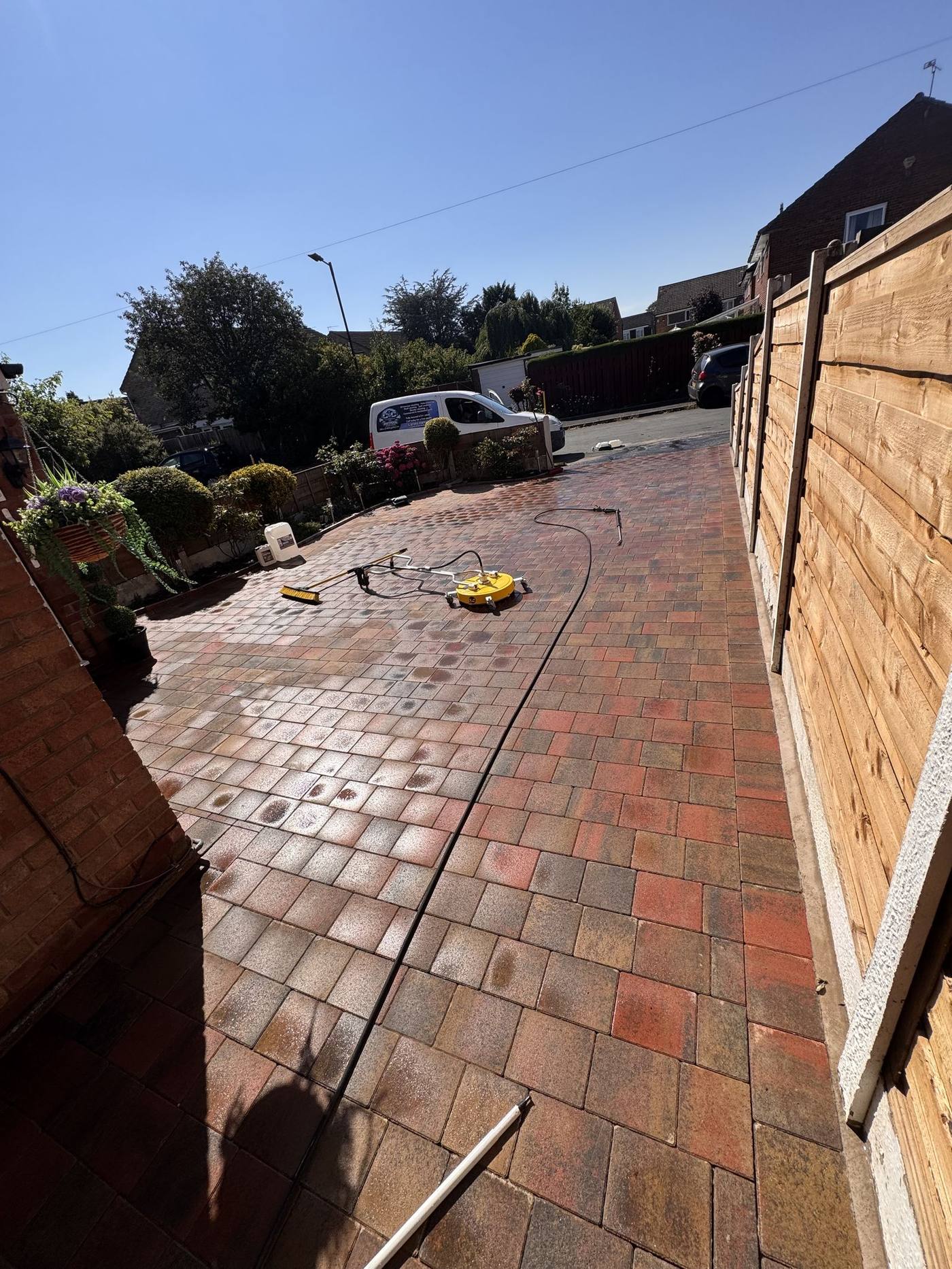
A typical Greater Manchester semi — block paving restored and ready.
Quick answer: Pressure washing in Prestwich covers everything from Victorian terrace driveways and stone paths to modern block paving and rendered new builds. C&C Precision serves the area with driveway cleaning, patio cleaning, softwashing, and re-sanding — with fast quotes via WhatsApp photo.
Why Prestwich Properties Need Regular Exterior Cleaning
Prestwich sits in a pocket of Greater Manchester where the climate does exterior surfaces no favours. Rainfall is consistent across all four seasons, temperatures rarely climb high enough to dry surfaces properly between wet spells, and large mature gardens — while attractive — create shaded, damp conditions that algae and moss thrive in. On a south-facing driveway with full sun exposure, growth is slow. On a north-facing flagged path running alongside a hedge, you can have a significant moss problem within a single season.
The issue with leaving organic growth unchecked isn't just cosmetic. Moss holds moisture against the surface beneath it, which accelerates the breakdown of mortar joints in block paving and flagging. Algae on render can penetrate micro-cracks and cause staining that goes deeper than the surface layer. On paths and steps, a thin film of green algae is genuinely hazardous underfoot, particularly in autumn and winter when it's wet. These aren't hypothetical problems — they're what most Prestwich properties show some degree of after a few years without maintenance.
Regular cleaning, typically every two to three years for most surfaces, keeps growth from establishing deeply and makes each subsequent clean straightforward. Leave it longer and you're not just cleaning — you're restoring, which takes more time, more product, and in some cases specialist treatment to get results that are close to the original surface.
Victorian and Edwardian Terraces: What to Expect
A large proportion of Prestwich's housing stock dates from the late nineteenth and early twentieth century. These properties typically feature natural stone flags on front paths and rear yards, engineering brick on lower courses, lime-based mortar in the pointing, and often a shared ginnel or back entry that sees almost no direct sunlight throughout the year. Cleaning these surfaces well means understanding what they're made of and what pressure they'll tolerate.
Natural sandstone flags can be cleaned effectively, but black spot — a form of lichen — is a common problem that doesn't respond to pressure alone. It needs a biocide application with adequate dwell time, usually twenty to thirty minutes, before agitation. Even then, deeply ingrained black spot will lighten rather than disappear entirely after a single treatment. That's the honest position: pressure washing in Prestwich on older sandstone improves it significantly, but managing expectations about staining on aged stone is part of doing the job properly. You can read more about this in the context of stone cleaning on different surface types.
Ginnels and north-facing yards need careful, lower-pressure work to avoid blasting loose mortar out of joints that may already be deteriorating. Old lime mortar is softer than modern cement-based pointing — it's designed to be, because it allows the structure to move slightly — but that means it's also more vulnerable to careless pressure washing. The objective is to clean the surface, not repoint the wall, and a tradesperson who understands the material will adjust accordingly.
1930s Semis and Bungalows: Driveways and Block Paving
Prestwich has a substantial belt of interwar housing — semis and bungalows built between the wars, many of which originally had concrete or tarmac drives that have since been replaced with block paving. Some of that paving was laid well, some less so. What they often share, regardless of age, is a loss of jointing sand, a build-up of silt and moss in the joints, and surface staining from car oil, leaves, and years of general traffic. Block paving cleaning addresses the visible contamination, but the sand situation underneath is a separate issue worth understanding before you book anything.
Pricing for block paving work varies depending on what the surface actually needs. Cleaning alone starts from around £3.50 per square metre. If the paving has significant biological growth and needs a chemical pre-treatment as part of the process, that moves to around £4.25 per square metre. A full restoration — clean, re-sand with kiln-dried sand, and finish — sits at around £5.50 per square metre. If the paving has recently been cleaned by someone else and just needs the sand replacing, re-sanding only comes in at around £2.00 per square metre. These aren't fixed quotes — condition and access affect the final figure — but they give a realistic starting point.
On the question of sealing: it's not always necessary, and anyone who tells you it always is should probably be questioned. Sealing slows the return of weed growth and makes future cleaning easier, but it's an additional cost and on some block paving it can change the surface appearance in ways some people dislike. If you're weighing it up, the guide on why weeds in block paving keep coming back explains the mechanics honestly and is worth reading before you decide.
New Builds and Modern Renders: Softwashing Explained
Newer developments on the edges of Prestwich — and refurbished properties throughout the area — frequently feature thin-coat render systems such as K-Rend or Weber. These finishes look clean when new but turn green or develop dark streaking within a few years in the Greater Manchester climate. The mistake many people make is assuming that because a surface looks dirty, it needs pressure washing. With modern render, the opposite approach is usually correct.
High-pressure washing on K-Rend or similar systems risks damaging the surface texture, forcing water behind the render at weak points, and stripping the finish unevenly. Softwashing uses a diluted sodium hypochlorite solution applied at low pressure to kill the algae, lichen, and biological growth at root level. The dwell time does the work — typically fifteen to thirty minutes depending on the severity of growth and the weather conditions — after which the surface is rinsed gently. The result lasts considerably longer than pressure washing because the organism is dead rather than physically removed and left to regrow from surviving spores. If you want a more detailed comparison of the two approaches, the guide on softwash vs pressure wash for render covers it thoroughly.
Results on heavily stained render can be dramatic, but again, honesty matters: render that has been left for many years may have some residual staining after treatment that requires a second application or, in some cases, simply won't come back to a like-new appearance without repainting. Most renders that are treated within three or four years of first showing growth respond very well.
Patios, Paths, and Garden Walls: The Full Picture
Patios in Prestwich gardens tend to be a mix of Indian sandstone, porcelain, older concrete slabs, and occasionally natural limestone or slate. Each material has different tolerances. Porcelain is the most forgiving — high pressure is fine and it cleans quickly. Indian sandstone needs lower pressure and, if black spot is present, a biocide treatment. Concrete slabs sit somewhere in between and usually clean well, though older ones can be porous enough to have absorbed staining that won't fully lift. Patio cleaning on different materials is covered in more detail elsewhere, but the short version is that matching the method to the material matters far more than simply turning the pressure up.
Garden walls — brick, natural stone, or rendered — are a different challenge again. The pointing on an older garden wall is often the most fragile part of the structure, and directing a pressure washer at mortar joints that are already soft or cracked will remove material you then have to pay to replace. The correct approach is lower pressure, appropriate chemical treatment where there's heavy biological growth, and working with the surface rather than against it. The guide on fence and wall cleaning done right goes into the specifics of this.
If your patio has black spots that haven't shifted after a standard clean, don't assume the job has been done badly. Black spot lichen on sandstone is one of the most stubborn surface problems in exterior cleaning. A biocide treatment followed by a second visit a few weeks later, once the organism has died back, will produce noticeably better results than trying to blast it off in a single session.
When to Call in a Professional Rather Than Hiring a Jet Wash
Hired pressure washers — the kind available from most tool hire companies — are built to deliver high volume at high pressure. What they don't offer is control. They typically operate at pressures suitable for industrial use, with limited ability to adjust, and they're designed to shift material fast rather than protect the surface underneath. For washing down a concrete garage floor or cleaning heavy contamination off machinery, they're fine. For block paving, aged stone, render, or any surface where the jointing or the finish matters, they're frequently the wrong tool.
The most common damage we see from DIY pressure washing: sand stripped from block paving joints leaving gaps wide enough to grow a garden in, mortar blown from between flags on Victorian paths, render damaged or lifted at hairline cracks, and moss spores spread across a clean area by uncontrolled overspray. None of this is difficult to understand — it's just physics. High pressure and a wide fan pattern move everything, including things you'd rather leave in place. If you're considering a hired machine on block paving, the guide on block paving re-sanding will give you a realistic picture of what you might be dealing with afterwards.
DIY is perfectly reasonable for some things: cleaning a small concrete path with a domestic pressure washer on a sensible setting, rinsing down a plastic fence panel, or a light refresh of a well-maintained patio. Where it crosses into professional territory is when the surface is fragile, when chemical treatment is needed, when re-sanding or jointing is part of the job, or simply when the area is large enough that getting it wrong is an expensive mistake. C&C Precision covers Prestwich and across Greater Manchester — send a photo on WhatsApp and you'll get a straight answer about whether it's a job worth getting in for or something you can handle yourself.
Practical Advice Before You Book a Pressure Washer in Prestwich
Regardless of who you use, a few things will make the job go more smoothly. Clear the area before anyone arrives — garden furniture, plant pots, bins, and anything stored on the drive or patio. This isn't just courtesy; time spent moving things around on the day costs you money if you're being charged by the hour, or eats into the time available if it's a fixed quote. If there are vehicles that need moving, have a plan for where they're going. Access to an outside tap is required for most pressure washing work, so make sure one is available and that the tap is working before the job starts.
On the question of photo quotes: for pressure washing in Prestwich, a photograph sent in advance will almost always produce a more accurate price than a per-square-metre figure given blind. Condition varies enormously — a 40m² driveway that hasn't been touched in ten years takes substantially longer than a 40m² driveway cleaned two years ago. A photo takes thirty seconds to send and means you're not getting a price based on guesswork. It also means a professional can flag anything that might affect the job — a cracked slab, a section of pointing that needs care, or a render type that needs a different approach.
Turnaround for most Prestwich residential jobs — a driveway, a patio, or a front and rear clean — is typically one to three days once booked, depending on the time of year. Spring and early autumn are busiest; winter bookings often have shorter waits. If you're preparing ahead of the colder months, the guide on how to prepare your home exterior for winter covers what's worth doing and in what order.
Frequently asked questions
Do you cover Prestwich for pressure washing?
Yes — Prestwich falls within our regular working area across Greater Manchester. We cover Prestwich and the surrounding parts of Bury and Salford. Send a photo on WhatsApp and we can usually confirm availability and give you a price the same day.
Can you pressure wash a rendered house in Prestwich without damaging it?
Not with a standard pressure washer — that's the honest answer. Render, especially K-Rend or thin-coat systems, needs softwashing rather than high-pressure cleaning. We use a sodium hypochlorite solution that kills algae and biological growth safely, with no risk to the render surface.
How much does pressure washing cost in Prestwich?
Prices depend on the size and condition of the area, not just the square footage. A typical terraced driveway in Prestwich starts from around £80–£120; a full front and rear block paving clean with re-sanding will be more. The fastest way to get an accurate figure is to send us a couple of photos on WhatsApp.
My block paving keeps getting weeds back after cleaning — why?
Weeds return when the jointing sand between blocks has been washed out over time, leaving open gaps where seeds settle and roots take hold. Cleaning removes what's there, but re-sanding with kiln-dried sand after the clean — and optionally sealing — closes those gaps and significantly slows regrowth.
Got a driveway or patio in Prestwich that needs cleaning?
Send a photo over WhatsApp and we'll get you a fast, no-fuss price — usually the same day.