Garden wall cleaning is one of those jobs that barely registers until the day you look up from the driveway and realise the boundary wall has been quietly turning green for the last three years. It happens gradually — a thin film of algae in spring, a bit of moss by autumn, and within a couple of seasons you've got a wall that looks twice its age. The North West doesn't help. Greater Manchester's damp climate, with moisture sitting in the air for months at a time, creates exactly the conditions that biological growth thrives in.
Walls and fences frame the whole property. A freshly cleaned driveway or patio looks noticeably less impressive when the surrounding walls are thick with algae and the fencing has gone from brown to black-green. Treating them as part of the same job — rather than an afterthought — is what takes a property from looking maintained to looking genuinely well cared for.
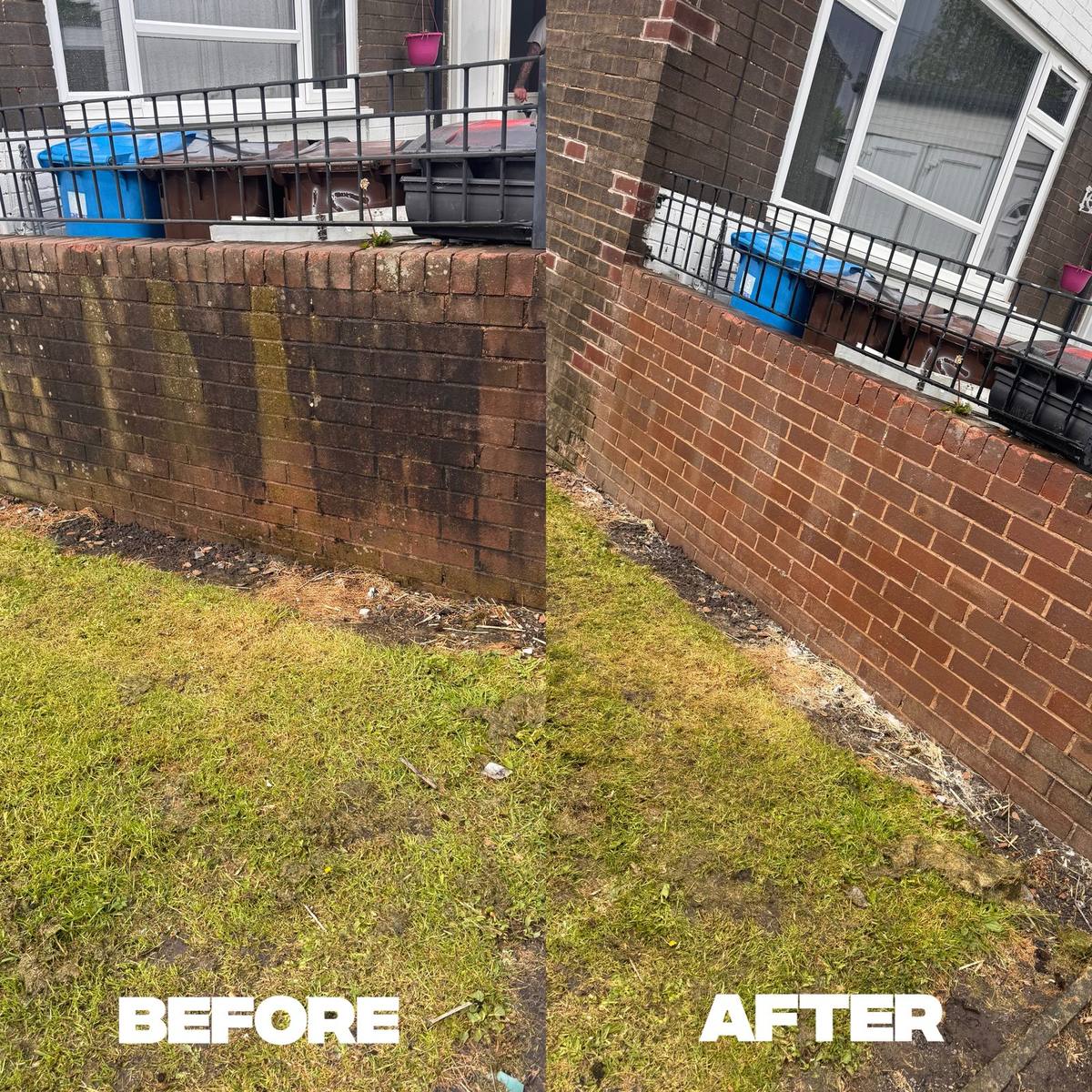
A garden wall cleaned by C&C Precision — the difference a proper clean makes to the whole property.
Quick answer: Garden wall cleaning involves removing algae, moss, lichen and embedded dirt from brick, stone or rendered walls using the correct pressure, chemicals and technique for the surface. Done properly, it restores appearance, prevents long-term damage and protects the structure — results last far longer than a basic rinse.
Why Walls and Fences Are Always the Last Thing People Clean
Driveways and patios are underfoot every day, so the dirt is impossible to ignore. You park on the driveway, you walk across the patio, you notice when they're slippery or stained. Walls and fences are different — they sit at the edge of your vision, doing their job quietly, and the deterioration creeps up so slowly it barely registers until someone visits and mentions it.
By the time most people notice a garden wall looks bad, the biological growth has usually been established for years. Algae colonises first, then moss takes hold in the algae layer, and eventually lichen roots itself into the surface. Each stage is harder to shift than the last, and lichen in particular is a long-term tenant — it anchors into the substrate and won't respond to pressure washing alone.
There's also a tendency to assume walls clean themselves in the rain. They don't. Rain wets the surface and dries again, but it doesn't kill biological growth — it feeds it. North-facing walls and those shaded by trees are the worst affected, because they retain moisture longest and dry out slowest.
What Actually Grows on Garden Walls and Fences
Most of what you see on a garden wall falls into four categories: algae, moss, lichen and black spot mould. They look similar from a distance but behave very differently, and treating them all the same way is why a lot of DIY cleans don't last. Algae is the thin green or orange film that makes surfaces slippery — it's relatively easy to kill with the right chemical and rinse away cleanly. Moss is bulkier, holds water and tends to grow in the mortar joints and any spot where moisture collects.
Lichen is the tricky one. It's a composite organism — part fungus, part algae — and it roots into the surface rather than just sitting on top. It often appears as grey, green or orange crusty patches and it takes time to respond to treatment. A strong biocide application with a proper dwell time is needed, and even then some discolouration can remain. Being honest about this matters: on some surfaces, particularly textured render or rough stone, lichen leaves a ghost mark even after the organism is dead. The surface is clean in the biological sense, but the staining may have lightened rather than completely disappeared.
Black spot mould tends to appear on timber fencing and smooth renders, especially in shaded spots. It responds well to sodium hypochlorite treatment but can be persistent in the grain of timber. If you've ever wondered why your fence looks patchy after a clean, this is usually why — the same issue affects patios too, as covered in this guide on why your patio looks patchy after cleaning.
Surface Types and Why Method Matters
Hard engineering brick and dense concrete cope well with pressure washing at appropriate levels. They're dense enough to handle it without damage, and a thorough clean followed by a biocide application will see them right. Natural stone is a different matter — sandstone and limestone are porous and relatively soft, and too much pressure strips the face of the stone, opens up the structure and makes it more susceptible to future soiling. The damage isn't always obvious immediately, but over the following winters it becomes clear.
Render — whether that's traditional pebbledash, smooth monocouche or coloured K-Rend — should never be hit with a pressure washer at anything approaching full pressure. The surface coating is thin and the bond between it and the substrate is what keeps water out of your walls. Strip that and you're looking at repointing or re-rendering costs that dwarf what you'd have spent on a professional clean. For K-Rend specifically, there's more detail in this guide on K-Rend cleaning done properly.
Pointing is another thing to assess before any cleaning takes place. Older walls with soft lime mortar or pointing that's already crumbling won't survive pressure washing — the water gets behind the joints and accelerates deterioration. If the pointing is already failing, cleaning needs to be done carefully and re-pointing discussed before any aggressive treatment.
Softwashing vs Pressure Washing for Garden Walls
Pressure washing is the right tool for some surfaces, but it's not the universal answer it's often assumed to be. On hard, dense materials in good condition — solid brick, concrete panels, engineering stone — it does the job well. On anything older, softer or rendered, the risk of damage is significant enough that a different approach is better. This is where softwashing comes in.
Softwashing uses a diluted sodium hypochlorite solution — the same active ingredient as household bleach, but applied at controlled concentrations — to kill biological growth at the root. The solution is applied at low pressure, left to dwell (typically 15 to 30 minutes depending on the severity of growth and surface type), and then rinsed off. Because it kills the organism rather than just dislodging it, the results last longer. There's no residual root system left in the surface to regenerate.
The practical advantage on garden walls is that you're not relying on mechanical force to do the work. That means render stays intact, pointing isn't disturbed, and soft stone retains its face. The results look cleaner too — pressure washing can leave tide marks and patchy areas where growth has been blasted off unevenly, while a proper softwash gives an even, consistent finish.
Before applying any cleaning solution to a rendered or painted wall, always test on a small, inconspicuous area and leave it for 24 hours. Some pigmented renders and exterior masonry paints are sensitive to sodium hypochlorite, and catching a reaction on a small patch is far better than discovering a problem across the whole wall.
Cleaning Timber and Composite Fencing Without Wrecking It
Timber fencing needs a light touch. The pressure that shifts moss from a brick wall will lift the grain on softwood boards, leaving a rough, furry surface that actually soils faster afterwards because it holds more dirt. Low pressure — well below what you'd use on a driveway — with a good detergent or biocidal wash solution is the correct approach. Work with the grain, keep the nozzle moving and don't dwell in one spot.
After cleaning, a biocidal treatment helps significantly. Timber is organic, which means algae and mould find it easy to colonise. A post-clean biocide application soaks into the surface and slows regrowth — without it, a fence in a damp, shaded garden can be back to green within a year. Whether you then apply a preservative or fence treatment is a separate decision, but the surface needs to be clean and dry before anything goes on top of it.
Composite fencing is more straightforward — it's less absorbent and more resistant to biological growth — but the joins and fixing points are worth paying attention to. Moisture sits in those gaps, and if growth gets established behind the boards it can be difficult to shift without disassembly. A regular light clean prevents that situation from developing.
When to Call in a Professional for Garden Wall Cleaning
There are situations where garden wall cleaning is genuinely not a DIY job. Deep lichen on heritage stonework, crumbling pointing, listed buildings or any wall with significant height that requires ladders all carry risks that go beyond what a hired pressure washer from the local tool hire depot can safely handle. The liability of damaging old or valuable stonework — or worse, causing injury — isn't worth the saving.
A professional will assess the surface before touching it, which is something most DIY approaches skip. That assessment is what determines the correct pressure, dilution, dwell time and rinse method. It's also what catches things like failing pointing or soft stone that needs pre-treating before any chemical is applied. If you're in Greater Manchester and want an honest look at what a wall needs, C&C Precision Precision Pressure Washing offers fast quotes — send a couple of photos over WhatsApp and you'll get a straightforward price based on what's actually in front of us.
For anyone dealing with render on the wall rather than exposed brick or stone, render cleaning is a specific service with its own considerations — it's worth reading about before attempting anything yourself, particularly on coloured or monocouche finishes.
Practical Takeaway: How to Approach the Whole Job Properly
The most common mistake with garden wall cleaning is treating it as a standalone job when it should be part of a wider exterior clean. Walls, fences, driveways, patios and paths all suffer from the same biological growth driven by the same damp conditions. Cleaning one and leaving the others means the cleaned surface looks out of place, and spores from adjacent areas recolonise it faster.
If you're doing the work yourself, the order matters: start high and work down. Clean walls and fences before the patio and driveway, so run-off from the walls doesn't dirty a surface you've already cleaned. Pre-treat biological growth with a biocide or appropriate chemical before applying any pressure — this loosens the growth and means you need less force to remove it, reducing surface damage. Then rinse thoroughly and consider a post-clean biocide to slow regrowth.
If the job involves stone cleaning alongside fencing and boundary walls, plan for longer dwell times on lichen-heavy areas and manage expectations honestly: some staining on porous stone lightens rather than disappears completely, and that's a characteristic of the material rather than a failure of the clean. A property that's properly maintained throughout — walls, surfaces, roof line — holds its appearance for years longer than one where effort is concentrated in one area and the rest is left to deteriorate.
Frequently asked questions
Can I pressure wash a garden wall myself?
You can, but the risk of damage is real — too much pressure on soft brick, sandstone or render strips the surface and blows out pointing. If the wall is hard engineering brick or concrete in good condition, a careful clean with a fan nozzle is manageable. Anything older, softer or rendered is best left to someone who knows what they're doing.
How do I remove green algae from a garden wall?
The most effective method is a diluted sodium hypochlorite (bleach) solution applied and left to dwell — this kills the algae at the root rather than just blasting it off with water. Once dead it can be rinsed away cleanly. Pressure washing alone shifts the surface growth but leaves the spores behind, so it comes back faster.
How long does garden wall cleaning last?
On a treated wall in a typical Greater Manchester garden, you'd expect results to look good for two to four years depending on aspect, tree cover and how much moisture the wall retains. North-facing walls in shaded spots green over faster. A post-clean biocide treatment extends the results noticeably.
Do you clean garden walls and fences in Oldham and Greater Manchester?
Yes — wall and stone cleaning is one of our regular services across Oldham, Rochdale, Bury, Bolton, Tameside, Stockport and the surrounding area. We're fully insured with £1,000,000 public liability and the fastest way to get a price is to send a couple of photos over WhatsApp.
Want a price on your garden wall or fence?
Send a couple of photos over WhatsApp and we'll come back to you with a fast, honest quote — no faff, no sales call.