If you've noticed green streaks, black patches or that general dinginess creeping across your render, you're probably wondering whether a pressure washer would sort it out. The short answer is usually no — and understanding why comes down to knowing the difference between softwash vs pressure wash render as a cleaning method, not just a setting on a machine. It's a question that comes up a lot across Greater Manchester, where our damp North West climate gives algae, moss and lichen exactly the conditions they need to take hold on north-facing walls and shaded elevations.
This guide covers how softwashing actually works, why pressure washing render tends to cause more problems than it solves, and what situations — if any — where a low-pressure rinse is acceptable. If you're weighing up DIY against calling someone in, there's honest guidance on that too.
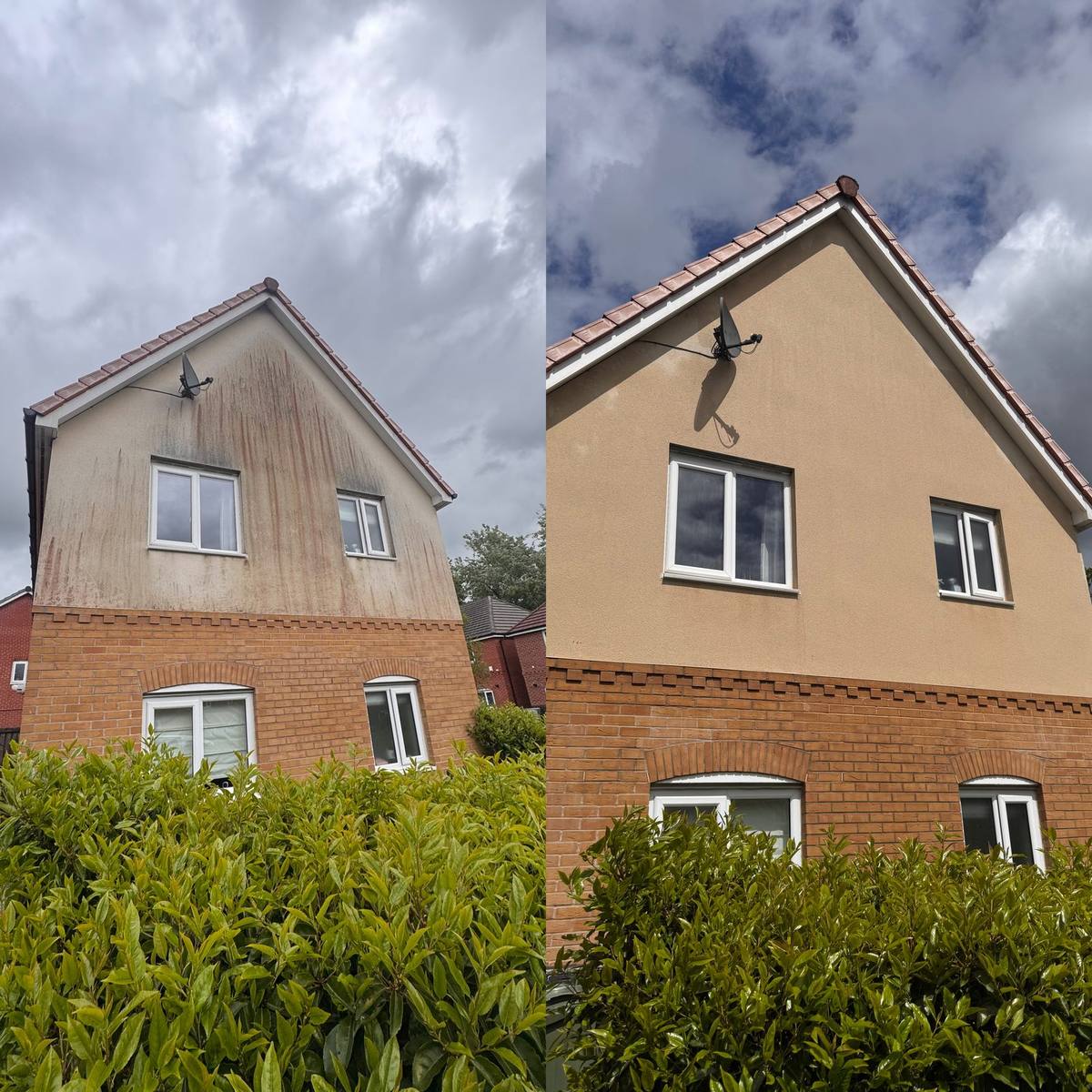
Before and after softwash on a rendered house front in Greater Manchester — no pressure washing involved.
Quick answer: For rendered surfaces, softwashing is almost always the right choice. High-pressure washing can crack, chip or blow off render — especially K-Rend and monocouche finishes. Softwashing uses a low-pressure sodium hypochlorite solution to kill algae, moss and bacteria at the root, leaving render clean without any risk of damage.
What Is Softwashing and How Does It Work?
Softwashing uses a low-pressure pump to apply a diluted sodium hypochlorite solution directly to the surface. The chemical does the work rather than the water pressure. When the solution dwells on the render — typically for ten to thirty minutes depending on the staining and the weather — it kills algae, lichen, moss and bacteria at the biological level, breaking down the organic matter rather than simply shifting it. The surface is then rinsed clean at low pressure, taking the dead growth with it.
This matters because most of what you see on render — the green tinge, the dark streaking, the reddish patches — is living biological growth. If you only remove it physically without killing the organism, you're leaving the root structure behind. Softwashing eliminates that root structure, which is why results last considerably longer than a straightforward pressure wash would.
Sodium hypochlorite is the active ingredient in softwashing and it's effective, but concentration and dwell time both need to be right. Too weak and it won't do the job. Too strong or left on too long without the right surfactants to slow evaporation, and you risk residue on the surface or damage to surrounding plants. This is one of the reasons the softwashing process is genuinely trade knowledge rather than something that translates directly to a DIY job with a bottle of bleach.
What's the Actual Difference in Pressure?
A standard domestic or trade pressure washer runs somewhere between 1,500 and 3,000 PSI depending on the machine. A softwash system typically delivers under 100 PSI — closer to what you'd get from a garden hose. That's not a slight difference. It's a completely different scale of force being applied to the wall.
To put it in context, the pressure used to clean a concrete driveway — which is dense, thick and built to take traffic loading — is roughly twenty to thirty times what a softwash system delivers to your render. Render is not concrete. It's a comparatively thin coating applied to the substrate beneath, and that difference in PSI is exactly why softwash vs pressure wash render is such a meaningful distinction in practice rather than just a theoretical one.
Some people assume that turning the pressure washer down to its lowest setting makes it safe for render. In reality, even a reduced-pressure lance is still delivering far more force than a softwash pump, and it doesn't have the chemical treatment to compensate for the lower cleaning action. You tend to end up with something that's neither effective nor safe.
Why Pressure Washing Render Is Usually a Bad Idea
Modern thin-coat renders — K-Rend, Weber, monocouche finishes — are typically only a few millimetres thick. They're designed to bond tightly to the substrate and deal with weathering, but they're not designed to withstand a high-pressure water lance at close range. High pressure finds weaknesses: small cracks in the surface, areas where adhesion isn't perfect, around window reveals and flashings. Once water gets behind render, you've got a damp problem inside the wall that costs significantly more to fix than the cleaning would have cost in the first place.
Older pebbledash and roughcast aren't immune either. Pressure washing can dislodge aggregate, create bare patches and leave the finish looking worse than it did before. Because these older finishes are often already showing their age, any damage tends to be difficult to match and repair invisibly. The stones used in original pebbledash aren't always available in the same grade, and repair patches rarely blend perfectly once the rest of the render has weathered.
There's also the internal damp risk to consider seriously. Greater Manchester gets consistent rainfall and high humidity. Render that's been compromised by pressure washing — even slightly — gives moisture a route into the wall structure. In older properties with solid walls rather than cavity construction, that can mean damp patches on internal walls, damaged plasterwork and the kind of problems that only become obvious months after the cleaning was done.
When Softwashing Is the Right Answer for Render
Softwashing is the correct method for virtually every type of render — K-Rend, monocouche, pebbledash, roughcast and painted render. It removes the green, black and red algae staining you typically see on north-facing walls and shaded elevations across Greater Manchester, and because the treatment kills the organism rather than just shifting the surface layer, the results hold considerably longer. Most professionally softwashed render stays clean for two to five years depending on aspect and tree cover nearby.
It also handles the full face of a property without risk of inconsistency. With a pressure washer on render, you're always working against the possibility of visible tracks, areas of accidental over-cleaning, or patches where the finish has reacted differently to the pressure. Softwashing applies chemistry evenly across the surface, dwell time does the work uniformly, and the rinse clears everything in one pass. The result tends to look noticeably more consistent across the whole elevation.
For render cleaning, softwashing is also the method recommended by most render manufacturers. K-Rend's own guidance specifically warns against high-pressure cleaning. Following that guidance matters if you ever need to make a warranty claim or if the property is being sold and a surveyor is involved.
Are There Any Cases Where Pressure Washing Render Is Acceptable?
In very limited situations — thick, sound, solid cement render in genuinely good condition with no cracking or delamination — a low-pressure rinse can be used as part of a softwash process. This means using water at low pressure to help the chemical solution dwell evenly on the surface and then to rinse off dead growth afterwards. This is still not the same as pointing a lance at a wall on full power, and it's not something you'd do independently of the chemical treatment.
If there's any doubt about the render's integrity — any visible cracking, hollow-sounding sections, areas around flashings or window reveals that feel suspect — the answer is softwash only, and a slow, careful application at that. A reputable contractor will check the render before starting rather than just committing to a method.
Before any cleaning starts, tap across the render surface with your knuckles. A solid, consistent sound suggests good adhesion. A hollow or drum-like sound means the render has started to delaminate from the substrate — that section needs assessment before any cleaning method is applied to it, soft or otherwise.
When to Call in a Professional Rather Than DIY
Sodium hypochlorite is straightforward when you know what you're doing and have the right setup. It needs to be diluted correctly for the specific surface and staining level, applied with surfactants that control dwell time and reduce runoff, and rinsed properly without just redistributing chemical onto garden beds, paving or neighbouring property. Getting the concentration wrong doesn't just mean a poor result — it can bleach or damage the render finish itself, or cause significant harm to planting and lawn areas below the treated wall.
There's also the access question. Gable ends, upper storeys and areas above extensions require working at height with appropriate equipment. Using a domestic ladder with a backpack sprayer to treat a two-storey gable end is a meaningful safety risk, not just an inconvenience. Trade contractors carry the right telescopic lance equipment, work from ground level where possible, and carry public liability insurance for situations where something does go wrong.
C&C Precision Precision Washing covers render cleaning across Oldham, Rochdale, Bury, Bolton, Manchester, Tameside, Stockport and the surrounding towns — if you're not sure what method your render needs or whether it's in a condition to be cleaned safely, sending a few photos is the quickest way to get a straight answer. You can also read about what the softwashing process involves in more detail before committing to anything.
Practical Takeaway: How to Get Your Render Cleaned Safely
If your render is looking green, streaky or stained, the right move is a professional softwash quote rather than reaching for a pressure washer or trying to replicate the process with consumer-grade products. Take two or three photos of the affected elevations — ideally one close up and one showing the full wall — and send them over on WhatsApp. Most reputable contractors can give you a realistic ballpark from photos alone and come back to you the same day without needing to visit first.
When you're speaking to a contractor, it's worth asking specifically whether they use a dedicated softwash pump rather than a pressure washer turned down low. The distinction matters. A proper softwash setup delivers consistent low pressure across the whole application; a pressure washer at reduced setting still behaves like a pressure washer and the operator is always working against that.
It's also worth being realistic about results. Most render that's been neglected for several years will come up dramatically cleaner after a professional softwash, but very heavy lichen or deep staining on porous finishes may lighten significantly rather than vanish entirely. A good contractor will tell you that before starting rather than after. If your render has underlying damage or delamination, that needs addressing separately — cleaning a compromised surface doesn't fix the structural issue beneath it. Guides like how to prepare your home exterior for winter and wall and fence cleaning done right cover some of the broader exterior maintenance context that's worth reading alongside this.
Frequently asked questions
Will softwashing damage my K-Rend or monocouche render?
No — softwashing is the industry-recommended method for K-Rend and monocouche specifically because it uses low pressure and a chemical solution rather than force. It will not crack, chip or delaminate the finish. High-pressure washing is what causes damage to these thin-coat renders.
How long does softwash last on render compared to pressure washing?
Softwashing kills the algae and bacteria at the root, so results typically last two to five years depending on the wall's exposure and aspect. Pressure washing — if used on render at all — just shifts the surface growth without killing the spores, so it tends to return much faster, often within a single season.
Is softwashing safe for plants and garden beds near the house?
When applied correctly by a professional, yes. We wet down plants and shrubs before treating the render, control the application so runoff is minimised, and rinse the surrounding area afterwards. Sodium hypochlorite breaks down quickly in soil. DIY application without these precautions carries more risk of plant damage.
How much does softwash render cleaning cost in Greater Manchester?
Price depends on the size of the house, how many elevations need treating and how heavily the render is stained. The quickest way to get an accurate figure is to send a couple of photos on WhatsApp — we can usually turn around a quote the same day without needing to visit first.
Not sure which method your render needs?
Send us a photo on WhatsApp and we'll give you a straight answer and a fast quote — no obligation.