If you've been searching for patio cleaning Tameside, you're probably looking at a patio that's gone from pleasant to embarrassing without you doing anything obviously wrong. It happens fast around here, and it keeps happening. The North West climate does its worst on outdoor surfaces year-round, and Tameside is no exception — by spring, most patios have a season's worth of algae, black spotting, or moss to show for it.
This guide covers what's actually happening to your patio, what a proper clean involves, what it costs, and when it makes sense to bring in a professional rather than hire a jet wash for the weekend. It's written to give you useful information, not to sell you anything.
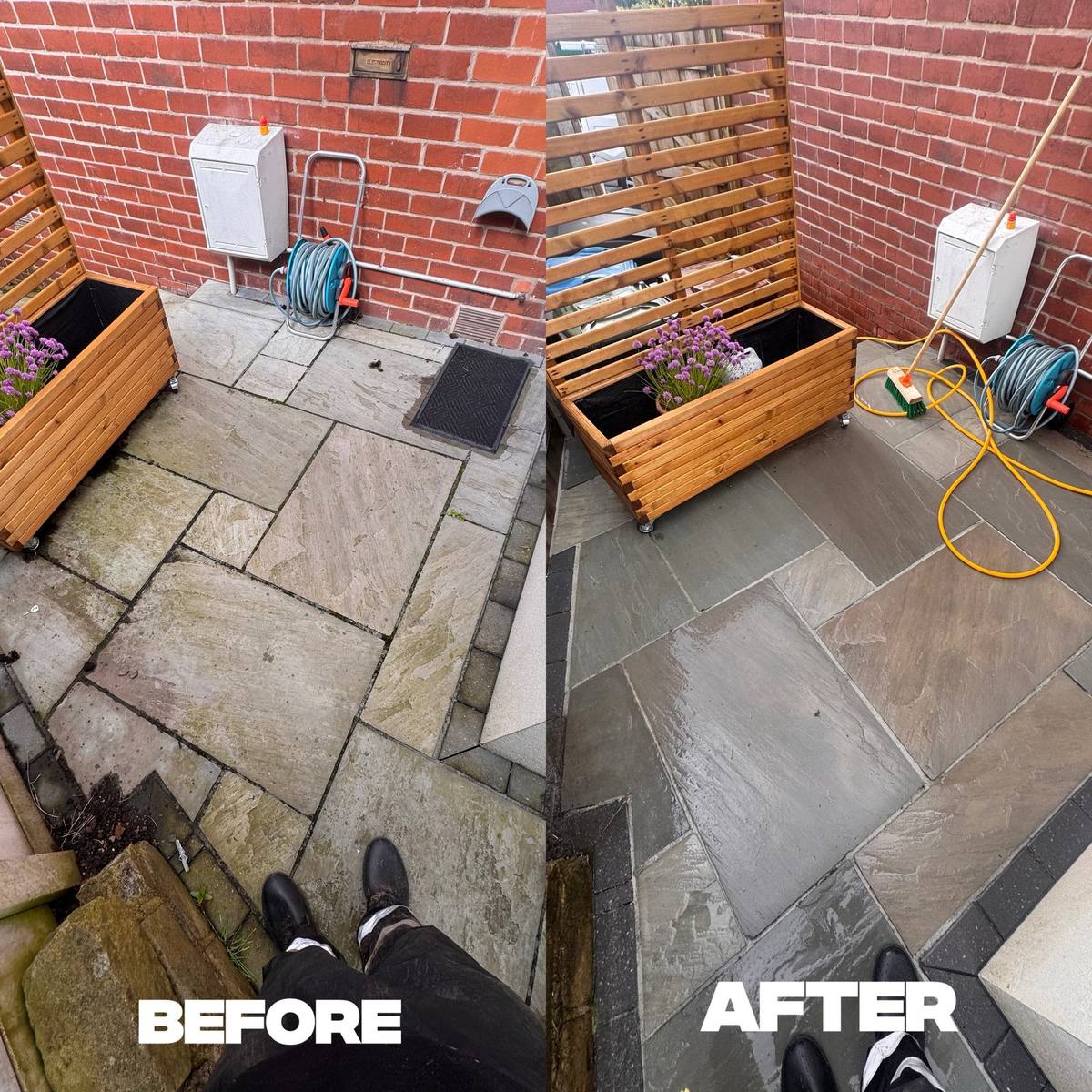
Indian sandstone patio cleaned by C&C Precision — common across Tameside homes and always worth doing properly.
Quick answer: Patio cleaning in Tameside typically involves pressure washing to remove algae, moss, and grime from concrete, sandstone, block paving, or porcelain surfaces. A professional clean restores appearance, removes slip hazards, and usually takes a few hours. Most Tameside patios cost between £80–£200 depending on size and condition.
Why Tameside Patios Get Dirty So Quickly
Greater Manchester sits in one of the wetter parts of England. Tameside — bounded by the Pennines to the east — catches its fair share of that rainfall, and the ground rarely dries out fully between showers, even in summer. That persistent moisture is exactly what algae, lichen, and moss need to take hold on paving. On a south-facing patio that gets good afternoon sun, growth is slower. On a north or east-facing garden, or anywhere shaded by a fence, outbuilding, or tree, the surface stays damp for long enough that algae colonises almost immediately after cleaning if nothing is done to prevent it.
The black and green staining you see isn't a sign of a dirty household — it's a straightforward biological response to damp, shade, and a porous surface. Concrete flags, sandstone, and block paving all have enough surface texture to trap moisture and organic matter. Once algae or lichen gets a foothold, the spores spread across the surface and into joints. Left untreated, the growth embeds itself deeper and becomes harder to shift. A patio that's cleaned every twelve to eighteen months is much easier — and cheaper — to maintain than one left for three or four years.
The Most Common Patio Surfaces in Tameside (and How Each One Gets Cleaned)
Concrete flags are the most common surface in older Tameside properties and are the most forgiving to clean. They're dense enough to handle a rotary surface cleaner at reasonable pressure, and most algae and general soiling lifts well. That said, very old concrete flags can be brittle, and any cracks or spalling mean you need to work carefully — pressure can widen existing damage. Pre-treatment with a biocide solution followed by surface cleaning and a rinse is the standard approach.
Indian sandstone is widely used in newer builds and renovations across the area. It looks good when clean, but it's a softer, more porous stone than people realise, and the wrong cleaning method causes real damage. High-pressure washing at close range erodes the surface texture, opens the pores further, and can leave the stone looking worse than before. The correct approach is a specialist bio-wash or black spot treatment with an appropriate dwell time, followed by a low-pressure rinse. You can read more about the general process in our guide on patio cleaning.
Porcelain is increasingly popular and is actually the most resilient to pressure washing — it's dense, non-porous, and algae struggles to embed deeply. The main risk with porcelain is the grout joints rather than the tile itself. Blast them too hard and you erode the pointing. Block paving — whether clay or concrete — needs its own approach: it responds well to surface cleaning, but the joint sand gets displaced and needs replacing after a thorough clean. That's a separate process, and one worth factoring into your budget if your block paving joints are already thin.
What a Professional Patio Clean Actually Involves
The process starts before any pressure is applied. A pre-treatment solution — typically a biocide or sodium hypochlorite mix at appropriate dilution — is applied across the whole surface and left to dwell. Dwell time varies depending on the level of growth: light algae might need ten to fifteen minutes, while embedded lichen on sandstone may need a longer soak. This step does a lot of the actual work; the cleaning stage that follows is removing what the chemical has broken down, not trying to blast it away with brute force.
The cleaning itself uses either a rotary surface cleaner — which works at controlled, even pressure without scarring the surface — or, for delicate materials like sandstone, a fan-tip lance at lower pressure. Edge detailing is done separately because the rotary head can't reach right to the margins. This is one of the things that distinguishes a proper job from a quick once-over: the edges and corners where growth accumulates most are cleaned by hand rather than left.
After cleaning, a post-treatment biocide is sometimes applied to slow regrowth. It's worth being straightforward here: not every stain comes out fully. Deep black spot lichen on sandstone, rust staining, or old paint can lighten significantly but may not disappear entirely. A professional should tell you this before they start, not after. Rust stains in particular often need a specific acid-based treatment to shift, and even then results vary by stone type.
How Much Does Patio Cleaning Cost in Tameside?
Pricing for patio cleaning in Tameside depends on surface type, size, and the level of growth. For plain concrete flag cleaning, you're generally looking at around £3.50 per square metre as a starting point. If the surface needs a chemical pre-treatment as part of the process — which most patios in this climate do — that typically moves to around £4.25 per square metre. Block paving that needs a full clean and re-sanding of the joints sits at around £5.50 per square metre, or £2.00 per square metre for re-sanding alone where the surface is already clean.
A typical Tameside back patio of around 30 to 40 square metres would cost somewhere between £105 and £170 for a standard clean with treatment. Larger patios, heavily overgrown surfaces, or work involving block paving re-sanding will sit higher. These figures aren't designed to obscure anything — they're honest starting points, and the actual quote will reflect what's in front of us.
The fastest way to get an accurate quote is to send a few photos via WhatsApp — a wide shot of the whole patio, a close-up of the worst affected area, and one of the joints if it's block paving. That's usually enough to give a firm price without a site visit.
Black Spots, Green Algae, and Weeds: What's Actually Growing on Your Patio
Green algae is the most common problem and the most straightforward to treat. It forms a thin, slippery film across paving — the kind that makes a wet patio genuinely hazardous underfoot — and responds well to biocide treatment followed by surface cleaning. On its own, it's not deeply embedded and lifts cleanly from most surfaces. If your patio is slippery after rain, this is almost certainly what you're dealing with.
Black spot is a different matter. It's caused by a specific type of lichen — Gloeocapsa magma and related species — that embeds itself into the stone rather than sitting on the surface. It shows up as dark grey or black patches and is particularly persistent on Indian sandstone. Pressure washing alone won't remove it; you need a dedicated black spot treatment, typically a stronger biocide or specialist remover left to dwell before cleaning. Results vary — on porous sandstone, significant lightening is realistic, but complete removal isn't always guaranteed. You can read more about why paving goes black and what's behind it.
Weeds in the joints are partly a cleaning issue and partly a maintenance one. Removing the top growth is straightforward, but the roots in the joint material come back unless the joint sand is replaced with a proper polymeric or stabilised sand after cleaning. If you're dealing with block paving, block paving re-sanding after a clean is worth considering — it closes the gaps that weed seeds find their way into and holds the surface more stable over time.
When It's Worth Calling in a Professional Rather Than Hiring a Jet Wash
Hiring a jet wash for an afternoon is fine for some jobs. A concrete path with light green algae, for instance, responds well enough to domestic pressure washing if you know what you're doing. The problems start when the surface is more sensitive or the growth is more serious. Sandstone is genuinely at risk from inexperienced high-pressure cleaning — people routinely damage the surface texture permanently and don't realise it until the stone starts trapping more dirt than before. If your patio is Indian sandstone, professional cleaning is the more sensible route.
Block paving is another case where DIY often creates more work than it solves. A standard jet wash blasts the joint sand out entirely, leaving paving loose and unstable. You've then cleaned the surface while destabilising the structure — and re-sanding is an extra step and cost that wouldn't have been necessary with the right approach. There's a fuller breakdown of this in our guide on professional cleaning versus DIY jet washing, which covers driveways but the same logic applies to patios.
For rental properties, pre-tenancy or end-of-tenancy condition work, or any large commercial area, professional cleaning is the only realistic option. C&C Precision works regularly with landlords and letting agents across Tameside and the wider Greater Manchester area — if you need a reliable, insured contractor for that kind of work, it's worth getting in touch. We also cover driveway cleaning in Tameside if the driveway needs attention at the same time.
Keeping Your Patio in Good Shape After Cleaning
In Tameside's climate, most patios benefit from a professional clean every twelve to eighteen months. Left longer than two years, growth becomes embedded enough to take more time and cost more to shift. If you're between professional cleans, a light treatment with a diluted biocide solution applied in autumn can significantly slow regrowth through the damp winter months. You won't find this eliminates the problem entirely, but it keeps it manageable.
Sealing is worth considering for block paving — it locks joint sand in place and makes the surface less hospitable to algae — but it's not the automatic answer for every surface. Sealants on sandstone are a particular area to approach carefully: the wrong product can darken the stone, cause uneven sheen, or trap moisture beneath the surface. If you're thinking about sealing, get specific advice for your surface type rather than assuming all sealants are equivalent.
For block paving, re-sanding the joints with kiln-dried or polymeric sand after cleaning makes a real difference to how long the surface stays in good condition. Polymeric sand sets firm when wetted and is significantly more resistant to weed ingrowth than standard kiln-dried. It costs a little more but typically lasts considerably longer. If you're interested in what that process involves, our patio cleaning guide for Bolton covers some of the same ground for a comparable Greater Manchester climate. The basic principles of maintenance are the same across the region.
Frequently asked questions
How long does patio cleaning take in Tameside?
Most standard patios take between two and four hours depending on size, surface type, and how heavily overgrown they are. An overgrown patio that needs pre-treatment dwell time or post-clean re-sanding will take longer. We'll give you a realistic time estimate when you send photos.
Will pressure washing damage my Indian sandstone patio?
High-pressure washing at the wrong distance or angle can pit and erode sandstone, especially older or softer stone. The correct approach is a lower-pressure rinse combined with a specialist bio-wash or black spot treatment. We adjust the method to the surface — sandstone is not treated the same as concrete.
Do you clean patios in Ashton-under-Lyne, Hyde, and Stalybridge?
Yes — we cover the whole of Tameside including Ashton-under-Lyne, Hyde, Stalybridge, Denton, Droylsden, Dukinfield, and surrounding areas. We're based locally and work across Greater Manchester, so travel isn't an issue.
Should I have my patio sealed after cleaning?
It depends on the surface. Sealing block paving can help lock in joint sand and slow algae regrowth, but it's not always necessary and the wrong sealant on sandstone can cause problems. We'll give you an honest view on whether it's worth it for your specific patio rather than recommending it as a default add-on.
Want a fast quote for your Tameside patio?
Send a couple of photos over WhatsApp and we'll come back with a price — usually the same day.