The phrase "professional driveway cleaning vs man with jet wash" gets searched more than you'd think, and it's a fair question to ask. Pressure washing looks straightforward from the outside — point water at a dirty surface and clean it. But the difference between a properly equipped operator and someone who's borrowed or bought a domestic machine is significant, and it shows up in the results, sometimes immediately and sometimes a few months down the line when the weeds are back and the surface looks worse than before.
This guide is written for homeowners and property managers across Greater Manchester who want to understand what they're actually paying for, what can go wrong, and how to separate a competent operator from someone who owns a pressure washer but not much else. There's no agenda here beyond giving you the information to make a decent decision.
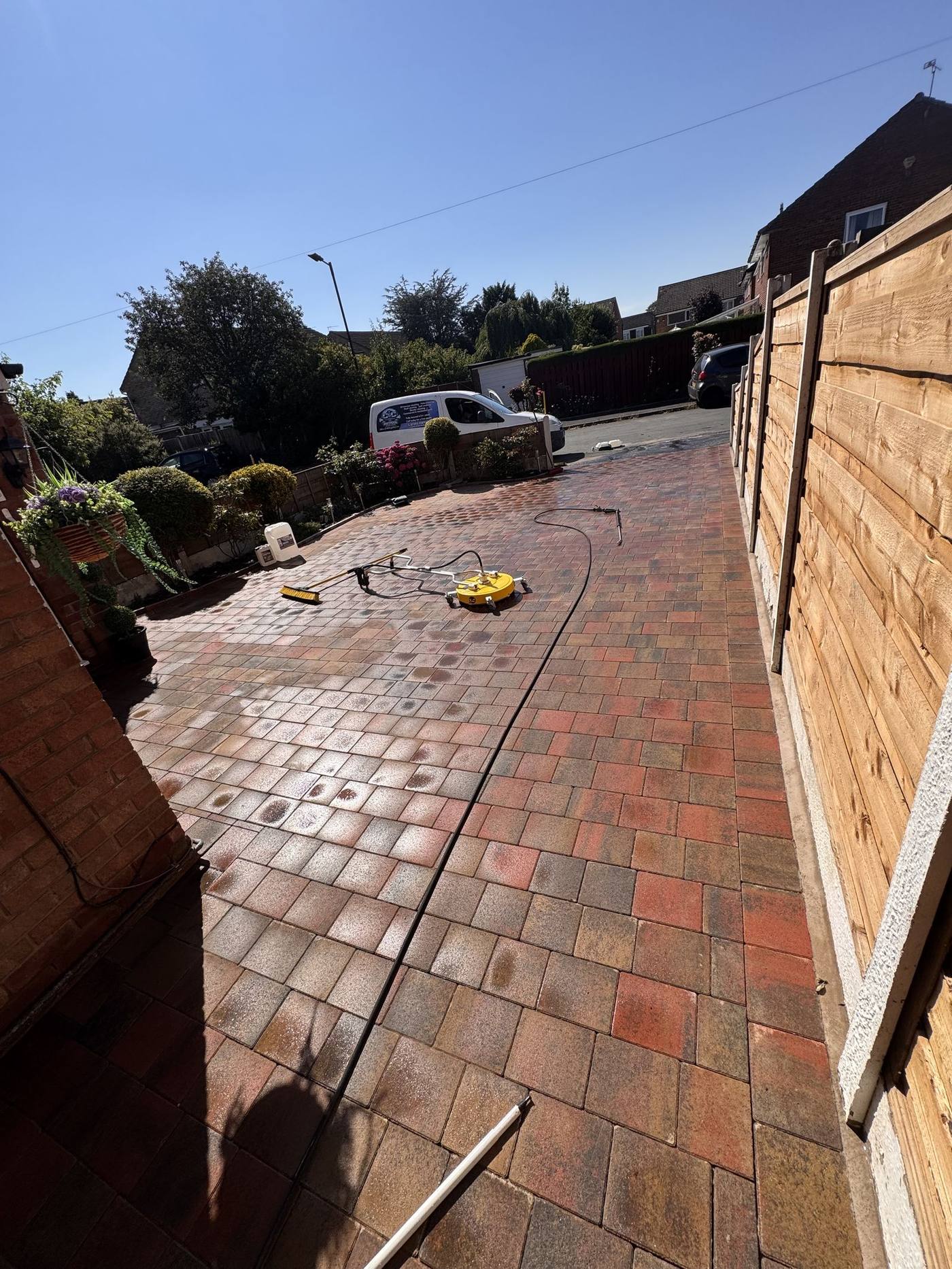
Block paving driveway after a full professional clean — pre-treated, surface cleaned and re-sanded.
Quick answer: A professional driveway cleaning service uses commercial-grade equipment, correct pressure settings, pre-treatments and re-sanding where needed. A man with a jet wash typically uses underpowered domestic kit, no pre-treatment, and can damage surfaces, wash out jointing sand, or leave streaks — costing you more in the long run.
What We Actually Mean by "Professional Driveway Cleaning"
A professional job starts before the water goes on. Surfaces with algae, black spot, lichen or moss need a pre-treatment — usually a biocide or surfactant applied and left to dwell for a set period. That dwell time matters. Sodium hypochlorite-based treatments, for example, need time to break down organic growth at the root level. Spraying and immediately washing achieves very little beyond shifting the surface layer. The growth comes back faster because the underlying biology hasn't been dealt with.
The cleaning itself on a driveway — whether that's tarmac, concrete or block paving — is done with a commercial rotary surface cleaner rather than a lance. A surface cleaner is a spinning head that keeps the water at a consistent distance from the surface, covering evenly without streaking. Pressure is matched to the surface type: block paving, imprinted concrete and natural stone all have different tolerances, and a professional operator knows them. On block paving specifically, the job isn't finished until kiln-dried jointing sand has been replaced in the joints — more on that shortly.
The end result of a professional clean isn't just a cleaner surface. It's a surface that's been treated, cleaned correctly for its type, and restored so it holds up for two to three years rather than a few months. That's what distinguishes the professional driveway cleaning side of this comparison from the alternative.
What the "Man With a Jet Wash" Usually Looks Like
To be fair, not every person offering cheap driveway cleaning is a cowboy. Some are genuine sole traders who've invested in decent domestic equipment and do their best with it. The problem isn't always intent — it's capability. A consumer pressure washer typically runs under 150 bar and delivers a modest flow rate, often under 10 litres per minute. That's enough to clean a car or garden furniture. It's not really enough to clean a large driveway properly and consistently.
The typical setup is a lance with a fan or turbo tip, no surface cleaner head, and no chemical pre-treatment. The operator works across the surface in sweeping passes, and on a good day with a lightly soiled driveway it can look acceptable. On a driveway with heavy moss, embedded algae or black spot — which describes most driveways in Greater Manchester given the damp climate — the results are patchy. Stubborn staining lightens rather than lifts, and without pre-treatment the organic material is suppressed rather than killed.
None of that is catastrophic on its own, but when you factor in what's been missed — re-sanding, pre-treatment, correct pressure management — the job rarely lasts. You're paying to defer the problem by a season, not solve it.
The Kit Gap: Why Equipment Matters More Than You'd Think
The rotary surface cleaner is probably the single biggest dividing line in professional driveway cleaning vs man with jet wash comparisons. A lance delivers pressure in a narrow fan pattern that varies in intensity across the arc. Move it too fast and you get inconsistent cleaning. Move it too slow or hold it too close and you get tiger-striping — those pale, uneven streaks that are particularly obvious on block paving and imprinted concrete. A rotary surface cleaner spins two jets at a controlled distance from the surface, distributing pressure evenly and covering the area methodically. The difference in finish is visible.
Flow rate matters as much as bar pressure. A commercial unit running 15–20 litres per minute shifts significantly more debris and residue than a domestic machine at the same pressure rating. On a large driveway — 60 or 80 square metres — that difference translates into whether the surface is genuinely clean or just lighter. Pre-treatment dwell time compounds this: a biocide applied 15–20 minutes before cleaning softens organic growth so it lifts cleanly rather than smearing across the surface. Skipping pre-treatment because you don't stock the chemicals, or because it adds time to the job, is the main reason results from underpowered setups don't hold.
What Can Go Wrong With the Wrong Approach
The most common and costly mistake on block paving is blasting jointing sand out of the joints. Every pressure wash disturbs the sand to some degree, but a lance held too close at too high a pressure can hollow out the joints significantly — and the consequences compound quickly. Open joints let weeds establish fast, water infiltrates beneath the paving, and without the sand binding the blocks together the surface begins to shift and rock underfoot. What started as a cleaning problem becomes a structural one. You can read more about this specifically in the guide on what pressure washing does to block paving sand.
Imprinted concrete driveways are another area where the wrong approach causes problems that are expensive to fix. High-pressure lancing can lift the sealant that gives imprinted concrete its colour and protection. Once that sealant is compromised, the surface fades and becomes porous. Resealing is possible, but it adds cost that wouldn't have arisen with the correct technique. Similarly, soft natural stone — sandstone in particular — and some render finishes can be abraded by pressure that would be entirely appropriate for concrete. On render, the wrong approach can open hairline cracks or strip the surface texture. There's more on that in the guide on why render goes green and how to fix it.
If your driveway or patio is made from sandstone, limestone or a soft natural stone, high-pressure washing should not be used on it at all. These surfaces respond to lower-pressure cleaning combined with appropriate chemical treatment — the same approach used in softwashing. An operator who reaches for a lance on sandstone without asking about the material first is one to avoid.
The Re-Sanding Question Nobody Talks About
Pressure washing block paving always removes some kiln-dried sand from the joints — always. It's not a question of how carefully it's done; it's a physical consequence of applying water and pressure to a surface where sand sits in open joints. A professional job accounts for this and includes re-sanding as part of the process, not as an optional extra to upsell at the end. The guide on how often block paving should be re-sanded covers this in more detail, but the short version is that open joints are the primary reason driveways look tired within months of being cleaned.
Kiln-dried sand is specifically formulated for this purpose — it's dry enough to flow down into the joints and compact without clumping, and it's what stabilises the block structure. Builders' sand or sharp sand are not substitutes; they retain moisture and promote weed growth rather than preventing it. A man with a jet wash rarely carries kiln-dried sand and rarely re-sands. That's not a criticism of their cleaning — it's just that re-sanding is a separate trade step that most domestic operators haven't incorporated into their process.
On pricing, block paving cleaning runs from around £3.50/m² for a basic clean, £4.25/m² with chemical pre-treatment, and £5.50/m² for a full restoration including re-sanding. Re-sanding alone, if you've had the cleaning done elsewhere, is around £2.00/m². Those figures give you a sense of what a proper job involves and why a cheap quote that omits re-sanding isn't really the same service.
When You Should Definitely Call a Professional
Block paving with visibly open joints, heavy weed growth or significant algae staining needs a professional approach — cleaning, pre-treatment and re-sanding combined. Imprinted concrete that's lost its sheen or colour needs resealing after cleaning, which requires the right products and surface preparation. Driveways with established moss or black spot algae — the dark, stubborn patches that don't respond to surface water — need a biocide with proper dwell time, not a pressure lance. These aren't jobs where a cheaper option gets you 80% of the result; they're jobs where the wrong approach makes the situation worse.
Surfaces where high pressure must not be used include sandstone, limestone, some render finishes, conservatory roofing, and older clay roof tiles. If you have any of these on your property and someone quotes to pressure wash them without mentioning softwashing or adjusting their approach, that's a red flag. Commercial properties — retail parks, housing association estates, rental portfolios — carry additional considerations around liability, scheduling around footfall and documenting condition before and after. That requires a different level of insurance and experience than domestic work.
Practical Advice: How to Tell a Good Operator From a Bad One Before You Book
Ask whether they use a rotary surface cleaner or a lance for driveways. A surface cleaner should be the default on any flat hard surface. Ask whether they pre-treat before washing, and what product they use — if the answer is vague, that's informative. Ask whether re-sanding is included for block paving, or whether it's priced separately. Ask to see photos from recent local jobs — not generic stock images, but actual before-and-after shots from driveways in the area. And ask for proof of public liability insurance. A minimum of £1 million is standard for any reputable operator working on residential or commercial property.
C&C Precision Precision Washing covers Oldham, Rochdale, Bury, Bolton, Manchester, Tameside, Stockport and surrounding areas. Quotes are straightforward — send photos of your driveway over WhatsApp and you'll get a price back quickly, without a site visit needed for most jobs. You can also look at customer reviews to see the kind of results achieved on local properties before making a decision. The point isn't to push a booking — it's that this is how a competent operator should work, and it gives you a useful benchmark when comparing anyone else quoting for the same job.
Frequently asked questions
Is hiring a man with a jet wash cheaper than a professional driveway cleaning company?
Sometimes the upfront price is lower, but it's rarely cheaper overall. Without a rotary surface cleaner, pre-treatment and re-sanding, results rarely last a full season — meaning you pay again sooner. A professional job done properly typically holds for two to three years.
Can a jet wash damage my block paving driveway?
Yes, particularly if a lance tip is used at close range or too high a pressure. It blasts kiln-dried sand from the joints, which destabilises the paving and lets weeds take hold fast. A rotary surface cleaner distributes pressure evenly and causes far less disturbance to the surface.
How do I know if someone is actually a professional pressure washer or just a bloke with a machine?
Ask whether they carry public liability insurance, use a surface cleaner head rather than a lance, pre-treat surfaces before washing, and re-sand block paving afterwards. If they can't answer those questions confidently, that tells you what you need to know. Ask to see photos of previous local jobs too.
Do I need my driveway re-sanded after every clean?
Not necessarily every single time, but any pressure washing will disturb the jointing sand to some degree. If your block paving joints are visibly open, or if weeds were heavy before the clean, re-sanding with kiln-dried sand is strongly recommended. Skipping it is the main reason driveways look tired again within months.
Want to know what a proper driveway clean actually costs?
Send a couple of photos on WhatsApp and we'll get you a straight price — usually within the hour.