If you've been searching for driveway cleaning in Tameside, you've probably noticed that driveways here seem to go green and grimy faster than they should. That's not just bad luck — it's the climate, the surface types common across the borough, and the way organic growth behaves on different materials. Getting a clean that actually lasts means understanding what's causing the problem in the first place, and matching the method to the surface rather than just hitting everything with high pressure and hoping for the best.
This guide covers the main driveway surfaces you'll find across Ashton-under-Lyne, Hyde, Droylsden, Stalybridge, Dukinfield and the surrounding areas — what each one needs, what can go wrong, and how to get a result that holds up through a Greater Manchester winter rather than looking the same by spring.
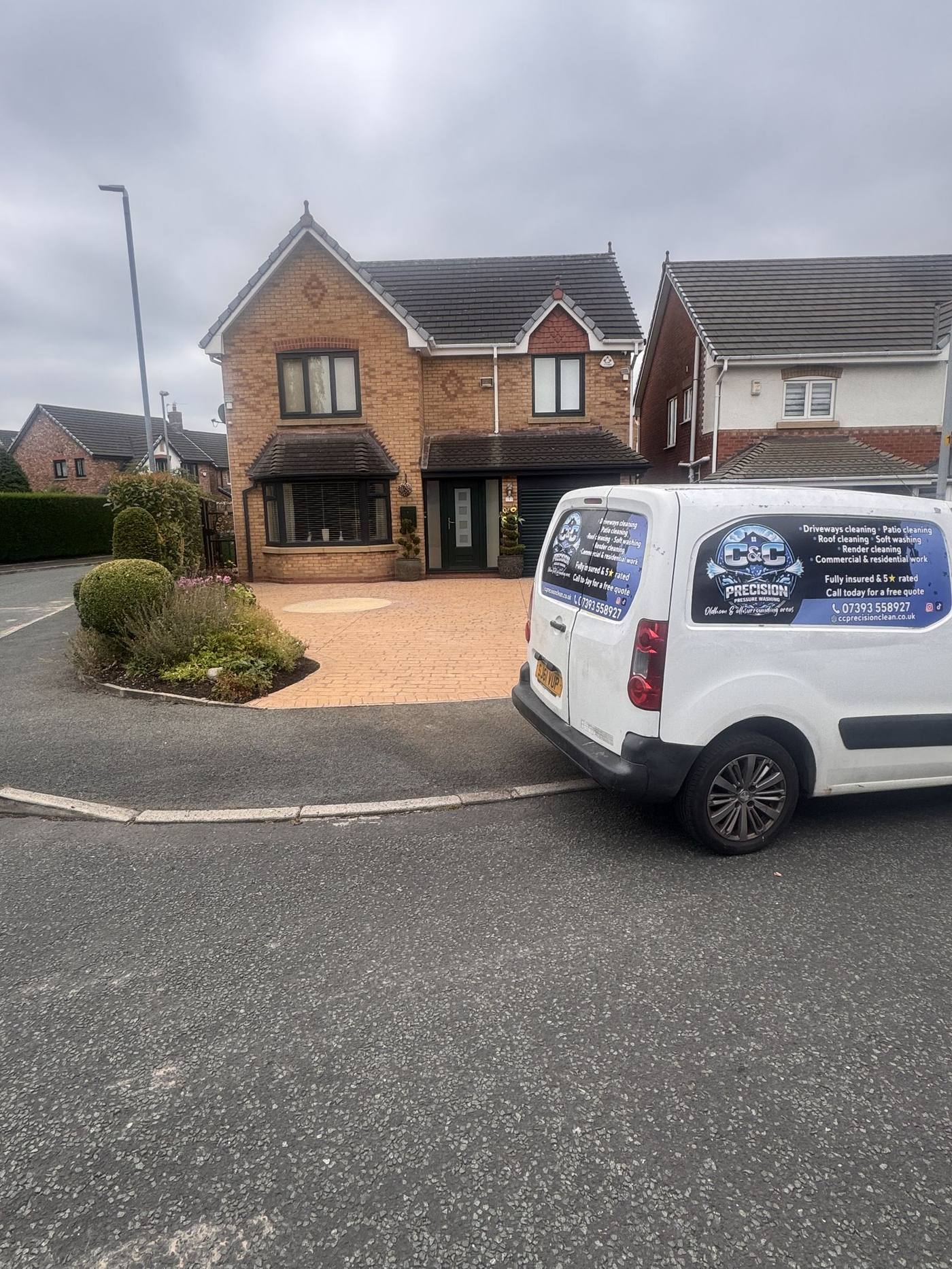
On site in Greater Manchester — surface type dictates the method before we even get the machine out.
Quick answer: Driveway cleaning in Tameside typically means dealing with block paving, imprinted concrete, tarmac, or stone — each needing a different approach. Block paving needs re-sanding after cleaning, imprinted concrete often needs resealing, and tarmac requires low-pressure treatment. One method does not suit all surfaces.
Why Tameside Driveways Get Dirty Fast
Tameside sits on the wetter, hillier eastern edge of Greater Manchester. Rainfall here is consistently higher than in central Manchester, and many streets — particularly the older terraced rows across Hyde and Ashton — are tightly packed with limited sunlight reaching ground level. Surfaces stay damp for longer after rain, and that moisture is exactly what algae, moss, and lichen need to establish themselves. A driveway that dries out quickly in a sunnier spot might stay clean for two or three years; the same surface in a shaded Tameside street can be noticeably green again within twelve months.
Black spot is particularly persistent here. It's a fungal growth rather than simple algae, and it roots below the surface layer of paving rather than sitting on top of it. That's why a straightforward pressure wash often fails to clear it properly — you remove what's visible on the surface but leave the fungal body beneath, and it returns within a season. A biocide treatment applied with dwell time before any pressure washing does the actual work; the machine then clears what the chemical has already broken down.
Understanding this helps you avoid the cycle of cleaning, watching it return, and cleaning again. The right treatment — chemical pre-soak, appropriate pressure, and where needed a post-clean biocide application — breaks that cycle properly rather than just pushing it back a few months.
Block Paving: The Most Common Surface for Driveway Cleaning in Tameside
Block paving is by far the most common driveway surface across Tameside. Drive through Droylsden, Dukinfield, or the residential streets around Ashton town centre and you'll see it almost continuously — clay or concrete blocks in a herringbone or stretcher bond, some recently laid, others fifteen or twenty years old and showing their age. The surface itself cleans up well with pressure washing, but the jointing sand is the part most people overlook.
Pressure washing flushes the sand out of the gaps between blocks. That's unavoidable — you're working with water at meaningful pressure, and the sand goes. If it isn't replaced, the joints sit open. Weeds take hold within weeks, particularly in spring and autumn when conditions suit germination, and once weeds are established the roots begin to disturb the blocks themselves. This is why block paving cleaning and block paving re-sanding are properly one job rather than two separate options. You can read more about this in our guide on what pressure washing does to block paving sand.
Pricing for block paving reflects this. A clean alone runs from around £3.50 per square metre; add a chemical treatment for organic growth and that moves to roughly £4.25/m². A full restoration including re-sanding with kiln-dried sand is typically around £5.50/m², and re-sanding alone — if the surface has already been cleaned — comes in at approximately £2.00/m². A standard residential driveway of 40 to 50 square metres therefore sits somewhere between £140 and £275 depending on what it needs. If you're unsure how often block paving should be re-sanded, that guide covers it in detail.
Imprinted Concrete: Easy to Damage if You Get It Wrong
Pattern imprinted concrete — sometimes called printed concrete or stamped concrete — became popular on driveways across Tameside in the 2000s and 2010s, and you'll find it on plenty of extended or replaced driveways across the borough. It's a poured concrete base with a pattern pressed into it and a coloured sealant coat applied on top. That sealant is what gives it the gloss and the colour, and it's also what degrades over time — typically showing as fading, cracking, or a whitish haze across the surface.
The problem with using high pressure on imprinted concrete is that whatever sealant remains gets stripped or further damaged, and the surface is left dull, porous, and in worse condition than before. Pre-treatment is important here — a controlled chemical soak loosens organic growth without the need for aggressive pressure — and the clean needs to be followed by resealing if the existing coat is compromised. Cleaning and resealing together is almost always the job that makes a visible difference for imprinted concrete that's more than five years old.
This isn't a job for a hired jet wash and a determined Saturday afternoon. The pressure needs to be controlled, the lance distance consistent, and the sealant chosen to match the existing surface type and condition. Get it wrong and you're looking at a reseal on damaged concrete rather than a reseal on a properly prepared surface — a distinction that shows in the finished result.
Tarmac and Concrete: Lower Pressure, Different Chemistry
Plain tarmac driveways are less forgiving than block paving. Hold a lance too close and you pit the surface or strip the fine aggregate; work too fast and you leave uneven stripes. The right approach is a rotary surface cleaner rather than an open lance — it delivers consistent pressure across the full cleaning path rather than concentrating it in a single point. For oil staining, which is common on older tarmac drives, a degreaser pre-treatment applied and left to dwell does more than extra pressure ever will.
Brushed concrete is similarly vulnerable to etching if the pressure isn't managed properly. It also tends to hold on to lichen and black spot more stubbornly than smooth surfaces, so dwell time with a biocide or fungicidal treatment becomes more important, not less. The surface cleaner attachment again gives a better result than an open lance — even coverage, no streaking, and no risk of cutting into the surface texture.
Both surfaces benefit from a post-clean biocide application to slow regrowth. In Tameside's climate, without it, you're likely to see green returning within twelve to eighteen months rather than the two to three years a treatment-and-clean combination can provide.
Natural Stone and Paving Slabs: Watch the Joints and the Surface
Indian sandstone and limestone patio and driveway surfaces are common on properties across Tameside, particularly on newer or renovated drives and patios. They look good when clean but they accumulate organic growth quickly in damp conditions — and sandstone in particular is susceptible to the black spot fungus that's so persistent across Greater Manchester. Because black spot lives below the surface layer, pressure alone doesn't clear it. You need a pre-treatment with dwell time — typically a sodium hypochlorite solution at appropriate dilution, or a dedicated biocide — before the surface cleaner goes over the top.
The joints on mortar-pointed natural stone also need attention. Old or crumbling mortar allows water ingress that accelerates frost damage, and any cleaning process that uses high pressure on compromised pointing will make that worse. It's worth checking the condition of the pointing before work starts so you're not pressure washing over joints that are already failing. Our stone cleaning service covers the right approach for different natural stone surfaces.
For any surface with black spot or heavy lichen growth, the chemical pre-treatment is doing most of the work — not the pressure washer. Apply, allow proper dwell time (typically fifteen to thirty minutes depending on conditions), then clean. Skipping straight to the machine means you're cleaning the surface but leaving the organism.
When to Call in a Professional Rather Than Hire a Jet Wash
Hiring a pressure washer from a local plant depot looks straightforward enough, and for a garden path or garden furniture it's probably fine. For a driveway, the situation is more complicated. Consumer and trade hire machines can generate enough pressure to flush block paving joints clean within minutes, to strip imprinted concrete sealant, or to surface-damage tarmac — and none of those outcomes are immediately obvious until you're looking at the aftermath. The guide on professional driveway cleaning versus hiring a jet wash covers this in more detail if you want to work through the comparison properly.
Beyond the pressure question, there's the chemistry. Biocide treatments, sodium hypochlorite dilutions for softwashing, degreasers for oil staining — these aren't things you can pick up at a garden centre in the form that professionals use. Getting the dilution wrong either means the treatment doesn't work or it risks damaging surrounding plants and surfaces. Re-sanding with kiln-dried sand also requires the right sand grade and proper compaction — too coarse and it doesn't lock; too fine and it blows out before it's set.
C&C Precision covers driveway cleaning in Tameside and across Greater Manchester with the right equipment, appropriate chemicals, and public liability insurance to £1,000,000. If your driveway has significant moss, weed growth, or needs re-sanding or resealing, the cost of a professional clean is almost always less than correcting a DIY job that's gone sideways.
What to Actually Do Before Booking Driveway Cleaning in Tameside
Before you contact anyone, take a proper look at the surface. Work out what material it is — block paving, imprinted concrete, tarmac, natural stone, or brushed concrete. Check whether the joints in any block paving are already loose or showing weed growth, and whether there's obvious black spot rather than just general greening. These details affect what the job involves and therefore what it costs.
Then take a photograph in reasonable light — not in deep shade and not with the sun directly behind you. A clear photo of the full driveway plus a close-up of any particular problem areas gives a tradesperson enough to quote accurately without needing a site visit. The same applies to our driveway cleaning service — send photos on WhatsApp and you'll typically have a price back the same day. No obligation, no sales call, just a number you can decide on.
If you're in a neighbouring area, our guide on driveway cleaning in Bolton covers similar surface types and conditions across that part of Greater Manchester.
Frequently asked questions
How much does driveway cleaning cost in Tameside?
Price depends on surface type, size, and condition — a standard block paving driveway typically runs from around £80 to £180 including re-sanding. Imprinted concrete that needs resealing costs more. Send a photo on WhatsApp and we'll give you a straight quote without the need for a visit.
Do block paving driveways need re-sanding after pressure washing?
Yes, almost always. Pressure washing flushes the jointing sand out of the gaps between blocks. If it isn't replaced with kiln-dried sand, weeds take hold quickly and the blocks start to shift. Re-sanding is part of a proper block paving clean, not an optional extra.
Can you clean imprinted concrete without resealing it?
You can clean it, but if the existing sealant is cracked, faded, or peeling, cleaning alone leaves the surface looking flat and unprotected. For most imprinted concrete driveways in Tameside that are more than five years old, a clean and reseal together is the job that actually makes a difference.
How long does a driveway clean take in Tameside?
A typical residential driveway takes between two and four hours depending on size and condition. If re-sanding or resealing is included it may run to a full day. We'll tell you the realistic timeframe when we quote so you know what to expect.
Not sure what surface you've got or what it'll cost?
Send a photo of your driveway on WhatsApp and we'll give you a straight price — usually within the hour.