If you've been searching for patio cleaning Bolton, you've probably already noticed that patios around here don't stay clean for long. The combination of damp air, overcast skies, and relatively little direct sunlight means algae and moss establish themselves quickly — and once they're in, they spread fast. A patio that looked reasonable at the start of spring can be slippery and visibly green by midsummer without much encouragement from the weather.
This guide covers what actually happens during a professional patio clean, what different surfaces need, and how to make an honest judgement about whether a DIY hire is worth attempting or whether calling someone in makes more sense. There are no hard sells here — just practical information so you can make the right call for your patio.
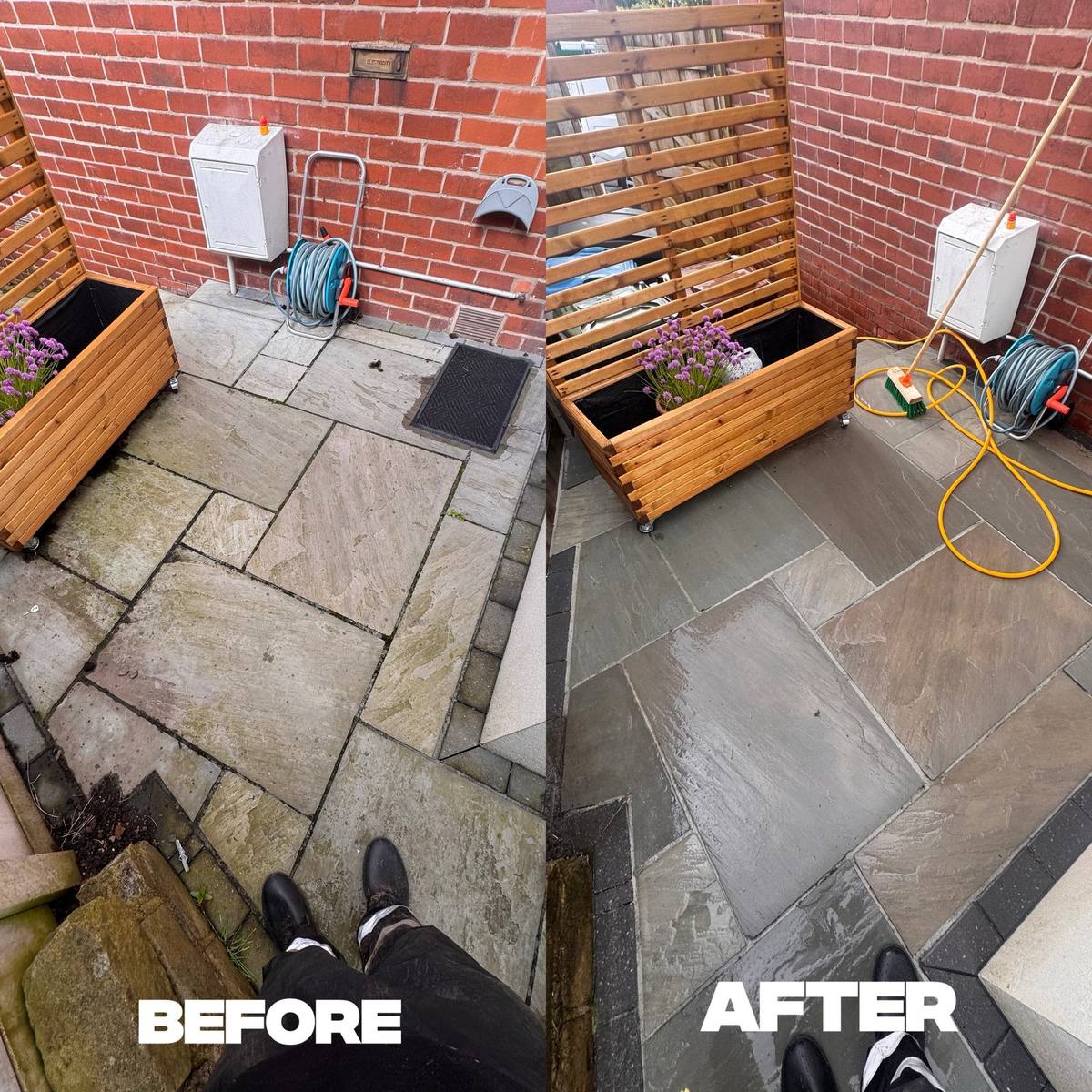
Indian sandstone patio — black spots and algae removed in a single visit.
Quick answer: Patio cleaning in Bolton typically costs £80–£250 depending on size, material, and condition. A professional will pressure wash or softwash the surface, remove moss, algae, and staining, and leave it looking close to new. Most jobs are completed in a single visit, with same-week availability common.
What Bolton Patios Are Actually Made Of
Bolton's housing stock is varied, and so are the patios. Older terraced properties often have concrete slabs — either original plain grey or the buff and red textured slabs that were popular in the eighties and nineties. Newer builds frequently have block paving, either brick-style or larger format, and a significant number of homeowners over the past decade have laid Indian sandstone or, more recently, porcelain. There's also the occasional tarmac yard, particularly around older back-to-back properties closer to the town centre.
The material matters because each one responds differently to cleaning. Porcelain is dense and largely non-porous, so it tolerates higher pressure and cleans relatively easily. Indian sandstone is softer and more absorbent, which means it stains more readily but also means aggressive pressure can cause surface erosion if the operator doesn't adjust accordingly. Block paving has joints filled with sand that can be displaced or washed away if the wrong equipment or technique is used — something worth understanding before anyone starts work. If you're unsure which surface you have, a good guide on Indian sandstone vs porcelain maintenance differences is worth a read before you make any decisions.
Knowing what you've got isn't just useful for the cleaner — it also helps you set realistic expectations. Some surfaces, particularly weathered sandstone with deep iron staining, will lighten significantly but may not return to showroom condition. That's worth knowing upfront rather than being surprised afterwards.
Why Bolton Patios Get Dirty So Quickly
Greater Manchester sits in a wet, mild climate band that suits biological growth almost perfectly. Annual rainfall is high, humidity rarely drops for long, and the grey overcast conditions mean UV exposure — which naturally suppresses algae — is limited for much of the year. Bolton, positioned on the edge of the West Pennine Moors, gets its fair share of that damp, and patios are on the receiving end of it constantly.
North-facing patios are worst affected, particularly those shaded by extensions, boundary walls, or dense planting. These surfaces stay damp for extended periods after rain, which gives algae, moss, and lichen the conditions they need to establish. Black spot — a common complaint across Greater Manchester — is a type of algae that penetrates into the surface rather than sitting on top of it, which is why scrubbing alone rarely gets rid of it. Even patios with reasonable sun exposure typically need proper attention every one to two years to stay in good condition.
Fallen leaves compound the problem in autumn. As they break down they create an acidic organic layer that accelerates staining, especially on lighter stone. Block paving joints fill with organic matter over time, which feeds weed growth through the cracks. None of this is unusual — it's simply what happens to outdoor surfaces in this part of the country — but it does mean that leaving things too long makes the eventual job harder and more expensive than it needs to be.
Pressure Washing vs Softwashing: Which Does Your Patio Need?
For most concrete slabs and block paving, pressure washing with a rotary surface cleaner is the right tool. A surface cleaner keeps the spray evenly distributed across a circular head, which prevents the uneven striping you get from a fan jet held at inconsistent distances. It also contains the overspray, which matters on patios close to walls, fences, or rendered surfaces. Done correctly, this method lifts embedded algae, grime, and surface staining effectively without damaging well-set joints.
Softer or more porous materials — certain Indian sandstones, textured renders, and older concrete that's become powdery — often do better with softwashing. This uses a diluted sodium hypochlorite solution applied at low pressure, left to dwell on the surface for a set period, and then rinsed off. The chemical does the work rather than the water pressure: it kills algae, moss, and lichen at the root rather than simply blasting the visible growth off. The result tends to last longer because the organism is actually dead rather than just removed from the surface temporarily.
In practice, many jobs involve both methods — a chemical pre-treatment to break down biological growth, followed by pressure washing to remove it cleanly. The pre-treatment dwell time varies depending on the concentration used and the extent of the growth, but allowing the chemistry to work before applying pressure almost always gives a better finish than skipping straight to the machine. It also reduces the pressure needed, which is gentler on the surface and the joints.
How Much Does Patio Cleaning Cost in Bolton?
Most domestic patio cleans in Bolton fall somewhere between £80 and £250, depending on size, surface type, and condition. A compact back-yard patio in reasonable shape sits at the lower end. A large Indian sandstone garden patio with heavy moss coverage, black spot throughout, and joints that haven't been touched in several years sits at the upper end. Pricing for patio cleaning generally runs from around £3.50 per square metre for a straightforward clean, up to £4.25 per square metre where a chemical treatment is included as part of the job.
If your patio is block paving and the joints have been damaged or washed out — either by weather or a previous clean done with too much pressure — re-sanding is a separate consideration. Re-sanding alone runs at around £2.00 per square metre, or a full restoration combining cleaning and re-sanding comes in at around £5.50 per square metre. Kiln-dried sand is the right material for re-sanding; it's dry, flows well into the joints, and compacts down properly. Regular building sand retains moisture and can encourage weed seed germination, which defeats the purpose. You can read more about why joints matter in this guide on what pressure washing does to block paving sand.
The honest answer is that no one can give you an accurate price without seeing the patio. Photos change everything — what looks like a straightforward job from a description can be something else entirely once you see the actual surface and its condition. The fastest route to a proper quote is to send a couple of photos rather than trying to describe it in words.
What the Cleaning Process Looks Like on the Day
A typical job starts before the pressure washer is even switched on. A pre-treatment solution is applied across the surface and left to dwell — the contact time matters, and rushing this stage produces a noticeably worse result. For heavily grown surfaces, this might be fifteen to twenty minutes; for lighter growth, less. The pre-treatment loosens biological matter, softens compacted debris in the joints, and begins killing organic growth at the root rather than just on the surface.
Once the dwell time is done, the rotary surface cleaner works methodically across the patio in overlapping passes. The dirty water lifts away and runs off the surface, taking the treated growth with it. Edges, steps, and tight corners close to walls are done with a hand lance at controlled distance — the surface cleaner can't reach these areas cleanly, so they need careful attention to avoid leaving a visible border of untouched grime. It's one of those details that separates a tidy finish from a job that looks half-done.
After washing, the surface is left to dry naturally. On a dry day in Bolton this usually takes a few hours; in cooler or more overcast conditions it can take longer. If the job includes a post-treatment biocide, this is applied once the surface is clean and damp rather than soaking wet — it needs to sit on the surface long enough to absorb rather than being diluted away. Joint sand, if it's being replaced, goes in once the surface is fully dry so the kiln-dried sand flows freely into the gaps rather than clumping.
When to Call a Professional Instead of Doing It Yourself
Hiring a pressure washer from a local tool shop is genuinely fine for some tasks — rinsing down a garden wall, cleaning out a bin area, washing off light surface dirt from a relatively new patio. Where it tends to go wrong is on anything with significant biological growth, older surfaces, or block paving with existing joints. The machines available for hire are often high-pressure units designed for general purpose use, not calibrated for domestic stone cleaning, and without a rotary surface cleaner attachment they apply pressure unevenly. Tiger-stripe marks across a patio — parallel lines where the fan jet has been swept back and forth — are a common result and are difficult to remove once they're in.
Joint damage is the other significant risk. Block paving joints rely on compacted sand to keep the blocks stable and to resist weed ingress. A fan jet directed into joints at too-close range strips that sand out in minutes, and the blocks then shift under foot traffic and water movement. Replacing the jointing sand is straightforward, but it adds cost that wouldn't have been there if the clean had been done correctly in the first place. There's a fuller explanation of this in the guide on driveway cleaning in Bolton, which covers many of the same surface types. C&C Precision Pressure Washing handles patio cleaning Bolton jobs regularly and the quotes are free — sometimes it's just worth checking the cost before committing to a hire.
Some stains genuinely won't come out fully regardless of who does the cleaning. Deep rust staining on sandstone, oil that has been left to cure into a surface for months, and certain paint marks will lighten rather than disappear. A professional can tell you honestly what's achievable before starting; a hire machine won't warn you either way.
Practical Advice: Getting the Most Out of a Patio Clean
Clear the patio before anyone arrives — furniture, plant pots, ornaments, anything sitting on the surface. It sounds obvious but it genuinely does save time, and on a job priced by the hour that matters. If you have raised beds or planters directly adjacent to the patio, mention them when you book — some chemical treatments need to be kept away from soil and plants, and a professional will work around this, but it helps to know in advance.
After any patio clean, check whether your joints need re-sanding before the first heavy rain. Washing removes organic matter that was filling gaps — gaps that weeds and wind-blown seeds will exploit quickly. Getting kiln-dried sand back into the joints within a week or two of cleaning is the single most effective thing you can do to slow regrowth and keep the patio looking right for longer.
A biocide treatment applied after cleaning is worth considering on any north-facing patio or anywhere that stays damp. It won't prevent regrowth indefinitely — nothing will in this climate — but it does slow the process down significantly, typically extending the time before the surface needs attention again. Combined with good jointing, it can make the difference between needing a clean every year and getting two years out of it comfortably. For anyone with block paving specifically, it's also worth reading about how often block paving should be re-sanded to keep the whole surface in good shape long-term.
Finally, think about what's near the patio as well as the patio itself. If you have a rendered wall, a moss-covered roof line, or a driveway that feeds dirty runoff onto the patio surface, cleaning the patio in isolation only solves part of the problem. Addressing the source — whether that's render cleaning or roof moss removal — means the patio stays cleaner for longer rather than being recontaminated by the surfaces surrounding it.
Frequently asked questions
How long does patio cleaning take in Bolton?
Most domestic patios take between one and three hours depending on size and condition. A heavily neglected patio with thick moss and compacted organic matter will take longer than a surface that just needs a seasonal freshen-up. We'll give you a realistic time estimate when you send your photos through.
Will pressure washing damage my Indian sandstone patio?
It can if done incorrectly — high pressure directed straight at sandstone can erode the surface and open up the stone. The right approach is a lower-pressure rotary surface cleaner combined with a pre-treatment soak, which does the heavy lifting before the water even touches the stone. We've cleaned plenty of Indian sandstone patios across Bolton and Greater Manchester without causing damage.
Do you cover the whole of Bolton?
Yes — we cover Bolton town centre and all surrounding areas including Horwich, Farnworth, Westhoughton, Kearsley, and Atherton. We're based in Oldham and operate across the whole of Greater Manchester, so nothing in Bolton is out of range. Send us a message and we'll confirm availability for your postcode.
How do I get a quote for patio cleaning in Bolton?
The fastest way is to send two or three photos of your patio over WhatsApp — one wide shot showing the full area and a closer shot of the worst affected section. We'll come back to you with a price the same day in most cases, no back-and-forth needed.
Want a fast price for your Bolton patio?
Send a couple of photos of your patio over WhatsApp and we'll come back to you with a firm quote — usually the same day.