If you've noticed your driveway or patio turning an increasingly dark shade over time, you're not imagining it getting worse. The question of why does paving go black comes up regularly, and the honest answer is that it's almost never dirt in the traditional sense — it's biology. What you're looking at is living growth that has colonised the surface, and understanding what it is makes it a lot easier to deal with properly.
This guide covers what causes the blackening, why it's particularly persistent in Greater Manchester and the surrounding areas, and what actually works to remove it and slow it down. There's no single magic solution, but there is a logical approach — and knowing the steps helps you avoid the mistakes that bring it straight back.
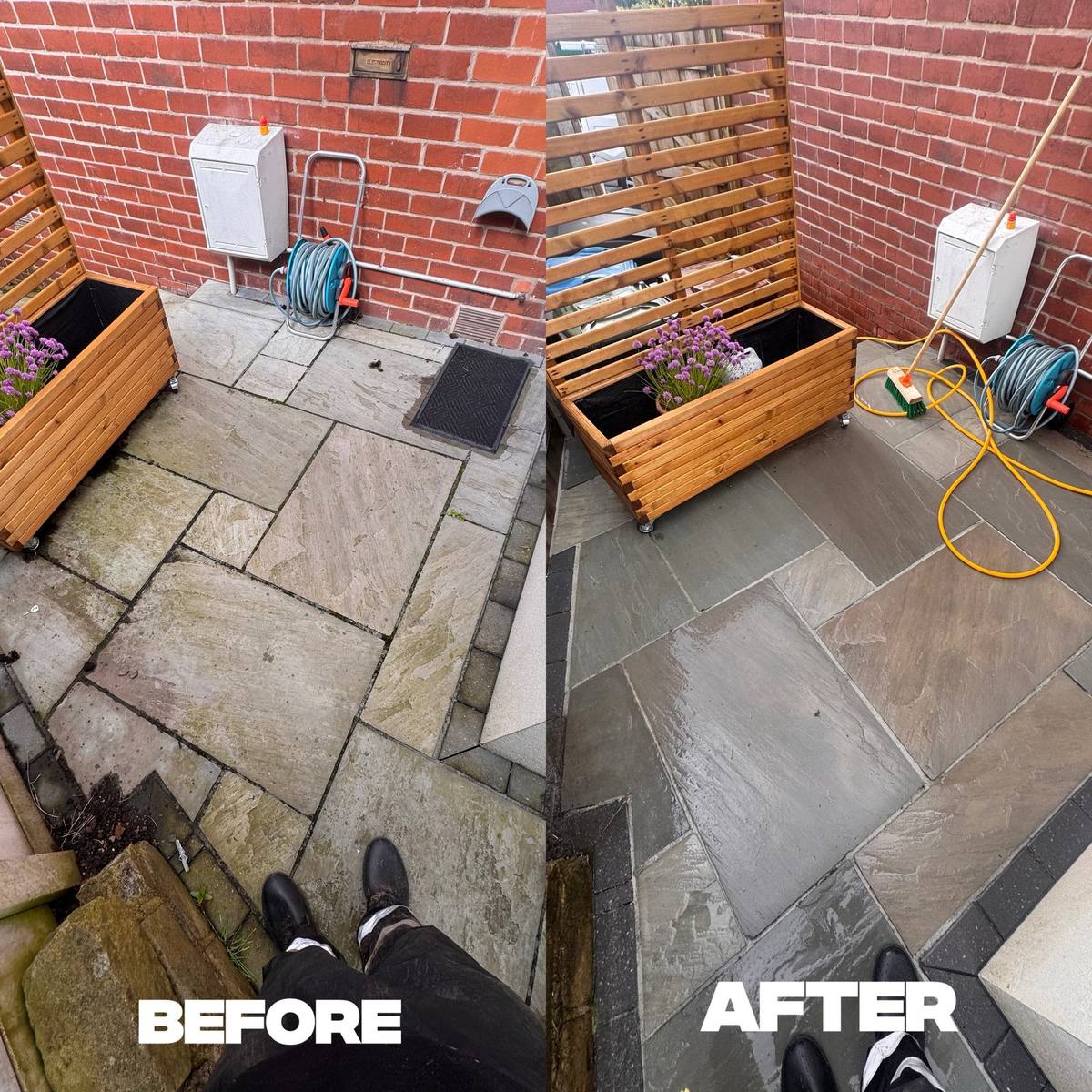
Indian sandstone patio in Greater Manchester — black biological staining removed with professional cleaning. The difference is immediate.
Quick answer: Paving goes black in the UK due to biological growth — mainly algae, lichen, and cyanobacteria — feeding on moisture and organic debris in our damp climate. Black spots and streaks on patios and driveways are living organisms embedded in the surface, not just dirt, which is why a garden hose alone won't shift them.
What Actually Causes Paving to Turn Black?
The black discolouration you see on UK paving is almost always biological. Algae, lichen, cyanobacteria, and sometimes black mould are the main culprits, and they thrive in exactly the conditions we have here — wet, overcast, and relatively mild. These aren't organisms that sit loosely on the surface waiting to be hosed off. They embed themselves into the texture of the paving, sending root-like structures called rhizines into porous materials, which is why scrubbing or a quick blast of water rarely shifts them for long.
Algae tends to establish first, often appearing as a green or greyish film before darkening over time. Lichen is slower to colonise but much harder to shift once established — it's a composite organism made of fungi and algae living together, and it has a remarkable grip on stone and concrete. Cyanobacteria, sometimes called blue-green algae, produces a particularly stubborn black crust and is common on paving in damp, low-light areas. None of these are a sign that anything is wrong with your paving — they're simply what happens to outdoor surfaces in Britain.
Why Is It Worse in the North of England?
Greater Manchester consistently ranks among the wettest urban areas in England, and towns like Oldham, Rochdale, Bury, and Bolton — sitting closer to the Pennines — see even higher rainfall than Manchester city centre. That sustained moisture is exactly what biological growth needs to colonise and spread. A surface that dries out quickly after rain gives algae and lichen very little to work with. A surface that stays damp for days at a time is ideal habitat.
Aspect matters too. North-facing driveways and patios, or those shaded by fences, walls, or overhanging trees, rarely get the sun exposure needed to dry out between rain events. These surfaces can stay damp almost continuously through autumn and winter, and by spring the blackening is noticeably worse. If your neighbours on the sunny side of the street have cleaner paving than you, that's usually why — it's not that they're cleaning more often, it's that their surface dries faster. This is worth keeping in mind when you're deciding how often to have patio cleaning or driveway cleaning carried out.
Does the Type of Paving Make a Difference?
It makes a significant difference. The more porous the surface, the faster biological growth takes hold and the deeper it penetrates. Indian sandstone is one of the most common paving materials in Greater Manchester gardens, and it's also one of the most prone to blackening — it absorbs moisture readily and has a texture that gives algae and lichen plenty of surface area to grip. Natural limestone and sandstone flags behave similarly. Textured concrete block paving has the same problem, with the added complication that the joints between blocks collect organic debris and stay damp longer.
Porcelain paving is at the other end of the scale. It's dense, low-porosity, and much less hospitable to biological growth. It will still discolour eventually, particularly if the joints are open or if debris accumulates and holds moisture, but it takes considerably longer. Smooth concrete driveways sit somewhere in the middle — less porous than natural stone, but still susceptible once the surface weathers and opens up over time. Understanding your surface type matters before you decide on a cleaning approach, since the pressure, nozzle, and chemical treatment all need to be matched to what's underneath.
Why Does Black Paving Keep Coming Back After You Clean It?
This is the most common frustration people have, and the reason is straightforward. Most DIY cleaning — including a pressure washer used without any pre-treatment — removes the visible surface layer of growth but leaves the root structures and spores behind in the paving. The surface looks cleaner immediately after, but within a season the growth returns, often faster than before, because the organisms are already established. High-pressure washing can also open up the surface texture of softer stones, which creates more grip for the next round of colonisation.
The question of why does paving go black again so quickly after cleaning almost always comes back to this: the biological cause hasn't been addressed, only the visible symptom. There's a useful parallel with weeds — pulling off the top growth without getting the root means it comes back. The same logic applies here. It's also worth noting that aggressive pressure washing on block paving can displace the jointing sand between blocks, which opens up the joints and makes the whole surface more vulnerable. If you've had block paving cleaning done before and noticed the joints emptying out, that's a separate problem worth addressing — you can read more about it in our guide on what pressure washing does to block paving sand.
Pre-treatment is the step most people skip, and it's the most important one. A sodium hypochlorite solution applied and left to dwell for the right amount of time kills the biological growth before any pressure washing begins. Without it, you're cleaning the surface — not solving the problem.
How Is Black Paving Properly Removed?
A proper clean starts before the pressure washer comes out. A biocidal pre-treatment — typically a sodium hypochlorite-based solution for softwashing, or a dedicated paving cleaner for harder surfaces — is applied to the paving and left to dwell. Dwell time varies depending on the product, the surface, and how heavily the growth is embedded, but cutting it short undermines the whole process. The chemical needs time to penetrate the biological matter and break it down at the root, not just bleach the surface.
Once the dwell time is complete, pressure washing removes the dead growth along with surface contamination. The technique matters here — the correct nozzle angle, working pressure, and standoff distance all vary depending on whether you're cleaning Indian sandstone, concrete block paving, or a resin-bonded surface. Getting this wrong can etch stone, damage surface texture, or blast the jointing sand out from between blocks. After the clean, a post-treatment biocide is often applied to slow regrowth. For block paving, the job usually isn't finished until the joints are re-filled with kiln-dried sand — more on this in our guide on how often block paving should be re-sanded.
When Should You Call In a Professional?
If the growth is extensive, embedded deeply, or has returned multiple times despite DIY attempts, it's worth getting a professional involved. The risk with incorrect technique isn't just a substandard result — it's damage to the surface that can be expensive or impossible to reverse. Etched sandstone, blown-out joints, and delaminated resin bond are all real outcomes of pressure washing done wrong. A professional will assess the surface type and condition before deciding on the approach, not after.
A professional will also look at the full picture — whether the paving needs re-sanding after the clean, whether sealing makes sense for the surface, and whether there are underlying issues like poor drainage or overhanging vegetation contributing to the problem. C&C Precision Precision Washing covers Oldham and the wider Greater Manchester area, and quotes are straightforward — send a few photos over WhatsApp and you'll usually have a price the same day. If you want to understand more about what separates a professional clean from a DIY attempt, the guide on professional driveway cleaning versus the bloke with a jet wash covers it in more detail.
How to Stop Paving Going Black Again After Cleaning
Sealing is the most effective single measure you can take after a thorough clean. An appropriate paving sealer — and the right type depends on the surface; impregnating sealers for natural stone, surface sealers for block paving — reduces porosity and makes it much harder for biological spores to get a foothold. It won't prevent growth entirely, and it does need reapplying every few years, but it extends the interval between cleans noticeably. On a surface like Indian sandstone in a shaded garden, the difference can be significant.
Keeping joints filled with kiln-dried sand is equally important for block paving. Open joints allow water to pool at depth, which creates a persistent damp zone that algae thrives in. This is one reason why the question of why does paving go black comes up so often on driveways where the jointing has been lost — the paving is essentially holding moisture it shouldn't be. Trimming back any overhanging vegetation reduces both shade and the organic debris that decomposes in the joints and feeds biological growth. And rather than waiting until the surface is heavily colonised, a lighter maintenance clean every two to three years keeps the problem manageable and costs considerably less than a full restoration.
Frequently asked questions
Is black paving dangerous to walk on?
Yes, it can be. Algae and lichen growth makes paving surfaces significantly more slippery when wet, which is a serious slip hazard — especially on driveways with a slope or steps. In the UK's wet climate this is a year-round risk, not just a cosmetic issue. Getting it cleaned isn't just about kerb appeal.
Can I remove black paving stains with a pressure washer alone?
You can remove the visible surface layer, but pressure washing alone won't kill the biological organism underneath. Without a biocidal pre-treatment, the algae or lichen root structure remains in the paving and regrowth comes back quickly — often within a few months. Pre-treatment is the part most people skip, and it's the most important step.
Why has my new patio already started going black?
New paving — especially natural stone like Indian sandstone — can start showing black spots within a year if it's in a shaded or damp area. The surface is clean to start with but biological spores settle quickly in the UK climate. Applying a sealer to new paving shortly after laying can significantly slow this process.
How much does it cost to have black paving professionally cleaned in Greater Manchester?
The cost depends on the size of the area, the type of surface, and how heavily the growth is embedded. The fastest way to get an accurate price is to send a few photos on WhatsApp — we can usually come back to you the same day with a figure. There's no obligation and no sales pitch.
Got black paving you can't shift yourself?
Send a photo on WhatsApp and we'll give you a fast, honest price — no sales calls, no faff.