Driveway sealer failure is more common than most people realise, and the frustrating part is that it's almost always avoidable. A sealer that peels within a season, clouds over white, or bubbles up across half the drive hasn't necessarily failed because of a bad product — it's usually failed because of what happened, or didn't happen, before the sealer went down. Understanding why sealers fail is more useful than simply buying a more expensive tin next time.
This guide covers the real causes: contaminated surfaces, trapped moisture, incompatible products, and the habit of sealing over a coat that was already coming away. Whether you've had a sealer fail on block paving, imprinted concrete, or natural stone, the reasons tend to follow the same pattern. Some of this applies to DIY jobs and some to trade work done without enough care — either way, the fix starts with knowing what went wrong.
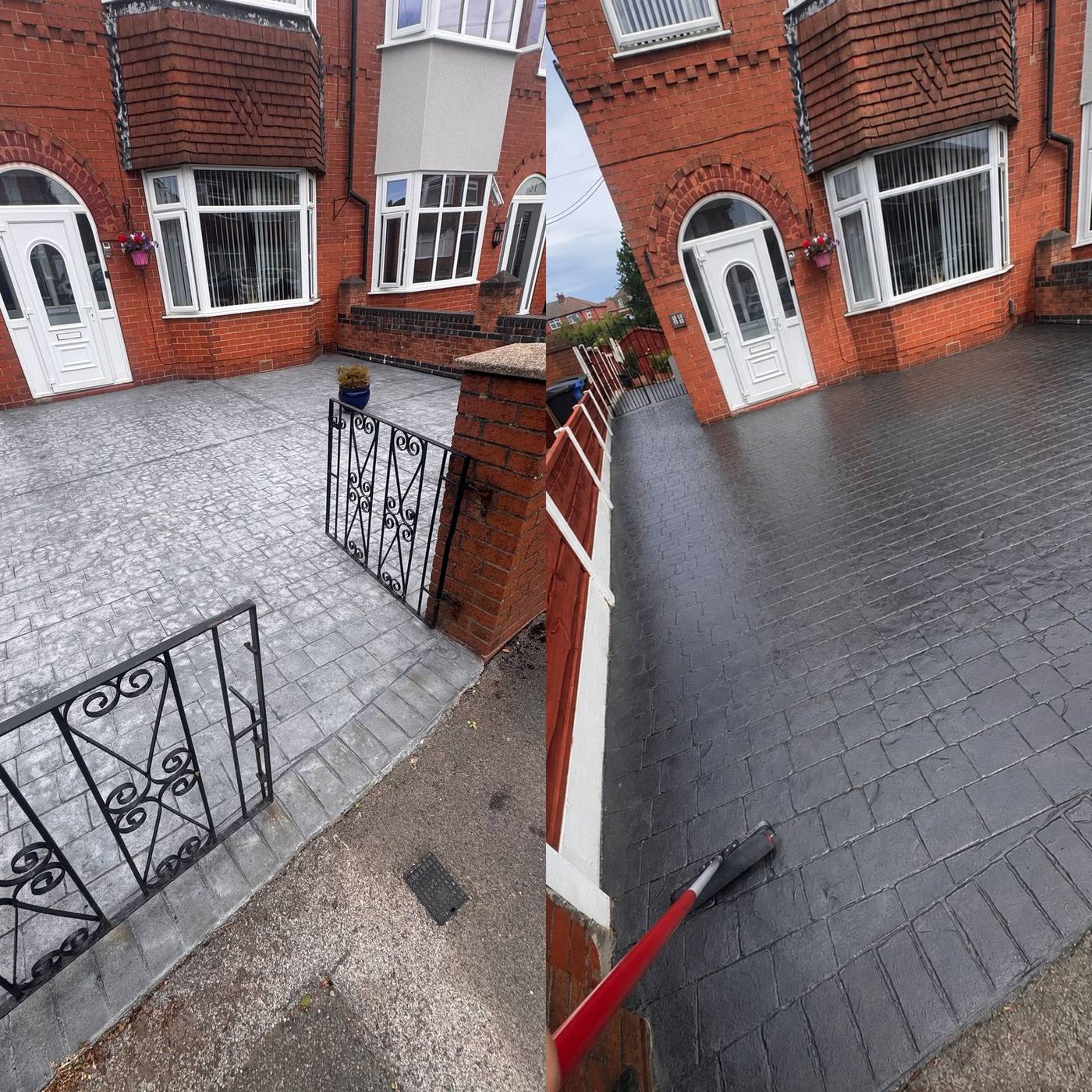
A pattern imprinted concrete driveway where the original sealer had failed completely. Deep-cleaned and resealed by C&C Precision in Oldham.
Quick answer: Driveway sealer fails when applied to a surface that isn't fully clean, dry, or properly prepared. Trapped moisture, algae, dirt, and incompatible sealer types all cause peeling, flaking, and clouding. The surface must be deep-cleaned and allowed to dry completely — usually 24–48 hours minimum — before any sealer is applied.
What Driveway Sealer Failure Actually Looks Like
The most obvious signs are peeling and flaking — sections of sealer lifting away from the surface in sheets or chips, particularly along edges, joints, or anywhere water tends to pool. On imprinted concrete, this often exposes the raw surface in patches while the surrounding area still looks sealed, giving a blotchy, inconsistent appearance that's difficult to correct without stripping the whole drive.
White clouding, sometimes called blushing, is another common symptom. The sealer doesn't lift away physically but turns milky or hazy, usually in patches or across large areas. It dulls the colour of the surface underneath and tends to get worse over time rather than better. Bubbling is related — small domes forming under the sealer film, which eventually burst and leave rough, open craters in the coating.
Patchy adhesion is subtler. Parts of the drive look fine while others appear dull, uneven, or have already started to degrade. People sometimes assume this is a surface problem — that the paving itself is deteriorating — but in most cases the substrate underneath is sound and the sealer is the issue. Before assuming you need new block paving or a complete resurface, it's worth diagnosing whether what you're looking at is driveway sealer failure rather than structural damage.
The Number One Cause: Sealing Over a Dirty Surface
A sealer needs a clean, inert surface to bond to. Organic matter — algae, lichen spores, moss residue, leaf tannins — sits on and in the pores of block paving and concrete even when the drive looks reasonably clean to the eye. That biological layer acts as a barrier. The sealer bonds to it rather than to the substrate, and because organic matter breaks down over time, the sealer comes with it.
Oil contamination causes the same problem. Even light surface oiling from parked vehicles, if not properly degreased before sealing, creates an invisible release layer. Sealers are designed to penetrate or coat a porous mineral surface — they're not designed to adhere to grease. A professional driveway clean before sealing isn't about aesthetics; it's about giving the product the substrate it needs to work.
The North West's climate makes biological contamination worse than in drier parts of the country. Greater Manchester sees persistent damp through autumn and winter, which means algae and green growth establish quickly — sometimes within a single season on a freshly laid drive. A surface that was sealed two or three years ago may look only lightly soiled but have a well-established biological film in the pores. Sealing over that guarantees early driveway sealer failure, usually within months rather than years.
Moisture Trapped Underneath
Sealing too soon after rain or pressure washing is one of the most consistent DIY mistakes made with driveways. Water absorbed into block paving or concrete needs time to work its way out, and in a cool, humid climate like Greater Manchester's that process takes longer than most people expect. What looks dry on the surface can be holding significant moisture in the body of the paving beneath.
When a sealer goes down over a damp substrate, the moisture has nowhere to escape. As temperatures change and the surface dries from below, vapour pressure builds up under the film and causes blushing, bubbling, or in severe cases full delamination. Imprinted concrete is particularly vulnerable because it's less porous than block paving and retains moisture in its surface texture for longer. The result is exactly the white clouding described earlier — and it's very difficult to reverse once it's set.
After pressure washing, wait a minimum of 48–72 hours before sealing — and that's in decent weather. If overnight temperatures are dropping below 10°C or rain is forecast within the next few days, add more time. Running your hand firmly across the surface and checking the underside of a loose block, if you can lift one, gives a better sense of true moisture content than looking at the surface alone.
Applying New Sealer Over Old Failing Sealer
The logic seems reasonable — if the existing sealer is failing, put a fresh coat on top and start again. In practice, this almost never works and usually makes the situation worse. A sealer can only bond as strongly as the layer it's applied to. If the existing coat is peeling, cracked, or losing adhesion, the new product bonds to a failing substrate rather than to the paving itself.
The result is that both layers fail together, and usually faster than the first coat did on its own. The combined film is thicker but weaker, and stripping it at that stage is more involved and more expensive than stripping the original failing coat would have been. Old sealer that is visibly delaminating or is incompatible with the new product — solvent-based over water-based, for instance — has to be removed chemically or mechanically before any fresh application. There's no shortcut around that step.
Chemical strippers for driveway sealers exist and work reasonably well on accessible surfaces, but they require dwell time, neutralisation, and a thorough clean-down before any new product goes on. Rushing that process leads straight back to driveway sealer failure, just with a fresh coat over the top of the problem.
Wrong Sealer for the Surface Type
Solvent-based sealers and water-based sealers behave very differently, and they're not interchangeable across surface types. Solvent-based products tend to give a glossier, more durable finish on imprinted concrete and are often used on block paving where a wet look is wanted. Water-based sealers are generally more breathable and better suited to natural stone or surfaces where vapour transmission matters. Using a solvent-based product on a stone that needs to breathe can cause moisture to build up beneath the surface, leading to spalling or staining over time.
Mixing types is a specific problem worth flagging. Applying a water-based sealer over a cured solvent-based coat — or the reverse — often results in immediate adhesion failure. The products don't chemically bond, and the new coat sits on top as a separate film that lifts at the first opportunity. If you don't know what's already on the drive, that's a reason to test a small area first or strip before resealing, not a reason to proceed and hope for the best.
Natural stone and sandstone in particular can be permanently damaged by the wrong sealer. Some products change the colour of the stone irreversibly, or seal in staining that could otherwise have been treated. For anyone considering stone cleaning before resealing, the choice of sealer should be confirmed for that specific stone type before anything is applied.
When to Call a Professional Before You Seal
If the surface has visible algae, green or black biological growth, cracked or missing jointing sand, heavy oil staining, or an existing sealer that's already failing, DIY sealing will make things worse rather than better. That's not a sales pitch — it's just the reality of what happens when a sealer meets an unprepared surface. The preparation stage is the work; the sealing itself is the easy part.
A professional process for block paving typically involves a thorough clean to remove biological contamination and loose material, a biocide treatment where growth is established, re-sanding with kiln-dried sand to restore the jointing between blocks, a drying period, and then sealer application under appropriate conditions. Block paving cleaning and block paving re-sanding done properly before sealing is what makes the sealer last three to five years rather than one. Pricing for that kind of work varies by condition and scale — cleaning from around £3.50/m², a clean with chemical treatment around £4.25/m², full restoration with re-sanding around £5.50/m², or re-sanding only at around £2.00/m².
C&C Precision Pressure Washing covers Greater Manchester and can assess a failing surface honestly — including telling you if sealing isn't the right next step. Sometimes a surface needs more work than a reseal, and sometimes the existing sealer just needs time and isn't failing at all. Getting that assessment before spending money on product or labour is worth the conversation. Customers can send photos over WhatsApp for a fast, no-obligation quote.
How to Avoid Driveway Sealer Failure: A Practical Checklist
Most driveway sealer failure is preventable if the preparation is taken seriously. The checklist below is honest rather than exhaustive — it covers the steps that actually make the difference between a sealer that lasts and one that peels off within a season.
- Deep-clean the surface properly. Not a rinse — a thorough clean that removes biological growth, surface grime, and any oil contamination. A surface that looks clean may still have algae in the pores.
- Apply biocide if there's been any biological growth. Pressure washing removes visible moss and algae but leaves spores behind. A biocide treatment kills residual growth and gives the sealer a clean substrate.
- Check the jointing sand on block paving. If sand is loose, low, or missing between blocks, the blocks will move and the sealer film will crack along the joints. Re-sand before sealing, not after.
- Strip failing old sealer. Do not apply new product over a coat that's already peeling or delaminating. Strip it first.
- Allow 48–72 hours minimum drying time after cleaning in Greater Manchester's climate — longer in cold or wet weather. Check the surface is genuinely dry, not just dry-looking on top.
- Confirm the right sealer for your surface type. Imprinted concrete, block paving, sandstone, and granite all have different requirements. Check compatibility before buying.
- Check the weather forecast. Most sealers need several hours without rain and temperatures above around 10°C to cure correctly. Applying ahead of rain is a reliable way to cause blushing.
- Don't seal over active biological growth. If there's green or black growth still present, the surface isn't ready. Seal over it and the growth continues underneath, breaking the bond from below.
Following this sequence won't guarantee a perfect result in every case — very old or heavily contaminated surfaces sometimes have ingrained staining that lightens rather than disappears entirely, and some existing sealer damage can't be fully reversed without stripping and starting again. But it will give any sealer the best possible chance of lasting, and avoid the frustration of driveway sealer failure repeating itself within a year.
Frequently asked questions
How long should I wait after pressure washing before sealing a driveway?
In Greater Manchester's climate, 48–72 hours is a realistic minimum after pressure washing — longer if rain is forecast or the weather is cold. Sealing too soon is one of the leading causes of driveway sealer failure. If the surface feels even slightly damp to the touch, wait.
Can I seal my driveway myself or do I need a professional?
You can seal a driveway yourself if it's already in good condition — no algae, no failing old sealer, correct product for the surface, and a dry spell in the forecast. The problem is that most driveways needing a reseal are also dirty, biologically contaminated, or have loose jointing sand. Skipping proper preparation is the fastest route to driveway sealer failure.
Why has my block paving sealer gone white and cloudy?
White clouding — sometimes called blushing — is almost always caused by moisture trapped under the sealer at the time of application, or by rain falling on a sealer that hadn't fully cured. It can sometimes be corrected by a professional solvent re-application, but in many cases the sealer has to be stripped and the whole process started again correctly.
How often should a driveway be resealed?
A properly applied sealer on imprinted concrete typically lasts 3–5 years before it needs refreshing; block paving sealers vary more depending on traffic and product quality. There's no fixed schedule — watch for fading colour, water no longer beading on the surface, or increasing weed and moss growth, which all signal the sealer is no longer doing its job.
Thinking about sealing your driveway?
Send us a photo on WhatsApp and we'll tell you honestly whether it's ready to seal and what it'll cost to get it there.