If you've been searching for gutter clearing Bury services this autumn, you're not alone. Every year from late September onwards, the same pattern plays out across the town: leaves from mature sycamores, oaks and horse chestnuts pile into gutters that may not have been touched since the previous autumn — or longer. Add in the reliable dampness of a Greater Manchester autumn and you have a recipe for blocked downpipes, overflowing gutters and the kind of slow water damage that doesn't announce itself until it's already cost you money.
This guide covers what actually happens when gutters block, how often you should be clearing them, when it makes sense to do it yourself and when it doesn't, and how to plan around the autumn booking crunch. No upselling, no panic — just a straightforward look at what's worth knowing before the leaves start to fall.
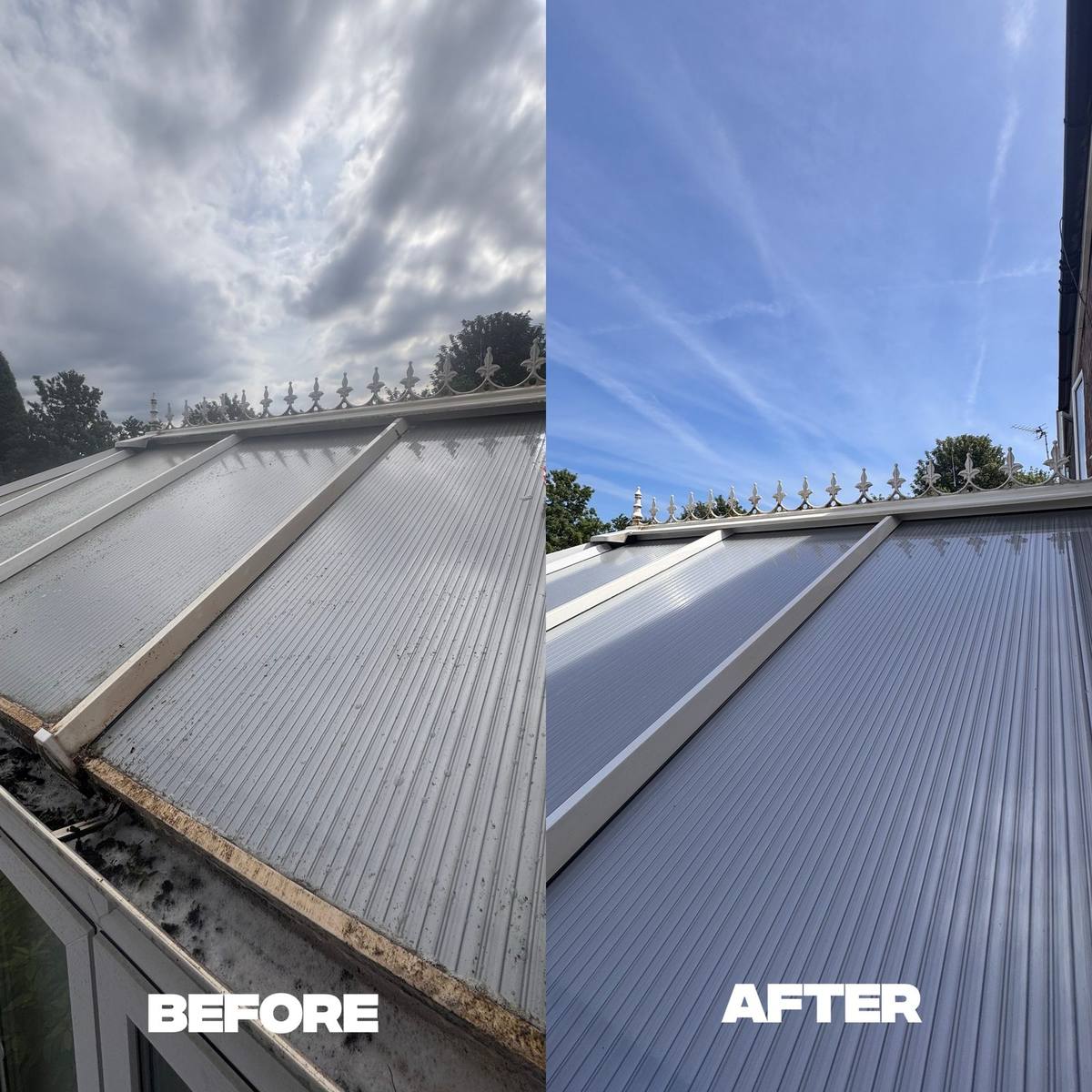
Moss and debris cleared from a conservatory roofline — the kind of build-up that blocks gutters every autumn.
Quick answer: Gutter clearing in Bury gets booked up fast in autumn because every property on the street has the same problem at once — leaves, moss and debris block downpipes just as heavy rain arrives. Most reputable local contractors are fully booked within weeks of October, so getting your name down early is the only reliable way to avoid water damage over winter.
Why Bury Gets Hit Hard Every Autumn
Bury has a particular combination of features that makes autumn gutter problems worse than in many other parts of Greater Manchester. The older housing stock — terraces and semis built in the early to mid twentieth century — typically has shallower gutters with fewer outlets than modern builds, meaning they fill faster and overflow sooner. Many of these properties also sit close to the road or to neighbouring trees, with little space for leaf debris to go anywhere other than straight into the gutterline.
The tree cover in areas like Ramsbottom, Tottington and the residential streets closer to Bury town centre is substantial. Leaf fall runs from mid-September through to late November, which means gutters take a sustained battering over nearly three months. A single large sycamore overhanging a roofline can deposit enough debris to fully block a section of gutter in a fortnight of wet and windy weather.
The Greater Manchester climate does the rest. Bury sits in the foothills of the Pennines, and it gets its share of horizontal rain. When gutters are partially blocked, that rain doesn't drain cleanly — it backs up, sits, and starts to cause problems that go well beyond a bit of overflow. The damp conditions also accelerate moss growth in the gutters themselves, which makes blockages worse and adds weight that can stress old brackets and joints.
What Actually Happens When Gutters Block
The most visible sign of a blocked gutter is water cascading over the front lip during heavy rain — you can often see it from an upstairs window or from the pavement across the street. But the more serious consequences are the ones you can't see straight away. When water consistently overflows and runs down the external wall rather than into the downpipe, it starts to saturate the brickwork. In older properties with solid walls and lime mortar, that moisture can work its way inward over weeks or months and appear as damp patches on interior plasterwork or, in bad cases, on ceilings below the roofline.
Standing water in blocked gutters also encourages moss and algae to take hold, both in the gutter itself and on the roof tiles above it. Once moss is established on a roof it starts to lift tiles slightly, which creates more gaps for water ingress. If you're already dealing with roof moss, the roof cleaning and moss removal process needs to be paired with proper gutter clearance, otherwise the cleared debris simply washes straight back in.
At ground level, blocked downpipes mean water dumps at the base of the wall rather than being carried away. Over time this saturates the soil against the foundations, which in older properties can cause movement or allow moisture to wick up through the ground floor. It's worth going outside during or just after heavy rain and looking at where the water is actually going — that five minutes of observation can tell you a lot about the state of your gutters and downpipes.
Why the Autumn Booking Rush Is Real
Gutter clearing in Bury follows a predictable seasonal pattern that's worth understanding if you want to plan sensibly. From mid-October onwards, every property on every street faces roughly the same problem at the same time. The number of reputable local contractors available is fixed, working days at height become shorter and riskier as November brings early darkness and wet roofs, and demand spikes sharply. This isn't a reason to panic — it's just useful to know.
Contractors who do this work properly won't operate in icy or persistently wet conditions at roof level. That rules out a significant proportion of late November and December days in Greater Manchester. Callers who leave it until November often find that available slots don't materialise until January or February, by which point a wet autumn and early winter have already done their work on any vulnerable pointing, fascias or internal walls.
Booking in September or early October doesn't cost anything extra — it just means you're ahead of the queue. If you're combining gutter clearing with other exterior work such as driveway cleaning or patio cleaning, doing it in one visit before the worst of the weather sets in is usually the most practical approach.
What a Gutter Clear Actually Involves
A proper gutter clear isn't just scooping out leaves and leaving. The process starts with removing the bulk of the debris — either by hand or with a wet-dry vacuum, depending on what's in there and how compacted it's become. Compacted wet leaf matter and moss can be surprisingly dense, and a gutter that looks lightly blocked from the ground can have a solid plug of debris when you actually get up to it.
Once the gutters are cleared, every downpipe needs to be flushed through with water to confirm it's flowing freely all the way to the drain. It's not uncommon to clear a gutter only to find the downpipe itself is blocked lower down — sometimes at an underground connection point that can't be seen from the roof. If the water isn't coming out at the bottom, there's still a problem.
A decent job also includes a quick inspection of the guttering itself while you're up there: checking for cracks, sagging sections, loose brackets and failing joints. None of that repair work is typically included in a standard clear, but knowing what's there means you can make an informed decision about what needs doing before the next heavy rain. Debris should be bagged and taken away, not blown off the roof or left on the driveway.
How Often Should Gutters Be Cleared in Bury?
For most Bury properties with no significant overhanging trees, once a year — ideally in late autumn after the main leaf fall has finished — is a reasonable minimum. That covers the bulk of the annual debris and means gutters go into winter in reasonable shape. If there are large deciduous trees within falling distance of the roofline, twice yearly is more sensible: once in late spring to clear out any winter accumulation, and again in November.
Properties that haven't been cleared for several years are a different situation. Heavy moss and compacted debris can actually require more than one visit to clear properly, and it's worth being realistic about that upfront. Old guttering that's been under sustained load from debris and standing water may also have joint failures or bracket damage that need sorting out separately — clearing the gutter won't fix a section that's already pulling away from the fascia.
For a more detailed look at maintenance intervals, the guide on how often gutters should be cleared covers the variables in more depth, including the difference between properties with and without nearby tree cover.
After clearing, check your downpipe outlets at ground level during the next heavy rain. Water should flow steadily from the pipe into the drain — if it's trickling, gurgling or not appearing at all, there's still a blockage somewhere in the run that needs clearing before winter sets in properly.
When to Call a Professional Rather Than DIY
DIY gutter clearing can be perfectly reasonable in the right circumstances: a single-storey extension, light debris, a stable ladder and someone confident at height. If that describes your situation, there's no particular reason not to do it yourself. A good wet-dry vac with a curved nozzle makes the job cleaner and faster than working by hand, and you'll spend less time on the ladder.
Working at height is one of the most common causes of serious DIY injury in the UK — that's worth saying plainly, not as a sales tactic but because it's true. Two- and three-storey properties, steep rooflines, and older guttering that may not be structurally sound enough to take any weight are all situations where the risk calculation changes. So is the presence of heavy moss, which can make surfaces slippery and adds unpredictability to the job. If you're not genuinely comfortable on a ladder at the height involved, getting someone else to do it is the right call.
Unknown blockages in underground drainage are another area where professional equipment makes a real difference. A contractor with a pressure jetter and the ability to run water through the system can diagnose and clear a buried blockage in an hour; the same problem investigated by hand from ground level can take considerably longer and may not get resolved at all. C&C Precision serves Bury and the surrounding areas across Greater Manchester — send a few photos over WhatsApp and you'll get an honest assessment of what's involved and what it's likely to cost.
Book Early or Wait Until Spring — Your Practical Options
There are really three sensible options here, and which one makes sense depends on your situation. The first is to book in September or early October, before the main leaf fall and before contractor diaries fill up. This gets the gutters cleared while the weather is still manageable, and means any issues with downpipes or joints get spotted before winter rain turns them into something more expensive. For most properties in Bury, this is the most straightforward choice.
The second option is to accept that November and December availability will be limited, book when you can, and manage the interim by keeping an eye on overflow during heavy rain. If the gutters are only partially blocked and the property is in reasonable condition, a few weeks of managed overflow isn't catastrophic — but you need to be honest with yourself about what you're seeing. Water running consistently down the face of the wall is worth treating as urgent regardless of the time of year.
The third option is to wait until late winter — January or February — when contractor diaries open up again after the Christmas period. This is a perfectly legitimate choice if the gutters aren't in critical condition, and it can sometimes mean easier scheduling. The trade-off is a full winter of reduced drainage capacity, which may or may not matter depending on your property's age, exposure and the condition of your external walls. If you're in any doubt about whether waiting is safe, the render cleaning cost guide for Greater Manchester gives some context on what prolonged water exposure can do to external surfaces — and how much putting it right typically costs.
Frequently asked questions
How much does gutter clearing in Bury typically cost?
For most standard semi-detached or terraced homes in Bury, gutter clearing sits in the range of £60–£120 depending on the length of guttering, number of downpipes and how blocked things are. Larger detached properties or those with significant moss build-up will sit at the higher end. The quickest way to get an accurate figure is to send a few photos of your roofline over WhatsApp.
Can blocked gutters really cause damp inside the house?
Yes, and it's more common than most people realise. When gutters overflow consistently, water runs down the external wall rather than away from the property, which can saturate older brickwork and eventually show up as damp patches on internal walls or ceilings. In some cases it takes months for the moisture to work its way through, so the blockage that caused it may already have been cleared by the time the damp appears.
Do you clear gutters as a standalone job or only as part of a bigger clean?
At C&C Precision we take on gutter clearing as a standalone job — you don't need to book anything else alongside it. That said, if your roof has visible moss or your fascias and soffits are grubby, it often makes sense to deal with everything in one visit while we're set up and on site.
How do I know if my gutters are blocked if I can't see them from the ground?
The most obvious sign is water pouring over the front of the gutter during heavy rain rather than flowing down the downpipe — you'll often see this from an upstairs window or from the street. Staining or green algae streaks down the external wall beneath the gutterline is another reliable indicator. If you're unsure, send us a photo and we'll give you an honest assessment.
Want a fast quote for gutter clearing in Bury?
Send a couple of photos of your gutters and roofline over WhatsApp and we'll get a price back to you quickly — no faff.