Indian sandstone is one of the most popular patio materials in Greater Manchester, and it is easy to see why — the natural colour variation and texture suit everything from Victorian terraces in Oldham to newer builds across Stockport and Bury. But pressure washing indian sandstone is not as straightforward as blasting a concrete driveway, and getting it wrong causes damage that cannot be undone. This guide covers the technique, the chemistry and the honest limitations, so you can make a proper decision about whether to tackle it yourself or hand it over.
The North West's damp climate does Indian sandstone no favours. Persistent moisture, shade from surrounding fences and buildings, and heavy biological growth mean that most patios in this region need attention every two to three years at a minimum. What you see on the surface — the green algae, the black spotting, the general greying — is rarely just dirt. Understanding what you are actually dealing with is the difference between a clean that lasts and one that makes things worse.
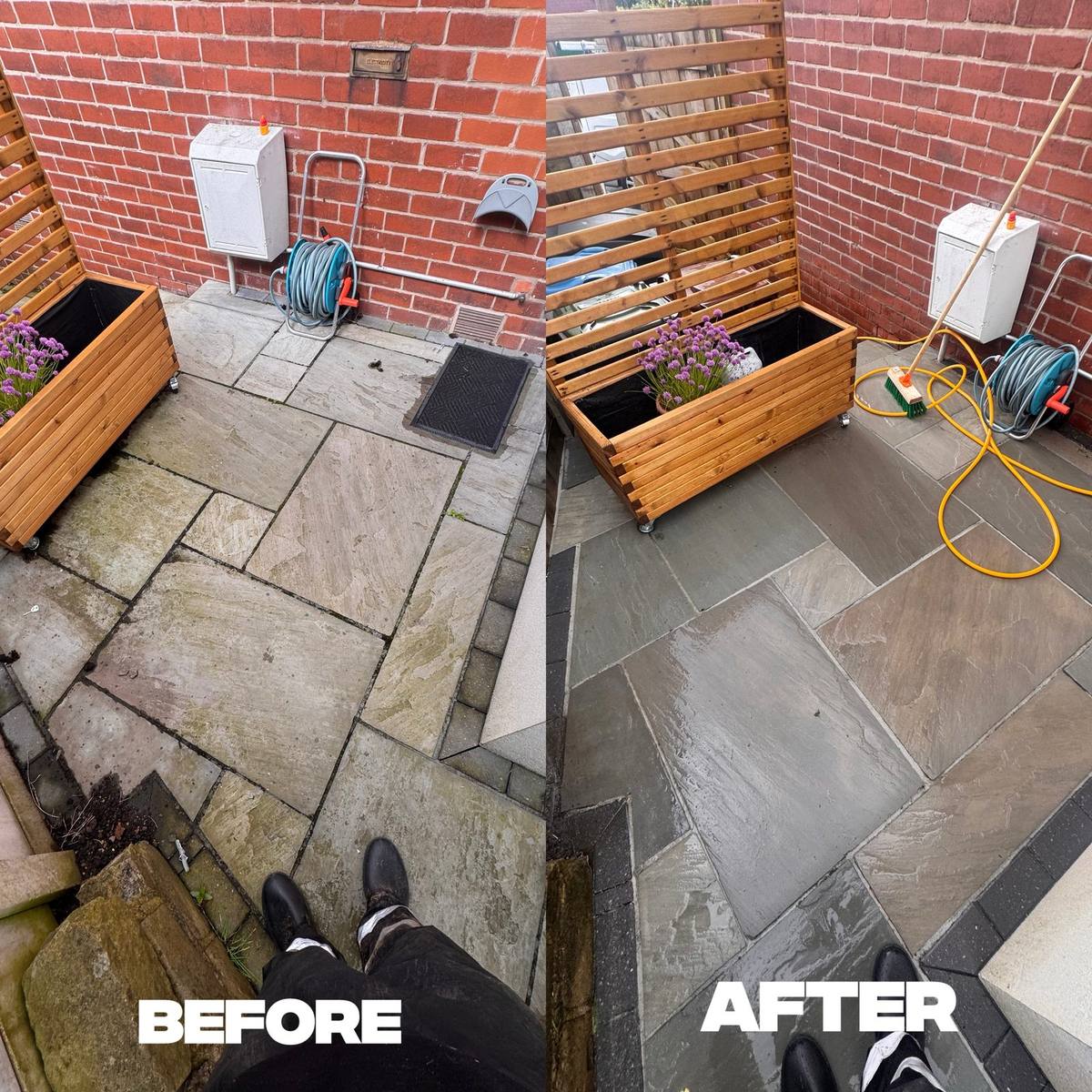
Real result from a C&C Precision job in Greater Manchester — Indian sandstone cleaned without surface damage.
Quick answer: Yes, you can pressure wash Indian sandstone, but it must be done carefully. Use a wide-angle nozzle, keep pressure below 1500 PSI, and maintain a safe distance. High pressure on sandstone strips the surface, widens joints, and accelerates weathering. A rotary surface cleaner on low settings gives the best result.
The Short Answer: Yes, With the Right Approach
Indian sandstone can be pressure washed safely. The critical word is safely — because the technique required is quite different from cleaning concrete block paving or a tarmac driveway. Lower pressure, wider nozzle angles and greater standoff distances are non-negotiable with sandstone. Get any of those wrong, even once, and the surface damage is permanent.
The good news is that done correctly, pressure washing indian sandstone produces excellent results. Years of biological staining, algae and general grime lift cleanly, and the stone's natural colour comes back in a way that feels genuinely satisfying. The process just requires more patience and more thought than most people expect going in.
It is also worth being honest about what pressure washing cannot do on its own. Deeply ingrained black spot staining, iron oxidisation within the stone's pores, and some oil-based marks will not move with water pressure alone, regardless of technique. Chemical pre-treatment is where those battles are won.
Why Indian Sandstone Is Different to Other Paving
Sandstone is a sedimentary rock — layers of sand grains compressed and cemented together over time. That layered, granular structure makes it naturally porous and, relative to porcelain or concrete, comparatively soft. Its surface is not a uniform skin that you can scour clean; it is a matrix of mineral particles with genuine texture and variation, and that texture is part of what makes it attractive.
The porosity is the key thing to understand. Sandstone absorbs water, biological matter and mineral compounds readily, which is why it stains as deeply as it does in wet climates like ours. It also means that high-pressure water does not just clean the surface — it can penetrate and destabilise the bond between the stone's layers, eventually causing spalling or delamination. This is not a theoretical risk; it is something that happens regularly on patios where domestic pressure washers have been used at full power.
Porcelain paving, by contrast, is vitrified and essentially non-porous, so it tolerates higher pressure without issue. Concrete block paving is denser and more resilient to abrasion. If you have been used to cleaning either of those surfaces and you approach sandstone the same way, you will cause damage within the first few passes.
The Biggest Mistakes DIYers Make With Sandstone
The three most common errors are: holding the lance too close to the surface, using a narrow or zero-degree nozzle, and blasting directly into the jointing sand. Each one causes a distinct type of damage. Close lance distance concentrates pressure well beyond safe limits for the stone. A narrow nozzle does the same — a pencil jet or 0-degree tip that might be useful for stripping paint should never go anywhere near sandstone. And directing any meaningful pressure into the joints will strip the sand out entirely, leaving open channels where weeds will establish almost immediately.
A fourth mistake, less immediately obvious, is skipping chemical pre-treatment and relying entirely on mechanical force. Black spot, lichen and heavy algae all have root structures that penetrate beneath the surface. Pressure alone shears them off at surface level, leaving the root structure intact and the staining largely in place. The stone looks better briefly, then reverts within a season. Applying a biocide, allowing proper dwell time — often 15 to 30 minutes depending on the product and contamination level — and then washing makes an enormous difference to how long the results last.
Rushing is the underlying problem behind most of these mistakes. Cleaning sandstone properly takes longer than people expect, and the temptation to turn up the pressure or get closer to compensate for slow progress is understandable. It is also the fastest route to a patio that needs replacing.
The Right Way to Pressure Wash Indian Sandstone
The correct setup for pressure washing indian sandstone starts with nozzle selection. A 25 to 40-degree fan nozzle spreads the water over a wider area and reduces the concentrated impact on any single point. Alternatively, a low-RPM rotary surface cleaner — the circular head that attaches to the lance — is one of the safest tools for sandstone because it maintains consistent standoff distance automatically and distributes pressure evenly across its cleaning path. It is also noticeably faster than working with a single lance on larger areas.
Pressure should stay under 1,500 PSI at the surface. Many domestic machines run higher than this, so the nozzle angle and standoff distance have to compensate. A minimum of 20 to 30 centimetres between the nozzle and the stone is a reasonable starting point — test on an inconspicuous slab first and adjust from there. Work with the grain of the stone where you can identify it, and keep your passes consistent rather than dwelling on stubborn patches.
Always pre-treat biological growth — algae, lichen and black spot — with an appropriate biocide before applying any water pressure. Allow it to dwell according to the product instructions. Treating first and washing second is what produces results that last more than one season; skipping it means you are removing the surface expression of the problem while leaving the cause in place.
What About Those Black Spots and Stains?
Black spot on Indian sandstone is a term used loosely to describe a few different things, and the treatment depends on what you are actually looking at. True black spot — the persistent, ink-dark spotting that resists everything — is usually iron-based staining that has oxidised within the stone's pore structure. It gets there through the stone's natural mineral content, through organic matter breaking down on the surface, or through contact with metal garden furniture and fixings. Pressure washing will not shift it, because the problem is inside the stone, not on top of it.
What actually works is a targeted iron stain remover or a dilute oxalic acid solution. Applied to a dry or damp stone, allowed to dwell — typically 10 to 20 minutes — and then rinsed at low pressure, these products break down the oxidised iron compounds and allow them to be lifted out. Results vary depending on how deeply the staining has penetrated and how long it has been there. Some stones come up looking almost new; others lighten significantly but retain some discolouration. Being honest about that variability matters, because anyone who promises total removal on every stone without seeing it is overselling.
Green algae and general biological staining respond well to sodium hypochlorite-based treatments — a dilute solution applied and left to work before rinsing. This is the basis of soft washing, which uses chemistry rather than pressure to do the heavy lifting and is particularly effective on surfaces that cannot tolerate high-pressure cleaning.
Should You Seal Indian Sandstone After Cleaning?
Sealing is worth considering once the stone is clean, but it is not always necessary and the type of sealant matters enormously. An impregnating sealant — one that penetrates the stone's pores rather than sitting on the surface — is the right choice for Indian sandstone. It protects against staining and slows biological recolonisation while allowing moisture vapour to escape. This is sometimes described as a breathable sealant, and for a naturally porous stone in a wet climate, breathability is not optional.
Surface film sealants — the kind that leave a visible sheen — are a different matter. Applied to a stone that is not completely dry, or one that holds any residual moisture, they trap that moisture beneath the film. In the North West, where temperatures fluctuate and the stone rarely dries out fully between October and April, this creates ideal conditions for the sealant to bubble, discolour and eventually flake. The stone ends up looking worse than it did before, and removing a failed surface sealant is a job in itself. If you are considering sealing, our separate guide on why driveway sealer fails covers the common mistakes in more detail and applies equally to patio slabs.
On many sandstone patios, regular chemical treatment every year or two — biocide application and a light rinse — is enough to keep biological growth manageable without sealing at all. It depends on the aspect of the patio, how sheltered it is, and how much maintenance you are willing to do.
When to Call a Professional Instead of DIYing It
There are situations where a professional is clearly the better option, and it is worth being straightforward about what they are. If your sandstone has heavy black spot contamination across a significant area, if you can see surface erosion or flaking that suggests the stone is already under stress, or if the jointing has largely disappeared and weeds are establishing in the gaps, the job is beyond what a domestic pressure washer and a weekend afternoon can realistically fix. Similar considerations apply to any patio cleaning project where the surface condition is uncertain before you start.
The cost calculation is also worth considering honestly. Replacing Indian sandstone that has been damaged by incorrect cleaning is expensive — materials, labour and the disruption of lifting and relaying a patio. A professional clean, including chemical treatment and re-sanding if needed, costs a fraction of that. For context, professional stone cleaning on a patio of typical size in Greater Manchester tends to come in between £3.50 and £5.50 per square metre depending on the condition of the stone and whether re-sanding is required — re-sanding alone runs around £2.00 per square metre, while a full clean with chemical treatment sits around £4.25 per square metre. C&C Precision covers Oldham, Rochdale, Bury, Bolton, Manchester, Tameside, Stockport and the surrounding towns — send a photo on WhatsApp and you will typically have a quote within the hour.
Practical Takeaways Before You Start
Test your pressure on a slab in an out-of-the-way corner before you commit to the whole patio. What the settings mean on paper and what they do to your specific stone in your specific conditions are two different things, and a test patch tells you what you need to know before any damage is done. Never use a zero-degree nozzle on sandstone under any circumstances.
Treat biological growth chemically before you touch it with water pressure. Allow the product to dwell properly — read the instructions and follow them, because dwell time is where the work actually happens. Rinse at low pressure and then assess what remains. A second chemical treatment will often shift what the first loosened but did not fully remove.
After cleaning, check the joints. If the sand has washed out — which it often has, even with careful technique — re-sand with kiln-dried jointing sand while the stone is dry. Compact it in properly and brush the excess clear. Open joints allow weeds to re-establish quickly and allow the slabs to move, which over time causes cracking at the edges. It is a straightforward step that makes a significant difference to how long the results last. You can read more about that process in our guide to block paving re-sanding, much of which applies equally to sandstone jointing.
Frequently asked questions
What PSI should I use to pressure wash Indian sandstone?
Keep it under 1500 PSI for Indian sandstone. Most domestic pressure washers run higher than this, so you'll need to use a wide fan nozzle and increase your standoff distance to bring the effective surface pressure down. A rotary surface cleaner with adjustable pressure is the safest tool for the job.
Will pressure washing damage Indian sandstone?
It can, if done incorrectly. Excessive pressure or a narrow nozzle will etch the surface, widen the joints and eventually cause the stone to delaminate or flake. Done properly — low pressure, correct nozzle, right distance — pressure washing is safe and very effective on sandstone.
How do I get rid of black spots on Indian sandstone?
Black spot on sandstone is typically iron oxidisation within the stone's pores, not surface dirt — so pressure washing alone won't shift it. You need to apply a dedicated iron stain remover or dilute oxalic acid solution, allow it to dwell, then rinse at low pressure. Repeat if necessary before any sealing work.
How much does professional Indian sandstone patio cleaning cost in Greater Manchester?
Prices vary depending on the size of the patio, the level of contamination and whether re-sanding or sealing is needed. The quickest way to get an accurate price is to send a photo of your patio on WhatsApp — C&C Precision typically respond with a quote within the hour, covering Oldham, Rochdale, Bury, Bolton, Manchester and surrounding areas.
Got an Indian sandstone patio that needs sorting?
Send a photo on WhatsApp and we'll give you a fast, no-fuss quote — usually within the hour.