If you've been searching for driveway cleaning Failsworth, you're probably looking at a surface that's gone from a decent-looking driveway to something that looks permanently grey, green or patchy — and wondering whether it'll ever come back. The good news is that the vast majority of driveways in the Failsworth area clean up well with the right equipment and a bit of patience. The less glamorous news is that quick fixes rarely last, and a hire machine from the local tool shop isn't always the answer.
This guide runs through what actually causes driveways around here to deteriorate so quickly, what a professional clean involves from start to finish, what it costs and what you can do to keep the results longer. It's meant to give you enough information to make a sensible decision — not to push you towards booking anything.
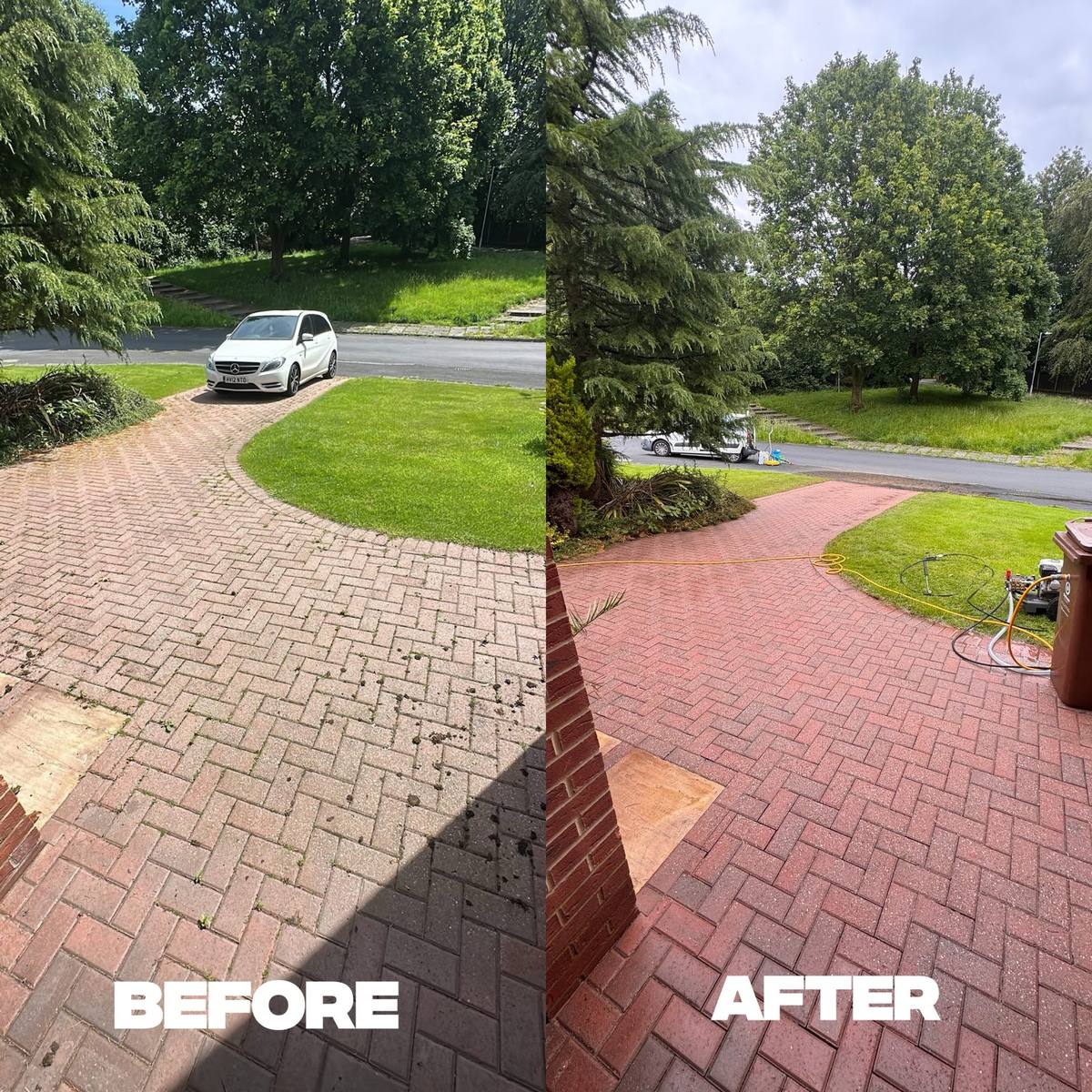
Block paving driveway — fully restored after a deep clean. This kind of result is typical across Failsworth and the surrounding Oldham area.
Quick answer: Driveway cleaning in Failsworth typically involves a pre-treatment to loosen algae and dirt, followed by rotary pressure washing to restore the surface. Most driveways take two to four hours. C&C Precision covers Failsworth and the wider Oldham area, offering fast WhatsApp quotes from photos.
Why Failsworth Driveways Get Dirty So Quickly
Greater Manchester doesn't get dramatically more rain than the rest of England, but what it does get is persistent damp. Overcast skies, mild winters and relatively low UV through the colder months mean that surfaces stay wet for long periods. Block paving and concrete that dries off quickly in sunnier climates stays damp here for hours after rainfall — sometimes days in winter. That's exactly the condition algae, moss and lichen need to establish themselves.
If you want to understand the science behind why paving goes black so reliably in the North West, this guide on why paving goes black in the UK covers it in more detail. The short version is that the dark discolouration is almost always biological growth — algae, rather than simply dirt — and it bonds to the surface in a way that a hosepipe won't shift. North-facing driveways and those shaded by a house or hedge are worst affected because they rarely get the direct sun that slows regrowth. Failsworth has no shortage of terraced streets with tight north-facing frontages, and it shows.
Wet weather also accelerates the physical deterioration of driveways. Rain washes out the kiln-dried sand between block paving joints, leaving gaps that weeds colonise and that allow blocks to shift. If you want to understand how persistently damp conditions affect paving over time, this piece on how wet weather destroys your driveway faster is worth reading before you decide what level of work you need.
What Surface Do You Have? It Changes the Approach
Failsworth has a mix of older concrete and tarmac driveways on the terraced and semi-detached streets closer to the town centre, alongside newer block paving and imprinted concrete on the more recent housing developments. The cleaning method varies significantly between them, and so do the results you can reasonably expect.
Block paving responds well to pressure washing with a rotary surface cleaner, and almost always looks dramatically better afterwards. It can also be re-sanded and optionally sealed once clean. Imprinted concrete — the stamped and coloured variety often found on newer builds — needs more care because the decorative sealer on the surface can be degraded by high pressure or strong chemicals if the operative isn't paying attention. Plain concrete and tarmac are generally more straightforward to clean but tarmac in particular can be softened by harsh chemicals, so pre-treatment needs to be matched to the surface. If you've got a block paving driveway, the full process including joint sand replacement is covered separately.
Stone driveways — whether natural sandstone flags or setts — are less common as front driveways in this area but do exist, particularly on older and more substantial properties. Natural stone is porous and can be more sensitive to high-alkaline chemicals. Setting expectations before any work starts is part of the job, not an afterthought.
How the Cleaning Process Actually Works
A proper driveway clean isn't simply turning up with a pressure washer and blasting everything. It starts with a pre-treatment — usually a diluted biocide or alkaline cleaner applied across the whole surface and left to dwell. Dwell time matters. Ten to fifteen minutes minimum allows the chemical to break down algae, loosen moss rhizomes and soften compacted surface grime before any water is applied under pressure. Skipping this step means the pressure washer is doing all the work the chemistry should be doing, which is slower and harder on the surface.
After the dwell period, the main cleaning pass is done with a rotary surface cleaner — a dome-shaped head that spins two jets of water in a controlled circular pattern close to the surface. This distributes pressure evenly across a consistent path and avoids the streaky lines and tiger-stripe marks that a lance or wand leaves on flat surfaces. It's one of the clearest differences between a professional result and a DIY attempt, as covered in more detail in this guide to professional driveway cleaning versus the bloke with a jet wash.
Edges, tight spots around manhole covers, areas along walls and kerb lines all need detailing with a wand at reduced pressure once the rotary pass is done. Then a final rinse clears the residue, and on block paving, any disturbed joint sand is blown out and replaced if re-sanding has been included in the job.
How Long Does a Driveway Clean Take in Failsworth?
For a small terraced front — the kind of compact hardstanding you see on streets off Oldham Road — the active work is often done within an hour and a half to two hours, but you need to factor in the pre-treatment dwell time on top of that. A small driveway with heavily embedded algae won't clean any faster just because it's physically small; the chemistry still needs time to work.
An average semi-detached driveway, the sort that fits two cars side by side, typically takes three to four hours for a thorough job including edges and a tidy rinse. If re-sanding block paving joints is included, add an hour or more depending on the size and condition of the joints. Larger detached properties with substantial driveways can take a full day. Any quote that suggests a large driveway will be done in under an hour is worth questioning — that kind of speed usually means the pre-treatment and edge work are being skipped.
A rushed driveway clean is one of the clearest warning signs in this trade. If someone is quoting thirty minutes for a full driveway, the pre-treatment dwell time alone should take at least that. Speed and quality don't go together on this kind of work.
What Does Driveway Cleaning Cost in the Failsworth Area?
Pricing for driveway cleaning Failsworth is generally calculated per square metre, and the rate varies depending on what the job actually involves. A straightforward pressure wash of block paving in reasonable condition starts from around £3.50 per square metre. If the surface has significant algae or moss that needs a proper chemical pre-treatment, expect closer to £4.25 per square metre. A full restoration — clean, re-sand the joints and leave the surface properly finished — is typically around £5.50 per square metre. If the paving has already been cleaned and just needs the joint sand topping up, re-sanding on its own starts from around £2.00 per square metre.
What pushes a price up is surface condition (heavily soiled jobs take longer), accessibility (tight side entrances or surfaces bordered by flower beds slow the work down), and whether sealing is required after cleaning. Sealing isn't essential on every driveway, but on block paving it slows algae regrowth noticeably and stabilises the jointing sand. What pushes a price down is a straightforward surface, good access and a driveway that's been cleaned recently and just needs maintaining.
The most practical way to get an accurate price for driveway cleaning Failsworth is to send a couple of photos over WhatsApp — one showing the full area and one closer up showing the surface condition. A visual gives far more information than a phone call and means a price can come back without anyone needing to visit first.
When Should You Call in a Professional Rather Than DIY?
Hire machines from tool-hire shops are rarely as capable as the equipment a trade operator brings. The PSI is typically lower, there's usually no surface cleaner attachment included, and domestic hire machines don't always sustain the pressure required to properly clean compacted algae from porous block paving. The result is often that surface dirt is shifted but the biological growth — the stuff that causes the black discolouration — remains partly embedded and regrows quickly.
There's also the question of technique. On block paving, incorrect pressure or the wrong nozzle angle can blast out all the jointing sand, leaving gaps between blocks that then shift and allow weed seeds to establish. On imprinted concrete, high pressure at the wrong distance can lift or craze the surface sealer, which is expensive to put right. The guide on monoblock driveway cleaning goes into more detail on the specific risks with block paving surfaces.
DIY with a domestic machine makes sense for routine maintenance rinsing, clearing loose debris or tidying up after a small patch of moss on an easy surface. Where the surface has years of embedded growth, where re-sanding or sealing is part of the plan, or where the paving is imprinted concrete with an existing sealer to protect, a professional clean is the more sensible route — both for the result and for avoiding damage.
Getting the Best Results — and Keeping Them Longer
After a professional clean, block paving is typically dry enough to walk on within an hour and ready for vehicles within two to three hours in normal weather. If a sealer has been applied, curing times vary depending on the product — usually a minimum of four to six hours before foot traffic and longer before vehicles, and the operative should tell you exactly what to expect before they leave.
Sealing block paving after cleaning extends the results noticeably in a climate like Greater Manchester's. It doesn't prevent algae growth permanently, but it slows recolonisation and makes the surface easier to clean at the next visit. Re-sanding the joints — using kiln-dried sand brushed in and compacted — stabilises the blocks and reduces the gaps that weeds exploit. If the jointing sand has washed out significantly, re-sanding is worth doing at the same time as the clean rather than as a separate job later.
How often a Failsworth driveway needs a professional clean depends on aspect, tree cover and surface type, but every two to three years is a realistic cycle for a block paved drive that's been sealed. Unsealed surfaces in shaded positions can look tired again within eighteen months. If you're thinking about longer-term maintenance, the full range of services covers everything from initial clean through to ongoing upkeep. C&C Precision Precision Pressure Washing covers Failsworth as part of its regular Oldham and Greater Manchester work, and photos over WhatsApp are the quickest way to get the conversation started.
Frequently asked questions
Do you clean driveways in Failsworth specifically, or just the wider area?
Yes, Failsworth is well within our regular patch. We're based in Oldham and cover the whole of Greater Manchester including Failsworth, Moston, Newton Heath and surrounding areas. Travel isn't a problem and it doesn't affect your price.
How do I get a quote for driveway cleaning in Failsworth?
The quickest way is to send two or three photos of your driveway over WhatsApp — one showing the full area and one closer up so we can see the surface condition. We'll come back with a price without needing to visit first. Most people have a quote within a few hours.
Will pressure washing damage my block paving or imprinted concrete?
Done correctly with the right equipment and technique, no. We use a rotary surface cleaner rather than a wand for open areas, which distributes pressure evenly and avoids the tiger-stripe damage you often see from DIY attempts. On imprinted concrete we always check the existing sealer condition before starting.
How long after cleaning can I use my driveway?
For a standard pressure wash with no sealing, the surface is usually dry enough to walk on within an hour and fine for vehicles within two to three hours in normal weather. If we apply a sealer or kiln-dried sand, we'll let you know the specific curing time before we leave.
Want a fast price for your Failsworth driveway?
Send a couple of photos over WhatsApp and we'll come back to you with a straight price — no visit needed, no obligation.