If you've got a monoblock driveway and it's starting to look green, greasy, or just generally worn down, you're probably wondering what cleaning it actually involves. Monoblock driveway cleaning isn't the same as cleaning a standard block paved or tarmac surface — the material behaves differently, the joints are different, and the risks of getting it wrong are different too. Understanding those differences before you pick up a pressure washer or call anyone out will save you a lot of bother.
This guide covers the practical side honestly: what works, what doesn't, what's realistically achievable, and where DIY tends to go wrong. The North West climate — damp, frequently overcast, not a lot of sustained UV — means driveways here accumulate organic growth faster than in drier parts of the country, and monoblock is no exception. What follows is based on real experience cleaning these surfaces across Greater Manchester, not a manufacturer's ideal scenario.
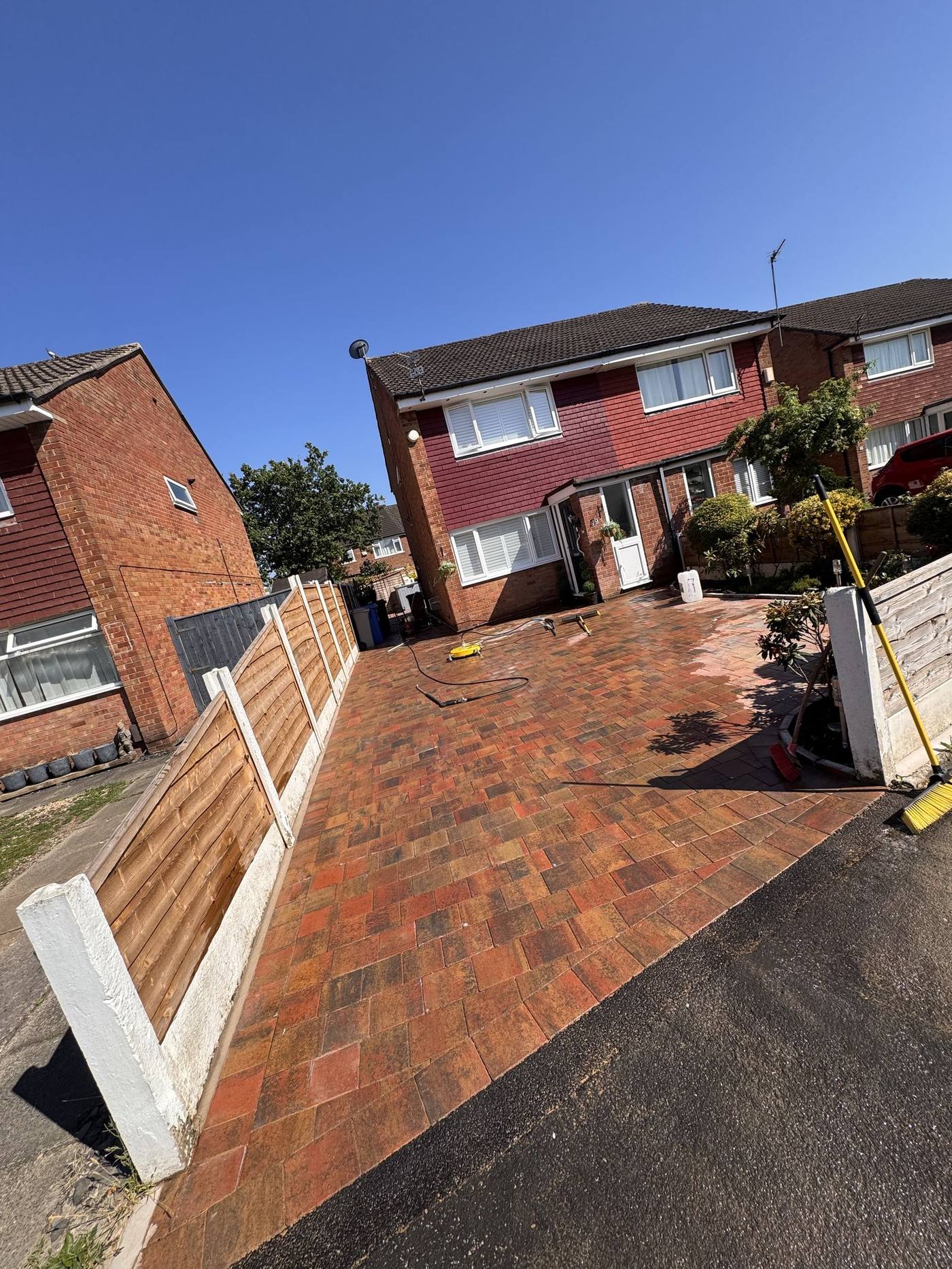
Brindle block paving cleaned by C&C Precision — tight jointing and restored colour typical of monoblock-style driveways.
Quick answer: Monoblock driveway cleaning differs from standard block paving because monoblock units are typically denser, smaller, and laid tighter with minimal jointing sand. This means lower pressure is needed to avoid surface damage, sand loss is less of a concern, but staining and compacted grime between the close-set joints can be harder to shift without the right technique.
What Is Monoblock Paving and How Does It Differ from Standard Block Paving?
Monoblock paving — sometimes called mono or monobloc — refers to smaller, denser concrete or clay paving units laid with very tight joints, often with a chamfered (bevelled) edge. The units themselves are typically thinner than standard block paving and sit close together with minimal jointing material between them. The finish tends to be finer and more uniform, and the surface is harder and less porous than larger concrete blocks. It was widely installed on driveways across Greater Manchester from the 1980s through to the early 2000s and is still commonly seen today.
Standard block paving — the kind you see in a herringbone or stretcher bond pattern — uses larger units with wider joints filled with kiln-dried jointing sand. That sand plays a structural role, locking the blocks in place. Monoblock's joints are much tighter and contain very little loose sand, which changes both how the surface behaves structurally and how it should be cleaned. The closer spacing means less flexibility in the surface, but it also means any cleaning approach needs to be more controlled — particularly around pressure and dwell time.
The distinction matters because advice written about block paving doesn't always transfer directly to monoblock. If you search for guidance and find generic pressure washing tips, check whether they're talking about the same material. The joint width alone changes the re-sanding question significantly, as we'll cover shortly.
Why Pressure Settings Are Different on Monoblock
Monoblock's denser surface can tolerate pressure washing, but that doesn't mean the higher the pressure the better. The tight joints and thinner unit profile mean that aggressive cleaning — particularly with an open lance held close to the surface — can cause problems. Surface dusting (where the cement matrix of the unit begins to break down), edge disturbance, and uneven cleaning lines are all common outcomes of using too much pressure or the wrong equipment. On older monoblock that has already seen some weathering, the surface is more vulnerable than it looks.
A rotary surface cleaner is the right tool for this job. It distributes pressure evenly across a controlled spinning head, which means no single point on the surface is taking a concentrated blast. For most monoblock driveways, working in the range of 1,500 to 2,000 PSI with a surface cleaner gives a thorough clean without the risk of pitting or surface damage. An open lance — which is what most domestic machines use — creates an intense, directed stream that's hard to control and almost always leaves streaking or marks, even when the operator is careful.
Speed of pass matters too. Moving the surface cleaner too slowly concentrates heat and pressure in one area; too fast and you're not lifting the contamination properly. On heavily soiled monoblock, slower passes on the first run, followed by a second pass after any pre-treatment has dwelled, tends to give the most consistent result. This is one of the reasons that driveway cleaning done properly takes longer than it might seem — the surface has to be worked methodically.
The Jointing Sand Question: Does Monoblock Need Re-Sanding?
With standard block paving, block paving re-sanding is almost always necessary after a pressure wash. The wider joints lose kiln-dried sand during cleaning, and without it the blocks become unstable — they can rock, shift, and eventually allow weeds to establish at depth. The sand is structural, not cosmetic, and replacing it properly is part of the job. You can read more about how this works in our guide on what pressure washing does to block paving sand.
Monoblock is different. The joints are so tight that there's very little loose sand to lose in the first place. In most cases, a well-executed monoblock driveway clean won't require re-sanding in the way that standard block paving does. The units are held in place by their close proximity and the compacted sub-base rather than by significant quantities of jointing material. For guidance on how often re-sanding is genuinely needed on block paving surfaces, the guide on how often block paving should be re-sanded covers the factors involved.
That said, it's worth checking joint integrity after the clean — particularly around edges, where vehicular loading is highest, and in areas where the surface has previously been disturbed or repaired. If any joints look open, unstable, or if units have slight movement, a light application of kiln-dried sand brushed in before the surface dries completely is straightforward and worth doing. It's a small step that prevents a problem from developing further.
Pre-Treatment: When and Why It Matters More on Monoblock
Because monoblock joints are so tight, organic matter and grime compact differently than in wider-jointed paving. Algae, moss, and general atmospheric dirt work their way into the surface texture and the joint edges and become quite dense over time — particularly in the North West, where surfaces rarely get a prolonged dry period to naturally inhibit biological growth. A pressure wash alone will remove the visible layer, but it often won't fully break down what's embedded in the surface matrix.
Pre-treatment with a biocide or, for vehicle-contaminated driveways, an alkaline degreaser, changes the outcome noticeably. Applied before pressure washing and allowed to dwell — typically 15 to 30 minutes depending on the product and the level of contamination — it begins to break down the biological matter and emulsify grease before the surface cleaner touches it. The pressure wash then removes the loosened material rather than trying to blast through it. This approach is gentler on the surface because you're relying less on raw pressure to do the work.
For driveways with heavy moss coverage or significant algae staining — common on north-facing drives or those shaded by hedges and trees — a biocide pre-treatment is almost always worthwhile. For greasy forecourts or surfaces near workshop areas, a degreaser is the right first step. The choice of chemical matters and so does the dwell time; rushing the pre-treatment stage is a false economy.
If a contractor quotes for monoblock driveway cleaning and doesn't mention pre-treatment at any point, ask them directly how they plan to deal with any algae, moss, or oil contamination. The answer will tell you a lot about the quality of the job you're going to get.
Staining, Oil Spots, and Surface Dusting: The Specific Problems on Monoblock Drives
Monoblock is prone to surface dusting as it ages — the outer cement layer gradually wears and becomes more absorbent, which makes the surface trap dirt and staining more readily. On a visually dark or uniform driveway, staining from oil, rust, or algae tends to stand out more than it would on a varied or textured surface. This isn't a sign that the paving is failing structurally, but it does mean that cleaning results can vary depending on how far the staining has penetrated.
Oil is probably the most common problem on monoblock driveways. Vehicles drip, overflow, and deposit oil directly onto the surface over months and years, and the tight joints trap it. Fresh oil responds well to alkaline degreaser with adequate dwell time. Old, set-in oil — particularly large patches that have been there for a year or more — will often improve significantly but may not disappear entirely. That's an honest position: improvement is realistic, complete erasure on deep, aged contamination often isn't. Anyone who guarantees otherwise should be treated with scepticism.
Algae blacking — the dark, slippery staining caused by algae — responds well to chemical treatment and pressure washing in combination. Rust staining, usually from metal furniture, drain covers, or cars, is more stubborn and may require a specific rust treatment product rather than a general biocide. Surface dusting itself isn't something cleaning resolves directly; once the outer matrix has broken down, cleaning can make the surface look considerably better, but a sealer applied after the clean can help stabilise the surface and reduce future staining.
When to Call a Professional Instead of Hiring a Pressure Washer
DIY monoblock driveway cleaning is possible in theory, but the margin for error is smaller than most people realise. Consumer pressure washers often operate at PSI levels that feel adequate but can still cause surface damage when combined with the wrong nozzle or technique. Pitting, streaking, and edge disturbance are all commonly caused by DIY attempts on monoblock, and once the surface texture is damaged it doesn't repair — the paving will trap more dirt going forward, not less. If the driveway is large (over 40–50 square metres), heavily contaminated, or hasn't been cleaned in several years, a professional will consistently get a better result than a hired machine.
The signs that point toward professional cleaning rather than DIY are fairly clear: significant moss or algae coverage, oil contamination across more than a small patch, visible joint deterioration around the edges, any units that already feel loose underfoot, or a surface that's been neglected for long enough that there's compacted organic matter in the joints. A professional brings calibrated equipment, appropriate chemicals, and the experience to read the surface and adjust the approach. That combination isn't replicated by a hire machine and a bottle of patio cleaner.
C&C Precision Pressure Washing covers Oldham, Rochdale, Bury, Bolton, Manchester, Tameside, Stockport and the surrounding towns, and the quickest way to get an accurate quote is to send a few photos over WhatsApp — most quotes come back the same day without needing a site visit first. You can also read through customer reviews if you want to know what to expect.
Practical Takeaways: Getting the Best Result from Monoblock Driveway Cleaning
Monoblock driveway cleaning done properly involves more than pointing a pressure washer at the surface. The key differences from standard block paving cleaning are: lower working pressure (or at least a controlled surface cleaner rather than an open lance), a pre-treatment stage for any biological or grease contamination, and a more measured approach to re-sanding — check the joints, but don't assume they need refilling in the way that wider-jointed paving does.
Before any contractor starts work, it's worth asking a few specific questions: What pressure will they be using and with what equipment? Do they apply a pre-treatment, and if so, what product and dwell time? Will they check the joints after the clean? Do they offer sealing, and if so, what type of sealer — a wet-look sealer changes the appearance significantly, while a matt or natural finish sealer stabilises the surface without altering the look. These aren't trick questions; a competent contractor will have clear answers to all of them.
On stain expectations: go in with realistic expectations. Monoblock that's clean, free of algae, and with the surface texture restored looks considerably better — but old oil patches may remain faintly visible and surface dusting won't reverse completely without a sealer. A clean that removes 80–90% of the contamination and leaves the surface stable and safe is a good outcome. If you want to understand how the wider picture of exterior surface cleaning works across different surfaces, the full services page covers everything from patio cleaning to render and roof work.
Frequently asked questions
Can I pressure wash a monoblock driveway myself?
You can, but it carries real risk. Most domestic pressure washers run at PSI levels that can pit the surface of older or lower-density monoblock units, and using an open lance rather than a rotary surface cleaner often leaves uneven streaking. If the driveway hasn't been cleaned in several years or has significant contamination, a professional will get a better result and avoid damage.
Does monoblock need re-sanding after cleaning like standard block paving does?
Usually not to the same extent. Monoblock is laid with very tight joints, so there's far less jointing sand to lose during cleaning compared to wider-jointed block paving. That said, it's worth checking the joints after the clean — if any areas look open or unstable, a light application of kiln-dried sand is worth doing before the surface dries completely.
How do I get oil stains off a monoblock driveway?
Oil in monoblock joints is genuinely difficult because the tight spacing traps it deep. A professional alkaline degreaser applied before pressure washing and left to dwell gives the best chance of breaking the oil down. Fresh stains respond much better than old, set-in ones — so the sooner it's treated the better. Don't expect 100% removal on old, large oil patches; improvement is realistic, full erasure often isn't.
How much does monoblock driveway cleaning cost in Greater Manchester?
Cost depends on the size of the driveway, how soiled it is, and whether pre-treatment or re-sanding is needed. The fastest way to get an accurate price is to send a few photos via WhatsApp — we can usually turn around a quote the same day without needing to visit first. Rough ballpark figures don't account for condition, so a photo-based quote is always more reliable.
Got a monoblock driveway that needs cleaning in Greater Manchester?
Send us a couple of photos on WhatsApp and we'll come back to you quickly with a straight price — no fuss.