Ainsworth sits on the Bolton and Bury border, and like most of Greater Manchester it gets its fair share of damp, overcast weather for a good eight months of the year. That combination of moisture and shade means driveways here green up quickly and stay green. If you've been searching for driveway cleaning Ainsworth, you'll know the problem: a driveway that looked fine two summers ago is now dark with algae, the joints in the block paving are full of weeds, and the whole thing looks like it belongs to a different property. It's not neglect — it's just the climate doing what it does.
This guide covers what actually goes into a proper driveway clean in this area, which surfaces need which treatment, and what's realistic to expect from the results. There's no pressure to book anything — the aim is to give you enough information to make a sensible decision, whether that's picking up a phone or having a go yourself.
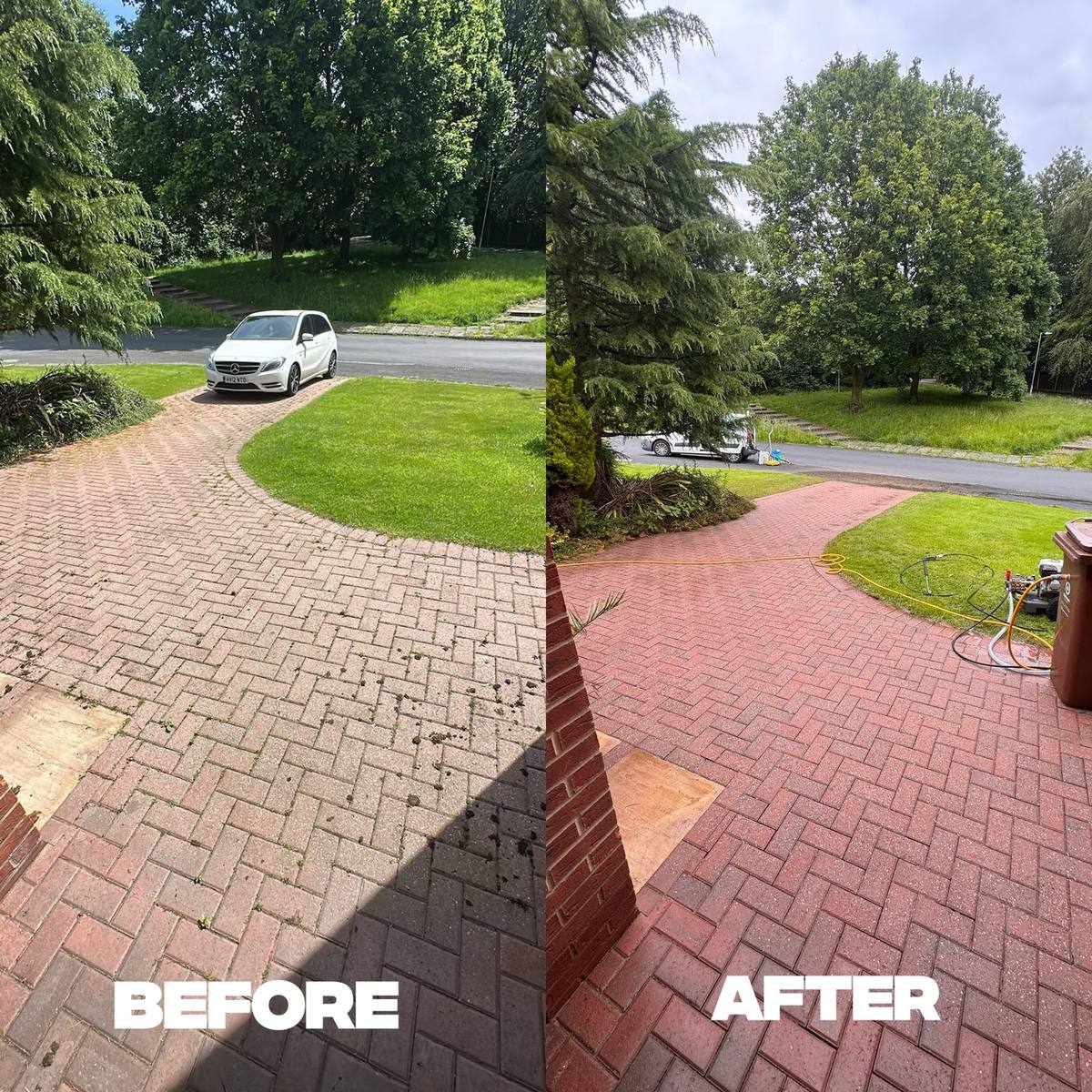
Block paving driveway restored in one visit — a typical result on local surfaces.
Quick answer: Driveway cleaning in Ainsworth works best when the method matches the surface. Block paving needs a rotary surface cleaner, re-sanding, and weed treatment. Concrete and tarmac respond well to pre-treatment and pressure washing. Most driveways in the area take two to four hours and are fully restored in a single visit.
What Surfaces Are Common on Ainsworth Driveways?
Ainsworth and the surrounding streets between Bolton and Bury cover a mix of housing stock from Victorian terraces through to newer detached and semi-detached builds. That variety means driveways vary considerably. Block paving is by far the most common surface on properties built from the 1980s onwards. Pattern imprinted concrete — sometimes called stamped concrete or PIC — became popular through the 1990s and early 2000s and still makes up a significant proportion of drives in the area. Older properties often have plain concrete or tarmac, and some have loose gravel or slate that doesn't require pressure washing at all.
Why does surface type matter before anyone mentions a pressure washer? Because the wrong approach on the wrong surface causes real damage. The pressure setting, nozzle type, chemical pre-treatment, and aftercare all change depending on what's underneath. Tarmac, block paving, and pattern imprinted concrete each have different tolerances and different failure modes. Getting that wrong isn't just a cosmetic problem — it can mean expensive repairs.
Block Paving: The Most Common Job We Do Here
Block paving cleaning makes up the bulk of driveway cleaning work in this part of Greater Manchester, and there's a reason for that. The joints between blocks are essentially permanent homes for moss, weeds, and compacted dirt if they're left untreated. The pavers themselves develop a layer of algae that starts as a light green tint and, given enough time and moisture, turns black and becomes genuinely slippery. Oil drips from cars soak into the surface and oxidise. What you're left with after a few years is something that needs more than a quick rinse.
The correct process for block paving cleaning starts with a chemical pre-treatment — typically a biocide applied and left to dwell for fifteen to thirty minutes depending on how much organic growth is present. That dwell time matters; rushing it means you're just rinsing the surface rather than breaking down what's embedded in it. After pre-treatment, a rotary surface cleaner is used rather than a lance, which keeps the pressure consistent across the surface and avoids the tracking marks that come from hand-lancing. Once cleaned, the joints are re-filled with kiln-dried sand as part of a proper block paving re-sanding — this stabilises the blocks, discourages weed regrowth, and is simply the correct way to finish the job. Leaving the joints open after cleaning makes the whole surface unstable over time.
On pricing, block paving cleaning starts from around £3.50/m² for a straightforward clean. If the surface needs a chemical treatment for heavier organic growth, that sits closer to £4.25/m². A full restoration including re-sanding is around £5.50/m², and re-sanding on its own — if the cleaning has already been done — is around £2.00/m². Most standard driveways in Ainsworth fall between 30 and 60 square metres.
Pattern Imprinted Concrete: Why It Needs a Careful Approach
Pattern imprinted concrete looks like stone or brick but is actually a single pour of concrete with a pattern pressed into it and a sealer coat applied on top. That sealer is what gives it the gloss and the colour, and it's also the thing most likely to go wrong if the cleaning isn't done correctly. High pressure at close range or the wrong chemical can cause the sealer to blister, turn milky white, or lift in patches. Once that happens, the only fix is stripping and resealing the whole surface — which costs considerably more than getting the clean right first time.
The correct approach uses controlled, lower pressure than you'd use on block paving, and a pre-treatment designed for sealed surfaces rather than a straight biocide. The cleaning lifts the organic growth without attacking the sealer beneath. On older pattern imprinted concrete where the sealer has faded — which is common on drives that are ten or more years old and haven't been maintained — resealing after the clean is worth considering. It restores the colour, makes the surface easier to maintain going forward, and gives it another layer of protection against the North West weather. It's worth reading our guide on how long driveway sealing lasts if you're weighing up whether it's worth doing.
Tarmac and Concrete Driveways: Straightforward but Easy to Get Wrong
Tarmac is a more forgiving surface than block paving or imprinted concrete — there are no joints to worry about and no sealer coat to damage. That said, it still benefits from a pre-treatment dwell to lift embedded algae and road grime before pressure is applied. Tarmac that's simply blasted without pre-treatment ends up looking cleaner from a distance but often has organic material still locked into the surface, which means it greens up again quickly. On older or more porous tarmac, pre-treatment makes a visible difference to the final result.
Plain concrete can look deceptively simple but it harbours deep staining — oil, rust from metal furniture, and years of compressed algae can all sit below the surface layer. One thing worth mentioning for anyone thinking about hiring a machine: high-angle lancing on concrete leaves tracking marks that are very difficult to remove. Running a lance back and forth in lines is one of the most common DIY mistakes, and the striped result often looks worse than the original dirty surface. A rotary surface cleaner eliminates that risk entirely because the pressure is applied evenly in overlapping circular passes.
Moss, Weeds, and Organic Growth: The Real Problem Under the Surface
The green and black you see on a neglected driveway is the visible symptom, but the actual damage is happening underneath. Moss puts out fine root structures that work into the joints of block paving and the surface pores of concrete, and those roots hold moisture. In winter, that moisture freezes and expands, gradually widening cracks and loosening blocks. Weeds in joints do the same thing on a larger scale. By the time a driveway looks seriously green, the biological growth has usually been established for a year or more. If you want to understand more about why this keeps happening through the winter months, this guide on why your driveway goes green every winter explains the cycle in more detail.
This is why a chemical pre-treatment step is not optional on driveways that have been left for several years. Pressure alone dislodges the visible growth but leaves the root structure and spores in place, which means regrowth starts within a few months. A proper biocide application — allowed to dwell at the right concentration — kills the organic matter at the root before pressure washing removes it. The result holds significantly longer. On very heavily mosses driveways, a follow-up biocide application a few weeks after cleaning can extend the results further still.
If your block paving driveway feels loose or spongy underfoot in places, the joint sand has likely broken down or been washed out over time. Cleaning it without re-sanding afterwards won't fix that — it may make it worse by removing what little sand remains. Get the joints checked before booking a clean if you've noticed movement in the blocks.
When to Call a Professional Rather Than Hire a Jet Wash
Hire machines from the local depot aren't bad tools, but there are real gaps between what they offer and what a professional setup does. Consistent pressure control is the main one — hire machines tend to run at a fixed, often high pressure with limited ability to adjust, and the lances that come with them aren't designed for flat surface cleaning. Without a proper rotary surface cleaner attachment, you're hand-lancing the surface, which almost always leaves tracking marks and pushes rather than removes joint sand. That matters on block paving because pulling out the joint sand leaves the blocks unstable.
There's also the chemical side. Knowing which pre-treatment is safe on which surface, what concentration to use, and how long to leave it isn't something that comes with a hire machine. Using the wrong product on pattern imprinted concrete, for example, can cause irreversible sealer damage. And if you do manage a reasonable clean with a hire machine, the job isn't actually finished without re-sanding the joints — that part is often overlooked entirely by DIYers, and it's what keeps the result looking good for longer. For a broader look at what separates a good operator from a poor one, the guide on driveway cleaning near me — who's worth hiring is worth a read before you make any decisions.
C&C Precision Pressure Washing carries full £1,000,000 public liability insurance, uses commercial-grade equipment calibrated to the surface, and covers Ainsworth as part of its regular Greater Manchester schedule.
What to Expect When You Book Driveway Cleaning in Ainsworth
The process starts with photos. Send two or three pictures of the driveway on WhatsApp — one from each end plus a close-up of the worst area — and you'll get a price back within the hour in most cases. There's no need for a site visit first. The photos give enough information to assess the surface type, the extent of the growth, and whether re-sanding is needed. From there, a date gets agreed and that's it until the day.
On the day itself, the pre-treatment goes down first and dwells while equipment is set up. Most residential driveways in Ainsworth take between two and four hours from start to finish. A smaller terrace drive with light growth can be done in under two hours; a larger detached property with heavy moss, block paving, and a full re-sand takes longer. When the team leaves, the drive will be visibly cleaner, the joints will be refilled with kiln-dried sand where needed, and there will be a light residue of fine sand on the surface — that beds in over the first few days of foot traffic and rainfall. It's worth being honest: very old oil stains may lighten rather than disappear entirely, and deeply etched concrete won't come back to new. What a proper clean does is remove the biological growth, restore the base colour, and put the surface in a condition that's easier to maintain going forward.
If you're comparing services across the area, the guide on driveway cleaning in Rochdale covers similar ground for nearby properties and is a useful reference point for what's standard in this part of Greater Manchester.
Frequently asked questions
How much does driveway cleaning cost in Ainsworth?
Most standard driveways in Ainsworth come in between £80 and £200 depending on size, surface type, and how much organic growth there is to treat. Block paving that needs re-sanding after cleaning sits at the higher end. The fastest way to get an accurate price is to send a couple of photos on WhatsApp — we usually come back within the hour.
Does pressure washing damage block paving?
It can if it's done with a lance rather than a rotary surface cleaner, or if the operator uses too much pressure at close range. A rotary surface cleaner keeps the pressure even and avoids tracking lines or blasting out joint sand unevenly. Re-sanding with kiln-dried sand after cleaning is the correct finish to stabilise the joints.
How long does a driveway clean take in Ainsworth?
Most residential driveways take between two and four hours. A smaller terrace drive can be done in under two hours; a large detached with heavy moss growth and block paving that needs re-sanding could take the better part of a day. We'll give you a realistic time estimate when you send the photos over.
How often should I have my driveway cleaned?
For most Ainsworth properties, once every one to two years is enough to stay on top of moss and algae growth before it becomes a deep clean job. North-facing driveways or those under trees will need attention more regularly. Keeping on top of it is cheaper than leaving it four or five years and needing a full restoration.
Want a price for your Ainsworth driveway?
Send a couple of photos on WhatsApp and we'll come back with a straight price — usually within the hour.