If you've noticed your driveway turning green, black, or just looking tired and worn, you're not alone. The North West climate — persistent damp, mild winters, and not enough dry spells to let surfaces breathe — creates near-perfect conditions for moss, algae, and organic staining to take hold. Driveway cleaning in Rochdale is something we carry out regularly across the borough, from Milnrow and Littleborough through to Heywood and the town centre itself, and the same problem shows up time and again: surfaces that haven't been touched in years and need more than a quick blast to come back properly.
This guide covers everything you'd reasonably want to know before booking — what surfaces we clean, how the process works, realistic timescales, what things cost, and when it's worth calling someone in rather than hiring a pressure washer from the local hire shop. No fluff, just the practical detail.
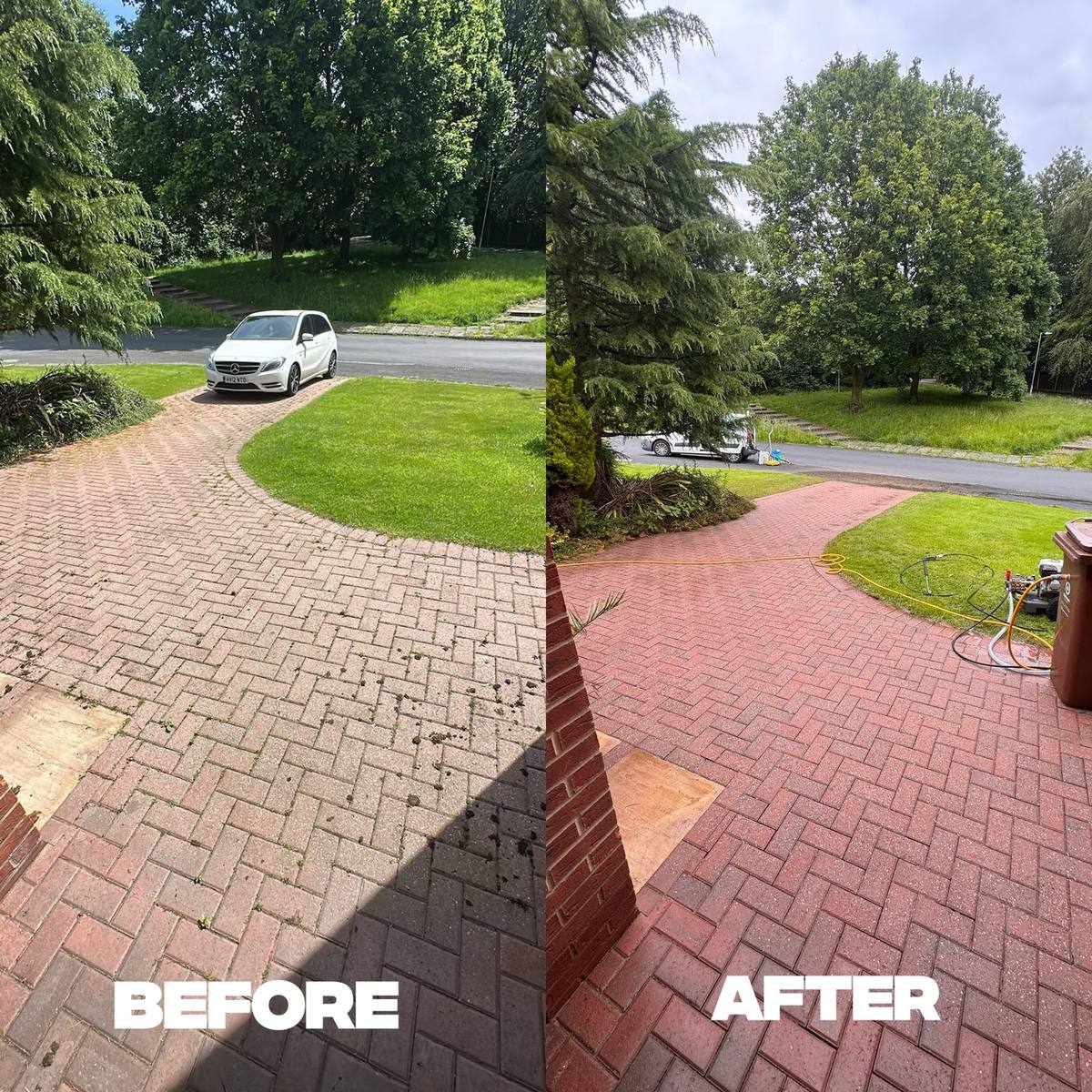
Before and after: block paving driveway deep cleaned by C&C Precision in Greater Manchester.
Quick answer: Driveway cleaning in Rochdale typically involves a pre-treatment to loosen moss, algae, and grime, followed by hot or cold pressure washing with a rotary surface cleaner. Most driveways take 2–4 hours. To get a fast quote, simply send a photo on WhatsApp — no site visit needed.
What Types of Driveway Do We Clean in Rochdale?
The most common surface we deal with is block paving — both older clay and concrete block driveways and newer installations that have started to lose their colour under a layer of green growth. If your driveway is block paving, you might also want to read our guide on block paving cleaning in Manchester explained, which goes into more depth on that surface specifically. Block paving responds well to pressure washing when the job is done properly, and it's the surface where re-sanding and sealing are most relevant afterwards.
Tarmac and concrete driveways are also common across Rochdale, particularly on older housing stock. These are generally more forgiving surfaces — tarmac especially — though very high pressure can cause surface pitting on older, friable tarmac, so technique matters. Imprinted concrete (sometimes called pattern imprinted concrete or PIC) needs particular care. The surface sealer that gives it its colour and sheen can be damaged if pressure is applied incorrectly, so this is one area where a domestic hire machine and a lance can cause real problems. Gravel driveways with block edging or concrete borders are also something we come across — the gravel itself doesn't get washed, but cleaning the edging and any hard-standing areas alongside it is straightforward.
Natural stone — sandstone, limestone, and granite setts — requires a slightly different approach depending on the stone's porosity and condition. Softer stones like sandstone can be damaged by excessive pressure. Some staining on porous stone will lighten significantly with the right treatment but won't vanish entirely; that's worth being honest about upfront rather than promising results that depend on factors outside anyone's control.
What Does the Cleaning Process Actually Involve?
The short version is: pre-treat, dwell, clean, rinse, edge. The longer version is worth understanding because it explains why a proper job takes longer than just showing up and blasting the surface with water.
Pre-treatment means applying a chemical solution — typically a biocide or a sodium hypochlorite-based mix at an appropriate dilution — to the surface and letting it sit for a dwell time before any pressure washing begins. That dwell time allows the chemical to break down moss, algae, lichen, and other organic growth at a biological level rather than just shifting the visible layer. Skipping this step and going straight to pressure washing will move the mess around and get the surface looking cleaner, but the regrowth tends to come back faster because the root systems and spores haven't been dealt with. On heavily contaminated surfaces, the difference in result is significant.
Once the pre-treatment has done its work, we use a rotary surface cleaner rather than a lance. A rotary cleaner gives a consistent, even clean across the whole surface without the striping effect you often see when a lance is used — that distinctive streaky pattern is the result of uneven pressure across the surface. After the main clean, the edges and any tight corners get hand-lanced carefully, and the whole area is rinsed down thoroughly. What's left should be a surface that's clean to the substrate, not just the top layer.
How Long Does a Driveway Clean Take?
For a small block paving driveway on a terraced house — the kind that fits two cars end-to-end — you're generally looking at around two hours from setup to pack-down, assuming reasonable moss levels and straightforward access. That includes pre-treatment dwell time, the clean itself, edging, and rinse.
A larger driveway on a semi-detached or detached property, particularly one with a side path, turning area, or steps included, will typically take three to four hours. Add re-sanding to that and you're usually looking at the longer end of a half-day job. Heavy moss or weed growth adds time regardless of the size — a smaller driveway that's been left for five or six years can take as long as a larger one that's been maintained more regularly.
We'll always give you a realistic time estimate when you get your quote rather than a vague window, so you know what to expect on the day. If something unexpected comes up on site — a section that's worse than the photos showed, for example — we'll let you know before it affects anything.
What Affects the Price of Driveway Cleaning in Rochdale?
Size is the main factor, which is why pricing is generally quoted per square metre. For block paving, a straightforward clean with a chemical pre-treatment runs from around £4.25/m². If your driveway needs a full restoration — clean, chemical treatment, and re-sanding with kiln-dried sand — that's typically around £5.50/m². Re-sanding on its own, if the surface is already clean, is around £2.00/m². These figures give you a working guide, though the final price depends on the specifics of your job.
Surface type affects price because it affects the method and time required. Imprinted concrete, for example, needs more care than standard block paving, and natural stone may need a specialist chemical rather than a standard biocide. Level of moss and weed growth matters too — a surface covered in thick, established moss needs more pre-treatment time and more passes with the surface cleaner than one that's just starting to discolour. Access is a practical consideration as well: if the driveway is on a steep slope, requires carrying equipment through a narrow gate, or has limited water supply nearby, that factors in.
Any add-ons — sealing, re-sanding, treating a path or patio at the same time — are quoted separately and clearly. There's no benefit to anyone in vague pricing, so we don't do it. You can also find more detail on how sealing affects long-term maintenance costs in our guide on how long driveway sealing lasts in Greater Manchester.
Block Paving Re-Sanding — Do You Need It After Cleaning?
Pressure washing removes jointing sand from between block paving — that's unavoidable, and it's part of why the surface looks so much cleaner afterwards. The joints are cleared of compacted dirt, moss, and old sand. The question is what happens next. Left without jointing sand, the gaps between the blocks become an open invitation for weeds and moss to establish themselves, and without the sand holding lateral pressure, individual blocks can start to shift and rock underfoot over time.
Re-sanding with kiln-dried sand after cleaning addresses both of those problems. The sand is brushed into the joints, compacted down, and any excess is swept off. It doesn't need to be sealed to do its job, though sealing on top of re-sanding gives you longer-lasting protection and makes future cleaning easier. If you want more detail on the re-sanding process itself, our block paving re-sanding page covers it properly.
The honest answer to whether you need it is: if your block paving has been pressure washed before and the joints are already sparse, yes. If it's a first clean and the joint sand was reasonably intact beforehand, it depends on what's left after the clean. We'll tell you on the day what we'd recommend rather than automatically upselling it on every job.
If you're getting block paving cleaned and re-sanded, check the weather forecast for the days following the job. Kiln-dried sand needs to be dry when it's applied and left to settle — a job done on a Thursday before a wet weekend will still work, but try to avoid heavy rain in the immediate hours after the sand goes down if you can plan around it.
When Is It Worth Calling in a Professional?
There are driveways where a domestic pressure washer and an afternoon will do a reasonable job — a small concrete or tarmac drive with light surface discolouration and no significant moss is a fair candidate. If that's your situation, hiring a machine and doing it yourself is a legitimate option and there's no reason to dress that up otherwise.
Where DIY tends to go wrong is on block paving, imprinted concrete, and natural stone. Block paving cleaned with a lance at the wrong angle strips the jointing sand unevenly and can shift individual blocks. Imprinted concrete is the most common surface we're called to after a DIY attempt has lifted or patched the sealer — once the sealer is damaged, the whole surface needs resealing to look uniform, which is a more expensive fix than having it cleaned properly in the first place. Stone like sandstone is easy to chip or surface-etch with excessive pressure. On any of these surfaces, the cost of getting it wrong is higher than the cost of getting it done right.
Heavy oil staining is another one to be realistic about. Pressure washing alone won't remove oil — it needs a specialist degreaser, the right dwell time, and sometimes more than one treatment. Some old staining will fade significantly but remain faintly visible, and that's an honest outcome rather than a failure. A professional driveway cleaner will tell you what's achievable on your specific surface before the job starts rather than after.
How to Get a Fast Quote for Driveway Cleaning in Rochdale
The quickest way to get a price is to send photos over WhatsApp. A couple of photos that show the full area — one from the street end and one from the house end — plus a rough idea of the dimensions (paces across and along is fine) is enough for us to give you a straight quote without needing to visit first. If there are specific problem areas like heavy oil staining or a section with damaged pointing, a close-up of those helps too.
You'll get a response the same day in most cases, and usually within a few hours. If the photos are clear, the quote is fixed — no surprises when we turn up. C&C Precision covers Rochdale and the surrounding areas across Greater Manchester including Heywood, Middleton, Milnrow, Littleborough, and Wardle, as well as the wider areas of Bury, Bolton, Oldham, Tameside, and Stockport.
If you'd like to see the kind of results customers across the region have had, our reviews page has feedback from real jobs. And if your property has multiple surfaces that need attention — a driveway alongside a patio, path, or render — it's usually more economical to get them done at the same time, so mention that when you get in touch.
Frequently asked questions
How much does driveway cleaning cost in Rochdale?
Price depends on the size of your driveway, the surface type, and how much moss or organic growth has built up. A small block paving drive on a terraced house will cost significantly less than a large imprinted concrete driveway on a detached property. Send us a photo on WhatsApp and we'll give you a straight price without needing to visit first.
How long does driveway cleaning take in Rochdale?
Most residential driveways take between two and four hours from start to finish. Larger driveways with heavy moss growth or add-on work like re-sanding can take longer. We'll give you a realistic time estimate when you get your quote.
Will pressure washing damage my block paving or imprinted concrete?
Done correctly with the right equipment and technique, pressure washing won't damage sound block paving or imprinted concrete. The risk comes from using a lance too close to the surface or at the wrong angle — that's what strips jointing sand and lifts sealer. We use a rotary surface cleaner which gives an even clean without that kind of focused pressure.
Do I need to be home when you clean my driveway in Rochdale?
Not necessarily — as long as we have access to the driveway and a water supply, many customers are happy for us to get on with it while they're at work. We'll discuss access and any specific instructions before the job so there are no surprises.
Want a fast quote for your Rochdale driveway?
Send a couple of photos on WhatsApp and we'll come back to you with a price — usually same day.