If you've just had your driveway cleaned or you're thinking about getting it sealed for the first time, one of the most common questions is how long it will actually last. Search for driveway sealing Manchester and you'll find a range of answers, many of them optimistic to the point of being misleading. The honest answer depends on your surface type, the product used, how well the surface was prepared, and — more than most guides admit — where you live. Greater Manchester's weather is not kind to exterior coatings.
This guide gives you a realistic picture of sealer lifespan, the factors that shorten it, and what to look for when it's time to redo the job. If you're weighing up whether sealing is worth doing at all, or trying to understand why a previous seal job didn't last as long as promised, most of the answers are here.
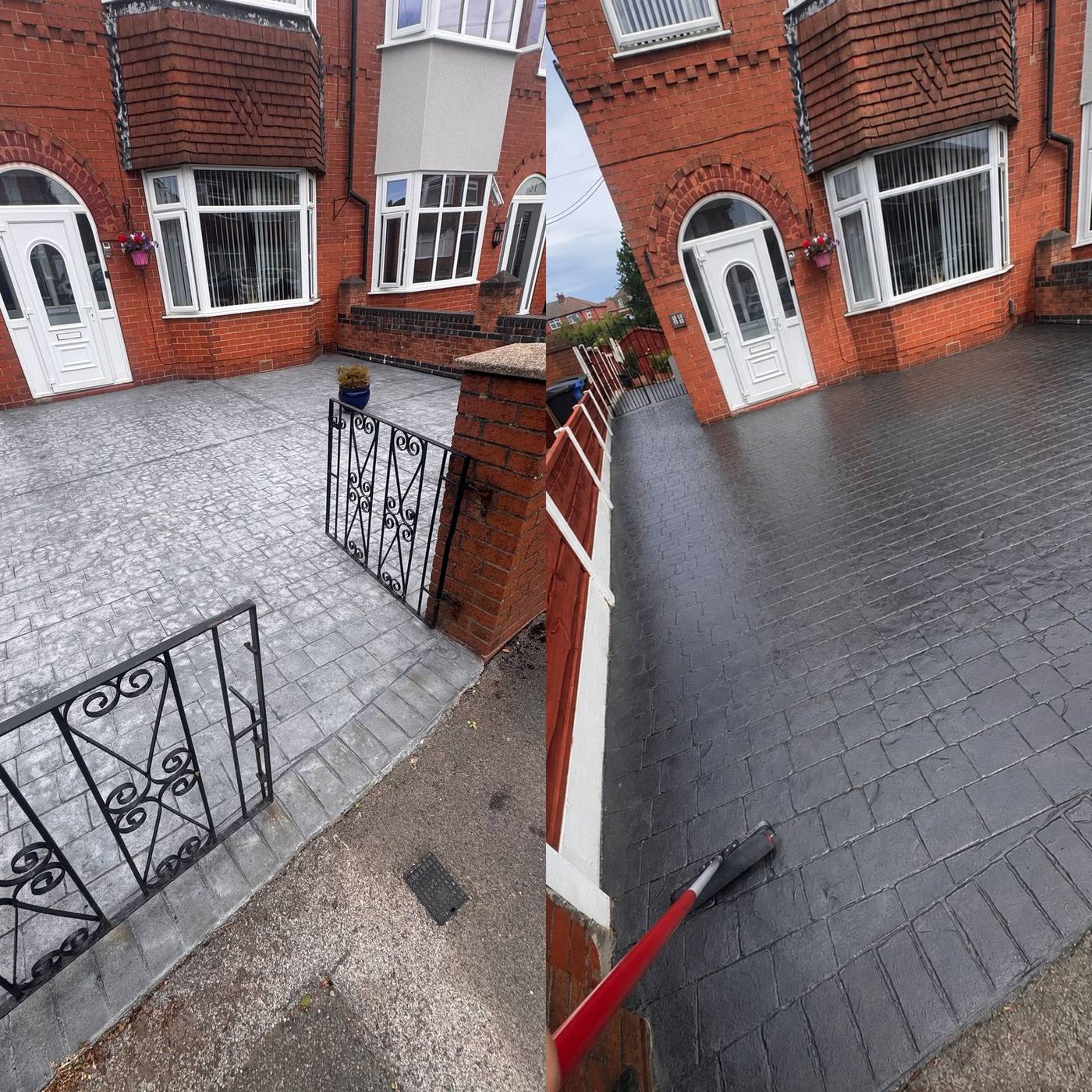
A faded imprinted concrete driveway in Greater Manchester, cleaned and resealed by C&C Precision.
Quick answer: A properly sealed driveway in Greater Manchester typically lasts 3–5 years before resealing is needed. Block paving and imprinted concrete sealers tend to last 3–4 years in our wet northwest climate, while quality sealers on well-prepared surfaces can stretch to 5 years with basic maintenance.
The Honest Answer: 3–5 Years for Most Driveways
Three to five years is a realistic lifespan for a properly applied driveway sealer in Greater Manchester. Some product marketing will quote up to ten years, but that figure tends to come from testing in controlled or southern European conditions — not from a northwest driveway that gets 1,100mm of rain a year, frequent freeze-thaw cycles through winter, and persistent algae growth from October to April. On a typical Oldham or Rochdale semi-detached, five years is a good outcome. Three to four is more common.
That doesn't mean sealing isn't worth doing. It means you should go in with accurate expectations rather than feeling let down when the surface needs attention again after a few years. The goal of a sealer is to slow deterioration, protect colour, and reduce how quickly moss and weeds get a foothold — not to make maintenance disappear entirely. A sealed surface is still easier to clean year after year than an unsealed one.
The gap between manufacturer claims and real-world performance usually comes down to UV exposure, traffic load, and how well the surface was prepared before the sealer went down. We'll come back to all three of those.
Does the Type of Driveway Surface Change the Lifespan?
It does, quite significantly. Imprinted concrete — the patterned, coloured concrete that became popular in the 2000s — tends to sit at the shorter end of the range. The sealer on imprinted concrete is doing more work: it's protecting the colour, providing a surface sheen, and keeping the concrete from becoming porous. UV exposure and foot traffic degrade it faster, and because the surface is rigid, any movement in the substrate tends to create hairline cracks where moisture gets under the sealer film. Realistically, three to four years before resealing is needed.
Block paving sits more comfortably in the three to five year bracket. The sealer here is less about colour protection and more about stabilising the jointing sand and slowing moss and weed ingress. Because block paving is a flexible surface — the blocks move slightly with ground conditions — a sealer that's too rigid can actually crack rather than flex. Getting the right product for the surface matters. Block paving cleaning is always the first step before any sealer goes down, and the condition of the joints going in directly affects how long the result holds.
Tarmac and plain concrete can last longer if traffic is light and the surface was in good condition at the time of sealing — sometimes up to five or six years. But heavy vehicle use, oil contamination, or an uneven surface dramatically shortens that. No sealer will compensate for a structurally compromised base.
Why Greater Manchester's Climate Is Hard on Driveway Sealers
The northwest gets more rainfall than most of England, and that moisture is the main enemy of any exterior coating. Standing water that doesn't drain properly sits against the sealer film, gradually breaking down adhesion. Freeze-thaw cycles in winter — where water absorbed into micro-cracks freezes, expands, and forces the surface apart — put stress on any sealed surface, and Greater Manchester gets enough of those to matter. A driveway in a sheltered suburb of Bolton or Stockport will behave differently to one exposed to wind and frost on higher ground around Saddleworth or Littleborough.
Algae and moss growth is persistent here in a way it simply isn't in drier parts of the country. The damp, overcast conditions from autumn through to late spring create ideal conditions for organic growth to establish on any surface that isn't perfectly sealed or regularly treated. Once algae gets a grip on a sealer film, it begins to break it down — both physically through root penetration and chemically through the acids it produces. This is one of the reasons softwashing with a biocide is a useful maintenance tool between full reseals; it treats the organic growth at the root rather than just surface-level.
Limited UV hours also mean that sealers applied in cooler months take longer to cure properly. A driveway sealed in October in Tameside or Bury needs more time to fully harden than the same job done in July. Rushing the drying and curing process in low temperatures is a common cause of early sealer failure — the product never bonds as it should.
What Actually Shortens a Sealed Driveway's Life
The single biggest cause of premature sealer failure is applying the product to a surface that wasn't properly cleaned or wasn't fully dry. Sealer applied over algae, lichen, or residual moisture traps contamination underneath it, bonds poorly to the surface, and often starts to peel or cloud within a year. This happens more often than it should, and it's why thorough preparation — not the sealer brand — is the real determinant of longevity.
Using the wrong sealer type for the surface is the second most common issue. Imprinted concrete needs a specific resin-based sealer; block paving generally works better with a product that allows some vapour transmission so moisture doesn't get trapped beneath it. Applying a film-forming sealer intended for imprinted concrete onto block paving can cause whitening and peeling as the surface tries to breathe. Not all sealers sold in trade or retail are suitable for all surfaces, and the labelling isn't always clear about this.
Heavy vehicle loads wear the sealer surface faster, particularly on block paving where the individual blocks flex under weight. And ironically, aggressive pressure washing after sealing — or between reseals — can damage the sealer film itself. High PSI washing strips the top layer of sealer over time, which is why a lower-pressure clean with appropriate chemicals is generally better for maintaining a sealed surface than going at it hard every spring.
Does Preparation Make a Difference to How Long It Lasts?
Yes — it makes more difference than anything else, including the quality of the sealer product. A mid-range sealer applied over a perfectly clean, dry, and properly prepared surface will outlast a premium product applied in poor conditions. This isn't a particularly complicated point, but it's one that gets glossed over when people focus on product selection rather than process.
For block paving, preparation means a thorough clean followed by block paving re-sanding with kiln-dried sand before any sealer goes down. The jointing sand needs to be in good condition and fully settled before sealing — if it isn't, the sealer will lock sand movement in a compromised position, and you'll get uneven jointing and potential block movement beneath the surface. Re-sanding alone, without cleaning first, is also counterproductive; the new sand just washes out with the first rain if there's organic matter in the joints degrading it.
For imprinted concrete and stone surfaces, preparation means removing all biological growth, degreasing any oil or fuel staining, rinsing thoroughly, and then waiting. In the northwest, that typically means allowing 24–48 hours of dry weather minimum before sealing — longer in autumn and winter. C&C Precision won't seal a surface that isn't ready, even if that means rescheduling. It's not worth the call-back six months later when the sealer starts to peel.
The surface temperature matters as much as the air temperature. Most sealers need the surface to be above 10°C and falling temperatures or incoming rain will compromise the cure. Check the forecast for the 24–48 hours after application, not just the day of the job.
Signs Your Driveway Sealer Has Failed and Needs Redoing
The clearest sign is water behaviour. A properly sealed surface will cause water to bead and run off rather than soak in. If you pour a small amount of water onto your driveway and it absorbs rather than beads, the sealer has lost its effectiveness and the surface is now porous again. This is the most reliable test you can do yourself, and it's worth checking annually rather than waiting until the surface looks obviously deteriorated.
On block paving, watch for sand washing out of the joints during heavy rain. If the joints are emptying out, the sealer that was binding the kiln-dried sand in place has broken down. Moss and weeds will follow quickly once the joints are open. On imprinted concrete, look for dullness and colour fade — the surface will look flat rather than having any sheen, and the pattern may appear washed out compared to when it was sealed. Visible flaking or peeling, where the sealer lifts from the surface in patches, is a clear sign of either product failure or a preparation issue on the previous job.
Moss and algae returning quickly after cleaning is another signal. A sound sealer slows recolonisation significantly; if you're cleaning the same growth off every few months, the surface protection is gone. At that point, cleaning alone won't solve the problem — the surface needs to be assessed for a full clean, treatment, and reseal. You can read more about what a full driveway cleaning process involves before any decisions about sealing are made.
What to Do Before Your Next Reseal: A Practical Checklist
Check the surface every year rather than waiting for obvious problems. A quick water-bead test in spring takes thirty seconds and tells you where the sealer stands. If moss or algae is starting to establish, treat it early — a biocide application when growth is light is far less disruptive than waiting until it's embedded in the joints and lifting the sealer film. The guide on cleaning block paving properly covers the difference between surface cleaning and proper treatment if you want to understand the process in more detail.
Don't pressure wash aggressively and assume you're maintaining the surface — high-pressure washing without the right technique strips sealer over time, particularly on imprinted concrete where the film is thin. If you're maintaining a sealed surface yourself between professional cleans, use lower pressure and a suitable surface cleaner attachment rather than a lance at close range.
Before any new sealer goes down, the surface needs a full professional clean. There are no shortcuts here. Get the clean done first, assess the condition of the jointing sand on block paving, and allow proper drying time. If you're unsure whether your driveway needs a full reseal or just a clean and moss treatment, send a couple of photos — it's usually possible to give a clear steer on what's actually needed without anyone having to come out first. Driveway sealing Manchester needn't be complicated when you know what questions to ask, and getting an accurate quote is easier than most people expect.
Frequently asked questions
How much does driveway sealing cost in Manchester?
It varies by surface type, size, and condition. Block paving re-sanding and sealing on a typical semi-detached driveway in Greater Manchester will cost more than a straight clean alone — the prep work is where the time goes. The best way to get an accurate price is to send a couple of photos on WhatsApp so we can see exactly what's involved.
Can you seal a driveway without cleaning it first?
No — and anyone who tells you otherwise is cutting corners. Sealer applied over algae, dirt, or damp surfaces will trap contamination underneath, bond poorly, and fail much sooner. A thorough clean and dry surface is non-negotiable if you want the sealer to last.
Is driveway sealing worth it in the northwest?
For imprinted concrete, yes — without a sealer the colour fades badly and the surface becomes porous and harder to clean. For block paving it depends on your priorities; sealing slows moss and weed growth and protects the jointing sand. Given how wet Greater Manchester is, most customers find it worthwhile.
How long after cleaning can a driveway be sealed?
The surface needs to be completely dry before any sealer goes down — in the northwest that typically means waiting at least 24–48 hours of dry weather after cleaning, and longer in cooler months. Rushing this step is one of the most common reasons sealers fail prematurely.
Thinking about getting your driveway cleaned and sealed?
Send a couple of photos on WhatsApp and we'll come back with a fast, honest price — no obligation.