If you've typed "driveway cleaning near me" into Google recently, you'll know the results page can feel overwhelming. Dozens of companies, varying prices, and almost no way to tell who actually knows what they're doing before someone turns up at your door. This guide is written to help homeowners across Greater Manchester cut through that noise and make a straightforward, confident decision.
The North West doesn't do dry summers. Between the rainfall, the shade from terraced housing and the general damp that settles across Oldham, Rochdale, Bury and the surrounding towns, driveways here earn their moss and algae faster than most parts of the country. That means the cleaning job matters more, and the difference between a contractor who genuinely understands exterior surfaces and one who's just hired a pressure washer for the weekend is worth knowing about before you commit.
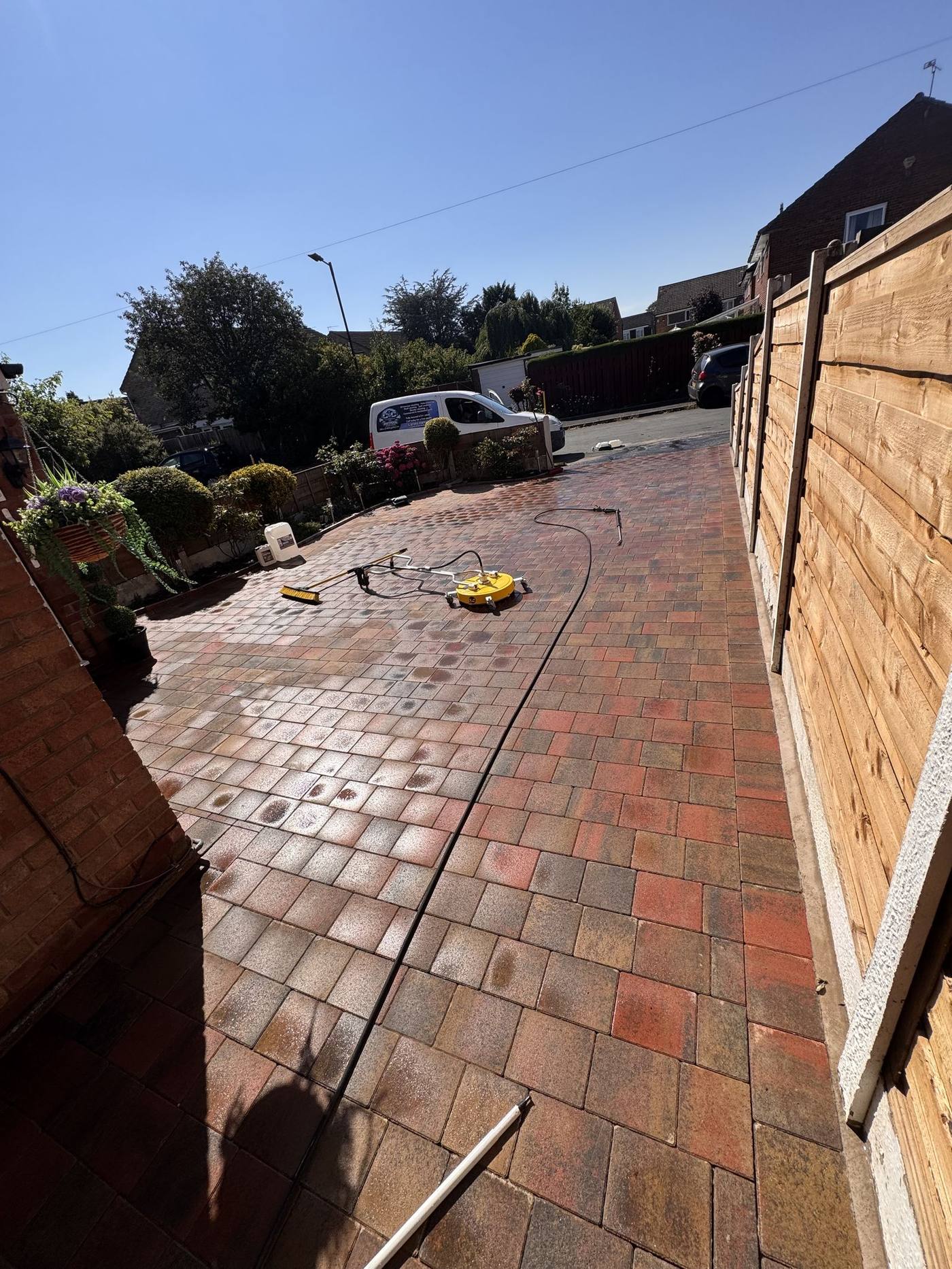
A freshly cleaned block paving driveway in Greater Manchester. The colours come back once the algae, moss and grime are properly lifted.
Quick answer: To find a reliable driveway cleaning company near you in Greater Manchester, look for verifiable Google reviews, proof of public liability insurance, and a contractor who asks to see photos before quoting. Avoid anyone who won't give a clear price upfront or turns up with just a domestic pressure washer.
Why "Driveway Cleaning Near Me" Gives You Mixed Results
A local search pulls up everyone from a sole trader with a domestic Karcher to a fully equipped professional outfit with commercial machinery, public liability insurance and years of experience across different surface types. Proximity to you tells you almost nothing about which category a business falls into. The search results are ranked by SEO, not by quality of work.
Better filters exist. Look for contractors with a consistent trail of detailed Google reviews — not just star ratings, but written accounts with photos that show real before-and-after results. Check whether the company carries public liability insurance and what the coverage limit is. Ask how they quote — a contractor who wants to see the job (even via photos) before giving a price is thinking about the work, not just the transaction.
The gap in results between a hurried, low-cost clean and a properly executed one is significant. It shows up immediately in the finish and it shows up again six months later, when one driveway stays cleaner for longer and the other is already greening over again.
What a Proper Driveway Clean Actually Involves
Most homeowners assume pressure washing is simply pointing a lance at the ground until it looks cleaner. A professional job is more considered than that. It usually starts with a pre-treatment — a biocide or cleaning solution applied to the surface and left to dwell. Dwell time matters: giving the chemical time to break down algae, lichen and embedded grime means the pressure washing stage does far less brute work and produces a better result with less risk of surface damage.
The cleaning itself should be done with a rotary surface cleaner rather than a handheld lance. A surface cleaner keeps consistent pressure across the whole area, avoids the streaky fan marks you often see on DIY jobs, and is significantly faster on anything larger than a path. After rinsing, the finishing details are where many cheap jobs fall short. On block paving, the high-pressure water will wash out the jointing sand between the pavers — that sand needs replacing with kiln-dried jointing sand brushed back in and compacted. Skip that step and the blocks become unstable and weeds establish themselves almost immediately.
A thorough driveway clean also involves checking for damage, loose edging or areas where weeds have pushed up from beneath — information a good contractor will flag to you rather than just work around.
Block Paving, Concrete, Tarmac, Imprinted Concrete — Does the Surface Type Matter?
It matters considerably. Each surface has its own pressure tolerance, its own chemical requirements and its own aftercare. Block paving is porous and can handle a thorough clean, but it needs re-sanding afterwards and benefits from a sealer application if the surface is ageing. Concrete flags are durable but can be etched by excessive pressure, especially if they're older or have started to degrade. Tarmac is the most pressure-sensitive of the common driveway surfaces — too much and you'll lift the aggregate, leaving a rough, pitted finish that looks worse than what you started with.
Imprinted concrete, sometimes called pattern imprinted concrete or PIC, needs particular care. The decorative top layer carries a sealer that protects both the pattern and the colour. High pressure applied directly to worn or cracking sealer can lift it and leave dull patches. In most cases, imprinted concrete needs a low-pressure chemical clean followed by resealing once dry — the sealer is what protects the investment.
Render and stone surfaces on the house itself follow similar logic — the softwashing approach, which uses sodium hypochlorite at low pressure rather than high-pressure water, is usually the right method for anything that could be damaged by force. If your driveway work extends to adjacent walls or a rendered front elevation, it's worth discussing that at the quoting stage rather than treating them as separate jobs.
How to Check if a Contractor Is Actually Worth Hiring
Start with Google reviews and read them properly. A 5.0 average from a handful of reviews means less than a 4.9 from eighty genuine customers with detailed write-ups and photos. Look for reviews that mention specific surfaces, specific towns in Greater Manchester, and describe the experience as well as the result. Recent reviews matter more than old ones — you're assessing the current business, not what it was two years ago.
Ask about insurance before anything else. You're looking for public liability cover — at minimum £1,000,000, though £2,000,000 or £5,000,000 is common among established contractors. A reputable company will produce the certificate without hesitation. If someone hedges, changes the subject or says they're "covered" without being able to show documentation, walk away. Pressure washing on your property without insurance is your liability if something goes wrong.
Notice how they quote. A contractor who asks for photos before giving a price, or who wants to know the surface type and approximate size, is thinking about the job properly. One who quotes a flat rate immediately without any information about your specific driveway is either very experienced at estimating or cutting corners. Ask a direct question or two — how they handle block paving re-sanding, what chemical they use as a pre-treatment — and see whether they give a straight answer. Green flag: specific, plain answers. Red flag: vagueness, upselling before they've even seen the job, or any reluctance to confirm their insurance in writing.
What to Expect to Pay for Driveway Cleaning in Greater Manchester
Pricing is almost always calculated by square metre for driveways of any meaningful size. For block paving cleaning, a basic clean without chemical pre-treatment starts from around £3.50/m². A clean with full chemical treatment — biocide pre-treatment, surface clean and rinse — is typically around £4.25/m². If the block paving needs re-sanding afterwards, which it usually does after a thorough clean, that adds around £2.00/m² on top. A full restoration — clean, chemical treatment and re-sanding — comes to around £5.50/m² as a combined rate. Re-sanding only, without a clean, is around £2.00/m².
A typical double driveway in Greater Manchester is somewhere between 40 and 60 square metres. At those rates, a full clean and re-sand on a 50m² block paved driveway would sit around £275. Concrete or tarmac driveways of a similar size tend to be at the lower end of the range because they don't need re-sanding. Very large driveways, or those with particularly heavy moss and algae buildup, may take longer and cost proportionally more.
A cheap quote isn't always a saving. A job that skips the pre-treatment, doesn't re-sand the block paving and leaves the surface unprotected will look good for six to eight weeks and then deteriorate quickly. A fair price for a proper job done once is better value than a low price done twice.
Before any contractor starts work, ask them directly: will you re-sand the block paving after cleaning? If they look uncertain or say it isn't necessary, that tells you something. Freshly cleaned block paving with no jointing sand is unstable and will colonise with weeds within a season. It's a basic step in any competent block paving clean.
When the Job Is Beyond a Basic Clean — Call a Professional
Some driveways haven't been touched in five or ten years. The jointing sand is gone, moss has established itself in the gaps, and the surface has a thick layer of biological growth that a domestic machine won't shift. In those cases, a standard clean is only the beginning of what's needed. Deep-set algae and lichen often need a longer chemical dwell time, stronger pre-treatment solutions, and sometimes a follow-up biocide treatment a few weeks after the initial clean to deal with any regrowth as the surface fully dries out.
Imprinted concrete that has lost its sealer needs to be assessed carefully. Cleaning a surface with failing sealer and then leaving it bare exposes the concrete underneath to staining and water ingress. The right process is clean, allow to dry fully — at least 24 hours in dry weather, longer in a Greater Manchester spring — and then apply a fresh sealer. If you're unsure how your driveway's sealer is holding up, look for dull or patchy areas, colour fading, or water soaking in rather than beading on the surface. Those are signs the sealer needs attention. More detail on sealing lifespan is covered in the guide on how long driveway sealing lasts in Greater Manchester.
If you're a landlord, letting agent or property manager with multiple sites, the logistics are different to a domestic job — access, scheduling, and the need for consistent results across several properties. C&C Precision handles commercial pressure washing across Greater Manchester for exactly this kind of work, and a separate guide covers the specifics of exterior cleaning for property managers in more detail.
Before You Book Anyone: A Simple Checklist
Send photos before agreeing a price. A WhatsApp photo of your driveway takes two minutes and means the quote is based on your actual job, not a guess. Any contractor worth hiring will want to see it before committing to a figure — and if they won't, that's a reasonable reason to be cautious.
Ask for proof of public liability insurance and confirm the coverage level. £1,000,000 minimum is the baseline; ask for the certificate, not just a verbal confirmation. Confirm what the job includes: pre-treatment or not, re-sanding on block paving, and what happens if there's a heavily affected area that needs more time. Make sure you understand what's included in the price before anyone starts. Check their reviews — look for ones with photos, specific locations in Greater Manchester, and enough detail to feel genuine. And finally, make sure you know how to reach them after the job if you have a question. A contractor who's easy to contact before the job is usually easy to contact after it.
Frequently asked questions
How much does driveway cleaning cost in Greater Manchester?
Most driveways in Greater Manchester come in between £80 and £250 depending on size, surface type and how long the job takes. Block paving that needs re-sanding afterwards will sit at the higher end. The best way to get an accurate figure is to send a couple of photos — it takes two minutes and removes the guesswork on both sides.
Is it worth getting a driveway professionally cleaned or can I just hire a pressure washer?
Hiring a pressure washer yourself is fine for a light refresh, but it rarely matches a professional result. Trade-grade surface cleaners, pre-treatment chemicals and the knowledge of how much pressure to use on each surface make a real difference — especially on block paving, imprinted concrete or anything with heavy moss and algae. You also risk stripping jointing sand or etching the surface if the pressure is set too high.
How do I know if a driveway cleaning company is insured?
Ask them directly and ask for the certificate — any reputable contractor will have it to hand. You're looking for public liability insurance, ideally at least £1,000,000 cover. If someone hesitates or can't produce the document, that's a clear sign to look elsewhere.
How long does a driveway clean take?
A standard single or double driveway typically takes between one and three hours depending on the size and condition. If the block paving needs re-sanding after the clean, add another hour. You don't need to be home for most of the job — a good contractor will be clear about access requirements when they quote.
Want a Fast Quote for Your Driveway in Greater Manchester?
Send a couple of photos over WhatsApp and we'll come back with a straight price — no faff, no obligation.