If your driveway has taken on a green tint over autumn and winter, you are not imagining it getting worse year on year. Green algae on driveways is one of the most common problems we deal with across Greater Manchester, and the damp, low-light winters here create near-perfect conditions for it to thrive. Left untreated, what starts as a faint green film becomes a slippery, embedded layer that discolours the surface and increases the risk of a fall every time it rains.
This guide covers why it happens, what separates a proper clean from a quick blast with a pressure washer, and what you can realistically do to slow its return. The advice applies whether your driveway is block paving, tarmac, concrete or imprinted concrete — though the method and the results will vary by surface type.
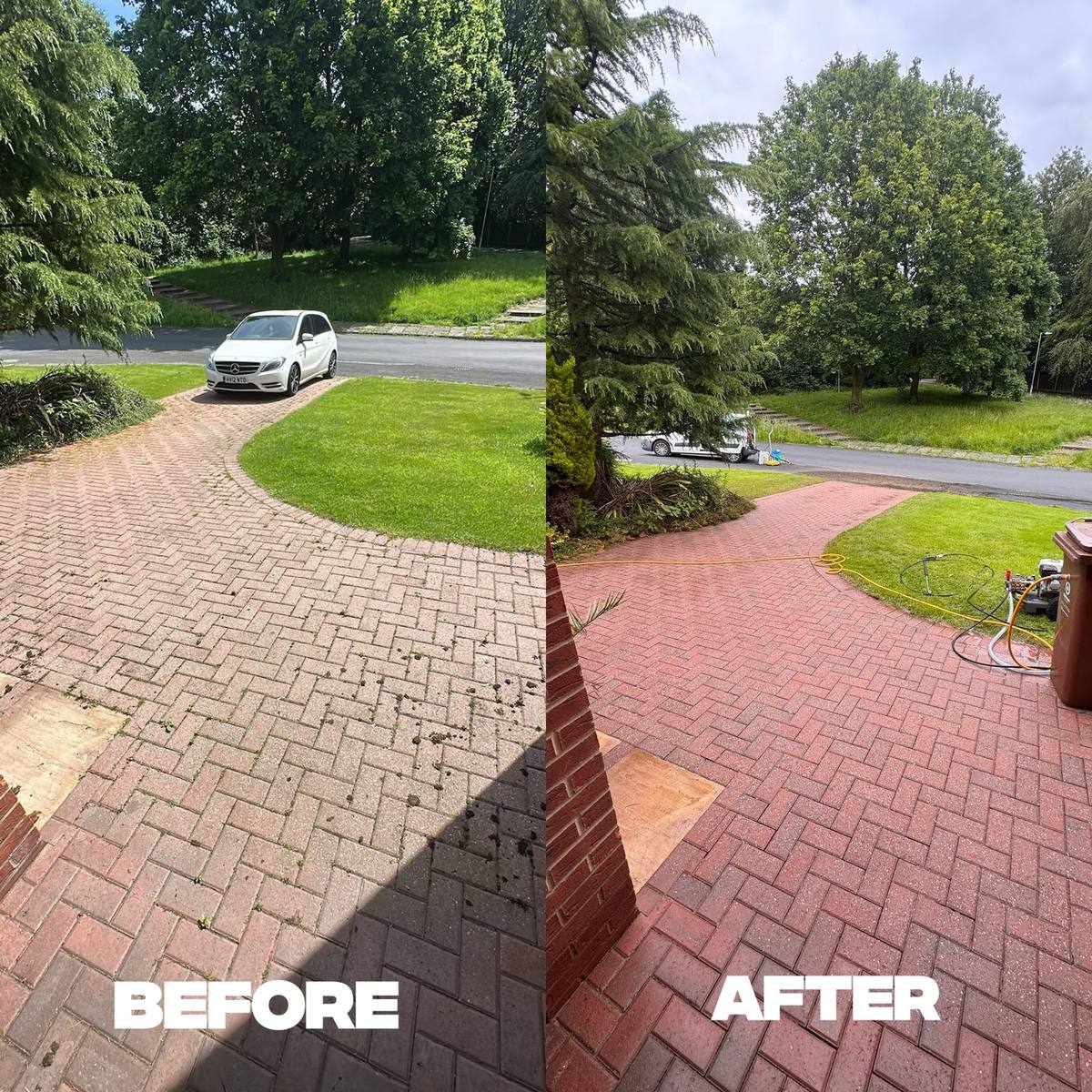
Before and after: green algae removed from a block paving driveway in Greater Manchester by C&C Precision.
Quick answer: Driveways go green every winter because low light, moisture and falling temperatures create perfect conditions for green algae, lichen and moss to colonise porous surfaces. Without treatment the growth returns season after season. Professional pressure washing plus a post-clean biocide treatment breaks the cycle and keeps surfaces clean far longer.
What Is the Green Stuff on Your Driveway?
People tend to use "moss" or "algae" interchangeably, but they are different things and they behave differently. Green algae is the thin, slippery film that spreads across the surface as a flat sheet — it looks almost like green paint in wet weather and it is the reason a damp driveway can feel like sheet ice underfoot. It colonises quickly and can cover a large area in a single season.
Moss is the thicker, cushion-like growth you find in joints and along edges. It roots into pointing material and, over time, physically lifts jointing sand or mortar, which causes long-term structural problems in block paving rather than just a cosmetic issue. Lichen is harder to spot and harder to remove — it presents as crusty, almost paint-like patches in grey, yellow or white, and it bonds chemically with the surface material rather than just sitting on top of it. Lichen takes longer to treat and some staining may lighten without fully disappearing, depending on the surface and how long it has been there.
Most driveways have all three to some degree. The green algae on a driveway is usually the most visible and the most immediate slip hazard, which is why it tends to get the most attention.
Why Winter Is Prime Time for Algae Growth
The North West of England does not get the hard frosts that other parts of the UK rely on to kill off surface growth. What we get instead is persistent damp — grey skies, drizzle that barely stops for weeks, and reduced UV light from October through to March. UV from direct sunlight naturally suppresses algae growth. Take that away for five or six months and the conditions suit algae almost perfectly.
Autumn makes things worse before winter does. Leaf fall in October and November deposits a layer of organic material across hard surfaces. Leaves mat down, hold moisture against the paving, and slowly break down into a nutrient-rich film. That is essentially fertiliser for algae and moss. A driveway that looked clean in August can be noticeably green by mid-November without anyone paying it much attention in between.
Lower foot traffic in winter means the natural abrasion that slows surface growth is reduced too. The combination of darkness, moisture, organic debris and reduced wear is why the worst cases we see are typically on driveways that have come through a full winter without any maintenance.
Why Some Driveways Are Far Worse Than Others
Aspect makes a significant difference. A north-facing driveway in Oldham or Rochdale may receive almost no direct sunlight between November and February. Without UV, algae and moss establish themselves quickly and deeply. South-facing drives on open plots will still grow algae — particularly in the shadowed areas near fences or walls — but they tend to be less severely affected overall.
Shading from trees, boundary fences and tall hedges creates the same effect. A driveway that runs alongside a mature hedge on both sides, as many are in the older terraced streets around Greater Manchester, can stay damp for days after rain because there is almost no air movement or sunlight reaching the surface. Overhanging trees also drop organic debris year-round, not just in autumn.
Surface material matters too. Older concrete block paving and tarmac both become increasingly porous as they age, giving algae and moss more purchase. A paved driveway where the jointing sand has been washed out over the years provides gaps for moss to root into and water to pool in. Smooth porcelain is less hospitable to algae than rough concrete, but no hard surface is immune if drainage is poor and shade is constant.
Why Pressure Washing Alone Doesn't Fix It
A pressure washer will remove visible growth, and the driveway will look dramatically better immediately afterwards. The problem is what it leaves behind. Algae and moss reproduce via spores, and those spores penetrate the surface material itself. Blasting the top layer off does not reach the spores sitting in the pores of the concrete or in the spaces between blocks. Within two to four months in the kind of damp conditions we have across Greater Manchester, the surface will typically be showing green again.
There is also a technique issue with DIY pressure washing. A standard domestic machine often lacks consistent pressure across the lance, and without a rotary surface cleaner attachment the operator tends to work in strips — which leaves visible cleaning lines, sometimes called tramlines or zebra stripes, across the surface. On block paving, high-pressure lance work at the wrong angle strips jointing sand from the joints, which then needs replacing before water and debris migrate down into the sub-base.
A proper process uses a pre-treatment — a biocidal solution applied to the surface and left to dwell, which starts breaking down the organic material before any washing begins. The pressure washing step then removes what has already been loosened rather than trying to do everything mechanically. A post-clean residual biocide or, where appropriate, a sealer is then applied to slow regrowth. That three-stage approach produces a significantly better result than a direct blast, and it lasts considerably longer.
The Right Way to Clean a Green Driveway
The process starts before the pressure washer is even unloaded. A pre-treatment solution — typically a sodium hypochlorite-based or specialist biocidal product — is applied to the surface and given time to work. Dwell time varies depending on the severity of the growth and the product being used, but cutting it short produces noticeably worse results. The pre-treatment breaks down the cellular structure of algae and moss, making everything that follows more effective and more thorough.
The cleaning stage uses a rotary surface cleaner for most flat surfaces rather than a lance. It delivers consistent, even pressure across the full width of the head, removes growth without striping the surface, and is much gentler on jointing material than a direct lance. For driveway cleaning on block paving, the pressure is kept lower than you might expect — enough to clean thoroughly without blasting out the sand. Tarmac, imprinted concrete and natural stone each have their own pressure requirements, and getting it wrong can cause surface damage that is expensive to put right. Detail work around edges, drainage channels and steps is done by hand where a rotary head cannot reach.
After cleaning, a residual biocide is applied to the clean surface. This continues working for weeks after the job is done and significantly extends the period before growth returns. For block paving, if the joints have been compromised — either stripped during cleaning or already eroded before we arrived — re-sanding with kiln-dried sand is done before any sealer is applied. Sealing is optional but worthwhile on paving that is going to see continued shade and moisture; it closes the surface pores, reduces water absorption and makes future cleaning considerably easier. You can read more about that process in our guide on how long driveway sealing lasts in Greater Manchester.
When It's Time to Call a Professional
There is nothing wrong with tackling light surface algae yourself — a proprietary patio cleaner, a stiff brush and some patience will deal with growth that has only been there a season or two. The honest answer to when it stops being a sensible DIY job is when the growth has been established for several years, when you can see moss physically lifting joints or edges, or when the driveway needs re-sanding after cleaning. Those situations need the right equipment and the right products to resolve properly.
Slip risk is also worth taking seriously. If someone in the household has mobility concerns or is at higher risk from a fall, green algae on a driveway is not something to put off until it is more convenient. Wet algae on smooth concrete or tarmac has very little grip at all.
For block paving that needs a full clean and restoration, pricing typically starts from around £3.50/m² for a standard clean, £4.25/m² where a chemical pre-treatment is included, and £5.50/m² for a full restoration including re-sanding. Re-sanding only, where the surface has already been cleaned, starts from around £2.00/m². If you want an accurate figure rather than a rough estimate, the quickest way is to send a few photos over WhatsApp — C&C Precision Precision Pressure Washing comes back with a price the same day in most cases, and the business carries £1,000,000 public liability insurance. The Google reviews are worth a look if you want an honest picture of the work.
If your block paving joints are visibly eroded or you can see moss rooting between blocks, clean the surface before re-sanding — never the other way around. Applying new kiln-dried sand to a surface that still carries algae or moss spores means the organic material is sealed in rather than removed, and the new sand will degrade far faster than it should.
Practical Steps to Keep Your Driveway Clean Longer
The single most useful thing most homeowners can do is clear leaves promptly in October and November rather than leaving them to mat down over winter. A leaf blower or a stiff brush once a week through the worst of autumn takes twenty minutes and makes a real difference to how much organic material accumulates on the surface. Keep borders and beds trimmed back from the edge of paving where possible — soil and organic debris washing across the surface in heavy rain is a consistent source of nutrients for algae and moss.
Drainage matters more than people realise. A driveway with blocked or poorly designed drainage channels will hold standing water after rain, and standing water accelerates growth significantly. Keeping drainage clear and checking that water is actually running off the surface rather than pooling is a straightforward maintenance task that costs nothing.
If you have had block paving cleaned professionally and the joints re-sanded, consider a sealer. It will not prevent algae indefinitely, but it slows the rate of regrowth and makes the next clean easier. On imprinted concrete, a fresh topcoat of sealant after cleaning refreshes the colour as well as protecting the surface. The realistic expectation in the North West is that an annual or biennial clean is normal maintenance — not a sign that something has gone wrong. Booking before winter sets in rather than waiting until March, when the damage has already accumulated over months of wet weather, generally means a shorter clean time and a better result. If you are on the Rochdale side of Greater Manchester, the specifics of driveway cleaning in Rochdale are worth a read.
Frequently asked questions
Is green algae on a driveway dangerous?
Yes, in practical terms. Wet algae on hard surfaces becomes extremely slippery — particularly on smooth concrete, tarmac or porcelain. It's one of the more common causes of slips outside residential properties in wet weather. If you can see green discolouration, the surface will already have reduced grip.
Will the green algae come back after pressure washing?
It will eventually, yes — especially on north-facing or shaded driveways in Greater Manchester where damp conditions persist. The key is applying a residual biocide after cleaning to kill off remaining spores and slow regrowth. A properly treated driveway will typically stay clean for one to two years rather than a few months.
Can I remove green algae from my driveway myself?
You can treat it with a patio or drive cleaner from a DIY store and a stiff brush, and that may deal with light surface growth. For anything that has been building up over more than one season, a domestic pressure washer usually won't generate enough consistent pressure or use the right technique to remove it properly, and you risk damaging joints or the surface itself.
How much does driveway cleaning cost in Oldham or Greater Manchester?
Price depends on size, surface type and how heavily soiled the driveway is — a standard block paving driveway on a semi will come out differently to a large imprinted concrete drive on a detached. The fastest way to get an accurate figure is to send a few photos over WhatsApp; C&C Precision usually comes back with a price the same day.
Got a green driveway in Greater Manchester?
Send us a photo on WhatsApp and we'll come back with a fast, honest price — usually same day.