Failsworth sits just a few miles from Oldham town centre, and like most of Greater Manchester, it doesn't get much in the way of dry spells. The combination of persistent damp, shaded driveways, and the kind of westerly weather that rolls in off the Pennines means algae, moss, and black spot build up on exterior surfaces faster here than in drier parts of the country. If you've been looking into pressure washing Failsworth properties, you'll find this guide covers the main surfaces, realistic costs, and where the limits of DIY begin.
This isn't a sales pitch. It's a straightforward look at what exterior cleaning involves for the types of homes you find in Failsworth — the terraced streets off Ashton Road, the semis around Broadway, properties with block paving driveways, rendered frontages, and rear yard patios that have been quietly turning green for years. The aim is to give you enough honest information to make a sensible decision about what to do next.
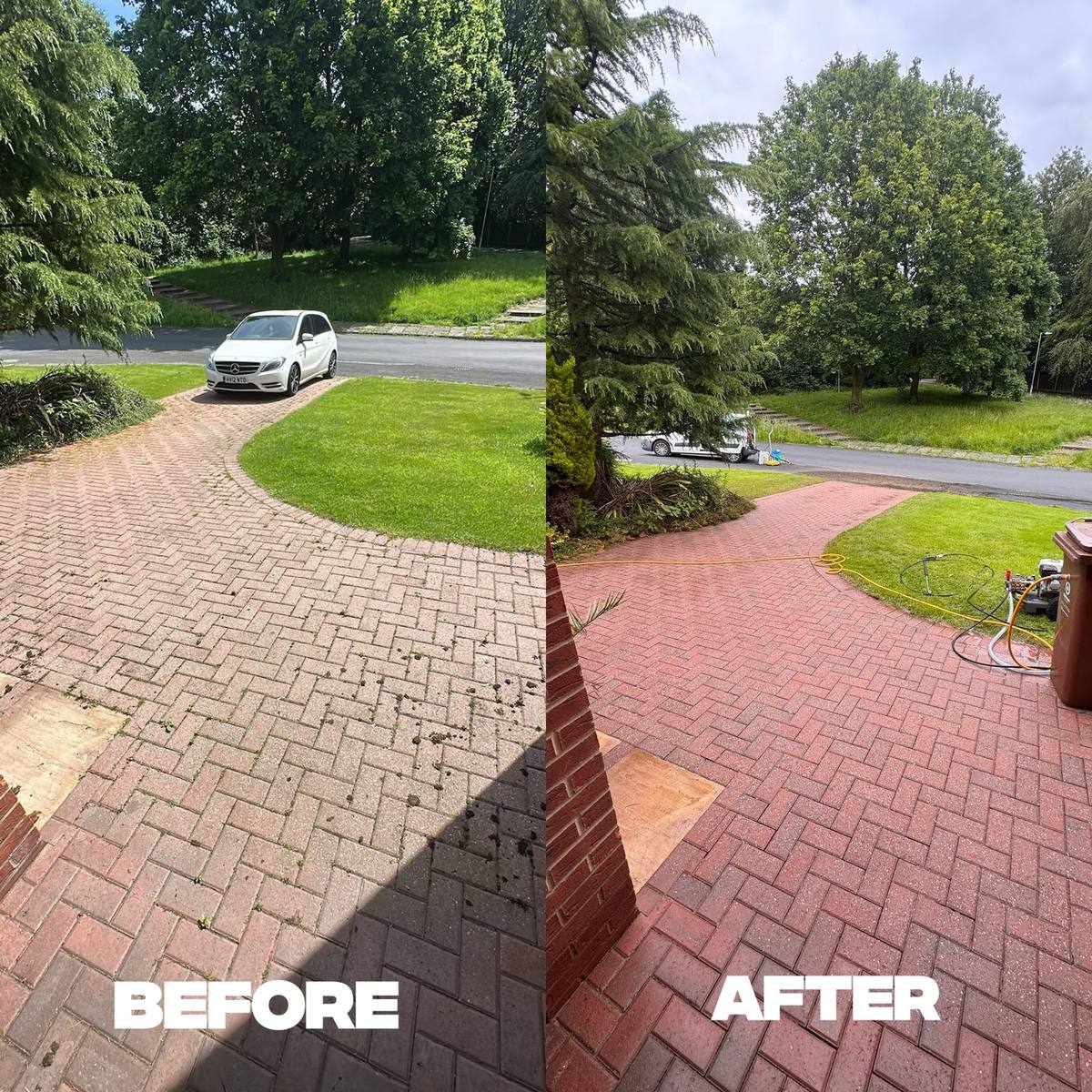
Block paving driveways are one of the most common jobs we do across Failsworth and Oldham.
Quick answer: Pressure washing in Failsworth covers driveways, patios, block paving, render, and roofs. C&C Precision serves Failsworth and the wider Oldham area with professional-grade equipment, fully insured to £1m public liability. Send photos on WhatsApp for a fast, no-fuss quote.
What Surfaces Can Be Pressure Washed in Failsworth?
Most exterior hard surfaces can be cleaned safely, provided the right method and the right pressure are used for each one. Block paving, plain concrete, imprinted concrete, tarmac, natural stone such as Indian sandstone and York stone, and porcelain slabs all respond well to pressure washing when it's done properly. The same applies to concrete flags, rear yard slabs, and paths — surfaces that tend to be overlooked until they've turned a consistent shade of dark green.
Roofs and rendered walls are a different matter. These surfaces are cleaned at low pressure using chemical treatments rather than the force of water. Moss and lichen on roof tiles, and algae or mould on rendered walls, need to be killed at the root before they can be removed — blasting them with a pressure washer doesn't achieve that and can cause real damage. You can read more about how that process works in the guide to softwashing and the separate guide covering roof cleaning and moss removal.
The short version: if it's a hard, flat surface outdoors, it can almost certainly be cleaned. If it's rendered or tiled, it needs a different approach.
Driveway Cleaning in Failsworth: What to Expect
Block paving driveways are common across Failsworth, and they follow a predictable pattern — the jointing sand washes out over time, moss takes hold in the gaps, and the surface gradually darkens with algae and general grime. Pressure washing Failsworth driveways of this type typically starts with a pre-treatment, applying a biocide or detergent to loosen organic material and begin breaking down the algae before water even touches the surface. After a dwell period, a rotary surface cleaner is used rather than an open lance — this gives an even, controlled clean without the stripe marks you get from wand cleaning. The surface is then rinsed down and inspected.
If the jointing sand has been lost — which it usually has on block paving that hasn't been maintained — re-sanding is the logical next step. Kiln-dried sand is brushed into the joints to stabilise the blocks, prevent future weed growth, and restore the finished look. Skipping this step leaves the surface vulnerable to further weed ingress and means the clean won't hold as well. You can find a full breakdown of that process at the block paving re-sanding page.
Imprinted concrete driveways need a gentler touch — the pattern and sealant can be damaged by excessive pressure. Tarmac is similar; it responds well to cleaning but shouldn't be blasted at high pressure, which can begin to degrade the surface over time. The guide to tarmac driveway cleaning done right covers this in more detail if your driveway is tarmac rather than block paving.
Patio and Path Cleaning Around Failsworth
Rear patios on Failsworth terraces and semis tend to be smaller than you'd find in suburban areas further south, but they accumulate the same problems — black spot algae embedded in the surface, moss growing in the joints, and a general greening that builds up season by season in the Greater Manchester damp. Indian sandstone is particularly prone to black spot because the algae roots into the porous surface rather than sitting on top of it. This means chemical pre-treatment is essential; pressure alone won't shift it fully, and on softer sandstone, excessive pressure causes pitting.
Porcelain is more forgiving — it's non-porous and cleans more easily, though it still benefits from a pre-treatment to loosen surface contamination before the rotary cleaner goes over it. Concrete flags and old-style rear yard slabs are generally the most straightforward, provided the surface isn't crumbling or has deeply ingrained oil staining, which lightens rather than disappears entirely. Honest expectation-setting matters here: patio cleaning produces a significant improvement on almost every surface, but a stain that has been sitting for years may lighten rather than vanish, particularly on porous stone.
Paths alongside the property and side passages are often neglected simply because they're out of sight. These tend to be the most heavily mossy areas because they don't dry out between rain showers — something that's especially true in the shadier spots common on Failsworth's older terraced streets.
Render and Softwashing in Failsworth
A significant number of properties in and around Failsworth have rendered frontages — K-Rend, pebbledash, and smooth monocouche finishes all appear regularly on the housing stock in this part of Oldham. These surfaces attract algae and mould because render is relatively porous and tends to hold moisture, which is exactly the condition algae thrive in. The result is a green or dark grey streaking that worsens noticeably through autumn and winter.
Render cannot be pressure washed. This is not a matter of preference — blasting K-Rend or monocouche with a pressure washer at anything approaching normal working pressure will damage the surface, force water into the substrate, and potentially cause sections to crack or delaminate. The correct method is softwashing: a diluted sodium hypochlorite solution is applied at low pressure, allowed to dwell, and then rinsed gently. The chemistry kills the algae, mould, and lichen at the root rather than just displacing it. Results last considerably longer than a pressure wash would, even if one were safe to use. The guide to K-Rend cleaning done properly goes into the detail of how this works on coloured render specifically.
Pebbledash requires particular care because the aggregate stones can be loosened if water gets behind them. Low-pressure application is the only sensible approach. For properties where organic growth has built up heavily over several years, a second treatment pass may be needed, and there's sometimes a weathering period before the full result is visible as dead algae gradually washes away in the rain.
How Much Does Pressure Washing Cost in Failsworth?
Pricing for exterior cleaning depends on surface type, size, condition, and what's included — there's no meaningful one-size figure. That said, for block paving cleaning in Failsworth, you're broadly looking at around £3.50 per square metre for a clean alone, £4.25 per square metre if a chemical treatment is included, and £5.50 per square metre for a full restoration with re-sanding. Re-sanding on its own, if the surface has already been cleaned, is typically around £2.00 per square metre. A standard semi-detached driveway in the area might run to 40–60 square metres, which gives you a workable ballpark.
Patio cleaning prices are similar in range, though the surface condition — particularly if there's heavy black spot on Indian sandstone — affects the time involved. Render softwashing is priced differently, usually per elevation or by property size, and depends on height and access as much as square meterage. Roof cleaning varies considerably by pitch, tile type, and degree of moss growth.
The quickest way to get an accurate figure without anyone needing to visit is to send a couple of photos over WhatsApp. A photo of the driveway or patio, one showing the worst-affected corner, and roughly what area you're working with is usually enough to put together a fair quote. Most people have an answer the same day.
When Should You Call a Professional Instead of DIYing?
Consumer pressure washers — the kind available from DIY stores for £80 to £200 — are fine for rinsing garden furniture or washing a car. They're not well suited to cleaning block paving, stone, or concrete to a proper standard. The pressure output is usually insufficient to remove embedded algae effectively, which means you end up with a surface that looks cleaner for a few weeks and then returns to its original state quickly. More damaging is when people use a lance at too close a range to compensate — this gouges soft block paving, blasts the jointing sand out entirely, and on imprinted concrete, strips the sealant layer.
Render is the clearest example of where DIY causes real problems. Even experienced pressure washers cause damage to rendered surfaces — it's a method that simply doesn't suit the material. Moss on roof tiles is another area where DIY carries risk: working at height without the right equipment and access is genuinely dangerous, and scraping or blasting moss off tiles damages the surface and doesn't address the underlying organism. The moss regrows within a season. A biocide treatment applied correctly kills it at the root and the dead material washes away naturally over the following weeks.
C&C Precision Pressure Washing covers Failsworth as part of its regular working area — if you're unsure whether your job needs professional equipment or whether it's something you can tackle yourself, send a few photos and you'll get an honest answer rather than a sales pitch.
Practical Tips Before Your Pressure Washing Job in Failsworth
Take photos of your driveway or patio before any cleaning work starts — including any existing cracks, damaged blocks, or discoloured patches. This protects you and the contractor, and means there's no ambiguity about what was already there before the job began.
Clear the area before the crew arrives. Move bins, plant pots, garden furniture, and anything stored along the edges of the driveway or patio. It sounds obvious but it adds time to a job when it hasn't been done, and in some cases means areas get missed. Check whether any block paving is visibly loose or rocking — individual blocks can be reset, but it's worth flagging this before work starts rather than after.
If your block paving driveway hasn't been re-sanded in several years, factor that into your planning. A clean without re-sanding is still a significant improvement, but the jointing sand is what keeps weeds from re-establishing quickly. On Failsworth's older properties, it's not unusual to find block paving where the sand has almost entirely washed away, leaving the blocks loose and the surface prone to settling unevenly.
Think about aftercare too. Sealing a driveway or patio after cleaning extends the results — sealed surfaces are more resistant to algae re-establishment and easier to clean when you come back to them in two or three years. There are different sealer types: wet-look sealers that add a sheen, and natural-look or matt sealers that protect without changing the appearance. Neither is objectively better — it comes down to what you want the surface to look like. If you're unsure about timing, the guide on the best time of year to clean your driveway is worth a read before you book.
Frequently asked questions
Do you cover Failsworth for pressure washing?
Yes — Failsworth is well within our regular working area. We're based in Oldham and cover Failsworth, Moston, Hollinwood, and the wider Greater Manchester area. Send us a couple of photos on WhatsApp and we can turn a quote around quickly.
Can you pressure wash a rendered house in Failsworth?
Not with a pressure washer — render needs to be softwashed, not blasted. We use a low-pressure sodium hypochlorite treatment that kills algae, mould, and lichen at the root without damaging the surface. It's the correct method for K-Rend, pebbledash, and monocouche render.
How long does a driveway clean take in Failsworth?
A standard block paving driveway on a Failsworth semi typically takes two to four hours depending on size and how much moss or organic build-up there is. If re-sanding is included, add a little extra time. We'll give you a realistic timeframe when we quote.
Is your pressure washing service insured?
Yes — we carry £1,000,000 public liability insurance on every job, including work in Failsworth. We're also 5.0 rated on Google, so you can check what other local customers have said before you book.
Want a quick price for pressure washing in Failsworth?
Send a couple of photos on WhatsApp and we'll come back to you with a straight price — no hard sell, no faff.