If you own a home with K-Rend or any other silicone render finish, you've probably noticed how quickly it picks up biological growth — green algae, black streaking, and that distinctive red or orange discolouration that seems to appear within a year or two of the render going on. K-Rend cleaning is one of the more misunderstood jobs in exterior maintenance, largely because the wrong approach — reaching for a pressure washer — is also the most damaging one. This guide covers what causes the staining, how it's correctly treated, what it costs, and what to watch out for when choosing someone to do the work.
Most of what follows applies to any through-coloured silicone render system, not just K-Rend by name. If your render is textured, slightly gritty to the touch, and came in a factory colour rather than being painted on afterwards, the same rules apply. The surface behaves in a particular way that makes standard cleaning methods either ineffective or actively harmful.
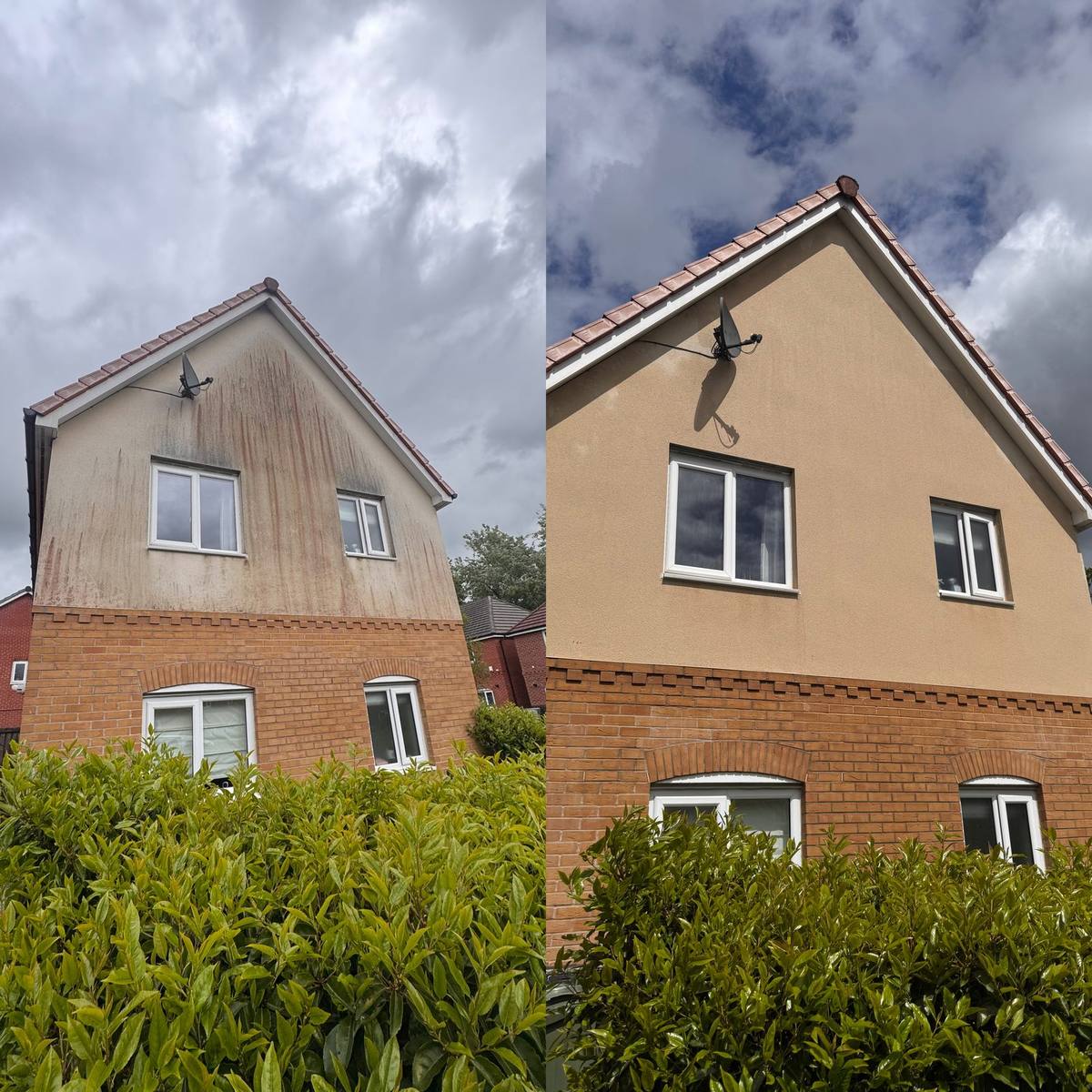
Before and after softwash render cleaning on a K-Rend finished home — red algae fully cleared without pressure washing.
Quick answer: K-Rend and coloured render should be cleaned using low-pressure softwashing with a diluted sodium hypochlorite solution — never a pressure washer at full power. This kills algae, moss and red staining at the root without damaging the render's texture or colour. Results typically last two to four years.
What Is K-Rend and Why Does It Stain?
K-Rend is a silicone-based through-coloured render system that's been applied to an enormous number of homes across the UK over the past two decades. Unlike traditional sand and cement render that gets painted, K-Rend carries its colour throughout the material and has a lightly textured, slightly open surface. That texture is part of what makes it look good when new — and part of what makes it vulnerable to biological contamination over time.
The surface is porous enough to allow airborne spores to settle and take hold. Algae, lichen, and a type of orange-pigmented algae called Trentepohlia are the most common culprits, and in the northwest of England they have everything they need to thrive: persistent damp, mild temperatures, overcast skies for much of the year, and very little sustained UV to keep growth in check. A render that looked clean when applied can look heavily stained within two to three years on a north or west-facing elevation. The staining isn't surface dirt — it's living biological material embedded into the render's texture, which is why rain doesn't shift it and garden hosepipes are useless against it.
Atmospheric pollution adds another layer of grime on top. In towns across Greater Manchester — Oldham, Rochdale, Bury, Bolton and the rest — traffic pollution and airborne particulates settle into textured surfaces and bond over time. That grey-black shadowing along the tops of reveals and around windows is a mix of biological growth and atmospheric soiling, and both need to be addressed together.
Why You Should Never Pressure Wash K-Rend
This is the section worth reading carefully, especially if you've already had a quote from someone proposing to use a pressure washer. Pressure washing K-Rend causes real, lasting damage. The silicone render system is designed to be slightly flexible and breathable, and its surface texture is relatively delicate compared to a concrete paving slab or a brick wall. High-pressure water erodes that texture, rounds off the grain, and removes the surface layer that carries the colour. You end up with a patchy, uneven finish that is genuinely difficult and expensive to remediate.
Beyond cosmetic damage, high-pressure water can be forced behind the render system itself — particularly around window reveals, sills, and any point where the render meets another surface. Once water gets behind the render it has nowhere to go, which can lead to blown patches, cracking, and eventually sections of render detaching from the substrate. K-Rend's own technical guidance specifically advises against pressure washing, and using high-pressure cleaning will void the system's warranty. If your render is still under any kind of guarantee, you'd be invalidating it the moment a pressure washer is applied.
The damage is also irreversible in the sense that you can't un-erode a surface texture. Repairing localised blown patches is possible but expensive and rarely invisible — colour matching render is never perfect after weathering. Avoiding the pressure washer altogether is significantly cheaper than fixing what it leaves behind.
The Right Method: Softwashing Explained
The correct approach to k-rend cleaning is softwashing — low-pressure application of a diluted sodium hypochlorite biocide solution across the render surface. The chemistry is straightforward: sodium hypochlorite kills biological growth at the cellular level, breaking it down rather than simply dislodging it. The solution is applied at a pressure that's little more than a garden sprayer, allowed to dwell on the surface for a set period — typically 15 to 30 minutes depending on the level of contamination and the ambient temperature — and then rinsed off gently.
Dwell time is not optional. The biocide needs time to penetrate the biological matter and kill it from the inside out. Jobs rushed through without adequate dwell time leave root matter alive in the render's pores, and the growth returns faster as a result. Done properly, the render is left biologically clean rather than just visually rinsed. Over the days and weeks following treatment, any residual dead matter continues to break down and is washed away by rainfall, and the render progressively lightens back towards its original colour.
It's worth being honest here: some staining on heavily contaminated or older render will lighten significantly without disappearing entirely. Deeply ingrained atmospheric soiling that has had years to bond can reduce rather than vanish. A good operative will tell you this upfront rather than promising results that aren't realistic. If you want to understand more about how the chemistry works, there's a detailed explanation in this guide on how sodium hypochlorite softwash actually works.
What Does K-Rend Cleaning Actually Cost?
Pricing for render cleaning varies depending on the size of the property, the number of elevations involved, the level of contamination, and whether there are any awkward access issues — gable ends, high eaves, or render that runs above a conservatory roof, for instance. For a typical Greater Manchester semi-detached with two main elevations and a relatively straightforward layout, you'd generally be looking at somewhere in the range of £200 to £350. A detached property with four elevations, a gable end, or significant height will sit higher — commonly £350 to £600 or above depending on scale.
Those are ballpark figures, not fixed quotes, and any contractor giving you a firm price without seeing the property at all — not even photos — should be treated with caution. The fastest way to get an accurate number is to send photographs over WhatsApp. Good photos of each elevation, a wide shot of the property, and any specific problem areas give an experienced contractor enough to work from without a site visit in most cases. You get a realistic price quickly, without waiting for someone to drive out and look at it.
Before sending photos for a quote, try to capture each main elevation in good light and include a wide shot that gives a sense of the property's overall size. Close-ups of any heavily stained areas help too — they allow a proper assessment of contamination level, which directly affects the time and product required.
How Long Will the Results Last?
A properly executed softwash treatment on K-Rend typically keeps the render in good condition for two to four years before biological growth returns to a level where re-treatment makes sense. That's a realistic range, not a guarantee — the actual interval depends on a number of factors that vary from property to property.
Aspect makes a significant difference. South-facing elevations dry quickly and receive more UV, which inhibits growth. North and west-facing elevations stay damp for longer after rain, which is exactly the condition that algae and Trentepohlia prefer — these elevations tend to recolonise faster and may need attention closer to the two-year end of the range. Nearby trees and overhanging vegetation accelerate growth by increasing shade and depositing organic matter. Properties in valleys or in areas with higher rainfall — and Greater Manchester has plenty of both — will generally see faster recolonisation than properties in more exposed, drier locations.
There are products marketed as render sealers or protective coatings that claim to extend the clean period. Some do provide a marginal benefit by reducing water absorption at the surface. None of them permanently prevent biological growth on a render that sits in a damp climate, and some coatings can interfere with the render's intended breathability. It's a decision worth thinking about carefully rather than accepting as a default add-on.
When to Call in a Professional Rather Than DIY
Sodium hypochlorite is available to the public and some homeowners do attempt DIY render cleaning. It's worth being straight about what that involves. The solution needs to be mixed at the right concentration — too weak and it won't kill the growth effectively; too strong and you risk bleaching the render, damaging surrounding plants, and creating a genuine hazard for skin and eyes. Professional operatives use calibrated equipment and understand how dilution rates interact with dwell time and ambient conditions. Getting it wrong is easier than it sounds.
Overspray is a real issue. Sodium hypochlorite will damage plants, bleach UPVC window frames if it runs down them in concentration, and mark glass if allowed to dry on it. Managing overspray — sheeting up planting, rinsing UPVC promptly, controlling where the solution goes — is part of the job and requires attention throughout. Working at height to reach upper elevations adds another layer of risk that most people aren't equipped to manage safely at home.
For anything above ground floor level, or any property where the render is more than lightly soiled, a professional is the sensible choice. C&C Precision carries £1,000,000 public liability insurance, uses proper softwash equipment, and works across the whole of Greater Manchester. If you're unsure whether your render needs professional attention or whether it's something you could manage yourself at low level, send a photo and ask — an honest answer costs nothing.
What to Check Before You Book Anyone
The most important question to ask any contractor quoting for k-rend cleaning is how they intend to clean it. If the answer involves a pressure washer — even described as "low pressure" or "a wide fan nozzle" — ask them to clarify exactly what pressure they're working at. Genuine softwash systems operate at very low pressure; if a contractor is describing anything that involves significant water force against the render, that's a concern worth pushing on.
Ask whether they carry public liability insurance, and what the limit is. For exterior cleaning on a domestic property, £1,000,000 is a reasonable minimum. Ask for photos of previous render cleaning jobs specifically — not just driveways or patios, because render cleaning requires a different approach and prior experience on similar surfaces matters. A contractor who can't or won't show you before-and-after photos of render work should prompt questions about whether they've done much of it.
Be wary of quotes given entirely unseen with no reference to the property at all. A contractor who hasn't looked at photos and isn't asking about size, access, or contamination level is either guessing at the price or intending to adjust it on the day. Most reputable contractors will either visit or — more commonly now — ask for photographs before committing to a figure. That process protects both parties and tends to produce more accurate, realistic quotes.
Frequently asked questions
Can K-Rend be pressure washed?
No — pressure washing K-Rend is strongly advised against by the manufacturer and will likely damage the render surface, cause colour fade, and could force water behind the system. The correct method is low-pressure softwashing using a biocide solution. Any contractor recommending high-pressure cleaning on silicone render should be avoided.
What causes the red or orange staining on K-Rend?
The red and orange staining common on K-Rend is caused by a type of airborne algae called Trentepohlia, which thrives in damp, humid conditions — exactly what you get across Greater Manchester and the northwest. It's not dirt and it won't wash off with rain. A sodium hypochlorite softwash kills it at the root and restores the render's original colour.
How long does K-Rend cleaning take?
A typical semi-detached house with standard render coverage can usually be treated in two to four hours. The softwash solution needs time to dwell and work on the biological growth before rinsing, so the job isn't rushed. Larger detached properties or those with heavily soiled render or difficult access will take longer.
Do you cover K-Rend cleaning in Rochdale, Bury and surrounding areas?
Yes — C&C Precision covers the whole of Greater Manchester including Rochdale, Bury, Bolton, Oldham, Tameside, Stockport and Manchester itself. Send photos of your render over WhatsApp and we'll get a price back to you quickly without needing to visit the property first.
Want to know what it would cost to clean your render?
Send a couple of photos of your render over WhatsApp and we'll come back to you with a fast, no-nonsense price — usually the same day.