If you're wondering about the best time to clean a driveway, you're asking the right question before booking rather than after. Timing doesn't just affect how straightforward the job is on the day — it affects how well the results hold up over the following months. Get it right and a single professional clean can keep a driveway looking decent well into the following year. Get it wrong and you're fighting the weather, the biology, and the calendar all at once.
This guide covers how the seasons interact with driveway cleaning in Greater Manchester specifically — where the climate is damper and cloudier than most of the country, organic growth is a near-constant problem, and a dry week in April genuinely feels like a gift. Whether you're planning to tackle it yourself or thinking about calling someone in, the timing advice here applies equally.
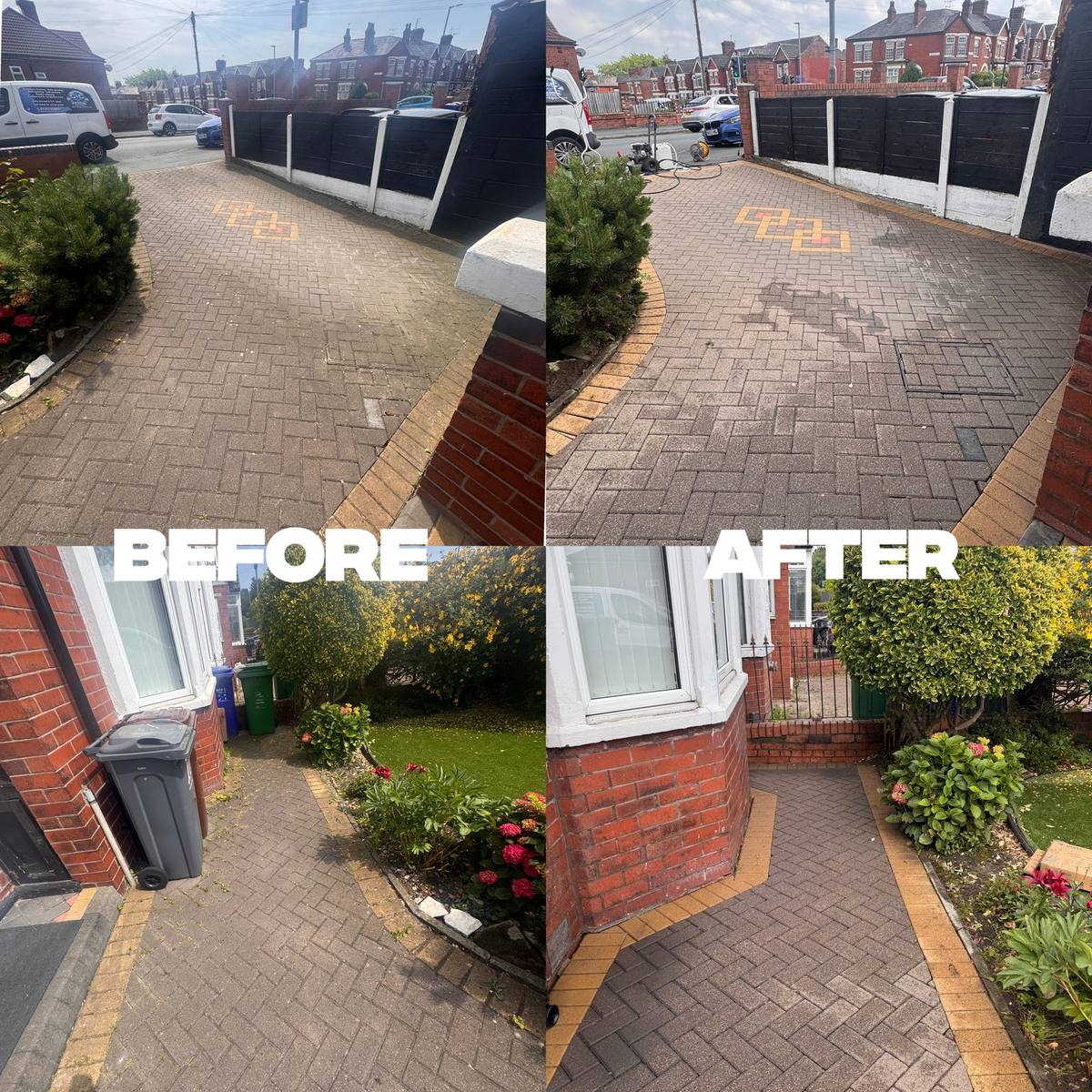
A wide driveway cleaned by C&C Precision in Greater Manchester — timing the clean right makes results like this last longer.
Quick answer: The best time to clean a driveway in the UK is late spring (April–May) or early autumn (August–September). Temperatures above 5°C help cleaning solutions work properly, drying conditions are reasonable, and you're tackling the worst of winter grime or summer algae before it embeds further. Avoid frost, heavy rain, and peak summer heat.
Why Timing Actually Matters for Driveway Cleaning
Most people think of driveway cleaning as a straightforward task — get the pressure washer out, blast it down, done. But the results you get depend heavily on conditions that have nothing to do with the machine itself. Temperature affects how well any cleaning solution or biocide performs. Surface moisture affects how evenly pressure washing cleans. And the time of year determines whether the organic growth you're dealing with is actively spreading or beginning to die back.
Moss and algae follow a growth cycle. They're most aggressive in autumn and winter, fed by the damp and lack of UV. By late winter, a North West driveway that's had a year without attention can have moss with established root systems working into the jointing sand of block paving, or algae forming a slick film across concrete and tarmac. Cleaning at the wrong point in that cycle — particularly in cold, wet conditions — means treatments can't dwell long enough to kill the root structure, so regrowth comes back faster than it should.
There's also the practical matter of surface damage. Water forced into pores or joints and then exposed to a frost will expand and can widen cracks or displace jointing sand over time. Cleaning a driveway in the wrong conditions doesn't just give poor results — it can leave the surface worse than before.
The Best Season: Late Spring (April–May)
Late spring is, consistently, the best time to clean a driveway in Greater Manchester. After a winter of rain, frost, and low sunlight, driveways carry their worst accumulation of the year — compacted moss, black algae, salt residue from grit, and general grime that's had months to settle in. Temperatures in April and May are mild enough for cleaning solutions and post-treatment biocides to work properly, typically above 10°C, which is the point where chemical treatments become meaningfully effective.
Daylight hours are longer, which matters more than people realise — UV exposure after a biocide treatment helps break down organic matter and slows regrowth. There are also better windows of dry weather in spring than in autumn or winter, which is important both for the clean itself and for any follow-up treatment that needs time to dwell on the surface rather than being washed off by the next shower. For block paving cleaning, where re-sanding is often part of the job, spring conditions are particularly suitable — kiln-dried sand needs a settled dry period to lock into the joints properly.
Booking in April or May also means you get the benefit for the whole of summer — when driveways get the most use and are most visible. A clean done in late spring, with a biocide applied after, typically holds well through summer and into early autumn before any meaningful regrowth begins.
A Strong Second Choice: Early Autumn (August–September)
If spring passes without a clean getting done, early autumn is a genuinely good second window. Surfaces have dried out over summer, any algae from summer rain hasn't had time to fully re-establish, and cleaning in August or September means you're getting ahead of the damp months that follow. From October onwards, Greater Manchester driveways get progressively wetter, darker, and more conducive to moss and algae growth — cleaning before that cycle accelerates makes sense.
Early autumn also tends to offer more booking availability than peak summer. The work is just as effective as spring — conditions are still mild enough for treatments to work, and a dry spell in August or September can be long enough to let everything cure properly. The main limitation compared to spring is that you're heading into, rather than out of, the difficult season, so a driveway cleaned in September may need attention again the following spring if it's heavily shaded or under trees.
For patios and block paving in particular, this timing works well. You can see the full summer's use on the surface, deal with any food or drink staining from the warmer months, and go into winter with a clean, re-sanded, or resealed surface that's better protected against frost and moisture ingress. More detail on that process is in our guide to patio cleaning.
What to Avoid: Winter, Frost and Wet Spells
Below about 5°C, the chemistry of most cleaning treatments changes significantly. Sodium hypochlorite — used in softwashing for algae, moss and lichen — becomes far less reactive in cold temperatures, meaning it needs much longer dwell times to do the same work, and often still won't fully penetrate established growth. Post-clean biocides applied in cold conditions may not bond properly with the surface, leaving little residual protection. The result is a job that looks reasonable on the day but sees regrowth come back quickly.
Frost is a more direct problem. If water is forced into the joints or pores of a driveway and temperatures drop below freezing overnight, that water expands. Over time this can widen existing cracks, displace jointing sand in block paving, and accelerate the kind of surface deterioration that leads to expensive remedial work. It's not a reason to never clean in winter — a mild dry spell in November or February can be fine — but if there's any risk of frost within 24 hours of the job, the risk isn't worth taking.
Heavy or persistent rain immediately after a clean is the other issue to avoid. Any treatment applied after pressure washing needs time to sit on the surface and work. Rain within a few hours can wash it straight off before it's had any effect. In Greater Manchester, checking a reliable 5-day forecast before booking is simply part of the process — a three-day dry window is the minimum worth working around.
What About Summer? The Peak Season Trade-Off
High summer — June through to mid-July — isn't a bad time to have a driveway cleaned, but it's not necessarily the best either, and it's worth being honest about the trade-offs. On very warm, sunny days, surfaces can dry unevenly during pressure washing, which occasionally causes streaking on concrete or certain stone types. Cleaning solutions can also dry too quickly before they've had time to work properly, particularly on large exposed areas in full sun.
The bigger practical issue is availability. Summer is the busiest period for exterior cleaning work, and booking slots fill up several weeks in advance. If you want a specific date in July, you'll need to plan ahead. Spring and early autumn tend to offer more flexibility. That said, if summer is when you get around to it, the results will still be good — just be realistic that a driveway cleaned in June may need another look by the following spring, and that some surfaces benefit from being cleaned in the cooler part of a summer day rather than full afternoon sun.
When to Call a Professional Instead of DIYing It
Hired domestic pressure washers have their place, but they have real limits. The machines available from hire shops typically run at lower pressures than commercial equipment and lack the flow rates needed to properly clear compacted moss from block paving joints or lift long-established algae from textured surfaces. More importantly, the chemicals available to trade — particularly professional-grade sodium hypochlorite solutions used in softwashing — aren't the same as what you'll find in a garden centre. The concentrations and application methods differ significantly, and so do the results.
For block paving that needs re-sanding after cleaning, this is genuinely not a DIY job in most cases. The sand needs to be kiln-dried and worked properly into the joints while the surface is in the right condition — doing it poorly means the sand washes out within weeks and the joints are left exposed again. Professional block paving re-sanding starts from around £2.00/m² on its own, or is included in a full restoration package from around £5.50/m² alongside cleaning. A clean with chemical treatment sits around £4.25/m², while a straightforward pressure wash of block paving starts from £3.50/m².
There's also the question of using the right pressure for the surface. Tarmac, sandstone, concrete, and block paving all have different tolerances — too much pressure on the wrong surface damages it, sometimes permanently. A professional will adjust technique and equipment to the surface type. C&C Precision Precision Washing carries £1,000,000 public liability insurance, which matters if something goes wrong — and it's worth checking any tradesperson you use holds the same before work starts. A soft mention: if you're in Greater Manchester and want a fast quote, photos over WhatsApp is the quickest way to get one.
Before booking any driveway clean, check a reliable 5-day forecast. You want at least two to three dry days — one for the clean itself, and one or two for any applied treatment to dwell and cure. In Greater Manchester, that window is more reliable in April, May, August and September than at any other point in the year.
Practical Takeaway: How to Time Your Driveway Clean
The straightforward answer to when the best time to clean a driveway is: aim for late April to May, or August to September. Both windows offer mild temperatures, reasonable dry spells, and conditions where treatments can actually do their job. Spring has the edge because you're clearing a winter's worth of growth and getting the benefit through the warmer months, but early autumn is a solid alternative if spring doesn't work out.
Check the forecast before confirming any booking — a dry window of at least two to three days is what you're working around. One professional clean per year is enough for most driveways in the North West. Shaded driveways, those under trees, or heavily trafficked ones may benefit from twice yearly attention, typically spring and early autumn. The main thing to avoid is leaving it so long that moss roots have time to break down jointing sand or surface material — at that point the job becomes more involved and more expensive, and some of the surface damage may be permanent. You can find more on surface-specific approaches in our driveway cleaning overview, or in the guide to tarmac driveway cleaning done right if that's the surface you're working with.
The best time to clean a driveway is the time that lines up with reasonable weather, reasonable availability, and the actual condition of the surface. Don't wait until it's slippery enough to be a hazard — by that point you've already lost ground that takes more work to recover.
Frequently asked questions
Can you pressure wash a driveway in winter?
You can, but results are often poor. Cleaning solutions work far less effectively below 5°C, and water left in joints or surface pores can freeze and cause damage. Unless it's a mild dry spell mid-winter, it's better to wait until spring. If there's any risk of overnight frost, leave it.
How often should I have my driveway professionally cleaned?
Once a year is enough for most driveways in the UK. Shaded driveways, those under trees, or heavily used ones may benefit from twice yearly. The key is not leaving it so long that moss and algae roots start breaking down joint sand or surface material, which makes the job harder and more expensive.
Does the time of year affect how long a driveway clean lasts?
Yes, noticeably. A driveway cleaned in good conditions — mild temperatures, a dry spell, with a biocide treatment applied after — will stay cleaner for longer than one done in wet or cold conditions where treatments can't properly dwell or cure. Timing the clean right is one of the easiest ways to get more value from it.
What's the best time of year to have block paving re-sanded after cleaning?
Spring or early autumn are both ideal. Kiln-dried sand needs dry conditions to settle into the joints properly — rain too soon after re-sanding washes it out before it can lock in. A settled dry forecast of at least 24–48 hours after the job is what you're looking for.
Want to know what your driveway clean will cost?
Send a couple of photos over WhatsApp and we'll come back to you fast with a straight price — no obligation.