If you've noticed your Indian sandstone patio developing patches of orange or rust-coloured discolouration, you're not alone. Indian sandstone turning orange is one of the most common complaints we hear from homeowners across Greater Manchester, and it catches a lot of people off guard — particularly because the stone often looked perfect when it was first laid. The good news is that it's usually treatable. The less good news is that treating it incorrectly can make things significantly worse, so it's worth understanding what's actually going on before you reach for the pressure washer or a bottle of patio cleaner.
The North West climate doesn't help matters. Oldham, Rochdale, Bury, and the surrounding towns see a lot of wet weather, and stone that's regularly damp for long stretches of autumn and winter is going to be far more susceptible to the kind of mineral and biological reactions that cause discolouration. Understanding the difference between those reactions — and knowing which one you're dealing with — is the first step to fixing the problem properly.
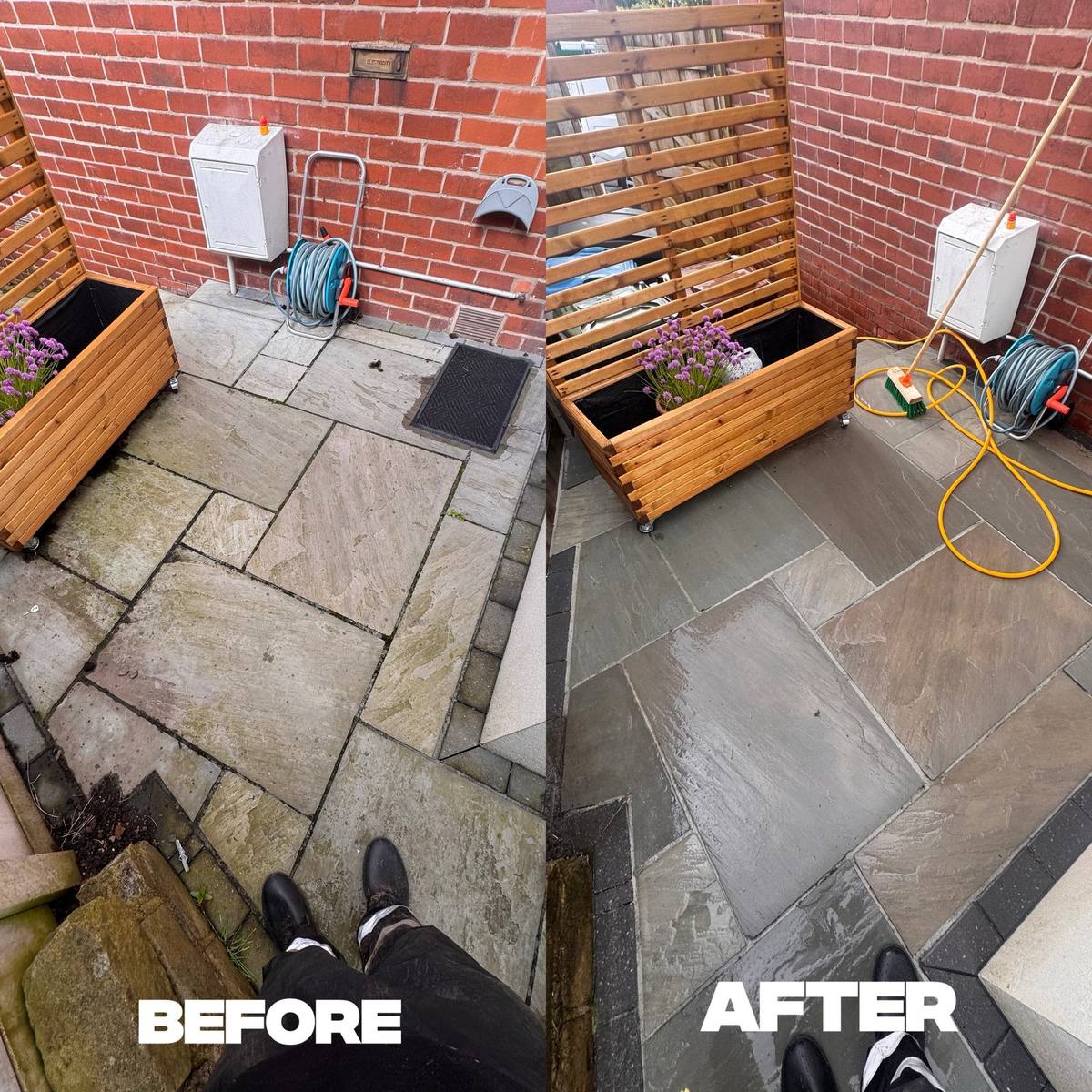
Indian sandstone patio — before and after a professional clean. Orange discolouration and black spot staining fully lifted.
Quick answer: Indian sandstone turns orange due to iron oxidation within the stone reacting with moisture and oxygen — essentially the rock rusting from the inside out. Algae, tannin staining, and contaminated jointing sand can also cause discolouration. Professional cleaning and sealing can restore the stone and slow future staining.
What Actually Makes Indian Sandstone Orange
Indian sandstone contains iron compounds that are naturally present in the rock — they're part of what gives many sandstone flags their warm, earthy tones in the first place. The problem starts when moisture works its way into the stone and oxygen reacts with those iron deposits. The result is iron oxidation: the stone is essentially rusting from within, and that rust colour works its way up to the surface as orange or reddish-brown patches. It's the same basic chemistry as a piece of steel left out in the rain.
This process is entirely natural and has nothing to do with the quality of the stone or how it was laid. Some flags are more iron-rich than others, which is why you'll sometimes see a patio where a handful of slabs have gone very orange while the rest look fine. The depth of the oxidation also matters — staining that's concentrated near the surface can often be treated, while deep mineralisation that has been building up for years is harder to fully reverse.
The Greater Manchester climate accelerates all of this. Stone that stays damp for weeks at a time over a wet winter has far more opportunity for that iron-moisture-oxygen reaction to take hold than stone in a drier part of the country. It's not a manufacturing defect or an installation problem — it's simply what happens to iron-bearing stone in a wet climate when it's left untreated.
Iron Oxidation vs. Algae: Telling the Two Apart
Not all orange staining on Indian sandstone is iron oxidation. Algae and biological growth can produce very similar-looking discolouration, and the treatment approach is completely different, so getting the diagnosis right matters. Orange or pinkish-brown staining caused by algae tends to have a more uniform, almost film-like quality across the surface. It often feels slightly slippery underfoot — that's the biological growth itself. It's a surface problem rather than something happening within the stone.
Iron oxidation, by contrast, tends to appear in irregular, blotchy patches — sometimes concentrated around certain flags and not others. It doesn't have that slippery texture, and if you try to wipe it off it won't shift. The discolouration is coming from within the stone rather than sitting on top of it. Biological staining responds well to a biocide treatment — the kind used in softwashing, where sodium hypochlorite is applied at the correct dilution and left to dwell. Iron oxidation needs an acid-based treatment, which is a different product altogether and one that needs to be used carefully on sandstone.
In practice, many patios have both issues going on at once — iron oxidation underneath and a layer of algae growth on top — which is part of why a proper assessment before treatment is important. If you treat for one and ignore the other, you'll only get a partial result.
How Jointing Sand and Organic Debris Make It Worse
The condition of the jointing between your flags plays a bigger role than most people realise. When the jointing sand breaks down — as it does over time, particularly in high-traffic areas or where moss has established itself — gaps open up between the flags. Those gaps allow water to pool and sit against the edge of the stone for much longer than it would on a well-jointed patio. More moisture held against the stone for longer means faster iron oxidation and more pronounced orange staining over time.
Organic material sitting on the surface compounds the problem further. Leaves breaking down over autumn and winter release tannins and acids that leach into the stone and add a brown-orange tint of their own on top of whatever mineral staining is already present. Moss does the same — it holds moisture against the surface and slowly acidifies the stone beneath it. A patio that hasn't been swept regularly over a couple of wet seasons can end up with several layers of different discolouration to deal with.
This is why good patio cleaning isn't just about removing what's visible on the surface. To get a lasting result, you need to address the jointing, clear out embedded organic material, and treat both the biological and mineral staining in the right order. Skipping steps tends to mean the discolouration comes back faster than it should.
Does Sealing Cause Orange Staining? (Common Misconception)
This is something that causes genuine confusion. Sealing is often recommended as a way to protect Indian sandstone — and applied correctly, it does help — but a poorly chosen or badly applied sealer can actually contribute to discolouration rather than preventing it. The most common scenario is sealing stone that hasn't fully dried out. If there's residual moisture in the flags when the sealer goes down, it gets trapped beneath the sealer's surface layer. That trapped moisture then drives the iron oxidation reaction from within, sometimes producing worse orange staining than if the stone had been left unsealed.
The type of sealer matters too. A topical or coating sealer sits on the surface of the stone and can darken or discolour unevenly as it ages, whereas a quality impregnating sealer penetrates into the stone and allows it to breathe while reducing moisture ingress. If your patio was sealed with an incompatible product, or by someone who didn't wait for the stone to dry properly, the sealer can end up being part of the problem. Stripping an old sealer before re-treating is sometimes necessary, and it's not a simple job.
If you're planning to seal Indian sandstone after cleaning, wait at least 48 to 72 hours of dry weather before applying — longer if the stone was heavily saturated or if it's a thicker flag. Rushing this step is the most common reason sealed patios end up with moisture-related discolouration within the first year.
Can You Clean It Off Yourself?
For light biological staining — the kind that's been building up for a single season — a diluted patio cleaner applied with a stiff brush and rinsed off can make a reasonable difference. It's worth trying before calling anyone out, particularly if the orange-brown tinge is fairly even across the surface and feels slightly slimy. That said, the results from domestic products are rarely as thorough as a professional treatment, and you'll often find the staining returns faster because the underlying biological growth wasn't fully cleared.
Iron oxidation is a different matter. Domestic patio cleaners are generally not formulated to deal with mineral staining, and the products that do work — acid-based iron removers — need to be used at the right concentration and with care. Sandstone is relatively soft and porous compared to granite or porcelain. Too strong a concentration, left on for too long, can etch the surface and leave the stone looking worse than the staining did. There's also the question of what happens to surrounding surfaces, jointing, and any nearby planting when you're working with acidic products.
DIY is worth attempting for surface-level biological growth. For established iron oxidation, or for staining that covers a significant portion of the patio, the risk of making things worse is real enough that it's worth getting a professional opinion first. You can find more detail on chemical approaches in our guide to sodium hypochlorite vs branded patio cleaners.
When to Call in a Professional
If Indian sandstone turning orange has become a noticeable problem — the discolouration covers a large area, it's been building up for more than one season, or basic cleaning hasn't shifted it — it's worth having someone assess it properly. A professional can look at the stone, identify whether you're dealing with iron oxidation, biological growth, a failed sealer, or a combination, and recommend the right treatment rather than guessing. Getting that diagnosis wrong is what leads to wasted money and, sometimes, permanent damage.
C&C Precision Pressure Washing carry out stone cleaning across Greater Manchester, including iron stain treatment on Indian sandstone patios. Photos sent over WhatsApp usually get a same-day quote without needing a site visit first — which at least takes the uncertainty out of whether it's worth proceeding.
Indian sandstone isn't cheap to replace, and some of the DIY horror stories we see — stone etched by incorrectly diluted acid, or patios re-sealed before drying and now covered in milky discolouration — would have been entirely avoidable. If you're uncertain, it costs nothing to ask. You might also find our patio cleaning guide for Tameside useful if you're in that area and want to understand what a professional clean typically involves.
How to Slow Down Orange Discolouration After Cleaning
Once the stone has been properly cleaned and is fully dry, a quality impregnating sealer is the most effective thing you can do to slow future iron oxidation. By reducing the amount of moisture the stone absorbs, you're limiting the reaction that causes the discolouration. It won't stop it entirely — the iron is in the stone itself and isn't going anywhere — but properly sealed sandstone in good condition needs far less remedial work than stone left bare in a wet climate like ours.
Keep the joints in good condition. If they're breaking down and allowing water to pool, get them re-sanded — kiln-dried jointing sand packed properly into clean joints makes a real difference to how quickly moisture gets under and around the flags. Regular sweeping to clear leaves and organic debris before they have a chance to break down on the surface is a simple habit that prevents a disproportionate amount of long-term staining. The same applies to moss — a stiff brush while it's still light growth is a ten-minute job; a full chemical treatment after it's established is half a day's work.
If you're also dealing with block paving elsewhere on the property, a lot of the same principles apply — our guide to driveway sealing after cleaning covers the sealer question in more detail. The honest answer on maintenance is that Indian sandstone cleaned and sealed properly, then kept clear of organic debris, will look significantly better for significantly longer than stone that gets a clean every few years when the staining becomes unavoidable.
Frequently asked questions
Is orange staining on Indian sandstone permanent?
Not always, but it depends on how deep the iron oxidation has gone and how long it's been left. Caught reasonably early, a professional clean using the right treatment can lift most of it. Left for several years, some staining can become very difficult to fully remove.
Will pressure washing remove the orange from my sandstone patio?
Pressure washing alone won't touch iron oxidation — you need a chemical treatment first. It can help remove biological staining like algae, but sandstone is a softer stone and high-pressure washing without the right technique can erode the surface over time. A surface cleaner at the correct pressure is safer than a lance used directly on the flags.
Does sealing Indian sandstone stop it turning orange?
A good impregnating sealer reduces the amount of moisture the stone absorbs, which slows iron oxidation down considerably. It won't stop it entirely — the iron is in the stone itself — but regular cleaning and proper sealing is the best way to keep on top of it. Make sure the stone is completely dry before sealing or you can trap moisture in.
How much does it cost to have Indian sandstone cleaned professionally in Greater Manchester?
Cost varies depending on the size of the area, the extent of the staining, and whether sealing is included. The quickest way to get an accurate figure is to send a photo on WhatsApp — we can usually give a price same day without needing to visit first.
Got an orange sandstone patio in Greater Manchester?
Send a photo on WhatsApp and we'll give you a fast, no-nonsense quote — usually within the hour.