If you've stood in a garden centre aisle comparing bottles and wondering whether the £12 patio cleaner does the same job as the sodium hypochlorite a professional would use, you're not alone. The question of sodium hypochlorite vs patio cleaner comes up regularly, and the honest answer is that they're not even in the same category — they work differently, cost differently over time, and produce results that are noticeably different once you've seen them side by side. This guide lays out what's actually going on so you can make a sensible decision for your own outdoor space.
A lot of what follows applies directly to Greater Manchester conditions — the persistent damp, the Atlantic weather rolling in from the west, the heavy shade that keeps patios and driveways wet for days at a time. That environment is unusually good at growing algae, moss and lichen, which means whatever cleaning approach you take needs to be genuinely matched to the scale of the problem rather than what's easiest to pick up on a Saturday morning.
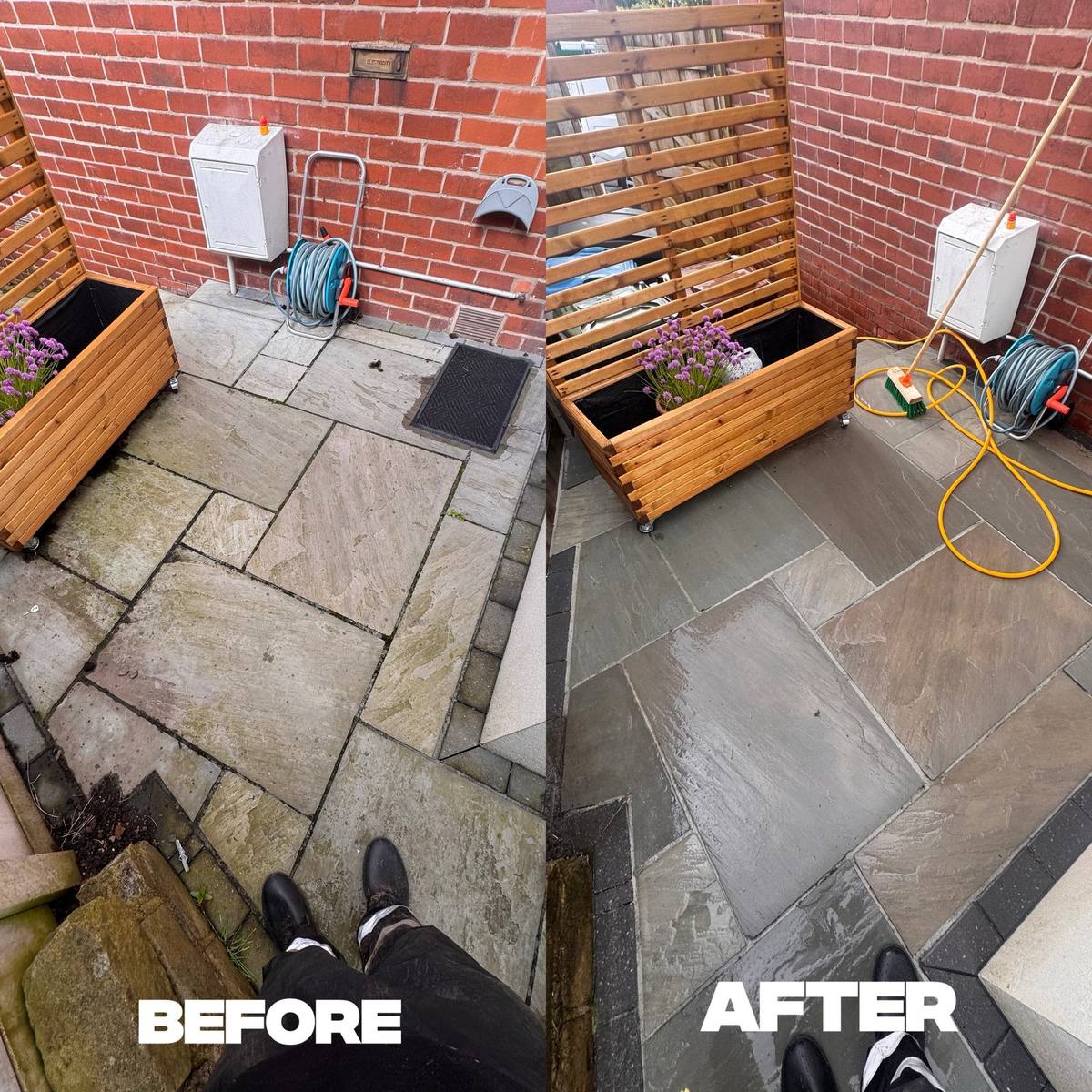
Indian sandstone patio in Greater Manchester — before and after professional sodium hypochlorite softwash by C&C Precision.
Quick answer: Sodium hypochlorite kills algae, moss and lichen at the root, while branded garden centre patio cleaners typically contain diluted surfactants that lift surface grime but leave organic growth alive. For lasting results, sodium hypochlorite wins — but concentration, dwell time and safe application matter enormously.
What Actually Makes Your Patio Go Green?
The discolouration on most patios isn't dirt in the conventional sense — it's biological. Algae, moss, lichen and a particularly stubborn organism called black spot fungus (Meristematic fungi) colonise the surface of stone, concrete and block paving by anchoring into the pores and feeding on moisture and organic debris. In the North West, where surfaces stay damp for extended periods, this process accelerates significantly. If you've noticed your patio going from clean to visibly green within a season, that's why.
Understanding this matters because it changes how you think about cleaning. Algae and surface-level moss can be shifted with mechanical scrubbing or basic surfactants. But lichen — which bonds to stone with a root-like structure called rhizines — and black spot fungus require something that can penetrate the surface and kill growth at a cellular level, not just displace it. If you'd like background on what causes this build-up in the first place, the guide on why paving goes black in the UK covers the biology in more detail.
This distinction is the entire reason the sodium hypochlorite vs patio cleaner debate exists. If all you had to deal with was loose surface grime, any cleaner would do. The problem is that on most patios in Greater Manchester — especially those with any shade — what you're actually dealing with is embedded biological growth, and that requires a different approach entirely.
What Is Sodium Hypochlorite and How Does It Work?
Sodium hypochlorite (NaOCl) is the active ingredient in professional softwashing. It's the same compound found in household bleach, but at far higher concentrations — professional-grade sodium hypochlorite typically runs at 10–12% active chlorine, whereas domestic bleach sits at around 3–5% and degrades quickly once the bottle is opened. At the right working dilution, it doesn't just clean a surface — it oxidises the cellular structure of biological growth, breaking down proteins and killing organisms including algae, moss, lichen and black spot fungi rather than simply dislodging them.
The two factors that determine whether sodium hypochlorite works properly are concentration and dwell time. Applied too dilute, it won't kill established lichen. Applied at the right strength but rinsed off immediately, the same result. A professional softwash involves mixing sodium hypochlorite to an appropriate working strength for the surface in question — typically lower for porous natural stone, slightly higher for concrete or reconstituted products — applying it evenly, and allowing adequate dwell time before rinsing thoroughly. That dwell time, often 15 to 30 minutes depending on conditions, is what distinguishes a genuine kill from a surface rinse.
This is why softwashing as a method uses low pressure rather than the brute force of a pressure washer. The chemistry does the work; the water delivery is just the vehicle. High-pressure washing on its own can blast off surface growth but leaves spores behind in the stone's pores, which is one reason results can be short-lived without a biocide component.
What's Actually in Branded Garden Centre Patio Cleaners?
Most retail patio cleaners — the ones sold in supermarkets and garden centres under names like Patio Magic, Wet & Forget and various own-brand equivalents — are primarily surfactant solutions, often with a diluted biocide element added. They're formulated to be poured from the bottle without specialist equipment, which means they're heavily pre-diluted. That's a deliberate design choice for consumer safety, but it also means the active ingredient concentration is a fraction of what a professional mix would contain.
Some products use benzalkonium chloride as a biocide, others use sodium hypochlorite in very low concentrations. The labels often say things like "kills algae and moss" and technically that's true — at sufficient concentration and dwell time, the active ingredient could. The practical issue is that by the time the product is diluted enough to be safe for a consumer to handle without PPE and suitable for general sale, the concentration is rarely high enough to penetrate and kill established biological growth on a porous surface. They work reasonably well on light surface algae on smooth, non-porous materials. On Indian sandstone, riven slate or block paving that hasn't been cleaned in a couple of years, they tend to suppress growth temporarily rather than eliminate it.
It's also worth reading the small print on application methods. Several popular retail products advise against using near water courses, on certain stone types, or without diluting further with water — which takes an already weak solution even weaker. The gap between the marketing and the chemistry is significant, and understanding it is central to the sodium hypochlorite vs patio cleaner question.
Head-to-Head: Results, Cost and Longevity
In terms of raw cleaning power, professional-grade sodium hypochlorite at the correct working dilution consistently outperforms retail patio cleaners on anything beyond light surface algae. That's not an opinion — it follows from the chemistry. What changes the real-world comparison is the effort involved, the cost and how long the results last.
A decent retail patio cleaner costs £10–20 per treatment and can be applied with a watering can. The results on a lightly contaminated surface can look reasonable. On a patio with established lichen or black spot, results are more likely to suppress than resolve the problem, and re-growth typically resumes within a few weeks to a couple of months, particularly in the damp conditions common across Greater Manchester. On the other hand, a patio properly treated with sodium hypochlorite — with adequate dwell time and a thorough rinse — typically stays biologically clean for one to three years, depending on shade, drainage and surface porosity. That difference in longevity changes the cost calculation significantly over a three-to-five year period.
For context on what professional patio cleaning costs, most jobs in Greater Manchester run from around £3.50 per square metre for a standard clean up to £4.25 per square metre where chemical treatment is included. The longevity of the result means that for most patios, professional treatment every two to three years works out cheaper over time than repeated retail products that need reapplying each season — and the result is cleaner to begin with.
The Risks of Getting Sodium Hypochlorite Wrong
Sodium hypochlorite used carelessly can cause real problems, and it's worth being straight about them. Run-off from an untreated mix reaching planted beds can damage or kill plants — chlorine in solution is toxic to most vegetation at higher concentrations. Applying it too strong on porous natural stone like sandstone or limestone can lighten the surface unevenly or accelerate surface erosion over time. On coloured concrete products, inappropriate concentrations can bleach out pigment. These are genuine risks, not hypothetical ones.
The controls are straightforward but require some discipline. Working dilution for patio surfaces is typically 3–6% active chlorine — not neat from the container. Adjacent planted areas should be pre-watered to dilute any incidental contact, and sheeted or sealed off where possible. After dwell time, thorough rinsing with clean water neutralises residual product and protects the surface. Personal protective equipment — gloves, eye protection, appropriate clothing — is standard when handling concentrated sodium hypochlorite, which is a strong oxidiser and will irritate skin and mucous membranes on contact.
If you're treating a patio close to a lawn or planted beds, soak the surrounding soil with clean water before applying any sodium hypochlorite solution. This reduces the concentration of any run-off that reaches plant roots and is one of the simplest ways to protect your garden during a chemical clean.
The reason most professionals advocate for softwashing as a controlled application method rather than pouring from a watering can is precisely this — consistent dilution, directed application and proper rinsing are the difference between a good result and an expensive mistake.
When It Makes Sense to Call in a Professional
There are situations where DIY sodium hypochlorite application is a reasonable choice for a confident, informed person with the right equipment. A small patio with modest biological growth, away from planted areas, on a robust surface like concrete flags or block paving — that's a manageable project if you're prepared to handle the dilution carefully and follow the process properly. For anything more complex, the risk-to-reward ratio shifts.
Delicate natural stone — Indian sandstone, riven limestone, porcelain — requires accurate dilution and careful application. Heavily colonised surfaces, particularly those with established lichen or black spot, need both the right chemistry and sometimes a low-pressure rinse to clear residue without damaging the stone underneath. Large areas close to planting schemes require careful sheeting and neutralisation. These are situations where a professional softwash delivers meaningfully better results with less risk. C&C Precision Precision Washing covers patio cleaning and softwashing across Greater Manchester — Oldham, Rochdale, Bury, Bolton, Tameside, Stockport and surrounding areas — and quotes are available quickly by sending photos over WhatsApp.
For block paving cleaning, there's an additional consideration: if re-sanding is needed after the clean, that's a separate stage involving kiln-dried sand brushed into the joints once the surface is fully dry. Getting the cleaning right first — including killing any growth in the joints — is essential for the sand to bond properly. Block paving cleaning in Greater Manchester typically runs from £3.50/m² for a standard clean, £4.25/m² with chemical treatment, or up to £5.50/m² for a full restoration including re-sanding. Re-sanding alone, where the surface has already been cleaned, is around £2.00/m².
Practical Takeaway: Which Should You Use?
The honest answer depends on what you're dealing with. Retail patio cleaners have their place — they're convenient, low-risk and adequate for light maintenance on robust, smooth surfaces that are cleaned regularly and don't have established biological growth. If your patio is cleaned every few months and sits in full sun with good drainage, a quality retail cleaner applied consistently will maintain it reasonably well.
For anything with visible lichen, black spot, established moss, or porous natural stone that's been left for more than a season, a sodium hypochlorite-based approach will produce better results and keep the surface clean for significantly longer. The gap in performance — in terms of both depth of clean and longevity — is substantial enough to matter in North West conditions where biological growth resumes quickly without a proper kill at root level.
A simple way to decide: if the surface was professionally cleaned or looked genuinely clean within the last year and you're maintaining rather than restoring, a retail cleaner is fine. If the patio has visible biological growth that's been building for more than one season, or the stone is natural and porous, the sodium hypochlorite vs patio cleaner question has a fairly clear answer — use the chemistry that's actually matched to the problem. For more on how Greater Manchester's weather contributes to surface deterioration, the guide on how wet weather destroys your driveway faster covers relevant ground.
Frequently asked questions
Can I buy sodium hypochlorite and apply it myself?
You can buy sodium hypochlorite from trade suppliers, but retail concentrations vary and getting the dilution wrong can damage stone or kill nearby plants. If you're confident with the process and have the right equipment it's possible, but most people find the results are better and the risk lower when a professional handles it.
Will sodium hypochlorite damage my Indian sandstone or block paving?
Applied at the correct dilution — typically 3–6% for patio surfaces — sodium hypochlorite is safe on Indian sandstone and block paving. The danger comes from using it too concentrated or not rinsing thoroughly. A professional will know the right mix for your specific surface.
Why does my patio go green again so quickly after using a garden centre cleaner?
Branded retail cleaners remove surface grime and some algae, but they rarely kill the spores and root structures embedded in the pores of the stone. Within a few weeks of rain and damp weather, biological growth resumes from where it left off. Sodium hypochlorite kills growth at the root, so clean results last significantly longer.
How long does a professional softwash keep a patio clean?
On most patios in the North West, a professional sodium hypochlorite softwash keeps biological growth away for one to three years depending on the surface type, drainage and how much shade the area gets. Regular maintenance cleans after that are quicker and cheaper than starting from scratch.
Want a patio that stays clean for longer?
Send us a photo on WhatsApp and we'll come back to you fast with a straight price — no fluff, no obligation.