If you have noticed a white or grey powdery film appearing across your driveway or path, you are looking at efflorescence on block paving. It is one of the most common complaints we hear from homeowners across Greater Manchester, and understandably so — a relatively new driveway suddenly looking tired and stained is frustrating. The good news is that it is rarely a sign of serious damage, and in most cases it can be dealt with effectively once you understand what you are working with.
This guide covers what efflorescence actually is, what causes it, how to remove it, and how to stop it coming back. The North West climate does not help matters — we get more than our share of wet winters — so it is worth understanding the full picture rather than just reaching for a pressure washer and hoping for the best.
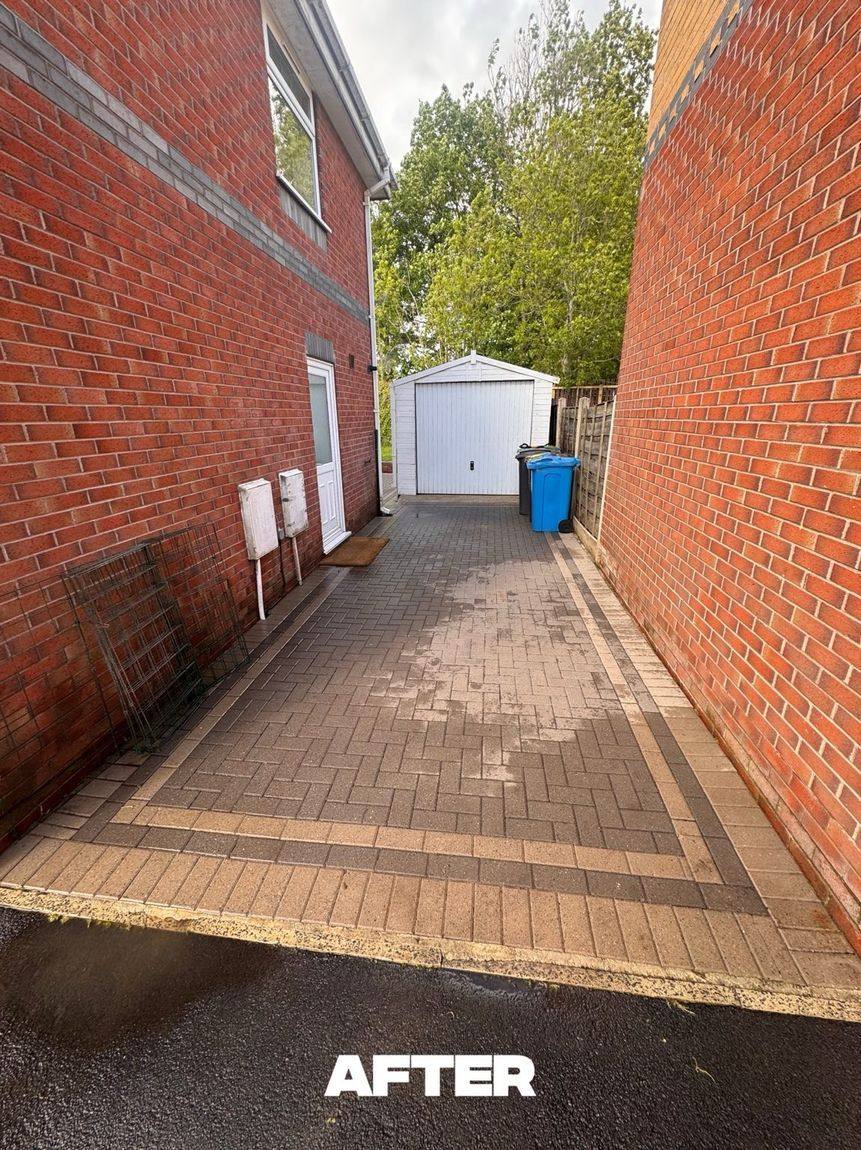
A block paving driveway in Greater Manchester — before and after a deep clean with surface staining fully cleared.
Quick answer: Efflorescence on block paving is a white, powdery deposit caused by soluble salts migrating through the blocks and crystallising on the surface as water evaporates. It is harmless structurally but looks unsightly. It can be removed with a stiff brush, dilute acid wash, or professional pressure washing, and often fades naturally over time.
What Is Efflorescence on Block Paving?
Efflorescence is the white or grey powdery deposit that forms on the surface of concrete block paving, natural stone, and brick. It is not mould, it is not algae, and it is not dirt that can simply be hosed away. What you are actually seeing is crystallised mineral salts — predominantly calcium carbonate — that have migrated from inside the block or the sub-base material and been left behind on the surface as water evaporates.
It is extremely common on brand new block paving, which tends to have a high residual salt content from the manufacturing process. Many homeowners assume something has gone wrong with their installation, but primary efflorescence on fresh paving is a normal part of how concrete cures and settles. Older driveways can develop it too, usually as a result of changing drainage conditions or disturbed jointing sand allowing more water movement through the structure.
The appearance can range from a faint haze across a few blocks to thick, chalky patches covering large areas. On darker or charcoal-coloured blocks it tends to look more dramatic simply because of the contrast, but the underlying process is the same regardless of block colour.
What Causes It? The Science Without the Jargon
Concrete blocks contain soluble salts as a natural by-product of their cement content. When water — whether from rain, ground moisture, or even condensation — enters the block or the bedding layer beneath it, it dissolves those salts and carries them upward through the material. When the water reaches the surface and evaporates, the salts are deposited as a visible residue. That is the whole process, repeated over and over with every wet-dry cycle.
The key triggers are predictable. New paving is the most obvious one, because freshly manufactured blocks simply contain more soluble material that has not yet been washed out. Beyond that, anything that increases the amount of water moving through your paving speeds up salt migration: wet winters (and in Greater Manchester we rarely go short of those), poor drainage that allows water to pond rather than run off, and depleted or missing jointing sand that leaves open channels between blocks for water to travel through freely.
Sub-base conditions matter too. If the material below the bedding layer is particularly lime-rich, or if there is a source of persistent ground moisture — a high water table, a nearby downpipe discharging onto the surface, or an adjoining lawn that retains water — efflorescence can keep returning long after the surface has been cleaned, because the source of the salts has not been addressed.
Is Efflorescence Harmful to Your Driveway?
In most cases, no. Primary efflorescence — the kind that appears on new paving in the first year or two — is cosmetic. It does not weaken the blocks, compromise the bedding, or indicate a structural problem. Left alone, it often fades gradually as the initial salt content depletes, particularly if the paving drains reasonably well and the joints are in good condition.
Secondary efflorescence is a different matter. This is the term used when staining appears on older paving, keeps recurring after cleaning, or develops alongside other signs of moisture problems — cracked or sunken blocks, lifted joints, or persistent damp in adjacent walls. In these situations the efflorescence is a symptom rather than the problem itself, and cleaning the surface without investigating the underlying cause will only give temporary results. It is worth being honest about that rather than pretending a clean alone will fix everything.
If you are also seeing efflorescence on rendered walls nearby, that is often a related sign of moisture movement through masonry — the guide on render cleaning in Saddleworth touches on some of the same principles for anyone dealing with both surfaces at once.
How to Remove Efflorescence from Block Paving
For light, recent deposits, dry brushing with a stiff-bristled brush is the sensible starting point. This removes loose surface crystals before they have a chance to bond more firmly to the block face. It will not eliminate established staining, but it is a useful regular maintenance habit and costs nothing.
For more stubborn staining, a purpose-made efflorescence remover or diluted acid-based cleaner is the next step up. These products work by dissolving the calcium carbonate deposits chemically. They need to be applied at the correct dilution, left to dwell for the recommended time — usually five to fifteen minutes depending on the product and the severity of the staining — and then rinsed thoroughly. This is where DIY can go wrong. Using too strong a concentration, leaving the product on too long, or failing to neutralise and rinse adequately can etch block surfaces permanently, strip colour from treated blocks, or damage adjacent mortar and metalwork. Always test on an inconspicuous area first, and read the product data sheet rather than guessing at dilution rates.
Professional block paving cleaning using a rotary surface cleaner delivers more consistent results across a full driveway than hand treatment, applying even pressure without the streaking that a lance alone tends to leave. When combined with appropriate chemical pre-treatment, it removes both the salt deposits and the general grime that accumulates alongside them. Honest caveat: very heavy or long-established deposits may lighten significantly without disappearing entirely — results depend on how deeply the salts have bonded to the block surface.
Before applying any acid-based efflorescence remover, wet the surrounding blocks and any adjacent brickwork thoroughly. This reduces absorption of runoff into surrounding materials and makes rinsing more effective. Never apply to dry blocks in direct sunlight.
The Role of Jointing Sand — and Why It Matters Here
The sand that fills the joints between block paving does more than hold the blocks in place. It acts as a partial barrier to water ingress, restricts weed growth, and helps the surface flex slightly under load without cracking. When joints become depleted — through weathering, high-pressure washing that was not followed by re-sanding, or simply age — those channels between blocks become open pathways for rainwater to penetrate directly into the bedding layer and sub-base, dramatically increasing the moisture movement that drives efflorescence.
Kiln-dried sand, compacted into the joints after cleaning, addresses this directly. It is a finishing step that is easy to overlook but makes a material difference to how quickly staining returns. For a driveway that has been cleaned but not re-sanded, the joints are essentially open wounds — water gets in freely and the salt migration cycle begins again relatively quickly. Block paving re-sanding as a standalone service costs from around £2.00/m², and as part of a full clean and restoration it is worth factoring in from the outset rather than treating as an optional extra.
The grade of sand matters too. Coarse or incorrectly graded sand does not compact properly and tends to wash out again within a season. Kiln-dried polymeric sand is more resistant to displacement and inhibits weed germination, though it needs to be applied to completely dry paving to bond correctly — something that requires planning in the North West, where a dry weekend in autumn can feel like a minor miracle.
When to Call in a Professional
There are situations where DIY treatment is either impractical or likely to make things worse. A large driveway with heavy, well-established efflorescence across its full surface is genuinely difficult to treat consistently by hand — the chemical needs to be applied evenly, dwelled for the right amount of time, and rinsed before it dries, which is hard to manage over a large area without commercial equipment. Rotary surface cleaners cover ground much faster and produce even results without the streaking that a domestic pressure washer often leaves behind.
Acid-sensitive block colours — particularly certain reds, buffs, and tumbled finishes — are another reason to be cautious about DIY acid washing. Some pigments react poorly to even diluted acid treatments, and the damage is not always visible immediately. A professional with experience across different block types will know what to use and at what strength.
If efflorescence keeps returning despite cleaning, that points toward an ongoing moisture or drainage issue that needs diagnosing rather than just repeated surface treatment. A professional can often identify the likely cause during a site visit — whether it is a blocked gully, a downpipe directing water onto the paving, or a sub-base that is retaining moisture — and advise on whether the issue is something a clean and re-sand will address or whether groundworks are needed. C&C Precision covers the full process from chemical pre-treatment through to re-sanding, serving driveways across Oldham, Rochdale, Bury, Bolton, Tameside, Stockport and the surrounding areas. Pricing for block paving cleaning starts from around £3.50/m² for a straightforward clean, rising to £4.25/m² where chemical treatment is included, and £5.50/m² for a full restoration with re-sanding.
Practical Takeaways: Keeping Your Block Paving Looking Its Best
Regular dry brushing — even just once every few weeks — removes loose salt deposits before they have a chance to harden and bond to the surface. It also keeps the joints clear of debris that traps moisture. It takes five minutes and a stiff brush, and it genuinely extends the time between professional cleans.
Check that your drainage is working as it should. Gullies and channels should be clear, and water should be running off the surface rather than ponding. If a section of your driveway consistently holds water after heavy rain, that is both an efflorescence risk and a sign that the falls may need attention. The guide on preparing your home exterior for winter covers drainage checks alongside other seasonal maintenance worth doing before the wet months set in.
Re-sand the joints when they start to look depleted — you will notice the sand level dropping and joints starting to look hollow or wide. Sealing is worth considering as a follow-up step after cleaning and re-sanding on paving that is otherwise in good condition. A quality penetrating or surface sealant reduces water absorption into the blocks, which directly limits the moisture movement that causes efflorescence. It is not a permanent fix and will need reapplying every few years, but it does make ongoing maintenance easier. If weeds are also a recurring problem, the guide on why weeds in block paving keep coming back is worth reading alongside this one — the causes overlap more than most people realise.
Frequently asked questions
Will efflorescence on block paving go away on its own?
In many cases, yes — primary efflorescence on new block paving often fades naturally within the first year as the initial salts are gradually washed out. However, if the staining is heavy, keeps coming back, or appears on older paving, it usually means there is an ongoing moisture or drainage issue that needs addressing rather than waiting it out.
Can I use vinegar or household products to remove efflorescence?
White vinegar is mildly acidic and can shift very light deposits on a small area, but it is rarely strong enough for established staining on a full driveway and can leave residue that attracts dirt. Purpose-made efflorescence removers are more effective, but they still need careful dilution and thorough rinsing — always test on a small, inconspicuous area first, especially on coloured or tumbled blocks.
How much does it cost to have block paving cleaned professionally in Greater Manchester?
Prices vary depending on the size of the driveway and the condition of the paving, but most residential driveways in the Oldham, Rochdale, and Bury areas fall in the range of £150–£350 for a thorough pressure wash. The quickest way to get an accurate price is to send a photo on WhatsApp — we can usually quote the same day without needing to visit first.
Does sealing block paving prevent efflorescence?
A good quality sealant reduces water penetration into the blocks and joints, which does lower the risk of efflorescence recurring after it has been removed. That said, sealing is not a guaranteed fix — if there is a drainage problem beneath the paving, moisture will still find a way through. Sealing works best as a follow-up to cleaning and re-sanding on paving that is otherwise in good condition.
Got white staining on your block paving?
Send us a photo on WhatsApp and we'll give you a fast, honest quote for cleaning or re-sanding your driveway.