Render cleaning in Saddleworth comes up regularly in our work across the eastern fringes of Greater Manchester, and it's easy to see why. The villages that make up Saddleworth — Uppermill, Delph, Dobcross, Greenfield, Diggle — sit at elevation, face the prevailing westerly weather systems that roll in off the Pennines, and stay damp for longer than lower-lying towns in the borough. That combination turns rendered walls green, black and streaked within a few years of being clean, sometimes faster. This guide explains what's actually happening to those surfaces, how they should be cleaned properly, and what to watch out for if you're thinking about tackling it yourself.
There's a reason render cleaning Saddleworth searches tend to find a mix of DIY advice and professional services — the problem is genuinely common here, and the consequences of getting the cleaning method wrong are serious enough that it's worth understanding before anything gets wet. Whether your home has modern K-rend, traditional pebbledash or exposed gritstone, the approach needs to match the surface. What clears algae from one material can strip or damage another.
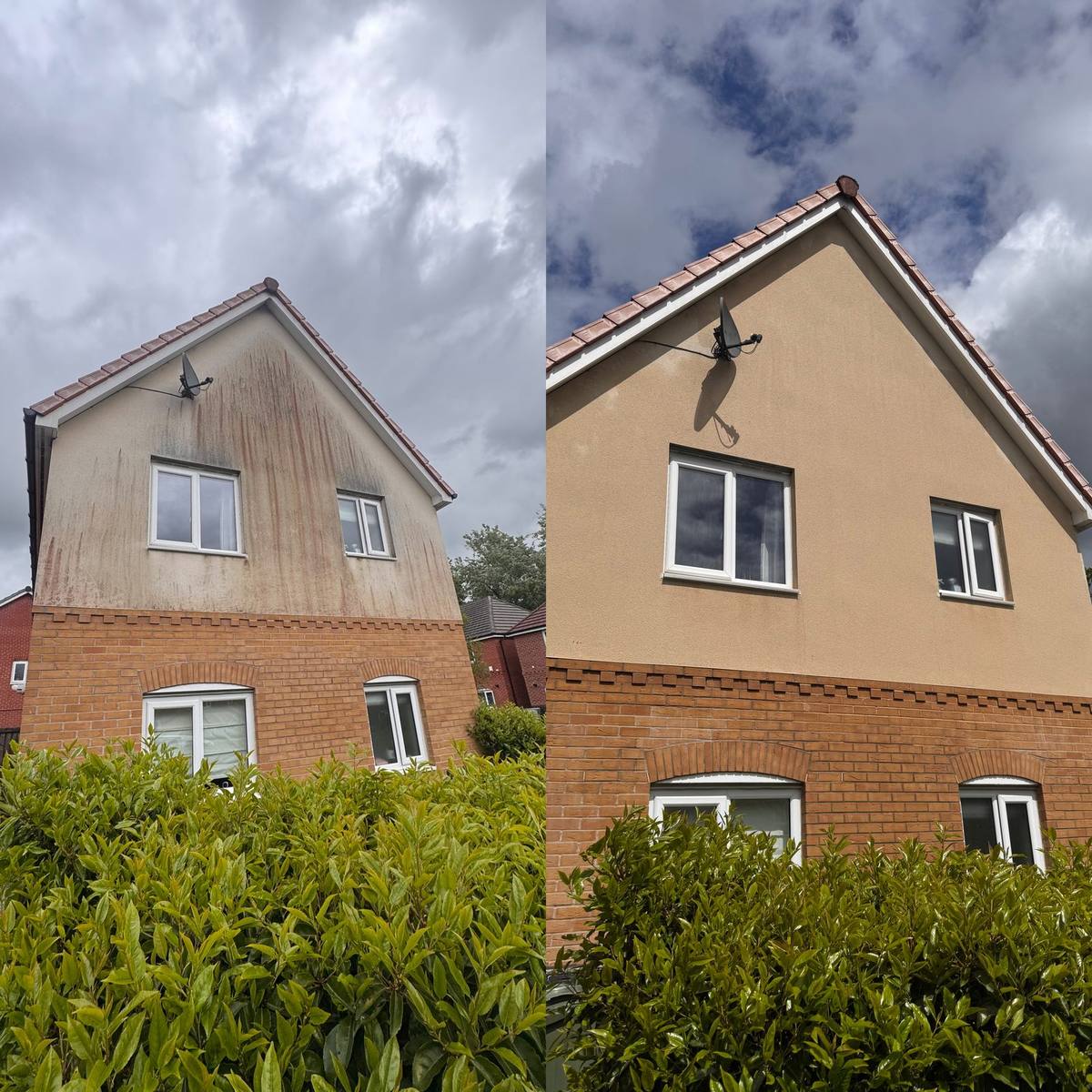
Before and after softwash render cleaning — red algae and green staining fully cleared.
Quick answer: Render cleaning in Saddleworth uses softwashing — a low-pressure treatment with sodium hypochlorite — to remove algae, black streaks and red mould from K-rend, pebbledash and monocouche finishes. It's safer than pressure washing on render and results typically last two to four years.
Why Saddleworth Homes Get Dirty Faster Than Most
Saddleworth sits between roughly 150 and 400 metres above sea level depending on the village, which means it catches more rainfall, more wind and more persistent low cloud than most of Greater Manchester. The annual rainfall across this part of Oldham borough is significantly higher than in the city centre or south Manchester, and the humidity rarely drops low enough for surfaces to dry out fully between wet spells. That sustained moisture is exactly what algae, mould and lichen need to establish and spread.
North-facing and east-facing elevations are the most affected — they receive less direct sun to dry them out and are often shaded by neighbouring properties or the surrounding hills. You'll often see one side of a terrace looking almost clean while the other carries thick green or black growth. The prevailing westerly winds also drive rain directly into rendered surfaces rather than running off them cleanly, which accelerates biological contamination and pushes moisture into any small cracks or texture irregularities in the render face.
This doesn't mean Saddleworth properties need constant maintenance, but it does mean the cleaning cycle is shorter than in less-exposed locations. A property in Stockport or south Manchester might go five or six years between cleans; the same property in Uppermill or Greenfield might need attention every two to three. That's not a failure of the surface or the previous clean — it's just the environment.
The Two Main Surface Types: Render vs Stone
Saddleworth has an unusual mix of building stock. You'll find modern K-rend and monocouche rendered new-builds on the edges of Uppermill and Greenfield sitting within a few streets of Victorian gritstone terraces, pebbledash semis from the mid-twentieth century and sandstone farmhouses that have been standing for two hundred years. Each of those surface types behaves differently when it gets contaminated, and each responds to a different cleaning approach.
Thin-coat renders like K-rend and monocouche are factory-coloured, applied at a few millimetres thickness over a base coat, and are specifically not designed to be hit with high-pressure water. The texture and colour sit in that thin surface layer, and pressure washing can erode it, force water behind the render and cause the kind of delamination and bubbling that needs a re-render to fix. Our guide on K-Rend cleaning done properly goes into the detail on that surface specifically. Pebbledash is more robust but the aggregate can be displaced by excessive pressure. Traditional gritstone and sandstone are generally more forgiving of controlled pressure, but they still benefit from chemical pre-treatment rather than raw water blast.
Getting this right starts with identifying what you've actually got. If you're not sure whether your render is a thin-coat product or a traditional sand-and-cement finish, that's worth establishing before anything else — the cleaning method and the risk profile are very different.
Why Softwashing Is the Right Method for Render
High-pressure washing on K-rend or monocouche is one of the most common causes of render damage we hear about from customers who've either done it themselves or had it done by someone who didn't know what they were working with. The pressure forces water into the render face, erodes the textured finish, and in some cases gets behind the render board or base coat entirely. Most thin-coat render manufacturers explicitly state that high-pressure washing voids the warranty on the product.
Softwashing uses diluted sodium hypochlorite applied at low pressure — often barely above garden-hose pressure — which means the render face isn't under any mechanical stress during the clean. The chemical does the work instead of the water. It penetrates the biological growth, breaks down the organisms at a cellular level, and is then rinsed away gently. The render surface stays intact, the colour is preserved, and there's no risk of water being forced into the wall structure. Our more detailed guide on how sodium hypochlorite softwash actually works explains the chemistry if you want to understand the process more fully.
Softwashing does take longer than pressure washing because the solution needs dwell time to work properly — typically fifteen to thirty minutes depending on the severity of the growth and the ambient temperature. Rushing that stage produces a surface that looks clean immediately but regrows quickly because the organism roots haven't been fully dealt with. Done correctly, it's a methodical process, not a quick blast.
What Softwashing Actually Does to Algae and Mould
Sodium hypochlorite doesn't just bleach the surface to make it look cleaner — it breaks down the cell walls of algae, lichen and mould spores so that the organisms can't survive and regrow in the same way. On render cleaning Saddleworth jobs we typically encounter red algae (the pink-orange streaking that's common on lighter renders), black crust contamination (often a combination of mould and traffic pollution) and green algae streaking under eaves and on sheltered sections of wall.
Each of those responds to softwash treatment, though heavy lichen — the crusty, grey-white growth that bonds tightly to the surface — sometimes needs a repeat treatment or a longer dwell period to fully break down. We're honest about this: some staining, particularly where contamination has been building for many years, will lighten significantly but may not disappear entirely after a single treatment. That's the nature of biological staining on porous surfaces, and anyone who promises you every property will come up perfect regardless of condition isn't being straight with you.
The meaningful advantage of softwash over pressure washing in terms of longevity is that killing the growth at the root significantly slows regrowth. Pressure washing can remove the visible surface growth while leaving the root structure in the pores of the render, which means regrowth happens faster. A proper softwash, done correctly, typically holds for two to four years on Saddleworth properties — though exposed, north-facing elevations will be on the shorter end of that range.
Cleaning Traditional Gritstone and Stone Walls
Millstone grit and sandstone are the materials that define Saddleworth's older building stock, and they age differently from render. The rough, open texture of gritstone holds organic matter in its surface, which is why older stone walls often look permanently dark or stained even when they're structurally sound. The good news is that this texture also responds well to a pre-treatment approach — applying a biocide or diluted sodium hypochlorite solution and allowing it to dwell before rinsing breaks down the biological matter in a way that raw pressure alone can't replicate.
Stone is generally more tolerant of controlled pressure washing than thin-coat render, so on gritstone elevations we can use slightly higher working pressures than we'd use on K-rend — but the key word there is controlled. The pointing between stone courses is usually older lime mortar on Victorian and Edwardian properties, and that can be damaged or dislodged if pressure is applied carelessly. Assessing the condition of the pointing before cleaning is part of any responsible stone cleaning job.
Many Saddleworth properties have a mix of both stone and render — perhaps a gritstone ground floor with a rendered first floor and gable, or stone elevations at the rear with rendered frontage. That's common enough that we're used to working with both materials on the same property in the same visit, adjusting the method and pressure settings accordingly.
When to Call a Professional Rather Than DIY
Hiring a domestic pressure washer from a tool hire shop and pointing it at your render is a genuine risk. Consumer-grade machines can generate pressures that are more than adequate to strip the surface of a thin-coat render, force moisture into the wall structure, or dislodge pointing. The damage isn't always immediately obvious — sometimes it only becomes apparent weeks later when you notice bubbling, damp patches inside the property or sections of render that have started to detach. Fixing that is a plasterer's job, not a pressure washer job, and it costs considerably more than a professional clean would have.
If your render shows any cracking, bubbling, hollow-sounding sections or existing detachment, get a professional assessment before any water goes near it. Cleaning a render that's already failing — however carefully — can accelerate the damage. A professional will identify those areas before starting and advise on whether cleaning is appropriate.
Sodium hypochlorite is also a chemical that needs handling correctly. At the concentrations used for render cleaning it can irritate skin and eyes, damage plants and garden features if not properly managed, and cause problems with nearby surfaces if it isn't controlled during application. Diluting it accurately, protecting surrounding vegetation, and rinsing in the right sequence takes some knowledge and the right equipment. It's not something to improvise with.
The case for DIY is strongest on very small, accessible areas with robust surfaces — perhaps a low garden wall in gritstone. For render on a full house elevation, particularly at height, the risk-to-reward ratio of doing it yourself is poor.
What to Expect from a Render Clean with C&C Precision
C&C Precision Precision Pressure Washing quotes from photos sent on WhatsApp — there's no need to book a separate site visit just to get a number. Send over a few photos of the affected elevations, let us know roughly what town you're in, and we'll come back with a straight price. For a typical three-bedroom semi in Saddleworth with render to the front and one gable, that generally falls somewhere in the £150–£300 range, though heavily affected properties or larger detached houses will sit higher.
On the day, we assess the render condition before anything is applied — checking for cracks, detachment or areas that need different treatment. The softwash solution goes on at low pressure, dwells for the appropriate time, and is rinsed off carefully. We don't leave until the job looks right. Render cleaning Saddleworth properties usually takes two to four hours for a standard semi; larger or more heavily affected properties naturally take longer. We work across Uppermill, Delph, Dobcross, Greenfield, Diggle and surrounding areas, as well as the broader Oldham, Rochdale and Tameside areas covered in our full services list.
If you're dealing with green or black render and want a realistic assessment of what can be achieved and what it'll cost, the quickest route is a WhatsApp message with a few photos. No sales pitch, just a straight answer based on what we can actually see.
Frequently asked questions
How much does render cleaning cost in Saddleworth?
Pricing depends on the size of the property, the number of elevations being cleaned and how bad the biological growth is. A typical three-bedroom semi in Saddleworth with render to the front and gable might fall in the £150–£300 range, but larger detached properties or those with heavy lichen will sit higher. Send us photos on WhatsApp and we'll give you a straight figure.
Will softwashing damage my K-rend or monocouche finish?
No — softwashing is specifically recommended for thin-coat renders because it avoids the high pressure that causes cracking, delamination and water ingress. The sodium hypochlorite solution is diluted appropriately for the surface and rinsed off at low pressure. It's the method most render manufacturers point to when they say pressure washing voids the warranty.
How long will the results last on a Saddleworth property?
Most renders in Saddleworth stay clean for two to four years after a proper softwash, though north-facing walls in exposed locations may green up faster. The softwash kills existing growth at the root rather than just washing it off the surface, which significantly slows regrowth compared to pressure washing alone.
Do you clean stone as well as render in Saddleworth?
Yes — we clean traditional gritstone and sandstone elevations as well as rendered surfaces, and many Saddleworth properties have a mix of both. Stone generally tolerates slightly more pressure than thin-coat render, but we still use a pre-treatment to break down organic matter before rinsing. Same process: assess the surface first, then choose the right method for it.
Want a fast quote for your Saddleworth property?
Send a couple of photos on WhatsApp and we'll come back to you with a straight price — no faff, no sales call.