If you've searched for driveway cleaning Whitefield, you've probably already noticed that driveways around here don't stay clean for long. The combination of a damp North West climate, mature trees lining the older residential streets, and north-facing drives that barely see direct sun for half the year means algae, moss and general grime build up quickly. A driveway that looks reasonable in spring can be visibly green and slippery by autumn without any neglect on the homeowner's part.
This guide covers the main driveway surfaces found in Whitefield, what actually works on each of them, and the honest limitations of cleaning — because some staining lightens rather than disappears completely, and it's worth knowing that before you book anything. Whether you're dealing with block paving that's started to shift, imprinted concrete that's gone a flat grey, or a tarmac drive covered in tyre marks and moss, the approach matters as much as the equipment.
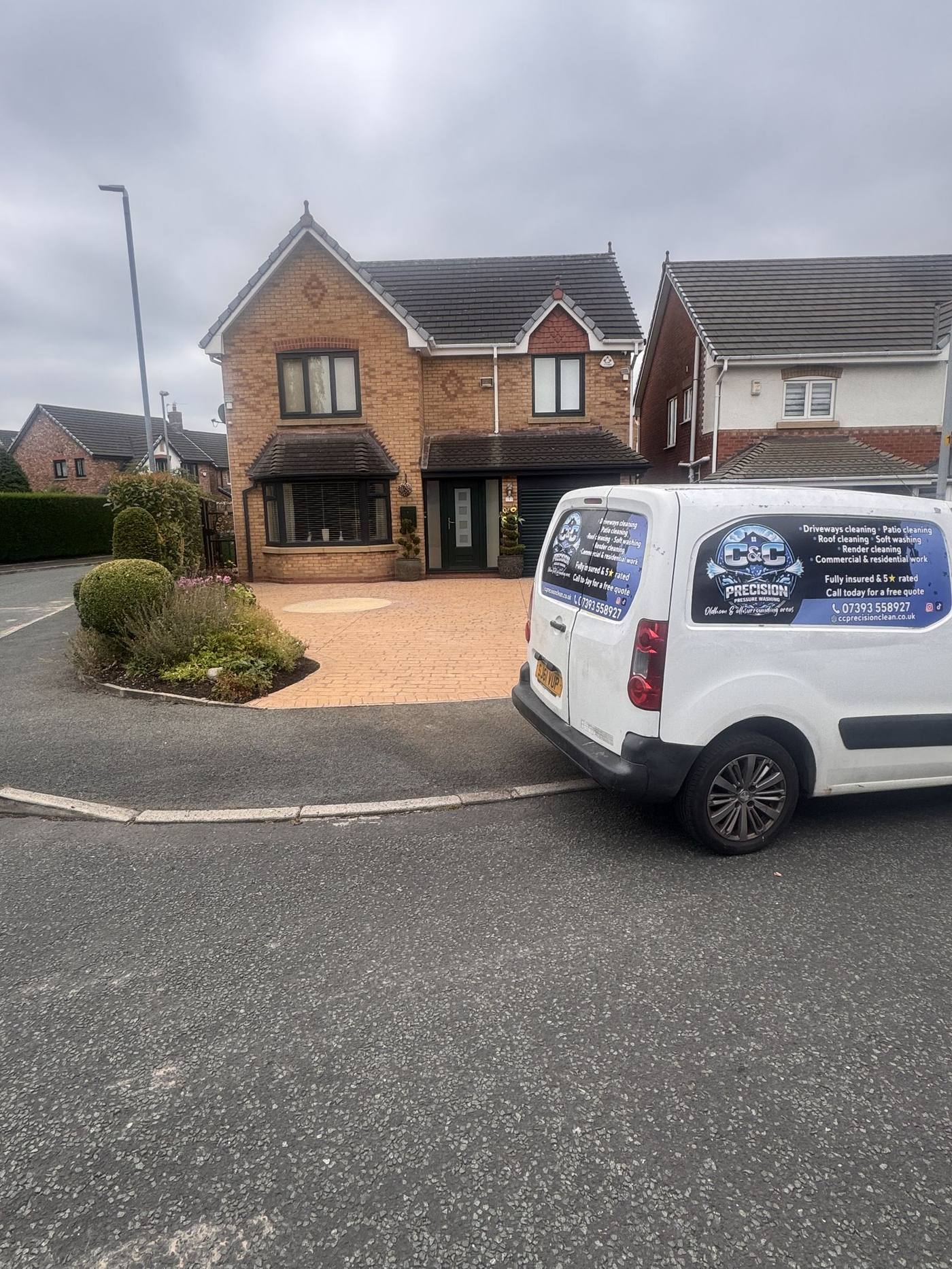
We cover Whitefield and the wider Bury and Manchester area from our base in Oldham.
Quick answer: Whitefield driveways — mostly block paving and imprinted concrete on semi-detached and detached homes — collect moss, algae and traffic grime quickly in Greater Manchester's damp climate. Professional pressure washing restores them fully, with re-sanding or resealing where needed. Most jobs are completed in a single visit.
What Whitefield Driveways Actually Look Like
Whitefield is a mix of inter-war semis along the older residential streets closer to the town centre and larger detached homes built from the 1980s through to the early 2000s on the estates off Bury New Road and towards Besses o' th' Barn. That housing stock means block paving and pattern imprinted concrete are by far the most common driveway surfaces you'll find — both were the go-to choices for their respective eras and both have their own cleaning requirements.
There are also plenty of older properties with brushed concrete or plain tarmac drives, and some of the more recently renovated homes have switched to natural stone or porcelain. Each surface responds differently to pressure washing, chemical pre-treatment and aftercare, so a one-size approach doesn't work. Understanding what you're actually standing on is the first step to setting realistic expectations about what a clean will achieve.
Block paving in particular tends to look worse than it is — years of algae and embedded dirt can make it look almost beyond saving, but it often comes up very well with the right process. Imprinted concrete is the opposite: it can look deceptively clean on the surface while the sealant underneath has broken down and is no longer doing its job.
Why Greater Manchester's Climate Makes Driveways Dirty Fast
Greater Manchester averages well over 800mm of rainfall a year, and Whitefield's position in the Irwell Valley does it no favours. Water drains off roofs, runs across drives and sits in the joints and surface texture of paving for extended periods. Add in mild winters that rarely get cold enough to kill off biological growth, and limited sunshine on north and east-facing drives, and you have near-ideal conditions for algae, moss and lichen to establish themselves.
Algae is usually the first thing to appear — a thin green or black film that makes the surface look dirty and becomes slippery underfoot when wet. Moss follows in the joints and any area where moisture pools. Lichen, the grey-white crusty growth, takes longer to appear but is the hardest to shift and can cause surface staining that persists even after the growth itself is removed. If you want to understand more about why paving goes black and what's actually causing it, this guide on why paving goes black in the UK covers the biology in more detail.
The practical consequence for driveway cleaning Whitefield is that even a well-cleaned surface will begin to recolonise within a season or two if no post-treatment biocide is applied. A good professional clean includes either a surface-applied algaecide after washing or a softwash pre-treatment with sodium hypochlorite that kills biological matter at the root rather than just blasting the visible growth off the surface. The latter produces a longer-lasting result and is well worth asking about when you get a quote.
Block Paving: Cleaning, Weeds and Re-Sanding
Block paving cleaning is more involved than it looks from the outside. The paving itself is only part of the job — the jointing sand between the blocks is equally important, and it's the first thing to suffer when a pressure washer is used without the right surface cleaner attachment. Over time, rainfall washes sand out of the joints naturally, and vigorous pressure washing accelerates that process significantly. Once the joints are thin or empty, weeds establish themselves quickly and the blocks begin to move slightly underfoot, which eventually leads to uneven surfaces and trip hazards.
A proper block paving clean uses a rotary surface cleaner rather than an open lance — this keeps the pressure consistent and directed downward rather than blasting joints apart. After cleaning, the joints need assessing. If they're depleted, block paving re-sanding with kiln-dried sand is the right next step. The sand is brushed into the joints and compacted, stabilising the surface and significantly reducing weed regrowth. It's not a permanent fix — sand does wash out again over years — but it extends the life of the clean considerably.
Pricing for block paving varies depending on what the surface needs. A straightforward clean starts from around £3.50 per square metre. If the drive has heavy biological growth and benefits from a chemical pre-treatment dwell before washing, expect around £4.25 per square metre. A full restoration including cleaning and re-sanding runs from approximately £5.50 per square metre, and re-sanding on its own where the drive has already been cleaned is around £2.00 per square metre. These figures give a reasonable guide — actual quotes depend on what the photos show.
Imprinted Concrete: Why It Needs a Different Approach
Pattern imprinted concrete driveways were enormously popular through the 1990s and early 2000s, and there are a lot of them in Whitefield. When they're in good condition, they look smart — a consistent colour with a defined pattern and a glossy or satin finish. When the sealant breaks down, which it will do over five to ten years depending on exposure and traffic, they go flat, patchy and grey. No amount of pressure washing alone will bring the colour back, because the colour is in the sealant, not the concrete beneath.
The correct process involves a chemical pre-treatment to loosen biological growth and any old, flaking sealant, followed by careful surface cleaning at appropriate pressure — too high and you risk micro-cracking the surface or forcing water under any remaining sealant, causing it to blister. Once clean and fully dry, a fresh coat of sealant — either solvent-based for a high-gloss finish or water-based for a more satin look — is applied to restore the colour and protect the surface. It's worth noting that if the concrete underneath has surface damage or deep staining, the sealant will cover it to a degree but won't make it invisible.
If your imprinted concrete drive is just looking dull rather than structurally deteriorated, sometimes a clean and reseal is all that's needed to transform it. If you're unsure whether the sealant has gone or whether cleaning alone would improve things, sending a photo is the most efficient way to get an honest answer.
Tarmac and Concrete Driveways in Whitefield
Older Whitefield properties — particularly the inter-war and post-war semis — tend to have either plain tarmac or brushed concrete driveways. These are the most straightforward surfaces to clean in terms of approach but can have their own stubborn problems. Oil staining from vehicles is the most common issue on tarmac, and it ranges from a faint shadow that improves significantly with degreaser pre-treatment to a heavily saturated patch that lightens rather than disappears. It's worth being honest about that — very old, deep oil contamination doesn't come out entirely, and anyone who tells you otherwise is overselling.
Biological growth on tarmac and concrete responds well to hot or high-pressure washing with a rotary surface cleaner, and the results are usually very good. The flat, non-porous nature of brushed concrete in particular means it cleans up clearly and evenly. Tarmac can look patchy after cleaning simply because worn and weathered areas absorb water differently, but this settles once the surface dries fully.
The guide on how wet weather destroys your driveway faster goes into more detail on what years of Greater Manchester rainfall does to different surfaces at a structural level — useful context if you're deciding whether to clean and maintain or replace.
When to Call a Professional Rather Than Hire a Pressure Washer
Hiring a pressure washer for a weekend is tempting, and for some jobs — rinsing a garden path, cleaning a fence — it's perfectly reasonable. For driveways, the risks are more significant than most people anticipate. On block paving, an open lance at the wrong angle strips jointing sand out of the joints in minutes, leaving the surface unstable and exposed to immediate weed reinfestation. On imprinted concrete, excessive pressure cracks aged sealant and forces water underneath, causing blistering that then requires a full strip and reseal to fix — a more expensive outcome than the professional clean would have been in the first place.
There's also the question of what happens to moss when you pressure wash without any chemical treatment. Blasting moss with water breaks it into fragments and spreads spores across the surface and into surrounding areas. A biocide pre-treatment — either sodium hypochlorite applied as a softwash or a surface algaecide — kills the growth before washing, meaning you're removing dead matter rather than dispersing live spores. The guide comparing professional driveway cleaning versus the bloke with a jet wash covers this in more detail if you're weighing up the options.
C&C Precision Precision Pressure Washing handles driveway cleaning across Whitefield and the wider Greater Manchester area with the right equipment for each surface type — surface cleaners, pre-treatment chemicals, kiln-dried sand for re-sanding and sealants where required. The work is backed by £1,000,000 public liability insurance, and quotes are turned around quickly from photos rather than requiring a site visit first.
Before booking any driveway clean, check whether your block paving joints are depleted — crouch down and look across the surface at a low angle. If you can see gaps between the blocks, or if any blocks rock slightly when you stand on them, factor re-sanding into your budget from the outset. It's significantly cheaper to do it as part of the initial clean than to call someone back separately once weeds have re-established.
Practical Advice Before Booking a Driveway Clean in Whitefield
The single most useful thing you can do before a team arrives is to clear the driveway completely — vehicles moved off, bins relocated, plant pots shifted to the side. It sounds obvious, but it genuinely affects the quality of the result. Cleaning around obstacles means edges don't get treated properly and the finished job looks uneven. If you have a large drive and only one vehicle, move it to the road for the duration.
Timing matters more than people realise for block paving and imprinted concrete jobs. Re-sanding requires the joints to be dry before kiln-dried sand is brushed in — if it rains immediately after, the sand doesn't settle correctly and can wash back out. Resealing imprinted concrete also needs a dry surface and ideally a dry 24 hours afterwards for the sealant to cure properly. Booking during a forecast dry spell isn't always possible in Greater Manchester, but it's worth trying. Your contractor will advise if conditions on the day aren't suitable.
For driveway cleaning Whitefield and the surrounding areas, the fastest way to get an accurate price is to send photos over WhatsApp. You'll get a quote based on what the surface actually looks like rather than a rough estimate over the phone — it takes 30 seconds and means there are no surprises on the day. You can also browse the full range of exterior cleaning services if you're considering getting more than just the driveway done at the same time.
Frequently asked questions
How long does a driveway clean take in Whitefield?
Most standard driveways take between two and four hours depending on size, surface type and how heavily soiled they are. Block paving that needs re-sanding afterwards will take a little longer. We'll give you a realistic time estimate when you send your photos.
Does block paving always need re-sanding after cleaning?
Not always, but it's needed more often than people expect. If the joints look thin, weeds have been growing in them, or the blocks move underfoot, re-sanding with kiln-dried sand is the right call. We'll tell you honestly when we assess the job — we won't add it on just to increase the bill.
Can you clean an imprinted concrete driveway without resealing it?
Yes, you can clean it without resealing, and sometimes that's all that's needed if the existing sealant is still in reasonable condition. If the surface looks patchy, dull or grey, resealing will make a significant difference and protect it for several years. We'll advise you based on what we see in your photos.
Do you cover Whitefield and nearby areas like Prestwich or Radcliffe?
Yes — Whitefield falls within our regular working area across Greater Manchester, and we also cover Prestwich, Radcliffe, Bury, Unsworth and the surrounding towns. Send your address and photos on WhatsApp and we'll confirm availability and turn a price around quickly.
Want a price for your Whitefield driveway?
Send a couple of photos on WhatsApp and we'll give you a straight price — no faff, no call needed.