If you've been searching for reliable block paving cleaning in Manchester, you've probably already noticed how quickly driveways and patios deteriorate in this part of the country. What looks presentable in spring can be green, slippery and heavily stained by autumn — and that's not an exaggeration. The combination of rain, shade and traffic means block paving here works harder than almost anywhere else in England, and it shows.
This guide walks through exactly how a proper block paving clean is carried out — from the chemical pre-treatment right through to re-sanding and the question of whether sealing is worth it. There's also some honest advice about when cleaning alone won't solve the problem, and what you can do between professional visits to slow the deterioration down. Pricing is included where it's useful, and there are no vague answers.
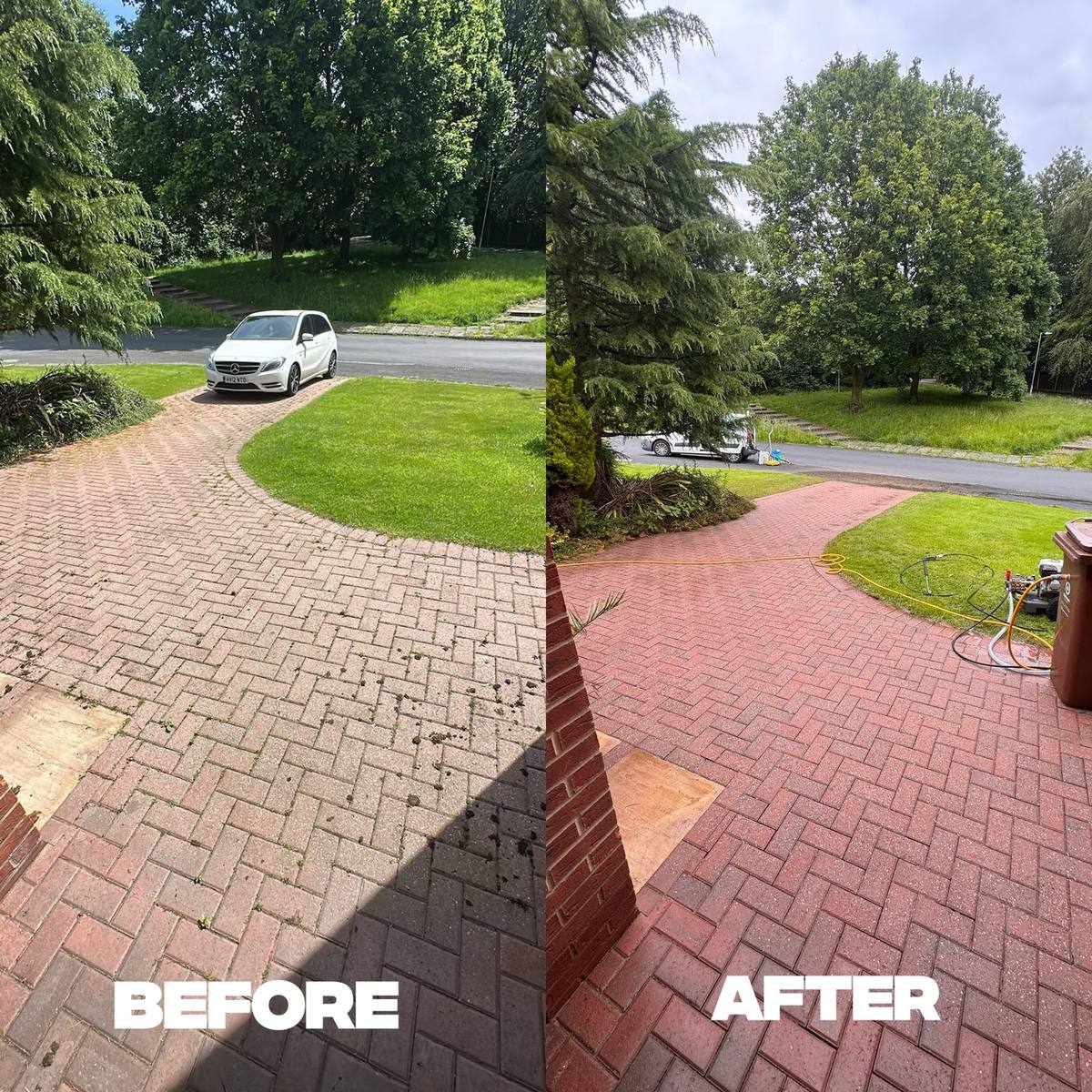
A red block paving driveway in Greater Manchester — the difference a proper clean makes.
Quick answer: Block paving cleaning in Manchester typically involves pre-treating moss, algae and weeds, then using a rotary surface cleaner to lift embedded grime without blasting out the jointing sand. Most driveways also need re-sanding with kiln-dried sand and optionally a sealant to protect the finish long-term.
Why Block Paving Gets So Dirty So Fast in the North West
Greater Manchester averages well over 800mm of rainfall a year, and much of that falls as persistent drizzle rather than heavy downpours that wash surfaces clean. That kind of damp sits on paving for hours, feeding algae, moss and lichen. Couple that with the region's overcast skies — surfaces in Oldham, Rochdale and Bury can go weeks in winter without direct sun — and you've got near-perfect conditions for biological growth to take hold.
Shaded driveways are the worst affected. A front driveway with a house to the east and a fence or hedge to the west might receive direct light for only a couple of hours a day in autumn and winter. In those conditions, algae can establish a visible film within weeks of a clean if no biocide treatment has been applied. This is a regional pattern, not a sign that the paving itself is poor quality or poorly laid.
Oil drips from parked vehicles, tannins from overhanging trees, and general foot traffic all add layers of staining on top of the biological growth. By the time most homeowners decide to act, they're dealing with several problems at once — which is why the cleaning process has to be methodical rather than just pointing a pressure washer at it and hoping for the best.
Step One: Pre-Treatment Before the Pressure Washer Goes On
The single most important part of any serious block paving clean happens before the machine is even switched on. A chemical pre-treatment — typically a sodium hypochlorite-based solution or a dedicated biocide — is applied across the whole surface and left to dwell. The purpose is to kill moss, algae and lichen at the root rather than simply dislodging the surface growth. If you skip this step and go straight in with pressure, you smear biological matter into the joints and across the blocks, and regrowth happens significantly faster.
Dwell time matters. Depending on the product and the severity of the growth, the treatment typically needs fifteen to thirty minutes to work properly. In cold weather that can extend longer. Rushing it shortens the effectiveness. A good pre-treatment will visibly change the colour of the biological growth — greens turn brown or white as the organisms die — which is a reliable sign it's doing its job before cleaning starts.
Pre-treatment is also what makes the difference between a clean that lasts eighteen months and one that's green again by the following spring. If you're interested in how this approach applies to other surfaces, the same principle underlies softwashing for roofs and render — kill the growth chemically rather than relying on pressure alone.
Step Two: The Actual Cleaning Process
Once the pre-treatment has had sufficient dwell time, the actual cleaning begins — and the equipment used here matters more than most people realise. A rotary surface cleaner, which spins two small jets beneath a circular hood, is the right tool for block paving. It cleans in an even, overlapping pattern, keeps the pressure consistent across the surface, and critically, it doesn't direct a concentrated lance of water directly down into the joints.
A direct lance blast is far more aggressive. It strips jointing sand quickly, can undercut blocks and leave an uneven, streaky finish. The rotary cleaner avoids all of that while still shifting years of grime. If you've ever seen a driveway after a DIY clean with a consumer jet washer and a lance, you'll have seen the streaking — that's down to inconsistent pressure and technique, not just machine power. Our related guide on whether pressure washing can damage your paving covers this in more detail if you want to understand the risks.
Water pressure is adjusted depending on the paving type. Older, more porous blocks need lower pressure than dense modern ones. Sandstone-effect block paving is more vulnerable than standard concrete block, and any surface that's already showing signs of surface spalling needs careful handling. A blanket approach — full pressure regardless of condition — is one of the most common mistakes made by inexperienced operators.
Step Three: Re-Sanding the Joints
After cleaning, the joints will have lost a noticeable amount of sand — some from the cleaning process itself, and some that was already depleted before work started. Refilling those joints isn't optional if you want the result to last. Kiln-dried sand — a fine, dry, free-flowing sand that's been dried to very low moisture content — is brushed across the surface and worked into the joints with a stiff broom. It settles into the voids and binds the blocks together, restoring the structural stability that jointing sand is designed to provide.
Beyond stability, re-sanding with a quality kiln-dried product also makes it significantly harder for weeds to re-establish. Seeds need loose, damp organic matter to germinate in. Tightly packed, dry jointing sand gives them very little to work with. This is why block paving re-sanding is a standard part of a thorough clean rather than an optional add-on — skipping it means the blocks will shift more readily and weeds will be back within a season.
Re-sanding as a standalone service, where the paving is already clean, typically runs from around £2.00/m². As part of a full restoration clean it's included in the package price. The blocks should be dry before kiln-dried sand is applied — wet sand clumps and doesn't settle into the joints properly, which is why jobs aren't rushed to completion in damp conditions.
After re-sanding, keep foot traffic off the paving for a few hours and avoid hosing it down or letting rain fall on it until the sand has had time to settle into the joints. Sweeping a small amount of additional sand across the surface a few days later — once everything has bedded in — helps top up any areas that have dropped slightly.
Should You Seal Block Paving After Cleaning?
Sealing is the question most homeowners ask, and the honest answer is: it depends on your priorities and your budget. A quality block paving sealer applied to a clean, dry surface will protect against oil staining, slow biological regrowth, and — depending on the product — either enhance the colour with a wet-look finish or preserve the natural appearance with a matt formulation. That's genuinely useful. But it's not a permanent solution and it's not the right choice for every situation.
Sealers need reapplying every three to five years, sometimes sooner if the paving gets heavy vehicle use or is exposed to strong sunlight. The application cost adds to the overall job price, and if the surface hasn't been properly cleaned and dried beforehand, the sealer traps moisture and can cause problems rather than prevent them. It's also worth knowing that a sealed surface that's been poorly maintained can look worse than unsealed paving — peeling or flaking sealer is difficult to remove cleanly.
Sealing makes most sense for people who've just had a full restoration clean, want to protect that investment, and are prepared to have it redone in a few years' time. It makes less sense for rental properties where the tenants' behaviour is unpredictable, or for very old paving where the surface is already deteriorating. An honest conversation about condition and expectations before committing to the cost is worth more than a blanket recommendation either way.
When Is Block Paving Beyond a Clean — and You Need a Professional to Tell You That
Cleaning transforms a lot of driveways, but it doesn't fix structural problems. If blocks are sinking in areas — creating dips that hold water or creating a trip hazard — that's a base or sub-base issue that needs a ground worker, not a pressure washer. Similarly, cracked or broken edging restraints mean the whole run of blocks in that section will continue to spread and drop until the edging is repaired.
Severely eroded joints — where the sand has been completely lost and blocks are rocking or clicking underfoot — can sometimes be remedied with a thorough re-sanding, but in advanced cases the blocks need lifting, the base relevelling, and the whole section relaying. Spending money on a surface clean in that situation makes sense only if you know the structural condition is sound enough to justify it. A straight answer about what the clean will and won't achieve is more useful than a job carried out that doesn't address the underlying problem.
Persistent lifting along one run of blocks, particularly near a boundary or a tree line, usually points to root intrusion. Roots will continue to lift blocks regardless of how well the surface is maintained. If the pattern of lifting is consistent and progressive, that's worth investigating before committing to any cleaning or restoration work. An honest assessment up front — even if it means recommending you speak to a groundworks contractor first — saves everyone time and money.
How to Keep Block Paving Looking Good Between Cleans
The most straightforward maintenance habit is also the easiest to ignore: brushing. A stiff outdoor broom used regularly — even just monthly — dislodges debris, prevents leaf matter from breaking down into the joints, and disrupts early-stage biological growth before it gets established. It takes a few minutes and makes a meaningful difference to how long a professional clean lasts.
Spot weeds should be dealt with as soon as they appear rather than left to establish a root system. A hand fork or a purpose-made weeding tool gets them out cleanly without disturbing the surrounding sand. Domestic weedkillers work, but check they're suitable for use on hard surfaces and won't stain — some formulations leave brown residue on lighter paving. If joints in particular areas are visibly low, brushing in a small amount of kiln-dried sand and compacting it by walking over it a few times is something any homeowner can do between professional visits.
Avoid using washing-up liquid or household cleaners on block paving. They don't cut through biological staining, they can leave a residue that actually encourages algae, and they're not appropriate for drainage into highway gullies. Consumer jet washers with a lance are useful for spot cleaning, but used across a whole driveway they tend to do more harm than good — stripping sand, creating uneven finishes and spreading rather than removing organic staining. For how this applies to patio surfaces as well, the guide on how often patios should be cleaned covers the maintenance intervals in more detail.
If you want a professional eye on the job, C&C Precision Precision Washing covers Oldham, Rochdale, Bury, Bolton, Manchester, Tameside, Stockport and the surrounding towns — quotes are based on photos sent over WhatsApp and most come back the same day. Pricing for block paving cleaning in Manchester starts from £3.50/m² for a standard clean, £4.25/m² with chemical pre-treatment included, and £5.50/m² for a full restoration with re-sanding.
Frequently asked questions
How long does block paving cleaning take in Manchester?
Most standard driveways take between two and four hours depending on size, condition and whether re-sanding is included. A heavily neglected paving with thick moss or established weeds will take longer because the pre-treatment needs adequate dwell time before cleaning begins.
Will pressure washing remove the sand from my block paving joints?
A rotary surface cleaner is far less aggressive on jointing sand than a direct lance, but some sand loss is normal during any thorough clean. That's why re-sanding with kiln-dried sand is a standard part of the job — it restores stability and helps lock the blocks in place.
How much does block paving cleaning cost in Manchester?
Prices vary depending on the size of the area, level of soiling and whether re-sanding or sealing is required. The quickest way to get an accurate price is to send a couple of photos over WhatsApp — most quotes come back the same day.
How often should block paving be professionally cleaned?
In the North West, once every one to two years is a reasonable interval for most driveways given the damp climate. Sealed paving can often go longer between cleans, while shaded driveways near trees may need attention more frequently due to faster moss and algae growth.
Want a price for your block paving driveway in Greater Manchester?
Send us a couple of photos on WhatsApp and we'll come back to you with a straight price — no fuss, no obligation.