If moss keeps coming back on your driveway within months of cleaning it, you're not doing anything wrong — you're just dealing with an incomplete process. Most domestic pressure washing removes what you can see, but leaves the underlying cause untouched. The moss looks gone for a while, then gradually reappears, and before long the surface looks as bad as it did before you started. It's a frustrating cycle, and it's one of the most common things people ask about.
Understanding why it comes back is the first step to actually breaking the pattern. The answer usually involves some combination of the North West climate, spores surviving in joints and pores, poor drainage or shade, and the absence of any chemical treatment after cleaning. Fix one of those and you'll see modest improvement. Address all of them properly and you can realistically go two to three years between cleans instead of six months.
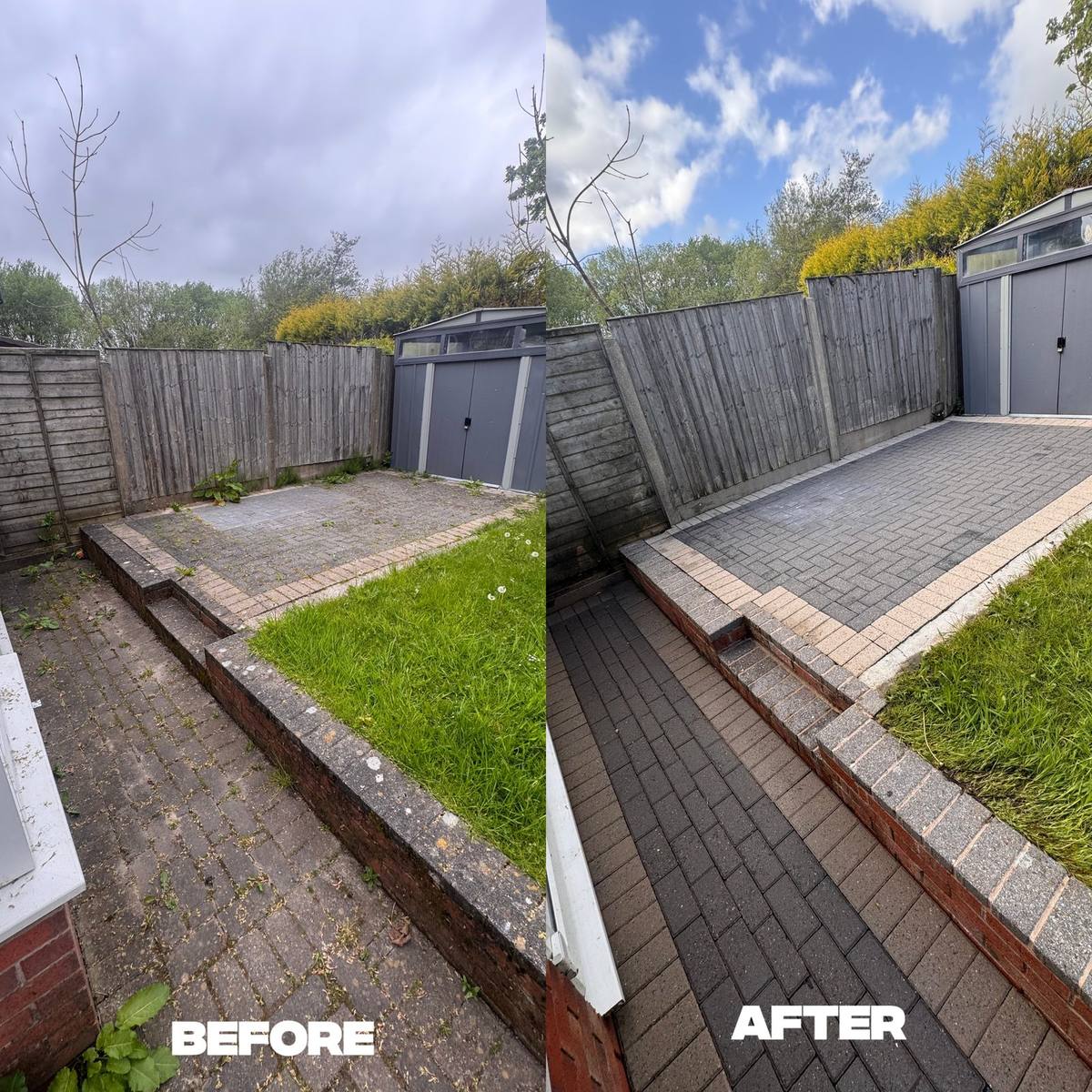
Rear block paving cleared of moss and weeds — left untreated, growth like this returns within a season.
Quick answer: Moss keeps coming back on driveways in the North West because the climate — heavy rainfall, low winter sun, and persistent damp — creates ideal growing conditions. Without treating the root cause (open joints, shade, or poor drainage), pressure washing alone removes the visible moss but leaves spores behind to regrow within months.
The North West Climate Is Almost Perfect for Moss
Greater Manchester is among the wetter parts of England. Oldham in particular sits on the western edge of the Pennines and catches a significant amount of rainfall — the hills force moisture-laden air upward and it drops as rain before it crosses to the drier east. Rochdale, Shaw, Royton, and the surrounding towns share similar exposure. The result is a climate that rarely stays dry long enough for outdoor surfaces to properly dry out between showers, especially from October through to April.
Moss doesn't need much. It thrives in damp, overcast conditions with mild temperatures — precisely what the North West delivers for most of the year. Unlike further south where warm, drier summers can desiccate moss and slow its growth, the climate here keeps it going almost year-round. Surfaces that might stay clean for two or three years in East Anglia can look green again within a season here.
That's not an excuse — it's context. Knowing the environment you're working against helps you make sensible decisions about treatment, sealing, and maintenance intervals rather than assuming something went wrong with the last clean.
Pressure Washing Removes Moss — It Doesn't Kill It
A pressure washer is a mechanical tool. It uses high-pressure water to dislodge and blast away visible growth — moss, algae, lichen, general grime. It does that job well. What it can't do is kill the spores that are embedded in the surface pores of block paving, concrete, or natural stone, or sitting in the joints between pavers. Those spores survive the wash, and once conditions are right again — which in Greater Manchester happens quickly — they germinate and the growth cycle starts over.
With block paving especially, the joints are the problem. Even a thorough pressure wash loosens the jointing sand and disturbs debris in the gaps, but it doesn't sterilise the surface. Spores left in the joints have everything they need: a sheltered environment, residual organic matter, and reliable moisture from the rain. Regrowth can begin in as little as six to eight weeks if no further treatment is applied.
This is why many DIY cleans feel like a short-term fix. The surface looks great immediately after, and then three or four months later there's a green tinge returning, and by six months it looks much as it did before. The cleaning wasn't necessarily done badly — the biocide step was just missed, and without it the result was always going to be temporary.
Open or Degraded Joints Are a Major Culprit
Block paving and natural stone rely on tight, well-filled joints to stay stable and resist biological growth. When jointing sand is washed out over time — through rain, repeated cleaning, foot traffic, or just age — the gaps between pavers open up. That loose, partially empty joint retains moisture, accumulates organic debris like dust and leaf matter, and offers very little competition to moss and weeds trying to establish themselves.
If you look closely at a driveway where moss keeps coming back on the driveway surface repeatedly and quickly, the joints are often visibly degraded — crumbling, hollow-sounding when tapped, or already full of established weed growth. Cleaning the surface without addressing the joints is a bit like repainting a wall without filling the cracks first. The underlying problem remains and the result won't last.
Block paving re-sanding with kiln-dried sand after a thorough clean is one of the most effective things you can do to slow moss regrowth. Kiln-dried sand is fine enough to pack tightly into joints, it compacts down well under vibration, and it gives moss and weeds far less to work with than an open, moisture-retaining gap. It's not glamorous work, but it makes a genuine difference to how long the result lasts. You can read more about the process in our guide to kiln-dried sand and block paving cleaning.
Shade and Poor Drainage Make It Worse
Two site-specific factors that significantly accelerate moss regrowth are shade and standing water. A north-facing driveway that gets little direct sunlight stays damp for hours after rain — sometimes all day in winter. Surfaces under trees or close to walls and fences lose airflow and light, and organic debris from overhanging branches falls directly onto the paving and breaks down into the kind of matter moss feeds on.
Poor drainage compounds the problem. If a driveway has areas that pond after rain, or if the surface has settled unevenly and water sits rather than runs off, those wet patches become prime moss territory. Block paving is permeable by design, but if the sub-base has settled or the falls are wrong, water lingers on the surface longer than it should.
It's worth walking your driveway after heavy rain and noting where water collects. Those are the spots you'll almost always find the worst moss growth. Trimming back overhanging shrubs or tree branches to improve light and airflow is one of the cheapest practical steps you can take, and it genuinely helps. If drainage is a structural issue, that's a conversation for a landscaper, but at minimum knowing where the problem spots are lets you apply maintenance treatments there more consistently.
Why Biocide Treatment Is the Missing Step
Biocide treatment — applied after pressure washing, once the surface is clean — is the step that most DIY cleans skip and most professional results depend on. A diluted sodium hypochlorite solution applied as a post-clean dwell treatment kills algae, moss spores, and other organic growth at a biological level rather than just removing what's visible. The surface looks the same after, but the spore load is dramatically reduced, and that directly translates to slower regrowth.
Softwashing — where sodium hypochlorite is the primary cleaning agent rather than pressure — is often more appropriate on certain surfaces, particularly render, softer stone, and roofing. For harder surfaces like concrete and block paving, a combination approach works well: pressure washing to remove bulk growth and grime, followed by a biocide dwell to deal with what remains. You can read more about how that process works on our softwashing page and in our honest comparison of sodium hypochlorite versus branded patio cleaners.
After any professional clean, ask whether a post-treatment biocide is included. If it isn't, the result will look the same on the day but won't last as long. It's the most important step most people don't know to ask about.
Trade-grade biocides are stronger and more persistent than off-the-shelf garden centre products. That's not a criticism of domestic products — they have their place as a maintenance top-up — but they're not the same as what a professional applies at the right dilution after a proper clean. The dwell time matters too: sodium hypochlorite needs time in contact with the surface to work effectively, and that means letting it sit rather than rinsing immediately.
When It's Time to Call a Professional
If moss keeps coming back on your driveway within a few months of cleaning, or if the joints are visibly degraded and the surface looks tired overall, it's a signal that the job needs more than a domestic pressure washer and an afternoon. There's a point where the time, equipment, and chemical investment required makes professional cleaning the more sensible option — and usually the cheaper one per year when you factor in how much longer the result lasts.
A professional driveway cleaning service involves a proper rotary surface cleaner (which cleans evenly without the streaking a lance produces), appropriate biocide treatment, and where needed, re-sanding of joints and an optional sealant application. For block paving, pricing typically starts around £3.50/m² for a standard clean, rising to around £4.25/m² when a chemical treatment is included, and approximately £5.50/m² for a full restoration that includes re-sanding. Re-sanding alone, on an already clean surface, usually comes in around £2.00/m².
C&C Precision Precision Washing covers Oldham and the wider Greater Manchester area — Rochdale, Bury, Bolton, Tameside, Stockport — and quotes are straightforward: send photos via WhatsApp and you'll get a clear price without a site visit in most cases. If you're weighing up whether sealing is worth adding after the clean, our guide on driveway sealing after cleaning covers the honest pros and cons.
What You Can Do to Slow Moss Down Between Cleans
You won't stop moss entirely in the North West — the climate won't allow it. But there's a meaningful difference between moss being a nuisance every six months and it being something you deal with every two to three years. The gap between those outcomes comes down to consistent, simple maintenance rather than any single treatment.
Trim back overhanging shrubs and branches where possible to improve light and airflow across the surface. Sweep the driveway regularly — particularly in autumn — to stop damp leaf matter sitting on the paving and breaking down into organic feed for moss. If joints are open or crumbling, get them re-sanded; it's a relatively low-cost intervention that makes a disproportionate difference to how quickly biological growth returns. And consider applying a diluted moss killer or biocide spray in late autumn, before the main growing conditions set in over winter.
Realistic expectations matter here. These steps won't give you a permanently moss-free driveway in Greater Manchester — nobody can promise that honestly. What they will do is significantly extend the interval between cleans and reduce the severity of growth when it does return. That's a worthwhile result, and it's achievable without spending a lot of money.
Frequently asked questions
How long should a driveway stay clean after professional pressure washing?
Realistically, a quality clean with post-treatment should keep moss at bay for 12 to 24 months in Greater Manchester, depending on shade, drainage, and joint condition. Without biocide treatment, you might see regrowth in as little as 3 to 6 months. There's no permanent fix in this climate — maintenance is part of the deal.
Does sealing block paving stop moss from coming back?
Sealing helps by closing off the surface pores that moss anchors into and making the surface easier to clean, but it's not a magic barrier. If the joints aren't properly re-sanded before sealing, moss will still find a way in. It's a useful part of the process, not a standalone solution.
Is moss on a driveway just cosmetic, or does it cause damage?
It's both. Over time, moss retains moisture against the surface, which accelerates freeze-thaw damage in winter — particularly in block paving joints and natural stone. It also makes surfaces slippery and dangerous. Left long enough, it can undermine the integrity of the jointing sand and destabilise the pavers themselves.
Can I treat moss myself with products from the garden centre?
You can slow it down with off-the-shelf moss killers, and they're worth using between professional cleans. The issue is that domestic products are usually lower concentration than trade-grade biocides, so they're less effective at killing spores deep in the surface. They work better as a maintenance top-up than a primary treatment.
Tired of moss coming back every year?
Send a photo of your driveway on WhatsApp and we'll come back to you fast with a straight price.