If you've noticed green or black staining spreading across your render, roof tiles or stone walls, you've probably started researching how to shift it. One term that comes up quickly is sodium hypochlorite softwash — a low-pressure chemical cleaning method that's become the standard approach for organic growth on delicate exterior surfaces. It works differently from pressure washing, and understanding why matters before you decide how to tackle the problem.
This guide covers what softwash actually is, how the process works, which surfaces it's suited to, and the questions most homeowners want answered before letting anyone near their property with chemicals. The aim is to give you enough honest information to make a sensible decision — whether that's booking a professional or simply understanding what you're looking at.
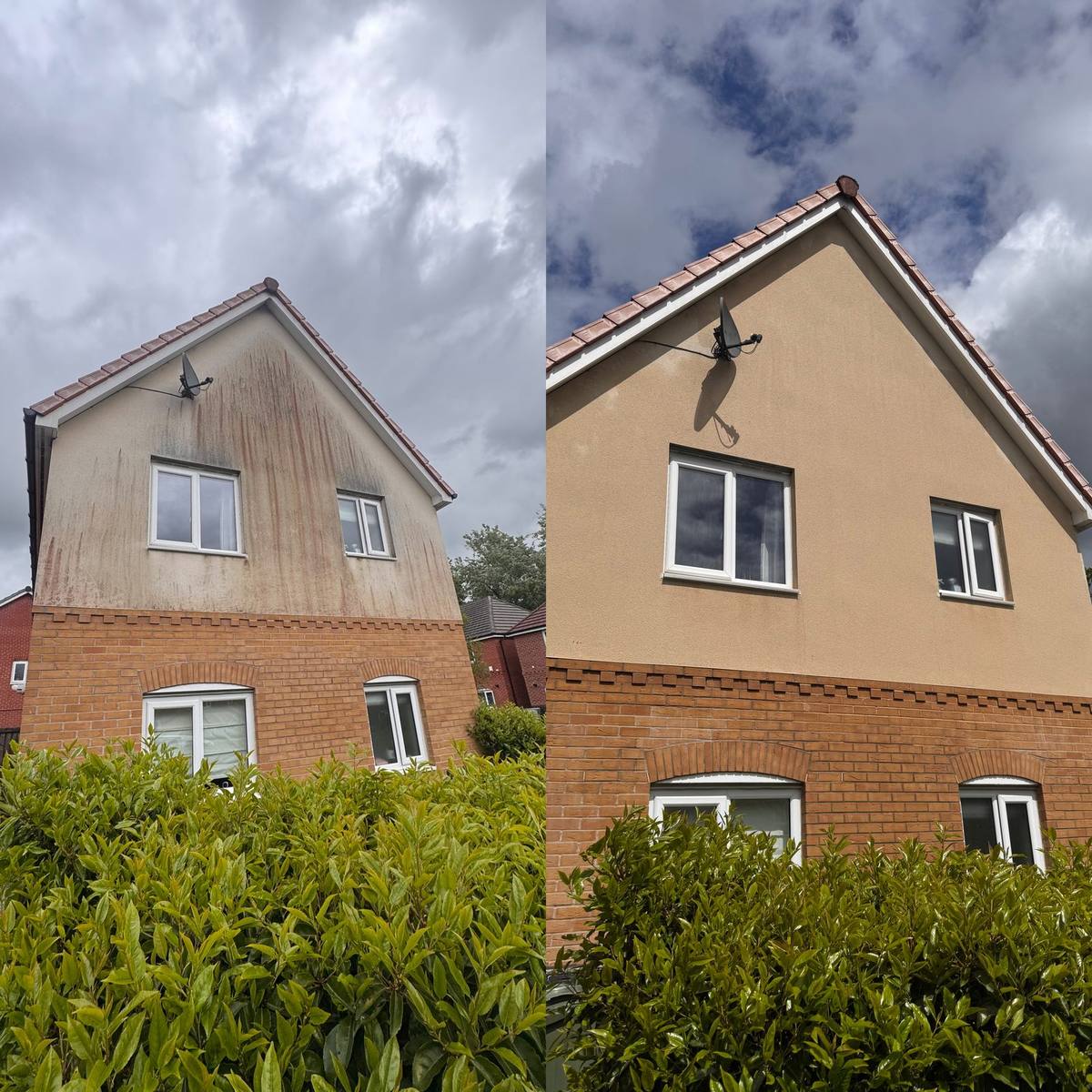
Red algae on K-Rend render, gone after a single sodium hypochlorite softwash treatment.
Quick answer: Sodium hypochlorite softwash is a low-pressure cleaning method that uses a diluted bleach solution to kill algae, moss, lichen and bacteria at the root. It's applied to surfaces like render, roofs and stone, left to dwell, then rinsed — removing organic growth without the damage high-pressure washing can cause.
What Is Sodium Hypochlorite and Why Do Cleaners Use It?
Sodium hypochlorite is the active ingredient in household bleach, but what professional exterior cleaners use is a different animal. The professional-grade product is a concentrated solution that gets diluted on-site to precise ratios depending on the surface and the type of growth being treated. You won't find it on the shelf at a supermarket, and the dilutions used in a garden sprayer from a YouTube tutorial are rarely right.
The reason it's so widely used in exterior cleaning is straightforward: it doesn't just remove the visible staining, it kills the organism causing it at the root. Algae, moss, lichen and black spot fungi are living things embedded in the surface. A pressure washer can blast away the top layer, but if the root structure stays behind, regrowth is usually back within months. Sodium hypochlorite softwash kills the biology first, which is why results last considerably longer.
It's worth knowing that sodium hypochlorite is used in water treatment plants to make drinking water safe. At the correct dilutions it's a well-understood, well-regulated substance — the risk comes from misuse, not from the chemistry itself.
How the Softwash Process Works Step by Step
The process starts before any chemical touches the building. Plants, borders and hard surfaces nearby are pre-wetted with clean water. This dilutes any overspray that lands where it shouldn't and gives vegetation a buffer. Drains and downpipes are noted so the rinse water can be managed sensibly.
The sodium hypochlorite softwash solution is mixed with a surfactant — a detergent-type additive that helps the chemical cling to vertical surfaces rather than running straight off. This matters particularly on render and gable ends where the product needs to stay in contact long enough to do its job. Application is at low pressure, typically no more than what you'd get from a garden hose. That's the defining difference between softwashing and pressure washing: the chemistry does the work, not the force of the water.
Dwell time is usually 15 to 30 minutes. During that window the sodium hypochlorite breaks down cell walls in the algae and moss, and you'll often see the surface visibly change colour as the growth dies off. After dwell time comes a thorough rinse, washing the dead material and chemical residue from the surface. Any trace that remains continues to neutralise over the following days as rain does its work.
What Surfaces Is Sodium Hypochlorite Softwash Used On?
Softwash is the correct method for surfaces where pressure washing would cause damage or force water into places it shouldn't go. Render cleaning — particularly K-Rend, monocouche and pebbledash — is one of the most common applications in Greater Manchester. These thin-coat finishes are textured and porous, which makes them brilliant at trapping moisture and growing algae, especially on north-facing elevations that rarely see direct sun. High-pressure washing can erode the surface texture or, worse, drive water behind the render coat, leading to damp problems that cost far more to fix than a clean.
Roof cleaning and moss removal is another area where softwash is the right tool. Concrete and clay roof tiles are brittle and the mortar bedding around ridge tiles can be disturbed by pressure washing. A sodium hypochlorite softwash applied at low pressure kills the moss and lichen without any mechanical stress on the tiles. The dead growth then loosens naturally over the following weeks of weather. Stone walls, limestone features and rendered conservatory roofs follow the same logic — delicate, textured or porous surfaces where chemical cleaning is safer than force.
Is Softwash Safe for Your Render and Roof?
This is the question that makes most homeowners hesitate, and it's a fair one. The honest answer is yes — at the correct dilution and with proper rinsing, sodium hypochlorite softwash will not harm K-Rend, monocouche, pebbledash, concrete tiles or natural stone. The product has been used on these surfaces professionally for years, and the method is now widely recommended by render manufacturers themselves precisely because it avoids the mechanical damage that pressure washing can cause.
The risk isn't the chemistry — it's misapplication. Using too high a concentration, leaving it to dwell too long, or failing to rinse thoroughly can cause issues. That's the argument for professional application, not against the method itself. As mentioned, the same active ingredient is used in water treatment to make drinking water safe; it's a question of dilution and process.
If your render is showing the kind of green staining common on Greater Manchester properties that spend half the year facing drizzle and low light, a professional softwash is likely the safest way to address it. You can read more about a specific variant of this problem in our guide on red algae on render.
Is It Safe for Plants, Pets and People?
This is usually the first thing homeowners actually want to know, and it deserves a straight answer. Sodium hypochlorite will damage or kill plants it lands on in any meaningful concentration — that's not something to gloss over. Pre-wetting plants before application, covering any particularly vulnerable specimens, and rinsing the surrounding area thoroughly after the job are all standard parts of professional practice. It's not a reason to avoid the method, but it is a reason to take care during application.
Pets should be kept away from the treated area during the dwell period and until the rinse is complete. Once the surface has been rinsed down, the solution neutralises quickly, and a damp surface that's been properly rinsed poses no meaningful risk to animals walking across it. For people, the main precaution during application is avoiding skin contact with the solution and not breathing the vapour at close range — both non-issues if you're not the one applying it.
Pre-wet all plants, borders and lawn edges before softwash application begins, and rinse them again immediately after the surface rinse is complete. The extra five minutes this takes is the simplest way to protect your garden.
When Should You Call a Professional Instead of DIY?
Be direct: mixing and applying sodium hypochlorite without experience is genuinely risky. The concentration required varies by surface — what's appropriate for a roof tile would be too strong for a painted render, and too weak on heavily colonised stone. Get the dilution wrong and you can damage the surface, strip a finish, or cause a chemical burn. These aren't unlikely worst-case scenarios; they're the kind of thing that happens when people follow general advice that wasn't calibrated to their specific surface.
Working at height adds a separate layer of risk. Cleaning a ground-floor render panel with a pump sprayer is one thing. Treating a gable end, a two-storey elevation or a roof from a ladder while handling chemicals is another entirely. Professional operators use appropriate access equipment, carry calibrated application kit, and hold public liability insurance. C&C Precision Precision carries £1,000,000 public liability cover for exactly this reason — because things can go wrong, and when they do, someone needs to be accountable.
If you're weighing up whether to hire a professional for softwashing or attempt it yourself, the honest answer is that for anything above head height or on a surface you can't afford to damage, the risk isn't worth it. A garden sprayer and a bag of pool chlorine is not the same as calibrated equipment and a trained operator.
The Honest Takeaway: When Softwash Is the Right Call
Softwash is the correct method when you're dealing with organic growth on a surface that pressure washing would damage — textured renders, roof tiles, stone walls, conservatory roofs, and similar. In Greater Manchester's climate, where properties spend months facing damp air and limited sun, these surfaces grow algae and moss reliably. A sodium hypochlorite softwash kills the growth at the root and leaves the surface clean without any mechanical stress.
There are things softwash won't fix. It's not the right tool for oil stains on block paving or tyre marks on a tarmac drive — those need a different approach, which you can read about in our guides on block paving cleaning and tarmac driveway cleaning. And be honest with yourself about expectations: heavy lichen on stone may lighten significantly without fully disappearing in a single treatment, particularly on very porous surfaces. That's not a failure of the method — it's just how heavily embedded growth behaves.
If your render is going green, your roof tiles have turned black, or your stone wall hasn't looked clean in years, a softwash treatment will shift what a jet wash won't. The simplest next step is to send a photo — most professional operators, including the team here at C&C Precision, will give you a straightforward view on what method your surface actually needs and what it's likely to cost before anyone drives out.
Frequently asked questions
How long does sodium hypochlorite softwash take to work?
The solution typically needs to dwell on the surface for 15 to 30 minutes to kill algae, moss and lichen at the root. You'll usually see the green or black colour start to fade during that time. A thorough rinse follows, and any remaining residue continues to break down over the next few days of rain and weathering.
Will softwash damage my K-Rend or monocouche render?
No — when mixed and applied correctly, sodium hypochlorite softwash is safe on K-Rend and other thin-coat renders. In fact, softwash is the recommended method precisely because high-pressure washing can erode the surface texture or force water behind the render. The key is using the right dilution and rinsing thoroughly.
How long will the results last after a softwash treatment?
On most surfaces you can expect to stay clean for two to four years, depending on the property's exposure to shade, moisture and surrounding trees. North-facing elevations in Greater Manchester's damp climate will regrow algae faster than south-facing ones. Some customers book a maintenance clean every couple of years to stay on top of it.
Can I buy sodium hypochlorite and do this myself?
You can buy SH, but professional-grade concentrations are not available over the counter and the dilution ratios vary significantly by surface — get it wrong and you risk damaging your render, killing your plants or causing a chemical injury. Add the risk of working at height on roofs or high gables and it's not something we'd recommend tackling without the right equipment and insurance.
Want to know if softwash is right for your render, roof or walls?
Send us a photo on WhatsApp and we'll give you a straight answer and a fast price — no obligation.