If you've noticed an orange or rust-coloured bloom spreading across the front of your house, you're not alone. Red algae on render is one of the most common complaints we hear from homeowners across Greater Manchester, and it's particularly stubborn in areas like Oldham, Rochdale and Saddleworth where north-facing gable ends rarely see enough sun to dry out between rainy spells. It looks worse than most people expect when they first spot it, and the natural instinct is to reach for a pressure washer or a bucket of bleach. Neither is the right answer.
This guide covers what red algae actually is, why rendered surfaces attract it so readily in the North West, and what the correct treatment looks like — including the honest limitations of any approach. If you're trying to figure out whether this is something you can tackle yourself or whether it needs a professional, the information below should help you make that call with some confidence.
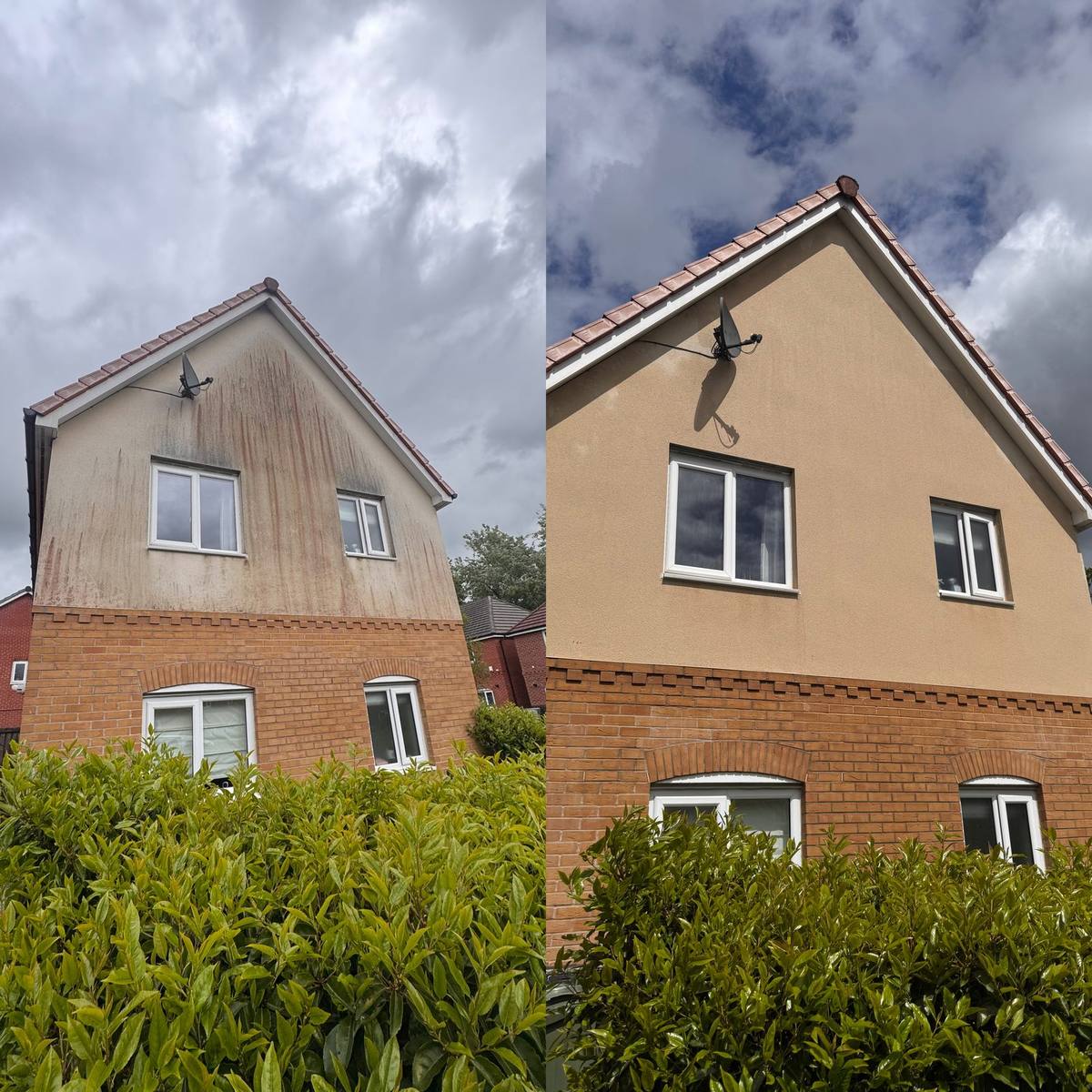
Before and after softwash on a rendered front elevation in Greater Manchester. The red algae staining was killed at root level and rinsed away cleanly.
Quick answer: Red algae on render is a microscopic organism — usually Trentepohlia — that thrives in damp, shaded conditions and produces a distinctive orange-red or rust-coloured staining. It cannot be removed by pressure washing alone. Softwashing with sodium hypochlorite kills it at the root and restores the render without causing damage.
What Is Red Algae and Why Does It Grow on Render?
The reddish-orange discolouration you're seeing is most commonly caused by Trentepohlia, a genus of microscopic algae that produces carotenoid pigments — the same family of pigments that make carrots orange. Despite looking like rust or a dye stain, it's a living organism, and that distinction matters enormously for how you treat it. It's widespread in damp, temperate climates and the North West of England gives it almost ideal conditions for most of the year.
Rendered surfaces are particularly hospitable. K-Rend, silicone render and traditional pebbledash all have a slightly open, textured surface that algae can grip onto and colonise. Render also retains moisture longer than brick or stone, especially on north-facing elevations that may only see direct sunlight for a few hours a day — or not at all in winter. Add in the shade cast by trees, close-packed terraced streets or neighbouring properties, and you have a surface that stays damp enough for biological growth to establish itself and spread. The organism follows moisture paths down the render face, which gives it that characteristic patchy, trailing appearance.
How to Tell If It's Red Algae (Not Rust, Staining or Efflorescence)
Getting the diagnosis right before you spend money on treatment is worth a moment's thought. Red algae on render tends to appear in spreading patches that follow the natural drainage of water down the elevation — broader at the top, trailing downward, often worse around parapet copings, window sills or anywhere that holds moisture. It has a slightly organic, uneven edge rather than a sharp line.
Rust staining from metal fixings, brackets or window hardware looks quite different: it runs in distinct vertical streaks directly below the source, often with a sharper, more concentrated colour at the origin point. Efflorescence — the white or grey powdery bloom caused by soluble salts migrating to the render surface — is a completely different problem and requires a different remedy entirely. If you dampen the discolouration and rub it gently with a cloth, algae will smear slightly and the cloth will pick up a faint orange-brown residue. Rust staining won't transfer in the same way. Efflorescence will dissolve and disappear temporarily then return from within the material as it dries.
The other tell-tale sign of algae is that the discolouration intensifies after rain and appears to spread over time. If your render looked fine two years ago and has gradually taken on this orange tinge, particularly on a shaded elevation, red algae is almost certainly what you're dealing with.
Why Pressure Washing Red Algae Off Render Is a Bad Idea
This is probably the most important thing in this guide, so it's worth being direct. Pressure washing might seem like the obvious solution — blast it off and be done with it — but on render it causes more problems than it solves. High-pressure water fragments the algae colony and drives spores into the open pores of the render surface, embedding the contamination more deeply rather than removing it. The face of the render may look temporarily lighter after treatment, but the biological growth hasn't been killed; it's been disturbed and dispersed, and it will return faster than before.
There's also a structural risk. Render — particularly older pebbledash or thinner silicone coatings — can be damaged or partially delaminated by high-pressure washing, especially if there are any areas where the render has begun to detach from the substrate behind it. A professional assessing the job before treatment will check for hollow sections and areas of concern. Pressure washing without that check risks blowing patches off entirely, which turns a cleaning job into a rendering repair. Overspray contamination onto adjacent surfaces, timber fascias, uPVC windows and soft landscaping is another common consequence that's easily avoided by using the right method from the start.
How Softwashing Actually Removes Red Algae from Render
The correct approach for red algae on render is softwashing — a low-pressure application of a diluted sodium hypochlorite solution combined with a surfactant. The surfactant helps the solution cling to vertical surfaces rather than running straight off, giving the active ingredient time to work. The solution is applied at pressures well below those that could damage render and is left to dwell on the surface, typically for fifteen to thirty minutes depending on the severity of growth and the ambient temperature.
During the dwell period, the sodium hypochlorite kills the algae at a biological level — breaking down the cellular structure of the organism rather than just bleaching the pigment. This is the critical difference between softwashing and any surface-only approach. Once the dwell time is complete, the surface is rinsed gently. The render should be visibly cleaner, and because the organism is dead rather than displaced, regrowth takes significantly longer. For more detail on how this process is used on different surfaces, the render cleaning page covers the approach we take across Greater Manchester.
Sodium hypochlorite dilution matters significantly. Too weak and it won't kill the algae effectively. Too strong and it can affect surrounding plants, uPVC trims and stonework. Professional softwash operators mix to specific ratios for the surface type and growth severity — it's not something to approximate with supermarket bleach.
How Long Does It Take for Results to Show?
On lighter growth, the transformation can be striking within a few hours of treatment — the render returns to something close to its original colour as the dead algae is rinsed clear. On heavier or more established growth, the results take longer to fully develop. A 'purging' effect is normal: as the dead algae loosens from the render surface over the following 24 to 72 hours, rain and natural weathering wash it away gradually. This can mean the render looks a little patchy in the days immediately after treatment before settling to its final appearance.
In cases where the growth is very heavy or has been present for several years, a second application may be needed to deal with any residual staining. This isn't a sign that the treatment hasn't worked — it's simply a reflection of how embedded the colony has become. A reputable contractor will tell you at the quoting stage if a second visit is likely, rather than presenting it as a surprise after the first treatment.
When Should You Call a Professional Instead of DIYing It?
There are several practical reasons to use a professional for this job rather than attempting it yourself. Sodium hypochlorite — even at the dilutions used for render cleaning — requires correct PPE including eye protection, chemical-resistant gloves and appropriate clothing. Overspray onto plants, lawns or garden features can cause real damage, and it's not always obvious in the moment how far spray is drifting. Runoff needs to be managed carefully, particularly near drains. These aren't reasons to be frightened of the process, but they are reasons why experience makes a difference to the outcome.
Working at height is the other consideration. A single-storey extension or low boundary wall is one thing, but a two-storey gable end — which is often exactly where red algae establishes itself — is a different matter entirely. Professional operators use appropriate access equipment and are trained to work safely at height. Beyond the safety question, an experienced contractor will also assess the condition of the render itself before applying any treatment: checking for hollow areas, cracks or areas of delamination that would make pressure rinsing risky. If you'd like a sense of what render cleaning typically costs in this area, the render cleaning cost guide for Greater Manchester covers pricing in plain terms. C&C Precision covers the full Greater Manchester area and can usually provide a quote from photos sent via WhatsApp the same day.
How to Keep Red Algae Off Your Render After Treatment
No treatment makes render permanently immune to biological growth — any honest contractor will tell you that. But there are practical steps that slow regrowth significantly. The most effective is improving airflow and reducing the amount of time the render stays wet. Trimming back trees, hedges or shrubs that overhang or press close to the elevation reduces the damp shade those plants create, and it's worth doing before treatment as well as after. Keeping gutters and downpipes clear is equally important — a blocked gutter that sends water sheeting down the render face will accelerate algae growth considerably, and you can read more about that issue in the gutter clearing guide for Bury, which covers a pattern that applies across the region.
For ongoing management, a maintenance softwash every two to three years is a far more sensible approach than waiting for heavy regrowth to return before acting. The cost of keeping on top of it at that interval is considerably lower than restoring render that has been left for five or six years. Some homeowners also choose to apply a biocide-based render treatment after softwashing, which can extend the clean period further — though results vary depending on the render type, aspect and the local environment. Algae will always be part of the picture on a rendered property in the North West; the realistic goal is managing the cycle rather than eliminating it entirely.
Frequently asked questions
Is red algae on render harmful to the building?
Left untreated over several years, red algae retains moisture against the render surface which can accelerate surface degradation and, in severe cases, promote the conditions for other biological growth like lichens that physically break down the substrate. It's not an immediate structural emergency, but it's worth dealing with before it gets established. Most homeowners act on it because of how it looks, and that's a perfectly valid reason too.
Can I use bleach from a garden sprayer to remove red algae myself?
Household bleach is a much weaker concentration than the sodium hypochlorite used in professional softwashing and is unlikely to kill the algae effectively at root level. More importantly, overspray or runoff can damage plants, stain adjacent surfaces and irritate skin and eyes. If you're not experienced with mixing and applying biocide solutions, the risk of getting it wrong outweighs the cost of having it done properly.
How much does it cost to softwash red algae off render in Greater Manchester?
The price depends on the size of the property, the severity of the growth and how much of the elevation is affected. A typical semi-detached front and side elevation in Greater Manchester generally sits in the range of £150–£350, but the most accurate way to get a price is to send a few photos on WhatsApp — we can usually turn a quote around the same day without needing to visit first.
Will the red algae come back after softwashing?
It can, eventually — render is a porous, textured surface in an outdoor environment, and biological growth will always be a possibility over time. However, a proper softwash kills the existing colony rather than just masking it, so regrowth is significantly slower compared to pressure washing. Many customers in Greater Manchester opt for a maintenance clean every two to three years to keep on top of it.
Got red algae on your render?
Send us a photo on WhatsApp and we'll come back to you quickly with a straightforward price — no obligation.