If you've noticed a green tinge spreading across your roof tiles, you're not alone. In Greater Manchester, moss on roofs is about as common as grey skies in February — and for the same reason. The damp, overcast climate gives moss exactly what it needs to take hold and spread. The question most homeowners ask is whether it's just an eyesore or whether it's actively causing damage. Understanding the key roof moss damage signs is the difference between acting at the right time and acting too late.
This guide is written to help you make that call yourself, from the ground, without needing to climb up and take a look. Some moss is cosmetic. Some moss is quietly working its way into your mortar joints and tile edges, retaining water and accelerating freeze-thaw cracking through every cold snap. Knowing which situation you're dealing with matters, and the visual cues are more readable than most people think.
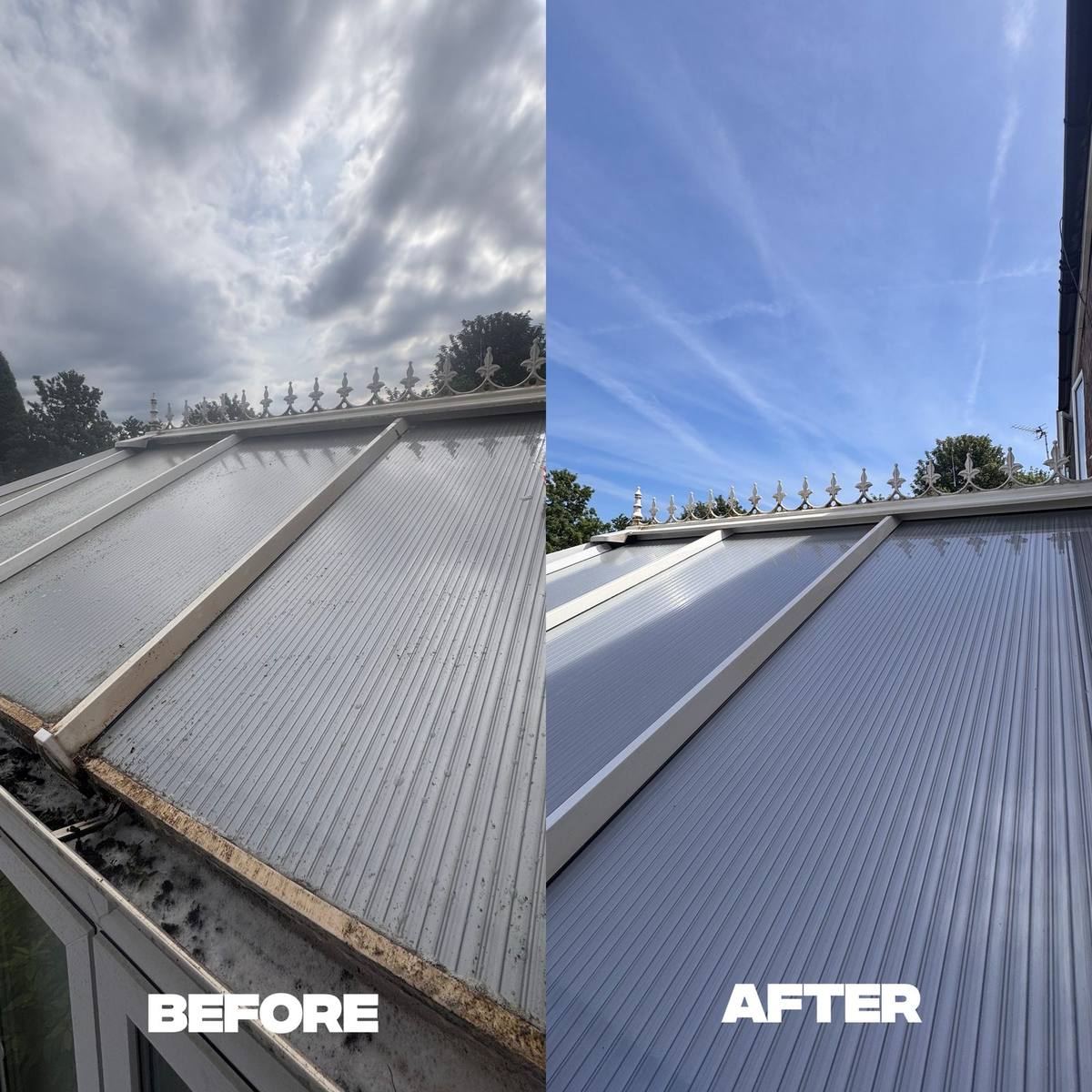
Before and after: conservatory roof cleared of moss, lichen and debris by C&C Precision in Greater Manchester.
Quick answer: Roof moss causes real damage when it lifts tiles, traps moisture against the roof structure, or blocks gutters — leading to leaks and rot. If moss is thick, spreading under tile edges, or your gutters are consistently full of green debris, it's moved beyond cosmetic and needs dealing with.
Why Moss Grows on Roofs in the First Place
Moss is a non-vascular plant that doesn't need soil — it just needs moisture, a reasonably rough surface to cling to, and some shade. Concrete and natural slate roof tiles provide all three. The texture gives moss something to grip, the porosity holds just enough moisture to keep it alive between rain showers, and any nearby trees or the roof's own pitch angle can limit direct sun enough to prevent it drying out.
North-facing slopes are the worst affected, simply because they get less sunlight and stay damp for longer after rain. In a place like Oldham or Rochdale, where annual rainfall is higher than the national average and overcast days are plentiful, even south-facing slopes can develop moss if there's organic debris sitting in the gutters feeding spores down onto the tiles. Dead leaves, lichen fragments and general urban grime all contribute to a growing medium that moss exploits readily.
It's also worth understanding that moss doesn't arrive randomly. Spores are airborne and land everywhere — what determines whether they establish is purely about conditions. A roof in a sheltered garden with large overhanging trees will almost always show moss faster than one in an exposed, sunny spot. In Greater Manchester's terraced and semi-detached housing stock, where roofs are often close together and gardens can be shaded, those conditions are widespread.
The Difference Between Cosmetic Moss and Damaging Moss
Not all moss is at the same stage, and the stage matters. Young, thin moss — the kind that's a flat, almost powdery green layer sitting on the tile surface — is largely cosmetic at that point. It hasn't put down substantial rhizoids (the root-like structures moss uses to anchor itself), it isn't yet lifting tile edges, and it isn't holding significant volumes of water against the tile or mortar. At this stage, the roof beneath is probably fine.
The situation changes once moss becomes established and thick. When you can see it standing proud of the tile surface, when it's visibly pushing up at tile edges or ridge line mortar, and when it's clearly colonising the gaps between tiles rather than just sitting on top of them — that's where structural risk begins. The rhizoids at this stage are physically embedded in mortar joints and can work into cracks in concrete tiles. The mass of vegetation is also holding water directly against porous surfaces for extended periods, which matters enormously during frost.
The visual test is reasonably simple: flat and green with no lift at the edges means you're probably in cosmetic territory. Raised, spongy-looking growth that appears to be getting under tiles, or that you can see bulging at ridge and hip mortar joints, means it's time to take it more seriously. Age and coverage area are rough proxies — a small patch on a lower course that appeared recently is different from a roof that's half-covered and hasn't been treated in fifteen years.
Roof Moss Damage Signs You Can Spot From the Ground
You don't need to get on the roof to read the main roof moss damage signs. A pair of binoculars and a short walk around the property will tell you a great deal. The clearest warning signs are moss visibly lifting the edges of tiles — you'll see gaps where tile laps should sit flat, sometimes with the moss itself poking out from underneath. If you can see daylight or shadow under tile edges from the ground, that's a meaningful sign.
Green or dark streaks running down the tile face and into the gutters are another indicator. This is moss being washed off gradually, and it tells you the colony is established enough to be shedding. If your gutters are overflowing during moderate rain when they shouldn't be, or if you can see a visible build-up of green-brown debris in the gutters themselves, moss and lichen debris is likely blocking them. Blocked gutters are a secondary damage route — water that can't drain properly backs up against fascias and soffits.
Inside the house, dark damp patches appearing on ceiling joists or plasterboard after sustained rain are the most serious sign. This usually indicates that water has already found a way in — either through cracked or displaced tiles, failed mortar, or water ingress at the fascia line caused by backed-up gutters. At this point you're dealing with consequences rather than prevention. It's worth checking your loft space after heavy rain if you have any concerns — a torch and ten minutes can confirm whether water is getting in before it shows on the ceiling below.
What Moss Actually Does to Tiles, Mortar and Gutters
The damage mechanism is primarily about water retention. Moss acts like a sponge, holding moisture directly against tile and mortar surfaces for far longer than those surfaces would stay wet on their own. During the colder months — and Greater Manchester has plenty of freeze-thaw cycles between October and March — that retained moisture expands as it freezes, then contracts as it thaws. Repeated cycles of this physical stress crack concrete tiles and break down mortar joints gradually but cumulatively.
The rhizoids compound the problem. They grow into existing micro-cracks in mortar and tile, physically widening them as the plant grows. Ridge and hip mortar is particularly vulnerable because it's exposed on multiple faces and often older. Once mortar joints start to fail, tiles become less stable and the roof loses its ability to shed water effectively at the most exposed points.
Gutters suffer through accumulation. As moss colonies shed material — especially during heavy rain — that debris washes into gutters and downpipes. Over time it compacts into a layer that prevents drainage. Standing water in gutters causes them to sag, pull away from fascia boards, and eventually allows water to run behind them and into the roof structure at the eaves. It's an unglamorous failure mode but a very common one, and it's directly linked to unmanaged moss growth above.
Signs It's Still Just Cosmetic (And You Have Time)
It's worth being balanced here, because not every green roof is an emergency. If the moss is relatively young, flat to the tile surface, and confined to a limited area — particularly lower courses on a south or west-facing slope — there's a reasonable chance the roof structure beneath is sound. If your gutters are clear and your interior ceilings are dry after heavy rain, those are good signs that the moss hasn't yet created secondary problems.
In these cases, you have time to treat it properly rather than panicking into a rushed decision. That said, "you have time" doesn't mean "leave it indefinitely." Moss in the cosmetic stage is considerably easier and cheaper to deal with than moss that has been establishing for several years. A biocide treatment applied now — the kind used in professional softwashing — will kill existing growth and inhibit regrowth for several years. Waiting until it's embedded in mortar joints turns a maintenance job into something that may also need re-pointing.
The North West climate doesn't offer long windows of dry, frost-free weather. If you've assessed your roof and concluded it's in the cosmetic-but-growing category, the practical move is to schedule treatment before the next wet winter rather than after it.
A useful habit: photograph your roof from the same spot each autumn. Year-on-year comparison photos make it easy to see whether moss is spreading, stable, or accelerating — and they're useful information for any professional you eventually bring in to assess the roof.
When to Stop Googling and Call a Professional
There are specific thresholds where a professional assessment stops being optional. If moss is visibly getting under tile edges or lifting ridge mortar, if you can see cracked, slipped, or displaced tiles alongside the moss growth, or if you've found evidence of internal damp after rain, you're past the monitoring stage. Similarly, if moss covers more than a third of the total roof surface, the remediation involved is beyond what any homeowner should attempt themselves.
It's also worth being direct about the tool question: pressure washing is not the right approach for most roofs. High-pressure water can crack concrete tiles, dislodge older slate, blast out mortar from joints, and force water under tile laps — causing the very ingress it's supposed to prevent. The professional standard is softwashing, which uses a low-pressure application of sodium hypochlorite solution to kill moss and lichen at the root. The dead material then breaks down and washes off naturally over subsequent rainfall, without any physical force being applied to the tile surface. If you want more detail on the roof moss damage signs that indicate softwashing is needed rather than a simple brush-off, our guide on lichen on roof tiles covers related treatment decisions in more depth.
C&C Precision cover roof cleaning and moss removal across Greater Manchester, including Oldham, Rochdale, Bury, Bolton, Tameside, Stockport and surrounding areas. Quotes are based on photos sent over WhatsApp — no visit required upfront, and most customers get a price back the same day. Full details are on the roof cleaning and moss removal page.
What You Can Do Right Now to Limit the Damage
The most immediately useful thing you can do is clear your gutters if they haven't been done recently. Blocked gutters accelerate every secondary damage route that moss creates — water ingress at fascias, soffits pulling away, and damp at the eaves. It's a straightforward job and it removes one of the main ways moss damage turns into something more expensive.
Beyond that, photograph the roof from each elevation and keep the photos dated. You don't need specialist equipment — a smartphone from the end of the garden works fine. What you're tracking is coverage and any change in how the tile edges look over time. If you can see the same section of roof in photos taken a year apart, you'll know immediately whether the moss is spreading or holding steady. This is the kind of information that's useful both for your own decision-making and for any professional assessing the situation later.
Avoid DIY pressure washing on roof tiles. The temptation is understandable — it looks like it would work — but the physical force involved is genuinely damaging to many tile types and to mortar joints that may already be compromised. The right treatment for roof moss is a biocide application at low pressure, and it requires working at height safely with the correct chemical concentration and dwell time. If the moss on your roof is past the cosmetic stage, or if you want it treated properly before another wet winter, arranging a professional softwash is the most cost-effective route. For context on how that approach compares to pressure washing on other surfaces, the guide on softwash vs pressure washing for render explains the underlying logic well, even though it focuses on walls rather than roofs.
Frequently asked questions
Can roof moss cause a leak?
Yes, but usually indirectly. Thick moss retains moisture against tiles and mortar, accelerating freeze-thaw cracking over time. It also blocks gutters, causing water to back up against fascias and soffits where it can penetrate the roof structure and eventually cause internal damp or leaks.
Is it safe to pressure wash moss off a roof?
Generally no — high-pressure washing can crack or dislodge tiles, force water under laps, and damage mortar joints. The professional standard for roof moss removal is softwashing, which uses a low-pressure application of sodium hypochlorite solution to kill moss and lichen at the root without physical damage to the roof surface.
How quickly does roof moss spread?
In a damp climate like Greater Manchester's, moss can establish and spread noticeably within a single season, especially on north-facing or shaded slopes. Once it gets under tile edges and into mortar joints, it accelerates its own spread by retaining more moisture — which is why early treatment is considerably cheaper than late treatment.
How much does professional roof moss removal cost in Greater Manchester?
Prices vary depending on roof size, pitch, access, and the extent of the moss. The fastest way to get an accurate figure is to send a couple of photos of your roof over WhatsApp — most customers get a quote back the same day without anyone needing to visit first.
Not Sure How Bad Your Roof Moss Is?
Send a photo over WhatsApp and we'll give you an honest answer and a fast quote — no obligation.