If you've noticed crusty, grey-green patches spreading across your roof, you're most likely looking at lichen on roof tiles rather than ordinary moss or algae. It's one of the most common calls we get from homeowners across Greater Manchester, and it's also one of the most misunderstood problems in exterior cleaning. Lichen tends to get dismissed as a cosmetic issue — something unsightly but harmless — when in reality it's actively working its way into the tile surface beneath what you can see.
The North West doesn't do lichen any favours in terms of keeping it under control. Oldham, Rochdale, Bury — these are damp, often overcast towns where roofs stay wet for long stretches and shade is plentiful. That's exactly the environment lichen thrives in. This guide explains what lichen actually is, why it behaves so differently from other roof growth, how it causes damage, and what a proper treatment involves. There's no sales pitch here — just a straightforward account of what works and what doesn't.
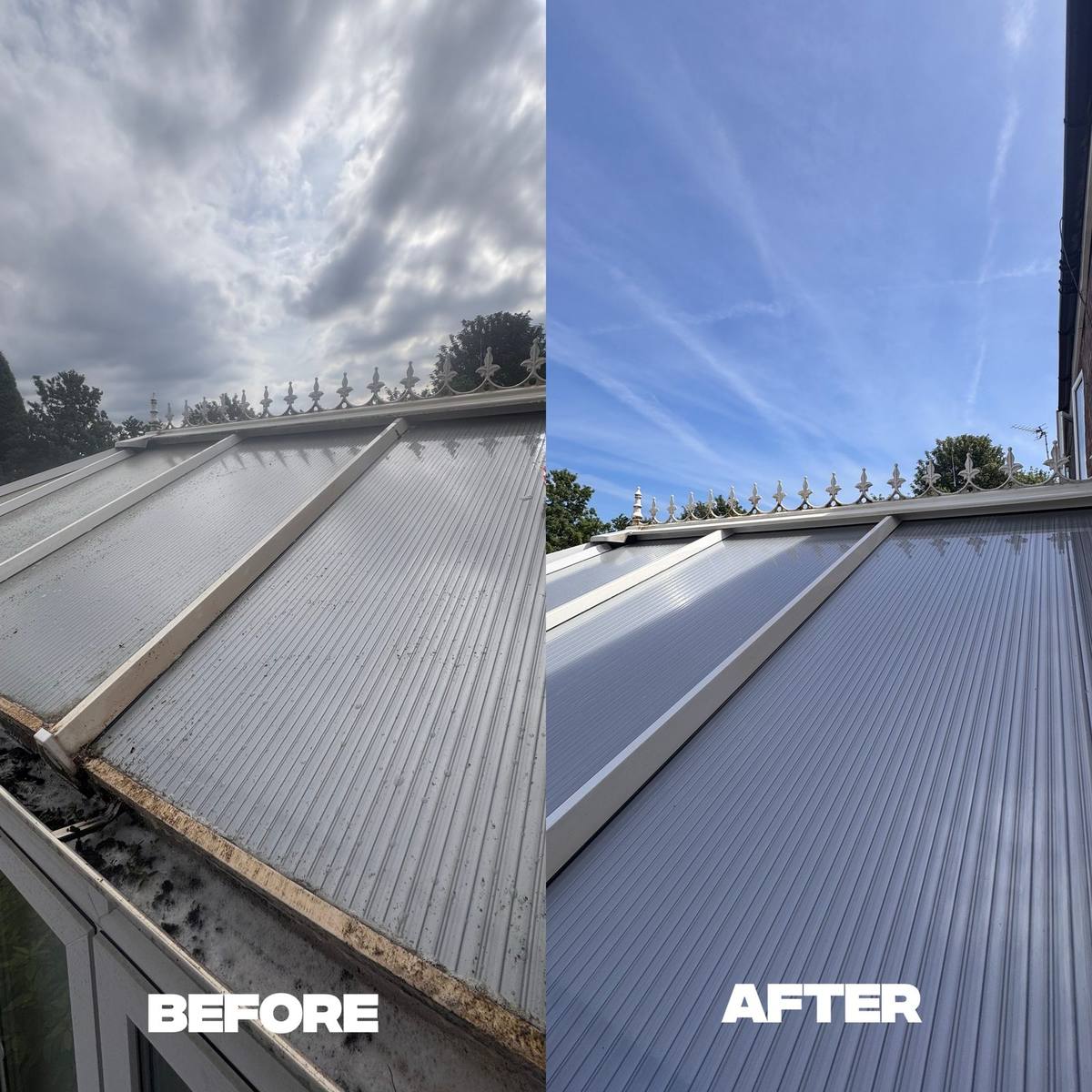
Before and after: lichen and moss removed from a conservatory roof using softwashing. Greater Manchester.
Quick answer: Lichen grows on roof tiles when airborne spores land on damp, shaded or weathered surfaces and anchor themselves with root-like structures called rhizines. It must be treated with a biocide — softwashing is the correct method — because pressure washing alone spreads spores and damages tiles.
What Exactly Is Lichen?
Lichen isn't a single organism. It's a partnership — a fungus and either algae or cyanobacteria living together in a way that benefits both. The fungal part provides physical structure and anchors the whole colony to whatever surface it's growing on. The algae or cyanobacteria carry out photosynthesis and produce the nutrients that keep the whole thing alive. That interdependence is why lichen is so resilient compared to moss or straightforward algae growth.
Moss is relatively soft and loosely attached. Algae is essentially a surface film — green or black discolouration that sits on top of a material. Lichen, by contrast, physically bonds with the surface it colonises. It can survive temperature extremes, prolonged drought, and poor nutrient conditions that would kill most other growth. That's why the standard approach to roof moss — a stiff brush and a pressure wash — simply doesn't work on lichen in the same way.
Understanding this distinction matters because it changes how you treat it. If you approach lichen like moss, you'll shift some of the visible growth and assume the problem is solved. It isn't. The biological structures embedded in the tile will remain intact and the colony will re-establish itself, often faster than before.
How Lichen Ends Up on Your Roof Tiles
Lichen spreads through airborne spores, which are present pretty much everywhere in the open air. They're microscopic, light enough to travel significant distances, and they settle on any surface that offers a foothold — weathered concrete, rough stone, ageing roof tiles. Once they land on a slightly textured or eroded tile surface, all they need is moisture to activate and begin colonising. In a place like Oldham or Rochdale, that moisture is rarely in short supply.
North-facing roof sections are particularly vulnerable because they dry out more slowly after rain and receive less UV exposure, which would otherwise inhibit growth. Roofs with nearby trees — common in residential streets across Tameside and Stockport — face the additional problem of leaf debris accumulating in valleys and gutters, keeping those areas damp for extended periods. Lichen on roof tiles in these conditions can achieve significant coverage within a few years if left untreated.
The age and surface condition of the tile also plays a role. Newer tiles with intact surfaces are less hospitable. Older concrete or clay tiles that have lost some of their surface hardness give lichen the rough texture it needs to get a grip. This is why you'll often see heavy colonisation on one section of a roof while an adjacent section remains relatively clear — it comes down to exposure, shade, drainage patterns, and the micro-condition of the tile itself.
Why Lichen Is More Destructive Than It Looks
The visible part of lichen — the flat, crusty growth you can see from the street — is only part of the picture. Beneath it, lichen produces structures called rhizines, which function like tiny roots. These penetrate the tile surface and allow the colony to anchor itself firmly in place. It's this anchoring mechanism that makes lichen genuinely damaging rather than just unsightly.
As the rhizines work their way into the tile, they widen existing micro-cracks and create new ones. Water gets into those cracks. In winter, that water freezes, expands, and widens the damage — a process called freeze-thaw cycling that's particularly relevant in the Pennine fringe areas around Oldham and the higher ground above Rochdale and Bury, where overnight frosts are common well into spring. Over time, this accelerates tile deterioration significantly beyond what would occur through weathering alone.
On concrete roof tiles, lichen growth also lifts and displaces the surface granules that give the tile its weather resistance. On both concrete and clay, prolonged lichen coverage traps moisture against the tile surface rather than allowing it to run off cleanly, increasing the risk of water ingress at junctions and ridge lines. For this reason, roof cleaning and moss removal that addresses lichen properly isn't a cosmetic exercise — it's maintenance with a real structural purpose.
Why Pressure Washing Lichen Is the Wrong Approach
Pressure washing is an effective tool for many exterior cleaning jobs. On a driveway or patio it removes embedded dirt, algae, and surface staining efficiently. On a roof, high-pressure washing is a different matter entirely. The force required to dislodge lichen — which is physically bonded to the tile — is enough to damage the tile surface itself, stripping protective coatings, dislodging granules on concrete tiles, and potentially cracking older clay tiles. You end up with a roof that looks cleaner for a few weeks but is structurally worse off.
There's also the spore problem. Pressure washing a lichen-covered roof blasts live spores across a wide area — over the ridge line, into gutters, onto adjacent sections of roof. You're essentially spreading the colony while disturbing the visible growth. Within a season or two, the regrowth is often heavier than the original problem. This is why the industry has moved away from high-pressure treatment for lichen and moss on roofs, and why softwashing has become the recognised method for this type of work.
It's worth noting that the same logic applies to other organic growth problems on textured surfaces. If you're dealing with algae and contamination on rendered walls, for instance, the softwash vs pressure wash question for render follows very similar reasoning — pressure can damage the surface and leave the biology intact.
How Softwashing Treats Lichen Properly
Softwashing uses low-pressure delivery — typically no more than mains pressure — to apply a sodium hypochlorite-based biocide solution across the roof surface. The chemistry does the work rather than the force. Sodium hypochlorite is effective against algae, moss, lichen, and the bacteria that cause black streaking, and when applied at the right dilution and left to dwell for an appropriate period, it kills the lichen at a biological level rather than just removing what's visible above the surface.
Dwell time matters. This isn't a spray-and-rinse job. The solution needs to sit on the surface long enough to penetrate the lichen colony and break down the cellular structures, including the rhizines anchoring it to the tile. How long depends on the extent of growth, the weather conditions, and the specific product formulation — but a properly applied softwash treatment typically involves leaving the biocide to work for a controlled period before any rinsing or follow-up visit.
The post-treatment process is something customers are often surprised by. The lichen doesn't disappear immediately after treatment. What you'll usually see is the growth gradually changing colour — from grey-green to a bleached, dull brown — over the weeks following treatment, as the dead colony breaks down and rain washes it clear. This is normal and expected. A thorough softwash treatment, like those described on our softwashing service page, addresses the biology; the visual result follows at the pace of the natural die-off process.
After softwashing, expect lichen to fade and loosen over four to eight weeks rather than disappearing straight away. The treatment kills the growth at a biological level — what you're watching over those weeks is the dead colony breaking down. If large patches remain after two months of wet weather, a follow-up rinse may be needed.
When to Call in a Professional for Lichen on Roof Tiles
Some jobs are within the reach of a reasonably capable homeowner. Treating lichen on roof tiles generally isn't one of them. Working at height on a sloped, potentially slippery surface carries serious injury risk. Falls from roofs cause fatalities every year in the UK, and that's among tradespeople who work at height regularly. Without proper access equipment — not a domestic ladder propped against a gutter — the risk is simply not worth taking for most people.
Beyond the safety question, there are signs that indicate professional treatment is the only sensible option. Widespread lichen coverage across most of the roof, particularly if growth has reached ridge lines or valleys, needs proper equipment to treat thoroughly. Visible tile damage — crumbling edges, displaced granules, tiles that move when prodded — should be assessed by a professional before any cleaning takes place. Roofs that haven't been cleaned or treated in ten or more years often have underlying issues that cleaning alone won't resolve. C&C Precision Precision Washing covers roof cleaning and moss removal across Greater Manchester, and a quote from a photo sent over WhatsApp is usually the quickest way to understand what's involved for your specific roof.
Professional operators carry public liability insurance for a reason. A £1,000,000 policy means that if something goes wrong — a tile is damaged, a ladder slips, water from rinsing causes an issue — there's cover in place. DIY work on a roof carries no such protection, and any damage caused may not be covered by your home insurance either.
What You Can Do to Slow Lichen Growth Long-Term
Once a roof has been properly treated, the aim shifts from cure to management. Lichen in Greater Manchester is a persistent challenge rather than a one-time problem. The conditions that caused it — damp air, shade, a textured tile surface — don't go away after treatment. What you can do is make those conditions slightly less favourable and extend the time before significant regrowth occurs.
Keep gutters clear and running freely. Blocked gutters cause water to back up and sit against the roof edge, keeping lower tile sections continuously damp. That moisture creeps upward over time and creates ideal conditions for lichen and moss to re-establish. The same principle applies to overhanging branches — they shade sections of the roof, drop leaf debris into gutters and valleys, and hold moisture against tiles that would otherwise dry out after rain. Trimming back branches where practical makes a genuine difference.
Periodic biocide treatment — a lighter maintenance application every two to three years rather than waiting for heavy colonisation — is the most effective way to keep the problem manageable. This is less work, less cost, and better for the tiles than letting growth build up to the point where restoration is needed. If you're already thinking about the broader exterior maintenance picture heading into the colder months, the guide on preparing your home exterior for winter covers a number of related points worth working through before autumn sets in properly.
Frequently asked questions
Can I remove lichen from roof tiles myself?
You can buy biocide sprays for DIY use, but working on a roof is genuinely dangerous without the right access equipment, and applying the product incorrectly can damage tiles or run off into drains. For anything beyond a small conservatory or outbuilding roof, it's worth getting a professional in who has the training, equipment, and insurance to do it safely.
How long does it take for lichen to die off after softwashing?
Softwashing kills lichen at the biological level, but the dead growth doesn't disappear overnight. You'll usually see it fade and loosen over four to eight weeks as weather and rain break it down. Some operators offer a rinse-down visit after the dwell period — it's worth asking when you get your quote.
Will lichen grow back after treatment?
Lichen can return over time, especially on roofs that are north-facing or heavily shaded — conditions that are common across Greater Manchester. A properly applied softwash treatment typically keeps regrowth at bay for several years. Keeping gutters clear and reducing overhanging vegetation helps extend that window.
Does lichen on roof tiles affect my home insurance?
Most standard home insurance policies exclude damage caused by a lack of maintenance, and heavy lichen growth that leads to water ingress or tile deterioration could be classed that way. It's not a reason to panic, but it is a legitimate reason not to leave it untreated for years — document the work if you do have it done.
Got lichen on your roof tiles in Greater Manchester?
Send us a few photos on WhatsApp and we'll come back to you with a straightforward price — usually the same day.