The question of roof cleaning vs roof replacement comes up more often than you might expect, and it usually starts the same way — a homeowner looks up at their roof, sees a thick blanket of green moss or dark biological staining, and assumes the worst. Sometimes that instinct is right. Plenty of roofs in Greater Manchester do reach the end of their useful life, and no amount of cleaning will change that. But a good number of roofs that look like they need replacing are structurally sound and simply need the biology dealt with properly. Understanding the difference can save you thousands of pounds.
This guide is intended to help you work out which category your roof falls into. It covers what moss, algae, and lichen actually do to tiles, what the warning signs of genuine structural deterioration look like, and how professional softwashing works for roofs that are sound underneath the growth. It is not a guide designed to sell you a cleaning service you do not need — if your roof genuinely requires replacement, that is what you should do.
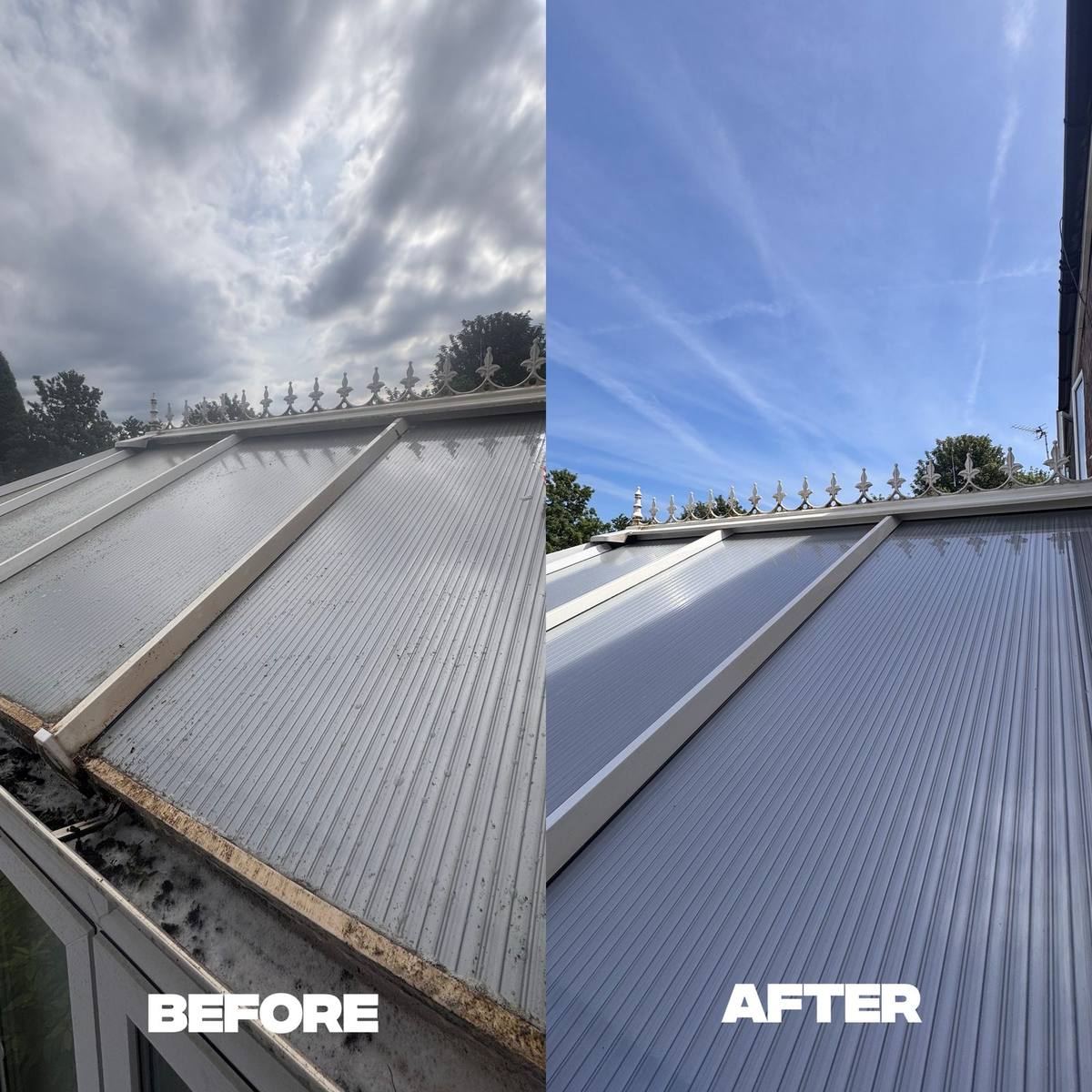
Moss and debris removed from a conservatory roof in Greater Manchester — cleaning, not replacement, was all it needed.
Quick answer: Roof cleaning is enough when the underlying tiles or slates are structurally sound but covered in moss, algae, or lichen. If tiles are cracked, slipping, or the roof deck is damaged, replacement is needed. Most roofs under 20 years old with biological growth benefit from professional softwashing rather than costly replacement.
Why So Many Homeowners Jump Straight to Replacement
A moss-covered roof looks bad. There is no getting around that. When the tiles are barely visible under a thick green layer and the gutters are choked with organic debris, the natural assumption is that something has gone seriously wrong. That impression is often reinforced by the first person who comes to look at it, which in many cases is a roofer who also happens to sell replacements. That is not a cynical point — most roofers are honest tradespeople — but it is worth acknowledging that the person quoting for a new roof has a different financial stake in the conversation than someone who would earn a few hundred pounds for a clean instead of several thousand for a replacement.
The honest reality is that biological growth — moss, algae, lichen, the black streaking you see running down older tiles — is primarily a surface problem. It looks alarming, but in many cases the tiles beneath are still performing their job. The growth colonises the surface because the North West's climate gives it everything it needs: persistent damp, limited drying time between rain events, and plenty of airborne spores. That is not a sign the roof has failed. It is a sign the roof has been sitting in Greater Manchester for a few years.
What Moss, Algae, and Lichen Actually Do to a Roof
Biological growth on a roof is not entirely harmless. Moss in particular is capable of retaining significant moisture against the tile surface, and over time that sustained dampness accelerates freeze-thaw damage — especially on older concrete or porous clay tiles. When water trapped under moss freezes in winter, expands, and thaws, it can gradually widen micro-cracks and contribute to spalling. Moss growth also creeps into the gaps between tiles and, if left long enough, can begin to lift them slightly. The root systems of lichen are more aggressive still, as covered in more detail in the guide to lichen on roof tiles: causes and proper treatment.
Gutters are another practical concern. A roof with heavy moss colonisation will shed debris into the guttering throughout the year, eventually blocking downpipes and causing water to overflow at the fascia. That overflow, repeated over months and years, can lead to damp problems at the eaves and in the wall beneath. None of this is invisible damage — it accumulates, and it has a cost.
That said, it is worth being clear about what biological growth does not automatically mean. Moss on the surface is not the same as a failed roof structure. Algae staining does not mean the tiles are cracked. The growth needs to be assessed in context, not treated as automatic evidence that the whole roof has had it. There is a meaningful difference between cosmetic colonisation on otherwise sound tiles and genuine tile deterioration that has been made worse by biological presence. Understanding that difference is the whole point of this guide.
Signs Your Roof Only Needs Cleaning
The good news is that the indicators of a cleanable roof are fairly straightforward to identify, and many of them can be assessed from the ground with binoculars or from photographs. If the following apply to your roof, a professional clean is almost certainly the right starting point before anyone discusses replacement.
- Tiles are lying flat and intact — no visible cracking, slipping, or missing sections
- No leaks or water ingress inside the property at the ceilings or in the loft space
- No visible spalling or surface breakdown on the tile face
- Moss, algae, or lichen are the primary visible problem rather than physical damage
- The roof is under 20 to 25 years old, or older but with a known maintenance history
- Ridge tiles and hip sections appear mortared and stable
Where these conditions are met, a professional softwash using sodium hypochlorite solution is the appropriate treatment. The key distinction between softwashing and a simple surface scrub is that the chemical solution kills the biology at root level rather than just removing the visible growth. Moss that is scraped off at the surface will regrow from the remaining root structure within a season or two. Softwashing eliminates it properly, which is why it is the method used by professional roof cleaners rather than the pressure washing approach you might use on a driveway or patio. You can read more about how softwashing works across different surfaces in the softwashing service page.
Signs You Genuinely Need Roof Replacement or Repair
Cleaning will not fix a structurally compromised roof, and it would be dishonest to suggest otherwise. There are clear red flags that indicate the problem has moved beyond biology and into the fabric of the roof itself. If any of the following are present, a roofer — not a cleaner — should be your first call.
Missing, cracked, or visibly slipping tiles are the most obvious sign. A tile that has shifted or broken is no longer doing its job of shedding water, and cleaning the remaining tiles around it does not address that. Interior water ingress — staining on ceilings, damp patches in the loft, or wet insulation — is a structural failure, not a surface problem. A sagging roof deck, which you can sometimes see as a dip or undulation in the roofline, suggests the underlying timber structure has been compromised, and that is a significant repair or replacement situation. Failed mortar on ridge tiles or hip sections also falls into this category — the mortar holds the ridge in place, and once it has deteriorated significantly, the ridge becomes vulnerable to wind lift regardless of how clean the tiles are. And if your roof is over 30 to 40 years old with no recorded maintenance or repairs, honest advice is to have a roofer assess the overall condition before spending money on cleaning.
Being direct about this matters. There are roofs where cleaning would be a waste of money, and sending someone up there to softwash tiles that are already failing serves nobody. The guide on whether roof moss is actually causing damage goes into more depth on how to assess what you are looking at.
How Professional Roof Softwashing Works
Softwashing a roof involves applying a diluted sodium hypochlorite solution at low pressure — the kind of pressure that poses no mechanical risk to the tiles. The solution is worked across the roof surface and left to dwell for a period of time, typically 15 to 30 minutes depending on the severity of the growth and the ambient temperature. During that dwell time, the biocide penetrates the root structure of the moss and kills the algae and lichen at a cellular level. Once the treatment has done its work, the roof is rinsed down carefully, again at low pressure, and the dead organic matter either washes away immediately or continues to break down and shed naturally over the following weeks of rain.
This approach is fundamentally different from high-pressure blasting, which strips the surface mechanically. High-pressure washing can crack older tiles, dislodge granules from the protective coating of concrete tiles, and force water up under the laps in a way that mimics driven rain — which is not what a roof is designed to handle from below. On older or more porous tiles, aggressive pressure washing can do genuine damage that softwashing would never cause. It is also less effective long-term, because it does not kill the biology — it just removes the visible portion of it.
If someone quotes for roof cleaning and their method is a high-pressure washer rather than a low-pressure softwash, that is worth questioning before you agree to the work — particularly if your tiles are more than 15 years old or show any surface weathering.
When to Call a Professional Roof Cleaner vs a Roofer
The triage here is fairly logical once you know what to look for. If the problem is biological — moss, algae, lichen, black streaking from airborne spores — and your tiles are physically sound, a specialist roof cleaner is the right first step. Biological growth is their domain. A roofer working on a clean roof has nothing meaningful to assess in terms of the growth problem, and most would not attempt to treat it in the same way a cleaning specialist would.
If there is structural damage — missing or broken tiles, failed ridge mortar, signs of water ingress, or a sagging deck — call a roofer first. Get the structural issues addressed, and then consider whether a softwash makes sense afterwards to remove the remaining biological growth and slow future regrowth. These two jobs are not mutually exclusive, and on a roof that has had minor repairs, a professional clean afterwards makes sense as part of bringing the whole thing back to a good standard.
What does not make sense is replacing a roof primarily because of moss. If the tiles are intact and lying flat, and the only visible problem is biological, replacement is the expensive solution to the wrong problem.
The Practical Takeaway: Check Before You Spend Thousands
The decision between roof cleaning vs roof replacement does not need to be complicated. Biological growth on sound tiles is a cleaning job. Structural damage — cracked tiles, failed mortar, leaks, sagging — is a repair or replacement job. Many homeowners never get a cleaning assessment before agreeing to a replacement quote, which means some of those replacements were probably unnecessary.
A professional softwash on a standard semi-detached in Greater Manchester will typically cost a few hundred pounds. A full roof replacement on the same property starts at around £5,000 and can go considerably higher depending on size, materials, and the extent of any underlying work. If your roof is structurally sound and the issue is moss or algae, there is a strong financial case for cleaning it properly rather than replacing it — and a well-executed softwash can keep the roof clear for three to five years before retreatment is needed.
C&C Precision Precision Washing covers Oldham, Rochdale, Bury, Bolton, Manchester, Tameside, Stockport, and the surrounding towns. If you want a fast, honest assessment of whether your roof needs cleaning or something more, send a few photos over WhatsApp and a quote can usually be turned around the same day. No obligation, no pressure — just a straight answer about what you are actually looking at.
Frequently asked questions
Can pressure washing damage roof tiles?
Yes — high-pressure washing can crack or dislodge older tiles and strip protective surfaces from modern ones. Professional roof cleaners use softwashing instead, which applies a low-pressure chemical solution that kills moss and algae at root level without mechanical force. It's safer and more effective long-term.
How long does roof cleaning last?
A professional softwash typically keeps a roof clear for three to five years, depending on the local environment and how much tree cover surrounds the property. Greater Manchester's damp climate means biological regrowth is inevitable, but regular cleaning is far cheaper than replacement. Some contractors offer biocide aftercare treatments to slow regrowth further.
Will cleaning my roof void its warranty?
It depends on the tile manufacturer and the cleaning method used. High-pressure washing can void some warranties, but low-pressure softwashing is generally accepted and sometimes even recommended by manufacturers to maintain the roof's condition. If you're unsure, check the warranty documentation or ask the cleaner to confirm their method before booking.
How much does roof cleaning cost compared to roof replacement?
A professional roof clean on a standard semi-detached house in Greater Manchester typically runs into the hundreds of pounds, whereas a full roof replacement can cost anywhere from £5,000 to £15,000 or more depending on size and materials. If your tiles are structurally sound, cleaning is almost always the right financial decision. Send a photo on WhatsApp and C&C Precision can give you a fast, accurate quote.
Not Sure What Your Roof Actually Needs?
Send us a photo on WhatsApp and we'll give you a straight answer — no sales pitch, just an honest assessment and a fast quote if cleaning's the right call.