If you've noticed your render going green, you're not alone — it's one of the most common calls we get across Greater Manchester, and it tends to get worse every autumn as the damp sets in. What starts as a faint discolouration on a gable end or north-facing wall can spread across an entire elevation within a couple of seasons, and once it's established, it doesn't go away on its own.
The good news is that green render is treatable, and in most cases it can be brought back to something close to its original colour without damaging the surface. The less good news is that the method matters a great deal — use the wrong approach and you'll either be back to square one within a few months or, worse, cause damage that costs more to fix than the original cleaning would have. This guide covers what's actually happening, what works, and what doesn't.
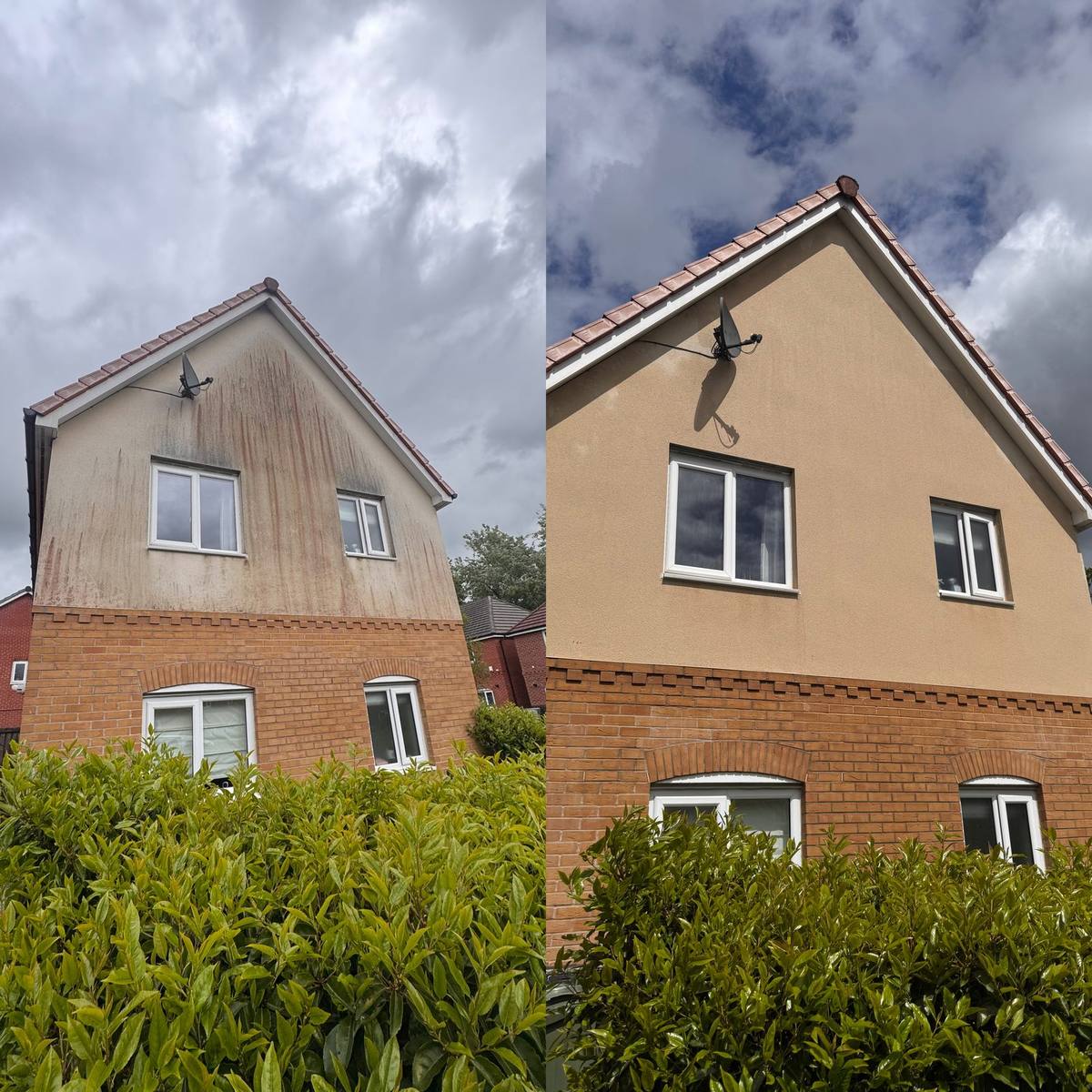
Before and after softwash — green and red algae killed at the root, render fully restored.
Quick answer: Render goes green because algae, lichen and mould colonise the surface moisture trapped in the texture. The proper fix is softwashing — applying a diluted sodium hypochlorite solution that kills the biology at the root, not just blasting it off with pressure, which damages the render and lets growth return faster.
What's Actually Causing Your Render to Turn Green
Render going green isn't surface dirt that's built up over time — it's living organisms actively colonising the wall. Algae are usually the first to arrive, spreading as microscopic spores carried on the wind or washed down from rooflines and gutters. Once algae establish a foothold, they trap moisture against the render surface and create conditions that suit more tenacious organisms: cyanobacteria, which give that blue-green tint, and eventually lichen, which bonds to the surface physically through root-like structures called rhizines.
The texture of render works against you here. Unlike smooth painted masonry, most modern renders have a slightly rough or granular finish that holds moisture and gives spores something to grip. The organisms aren't just sitting on the surface — they're embedded in it, which is why a quick rinse or a pass with a brush rarely solves anything for long.
Understanding that you're dealing with biology rather than grime is the starting point, because it changes the treatment entirely. You need to kill the growth, not just remove what's visible.
Why Rendered Walls in Greater Manchester Are Especially Vulnerable
The North West's climate is about as favourable for biological growth on external surfaces as it gets. High annual rainfall, persistent cloud cover, and relatively low UV exposure between October and April mean render walls stay damp for extended periods — sometimes weeks at a time without drying out properly. UV light is one of the few natural checks on algae growth, and in Greater Manchester there's rarely enough of it to make a meaningful difference.
Aspect plays a big role too. North-facing elevations and shaded gable ends that face into neighbouring properties barely see direct sun at any point in the year, which means moisture lingers and growth spreads faster. Walls near established trees are worse still — the canopy reduces airflow and sunlight simultaneously, and falling debris introduces additional organic matter that feeds the organisms already there. If you've got a north-facing rendered wall with an oak or sycamore nearby, render going green is almost a certainty within a few years of the render being applied.
Towns like Oldham, Rochdale and parts of Bury sit at higher elevations and catch more rainfall and wind-driven moisture than areas further south. It's not unusual to see a house in these areas where the front elevation looks reasonable but the rear or side facing the prevailing weather is heavily affected. None of this is unusual — it's just what happens to render in this part of the country without periodic treatment.
Why Pressure Washing Alone Makes the Problem Worse
It's a natural instinct to reach for a pressure washer when something looks dirty, and a pressure washer will remove the visible green from a rendered wall. The problem is what it leaves behind and what it does to the surface. Algae, lichen and cyanobacteria don't exist only on the surface — they penetrate into the pores of the render, and high-pressure water strips back what's visible without killing what's embedded. Spores remain intact and, if anything, are dispersed more widely across the wall and surrounding surfaces.
There's also the question of physical damage. K-Rend, monocouche and scraped finishes are designed to be durable but they're not indestructible, and excessive pressure — especially close-in with a narrow-angle nozzle — can pit, streak or erode the surface texture permanently. Pebbledash is particularly unforgiving because individual pieces of aggregate can be dislodged, leaving the wall looking patchier than before you started. Some render manufacturers specify in their warranties that high-pressure cleaning voids cover — worth knowing before you hire a machine.
The other practical issue is regrowth speed. When pressure washing opens up the render surface without treating the underlying biology, re-colonisation often happens faster than it did the first time. Homeowners sometimes find themselves back to visible green within three or four months. You can read more about why the method matters in this comparison of softwash vs pressure wash for render.
What Softwashing Actually Does and Why It Works
Softwashing uses a low-pressure application of diluted sodium hypochlorite — the same active compound as bleach, but applied in a controlled way at appropriate concentrations for the surface. The solution is applied at low pressure, which means no physical abrasion to the render, and left to dwell on the surface for a period of time that allows it to penetrate into the texture and kill the organisms at a biological level. The wall is then rinsed thoroughly with clean water.
The dwell time is important and often underestimated. A quick spray and rinse won't achieve the same result as allowing the solution to work into the surface for fifteen to thirty minutes, depending on how heavily affected the wall is. What you'll often see during this phase is the green turning to a grey-white as the organisms die — that's the treatment working. The surface won't be perfectly clean immediately in all cases; some heavy lichen staining lightens rather than vanishes completely in a single treatment, and that's honest.
The key practical benefit of killing the biology rather than just removing the visible growth is how long the result lasts. A properly executed softwash on a render wall in Greater Manchester typically holds for two to four years before retreatment is needed, compared to months for a pressure wash without biocidal treatment. You can find more detail on the softwashing service page, and for roof surfaces the same principle applies — if lichen on rooflines interests you, the guide on lichen on roof tiles covers that separately.
One practical step you can take before any treatment is to check and clear your gutters and downpipes. If there's an overflow point above the affected area of render, water will continue to run down the wall after cleaning and the green will return faster. Fixing the source of the moisture makes any cleaning treatment last significantly longer.
K-Rend, Pebbledash, Monocouche — Does the Render Type Matter?
The render type doesn't change whether softwashing works — it does, across all common residential finishes — but it does affect how the work is approached and what results are realistic. K-Rend and similar polymer-modified renders are through-coloured, meaning there's no painted layer to worry about, and they respond well to softwashing when the correct dilution is used. The main risk with these finishes is leaving the solution on too long or using too high a concentration, which can cause temporary lightening. A rinsed and diluted application avoids this.
Monocouche render is similar in principle to K-Rend and the same care applies. Pebbledash is more porous and the uneven aggregate surface holds moisture readily, which is partly why it tends to green up faster than smoother finishes. It also means the biocidal solution needs time to reach into the textured surface, so dwell time is important. The aggregate itself isn't an issue for softwashing — it's the pressure washing approach that risks dislodging it.
Older sand and cement render, common on pre-1980s housing stock across Greater Manchester, can be more variable. If there are existing hairline cracks or areas where the render has started to detach from the substrate, these should be identified before any cleaning treatment. Water and cleaning solution entering behind loose render can worsen existing problems. A professional will flag this before starting work.
When to Call a Professional Instead of DIYing It
There are off-the-shelf render cleaning products available, and some of them contain low concentrations of sodium hypochlorite or other biocides. For a small, lightly affected patch on a wall you can reach safely from the ground, a consumer product applied correctly can make a visible difference. The limitations are concentration, volume and rinsing — consumer products are typically weaker than trade formulations, rinsing from a domestic hose lacks the flow to clear the solution properly, and most homeowners aren't carrying the volume of product needed to treat a full house elevation thoroughly.
Where it gets riskier is on multi-storey work, heavily affected surfaces, or textured finishes where streaking from uneven application is visible. Getting softwash solution onto windows, uPVC or surrounding planting without a plan to rinse it promptly causes problems. Access equipment — ladders, platforms or a cherry picker for larger properties — adds another dimension that makes professional involvement the safer and more practical option. Render cleaning done by an experienced operative also means the surface assessment happens before the job starts, not midway through.
C&C Precision Precision Pressure Washing covers all of Greater Manchester and quotes based on photos sent via WhatsApp, which means no wasted site visit for either party before a price is agreed. Fully insured to £1,000,000 public liability, and the quote process is straightforward — send a few photos and get a number back quickly.
What to Do Right Now If Your Render Is Turning Green
The most useful thing you can do immediately is photograph the affected elevations — ideally on a dry day with reasonable light — and note which direction the wall faces. South-facing render going green is less common and might indicate a different contributing factor like overhanging vegetation or a persistent gutter overflow, worth identifying before treatment. North and east-facing walls in Greater Manchester tend to be the ones that need attention most regularly.
Check whether there are any obvious sources of ongoing moisture: blocked or overflowing gutters above the affected area, downpipes that discharge onto a hard surface and splash back, or ground-level vegetation growing against the wall. None of these prevent cleaning, but they'll affect how long the result lasts if they're not addressed alongside the treatment. A professional will point these out, but it's useful to be aware going in.
Winter is the worst time to let green render go untreated — the combination of damp and low temperatures accelerates biological growth, and what looks like a manageable patch in September can be significantly worse by March. Getting a quote before the worst of the weather sets in is sensible. If you're in Greater Manchester, send a few photos via WhatsApp with a note on the size of the property and which elevations are affected — that's enough to give you a realistic price without anyone needing to visit first.
Frequently asked questions
How quickly does render go green again after cleaning?
After a proper softwash treatment, most renders in Greater Manchester stay clean for two to four years depending on aspect, nearby vegetation and how exposed the wall is to rainfall. North-facing elevations and walls under trees will re-green faster than south-facing ones in open positions. A pressure wash without biocidal treatment often sees visible regrowth within months.
Is softwashing safe on K-Rend and monocouche render?
Yes, when applied correctly at the right dilution and rinsed thoroughly, sodium hypochlorite softwashing is safe on K-Rend, monocouche and most modern through-coloured renders. The key word is correctly — too strong a mix or inadequate rinsing can cause temporary bleaching or affect surrounding planting. An experienced operative will know the right concentrations and approach for each finish.
Can I use a pressure washer to clean green render myself?
You can remove the visible green with a pressure washer, but without a biocidal treatment you're leaving the spores intact and often opening up the render surface, which means regrowth comes back faster than before. On textured renders like K-Rend or pebbledash, excessive pressure can also cause physical damage to the surface that's expensive to repair. For a lasting result, the biology needs killing first.
How much does render softwashing cost in Greater Manchester?
Cost depends on the size of the property, the number of elevations being treated and how heavily the render is affected — a typical semi-detached in Oldham or Rochdale will sit in a different bracket to a large detached with four elevations. The quickest way to get an accurate price is to send a few photos on WhatsApp so the scale and condition can be assessed without a wasted site visit.
Got green render you want sorting properly?
Send a photo on WhatsApp and we'll come back to you with a fast, no-nonsense price — usually the same day.