If your patio looks patchy after cleaning, you're not alone — it's one of the most common complaints we hear from homeowners across Greater Manchester who've had a go themselves or had a cheap job done by someone with a basic pressure washer. The surface looks reasonable when it's wet, then dries out into a blotchy, streaky mess that honestly looks worse than it did before you started. Understanding why this happens means understanding a bit about how pressure washing actually works, and where the process tends to go wrong.
There are several reasons a patio ends up looking uneven after cleaning, and most of them come down to equipment, technique and chemistry — or the absence of them. This guide walks through the main causes, what can be done about it, and when it makes more sense to bring in someone with the right kit rather than keep fighting a losing battle with a domestic pressure washer from B&Q.
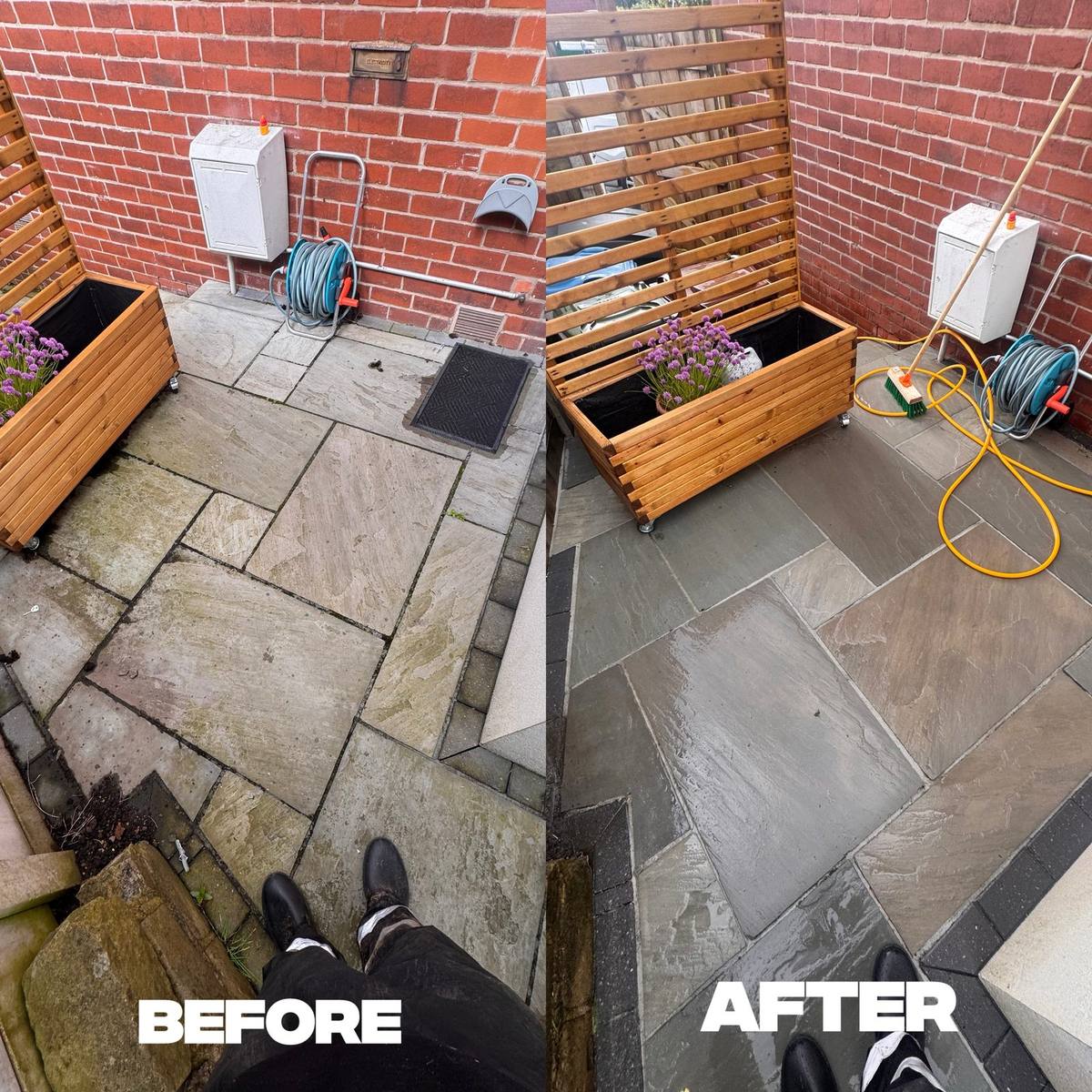
Indian sandstone showing uneven staining and black spots before professional cleaning — a common result of DIY attempts.
Quick answer: A patchy patio after DIY cleaning is usually caused by inconsistent pressure, wrong nozzle distance, skipping pre-treatment, or surface contamination the water alone can't shift. Different stone types and existing algae or black spot staining make uneven results almost inevitable without professional equipment and technique.
The Most Common Cause: Inconsistent Pressure and Distance
The single biggest reason a patio comes out patchy after cleaning is lance cleaning — pointing the wand directly at the surface and sweeping it back and forth by hand. Even a small variation in distance between the nozzle and the patio, a few centimetres either way, changes the pressure dramatically at the point of impact. The result is lighter bands where the lance was closer and darker strips where it was further away. You can see it clearly once the surface dries.
A rotary surface cleaner — the disc-shaped head that spins two jets underneath a shroud — solves this almost entirely. It keeps the jets at a fixed, consistent distance from the surface and covers evenly in overlapping passes. Without one, you're relying on a perfectly steady hand and perfectly consistent speed across the whole area, which isn't realistic for anyone cleaning a patio occasionally rather than every day.
This is also why hiring a pressure washer and doing it yourself rarely produces the same results a professional gets. The machine might be similar in terms of bar pressure, but the technique and attachments are where the difference shows. A domestic rotary head from a hire shop will do a better job than a lance, but it won't have the same build quality or consistent pressure output as the commercial kit used regularly on jobs across the area.
Wrong Nozzle for the Job
Pressure washer nozzles come in a range of fan widths, from a narrow pencil jet to a wide 40-degree fan. Most people default to a fairly narrow angle because it feels more powerful — and it is, but that concentrated force on one spot is what creates the uneven result. A narrow jet strips algae and surface grime off one small area intensely while leaving the surrounding section comparatively untouched, and the contrast shows up as patchiness once the surface dries.
On softer materials — natural sandstone, aged concrete, certain types of reconstituted stone — a pencil or narrow-fan jet can actually damage the surface as well as clean it unevenly. It blasts out the softer material between aggregate particles, leaving a rougher texture that catches dirt faster going forward. The damage often isn't obvious until the surface is dry and lit from an angle. If you're considering patio cleaning on natural stone in particular, nozzle choice matters more than most people realise.
The right nozzle depends on the surface type, the level of soiling and what pre-treatment has been applied. On a patio that's been properly pre-treated with a biocide and given adequate dwell time, you often need less pressure to finish the job cleanly than you'd assume — the chemistry has already done the heavy lifting.
Skipping Pre-Treatment Is a Big Mistake
Pressure washing alone shifts loose dirt and surface debris reasonably well. What it doesn't do is remove biological growth — algae, moss, lichen and black spot fungus are attached to and in some cases embedded into the surface, and high-pressure water on its own mostly dislodges the top layer and spreads the rest around. That's why patios so often look patchy after cleaning — the growth hasn't been neutralised, just redistributed.
The correct approach is to apply a pre-treatment before the pressure washer comes out. A dilute sodium hypochlorite solution — the same chemistry used in softwashing — breaks down the cellular structure of algae, moss and lichen. Left to dwell on the surface for a period of time (typically 15 to 30 minutes depending on the concentration and the level of growth), it kills the organic matter so the pressure washing stage can rinse it away cleanly rather than just push it around.
In the North West, where damp, overcast conditions persist for much of the year, biological growth on patios is more aggressive than in drier parts of the country. Greater Manchester gets enough rainfall and low light to keep algae active through autumn and winter, which means a patio can look green again within a few months of cleaning if the underlying growth wasn't properly treated and the surface isn't protected afterwards. Skipping pre-treatment is a false economy in this climate.
Different Stone Absorbs Water and Chemicals Differently
Not all patio surfaces behave the same way under a pressure washer, and treating them as if they do is a reliable route to an uneven result. Indian sandstone is porous and relatively soft — it responds well to lower pressure and a pre-soak but can be damaged by anything above around 100 bar applied too close. Natural limestone is similar in some respects but can react badly to acid-based cleaners sometimes used on other surfaces. Concrete slabs are more forgiving but tend to show tide marks if rinsed inconsistently. Porcelain, increasingly common in newer gardens across Stockport, Bury and the wider area, is non-porous and handles higher pressure easily, but any joins or grouting between tiles need more care.
A mixed-surface patio — or one where some slabs have been replaced with a different type of stone — is particularly prone to a patchy after cleaning look, because the different materials absorb water at different rates and respond differently to chemical treatment. What works on the concrete section may leave the sandstone looking bleached, or vice versa. Recognising surface type before you start isn't something most homeowners do, and it's one of the clearer areas where professional experience makes a practical difference.
Black Spot and Lichen Won't Come Off With Water Alone
Black spot — caused by a fungus called Venturia — is a specific and particularly stubborn problem on limestone and sandstone patios. It appears as dark grey or black spots, often circular, and it grows into the stone rather than just sitting on top of it. Pressure washing black spot without pre-treatment breaks the surface crust but leaves the mycelium embedded in the material, and the dark colouration returns within weeks. It also spreads spores across the surface in the process, which is partly why patios cleaned by blasting often look more mottled and patchy afterwards than they did before.
Lichen behaves similarly. It has a root-like structure called a holdfast that anchors into the stone, and physically blasting the surface body away doesn't remove the holdfast or kill the organism. A dwelling biocide — applied and left for adequate contact time — is the only reliable way to kill both black spot fungus and lichen before attempting to clean the surface. Some staining will always lighten rather than vanish entirely depending on how long the growth has been present and how far it's penetrated the stone, and it's honest to say that upfront rather than promise a completely uniform result.
If you're treating black spot or lichen on a patio yourself, apply your biocide solution and leave it to dwell for at least 20 to 30 minutes before you touch the pressure washer. Going straight to pressure washing first is the most common reason the problem keeps coming back.
When It's Time to Call a Professional
If your patio is still looking patchy after a second DIY attempt — or if it cleaned up fine but was green again within a month — it's a sign that the underlying biology wasn't dealt with properly. Black spot, lichen and established algae colonies aren't a cosmetic problem you can rinse away; they need the right chemistry applied correctly and given time to work. At that point, the cost of a professional clean is almost always recovered in time and materials you'd otherwise spend on repeated attempts.
Persistent orange staining (usually iron from fertiliser or certain stone types), widespread dark spotting, or a surface that's been cleaned but left looking more uneven than before are all signs that professional equipment and trade-grade chemistry are needed. C&C Precision Precision Washing cover the whole of Greater Manchester — Oldham, Rochdale, Bury, Bolton, Tameside, Stockport and across into Manchester — and quotes are straightforward: send a few photos over WhatsApp and you'll get an honest price without a survey visit. Our reviews reflect the standard of work you can expect.
Pricing for block paving cleaning starts from £3.50/m² for a standard clean, rising to around £4.25/m² with chemical treatment included, and £5.50/m² for a full restoration with re-sanding. Re-sanding alone, if the paving has already been cleaned, is from £2.00/m². Natural stone patio cleaning is priced similarly depending on condition and access. None of that includes unnecessary upselling — the quote reflects what the surface actually needs.
What You Can Do to Get a Better Result Next Time
If you're going to have another go yourself before calling anyone in, the sequence matters. Apply a biocide pre-treatment first — a diluted sodium hypochlorite solution is effective and widely available — and leave it to dwell properly before you start the pressure washer. Rushing the dwell stage is the single most common mistake, and it's why DIY results so often fall short even when the equipment is reasonable.
Use a rotary surface cleaner rather than a lance, work in overlapping passes at a consistent walking pace, and rinse with a wide-angle nozzle rather than a narrow jet. Keep the head at a steady height and don't linger in one spot. For anything beyond light surface dirt and recent moss growth, the honest advice is that a domestic machine and a weekend afternoon isn't likely to produce the even result you're hoping for — not because you're doing it wrong, but because the equipment and chemistry available at trade level are genuinely different. You might also find our guide on patio cleaning in Royton, Oldham useful for more localised context, or our piece on the best time of year to clean a driveway if you're planning wider exterior maintenance.
Frequently asked questions
Why does my patio look streaky after I pressure washed it?
Streaking is almost always caused by lance cleaning rather than using a rotary surface cleaner, or by varying the distance from the surface as you move across it. The uneven pressure leaves lighter and darker strips that are very obvious once the patio dries. A flat rotating head and consistent technique are needed to avoid this.
Can I fix a patchy patio myself or do I need a professional?
Light patchiness from an uneven rinse can sometimes be improved by a second pass with a rotary surface cleaner and a proper pre-treatment biocide. But if the patchiness is down to black spot, lichen or deep-set organic staining, DIY methods rarely shift it fully and you risk spreading spores. A professional clean is usually the more cost-effective route at that stage.
Why does my patio look clean when wet but patchy when it dries?
Water temporarily masks staining, biological growth and surface contamination — everything looks better wet. As the surface dries, residual algae, mineral deposits and unshifted organic matter become visible again, often in a patchy pattern that reflects how the cleaning was carried out. Pre-treatment and thorough rinsing are the only reliable fix.
How do professionals get an even finish on a patio?
Professional patio cleaning involves a pre-treatment stage — usually a biocide or sodium hypochlorite mix applied and left to dwell — followed by a rotary surface cleaner run at consistent pressure across the whole area, and a final low-pressure rinse. The combination of chemistry and the right equipment is what produces an even, consistent result that DIY kit rarely replicates.
Got a patio that still looks uneven after cleaning?
Send us a photo on WhatsApp and we'll give you a straight, fast quote with no fuss.