If you've been searching for patio cleaning Royton, you're probably looking at a surface that's gone green, turned slippery underfoot, or developed that dark, ingrained staining that seems to come back every year no matter how much you hose it down. It's a common problem in this part of Oldham, and there are straightforward reasons for it.
This guide covers why patios here deteriorate the way they do, what a professional clean actually involves, what different surfaces need, and how to make sure you get a result that lasts — not just a surface that looks clean for a few weeks before the green comes back.
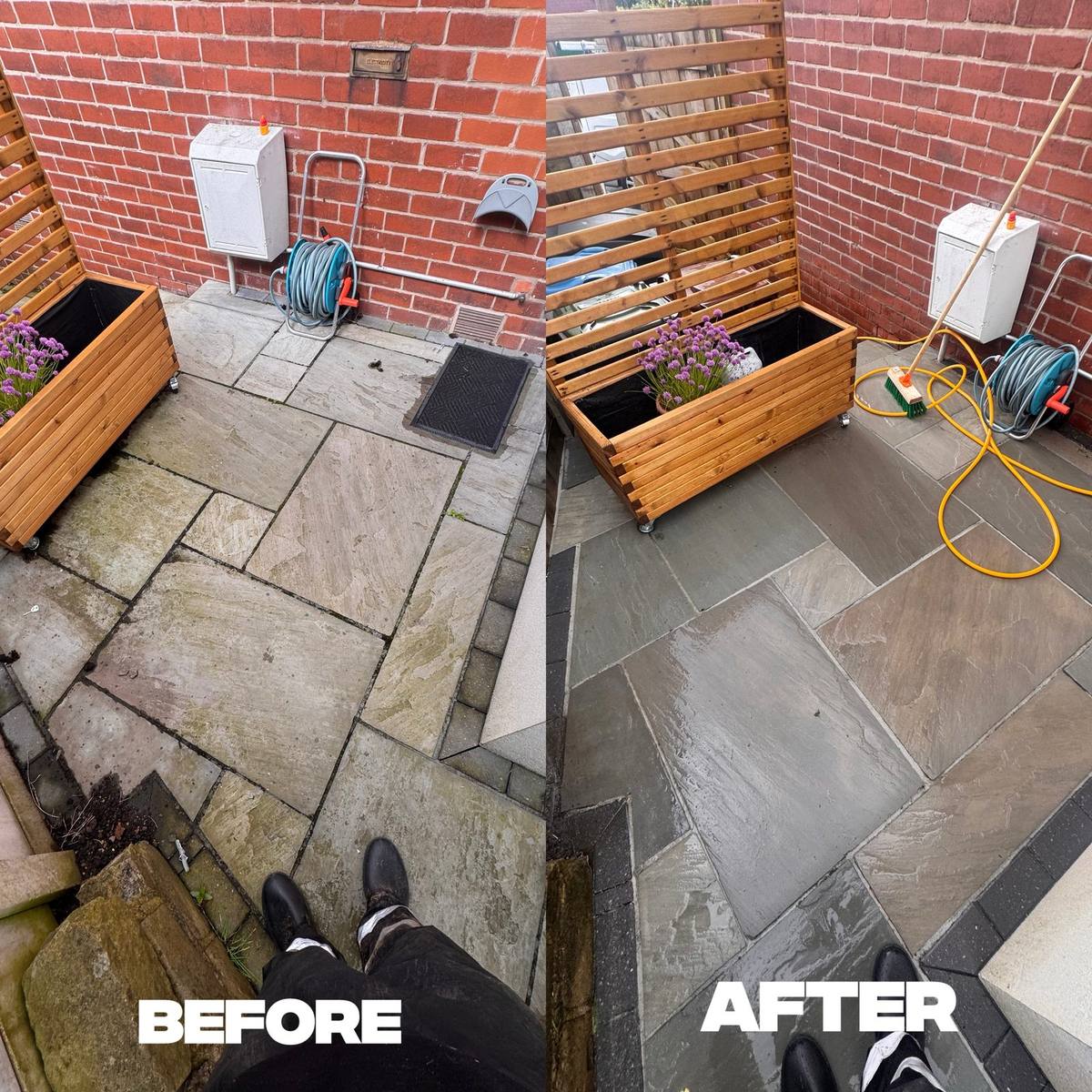
Indian sandstone patio — black spots and algae gone after a single visit.
Quick answer: Patio cleaning in Royton typically costs £100–£250 depending on size and condition. A professional will pressure wash or softwash the surface, remove moss, algae and staining, and leave it safe and presentable. Most jobs are completed in a single visit, with results visible immediately.
Why Royton Patios Get Dirty So Quickly
Royton sits on the western edge of the Pennines, and that positioning matters. The hills funnel damp air in off the moorland, and rainfall here is consistent rather than seasonal — the kind of persistent moisture that keeps surfaces wet for long stretches between dry spells. Shade from fences, walls and overhanging trees makes it worse. When a surface stays damp for days at a time, algae and moss establish quickly, and black spot lichen follows not long after.
Most patios in this area need a proper clean every one to two years just to stay safe underfoot. Black spot in particular is stubborn — it roots into porous surfaces like Indian sandstone and doesn't shift with a domestic hose. Moss in the joints eventually lifts pointing and paving if it's left, and a green or algae-covered surface becomes genuinely slippery when wet, which is a real hazard through autumn and winter.
The organic debris — leaves, soil, bird mess — compounds everything. It sits in joints and low points, breaks down into a film of organic matter, and gives algae the nutrients it needs to take hold faster the following season. Cleaning regularly breaks that cycle.
What Patio Surfaces Do We Clean in Royton?
We clean Indian sandstone, porcelain, concrete slabs, block paving, natural stone and older mortar-jointed flags. Each material has its own characteristics, and treating them all the same is how surfaces get damaged or end up looking worse than before. Patio cleaning isn't a single process — it's a process adapted to what's actually in front of you.
Sandstone is soft and porous, which means it absorbs staining quickly but also means it can be damaged by excessive pressure. Porcelain is dense and resistant, but its surface — whether polished or textured — can streak if the technique isn't right. Concrete and block paving are generally more forgiving and can handle more aggressive cleaning where it's needed, but even these need a surface cleaner rather than a raw lance to avoid banding and uneven results.
Natural stone slabs, particularly older Yorkshire stone or reclaimed flags, can vary enormously in hardness and condition. We assess each job individually before starting — it's the only way to get a clean that improves the surface rather than compromising it.
The Cleaning Process: What Actually Happens on the Day
The first step on most jobs is pre-treatment. Where there's established moss, algae or black spot, we apply a biocide or a dilute sodium hypochlorite solution and allow it to dwell on the surface before any pressure washing begins. Dwell time matters — rushing straight to the pressure washer without a chemical stage means you're relying on mechanical force alone, which drives grime into porous surfaces rather than breaking it down. The chemistry does a significant part of the work if you give it time to act. You can read more about how that works in our guide to how sodium hypochlorite softwash actually works.
Once the pre-treatment has had time to work, we use a rotary surface cleaner for the flat areas — this gives an even, consistent clean without the striping you get from a hand lance swept across slabs. Edges, steps, corners and detailed areas are done with a hand lance at controlled pressure. Everything is rinsed down thoroughly at the end.
On block paving, the cleaning process inevitably removes some of the jointing sand — this is normal and expected. If re-sanding has been agreed as part of the job, we finish by brushing kiln-dried sand into the joints once the surface has dried sufficiently. Kiln-dried sand compacts properly into the joints, stabilises the individual blocks and reduces weed germination compared to leaving joints open or using ordinary building sand.
If your patio has established black spot — the dark, circular lichen patches that look almost painted on — be realistic about the outcome. On porous surfaces like sandstone, black spot often lightens significantly rather than vanishing completely in a single clean. A second treatment after a few weeks, once the biocide has continued to work, usually removes the remainder. Any contractor who promises total black spot removal in one visit on a heavily affected sandstone patio is overpromising.
How Much Does Patio Cleaning Cost in Royton?
Most standard residential patios in Royton fall between £100 and £250 for a straightforward clean. A small rear patio of around 20 to 30 square metres in moderate condition sits at the lower end of that range. Larger areas, or surfaces with heavy moss, significant black spot or years of neglect, take more time and cost more accordingly. We don't apply a flat per-square-metre rate to residential patio jobs — we quote per job based on photos, so you know exactly what you're paying before we arrive.
For block paving specifically, our pricing runs from around £3.50 per square metre for a standard clean, £4.25 per square metre with a full chemical pre-treatment included, and £5.50 per square metre for a complete restoration that includes cleaning and re-sanding with kiln-dried sand. Re-sanding on its own, without a full clean, is around £2.00 per square metre. These figures give you a realistic starting point, though the actual quote depends on the job in front of us.
Sealing is a separate conversation. It adds cost upfront but extends the time between cleans and makes ongoing maintenance easier. We can advise on whether sealing makes sense for your particular surface — it isn't right for every patio, and we won't push it where it isn't needed.
Sandstone vs Porcelain: Does the Surface Type Change the Job?
It changes it quite significantly. Sandstone is a soft, sedimentary stone — it's quarried in large quantities in India and exported widely, and it's genuinely attractive when clean. But its porosity means it stains readily and it can't take the same working pressure that harder surfaces can. On sandstone, we keep pressure lower and rely on longer dwell times with the chemical pre-treatment to do more of the heavy lifting. This protects the surface face while still getting a thorough clean.
Porcelain is at the other end of the spectrum — it's fired at high temperature and is much denser than natural stone. It handles more pressure without risk, but getting an even result on textured porcelain still requires the right equipment and technique. Polished porcelain shows water marks and any inconsistency in the clean more clearly than a riven or brushed finish, so attention to rinsing and technique matters.
Getting the pressure wrong — particularly on sandstone — is one of the more common ways DIY pressure washing causes lasting damage. The surface looks clean immediately after but shows premature wear or eroded texture over the following seasons. Professional stone cleaning is about understanding what the material can take, not just pointing a lance at it.
When Should You Call in a Professional?
If the surface is visibly green, black or slippery underfoot, it's past the point where a garden hose or a consumer-grade pressure washer will sort it. Most domestic pressure washers lack both the water flow and the surface cleaner attachments that give an even result — they tend to move dirt around, leave banding across the slabs, and can force water under paving if used at too close a range. The results often look reasonable on the day and then disappoint within a few weeks as pushed-in debris and remaining algae spores regrow.
If there's established moss in the joints, significant black spot staining, or the patio genuinely hasn't had a proper clean in three or more years, a professional clean will be faster, safer and produce results that last considerably longer. C&C Precision Precision Washing covers Royton and the surrounding Oldham area — you can get a quote by sending photos on WhatsApp, which keeps things quick and straightforward.
Patio cleaning Royton is one of the more common jobs we do in this part of Greater Manchester, and the combination of damp conditions and porous surfaces means the results of a proper clean are usually dramatic. If you're also dealing with a dirty driveway alongside the patio, it's worth sorting both in one visit — our guide on driveway cleaning in Chadderton covers the process for that in detail.
Practical Advice Before You Book a Patio Clean
Clear the furniture, plant pots and any garden equipment off the patio before we arrive if you can. It saves time on the day and keeps the cost down — we're not charging you for time spent moving things around. If there are fixed items like built-in planters or permanent fixtures, just let us know and we'll work around them.
When you're sending photos for a quote, take them in reasonable daylight so the actual condition is visible — including the joints if there's weed or moss growth there, and any areas with heavy staining. A clear photo saves back-and-forth and means the quote you get is accurate rather than provisional.
After the clean, give the surface a couple of hours to dry before walking on it or putting furniture back. If you've had the joints re-sanded, avoid heavy rain for 24 hours if possible — though in Royton that's admittedly not always within your control. If you want to discuss sealing the surface after cleaning, or if there are areas where the pointing has broken down and needs attention, raise it when you enquire so everything can be included in one visit and one quote.
Frequently asked questions
How long does patio cleaning take in Royton?
Most residential patios take between one and three hours depending on size and condition. A small, moderately dirty patio can be done in an hour; a larger area with heavy moss, weed growth in the joints and neglected edging will take longer. We'll give you a realistic time estimate when we quote.
Will pressure washing damage my sandstone patio?
Not if it's done correctly. High-pressure washing directly on soft sandstone can erode the surface over time — that's why we use a lower working pressure combined with a chemical pre-treatment that loosens the organic growth before we wash. We've cleaned dozens of sandstone patios across Oldham and Royton without damage. The before/after results speak for themselves.
Do you re-sand the joints after cleaning block paving or patios?
Yes, we offer block paving re-sanding with kiln-dried sand as an add-on to any clean. Pressure washing does wash out some of the jointing sand — this is normal — and re-sanding stabilises the surface, reduces weed regrowth and finishes the job properly. Just mention it when you enquire and we'll include it in the quote.
Do you cover Royton and the rest of Oldham?
Yes — Royton is one of our core local areas. We're based in Oldham and cover the whole borough as well as Rochdale, Bury, Bolton, Manchester, Tameside and Stockport. If you're in or around Royton, you're well within our regular working area with no call-out fee.
Want a price for your Royton patio?
Send a couple of photos on WhatsApp and we'll come back with a firm price fast — no jargon, no obligation.