If you've been searching for patio cleaning Whitefield, you've likely already noticed how quickly outdoor surfaces deteriorate around here. A patio that looked reasonable in spring can be covered in green algae, black spot, and a faint carpet of moss by autumn — and that cycle repeats year after year. This guide covers why that happens, what a proper clean actually involves, what it costs, and how to keep results lasting longer. Whether you decide to book someone or tackle it yourself, you'll find enough detail here to make a genuinely informed decision.
Whitefield sits in the Bury borough, close enough to the Pennine fringe that rainfall and cloud cover are facts of life rather than occasional inconveniences. That persistent damp is the root cause of most patio problems in the area, and understanding it makes the rest of this guide easier to follow. We'll cover everything from patio cleaning basics through to block paving re-sanding and long-term maintenance.
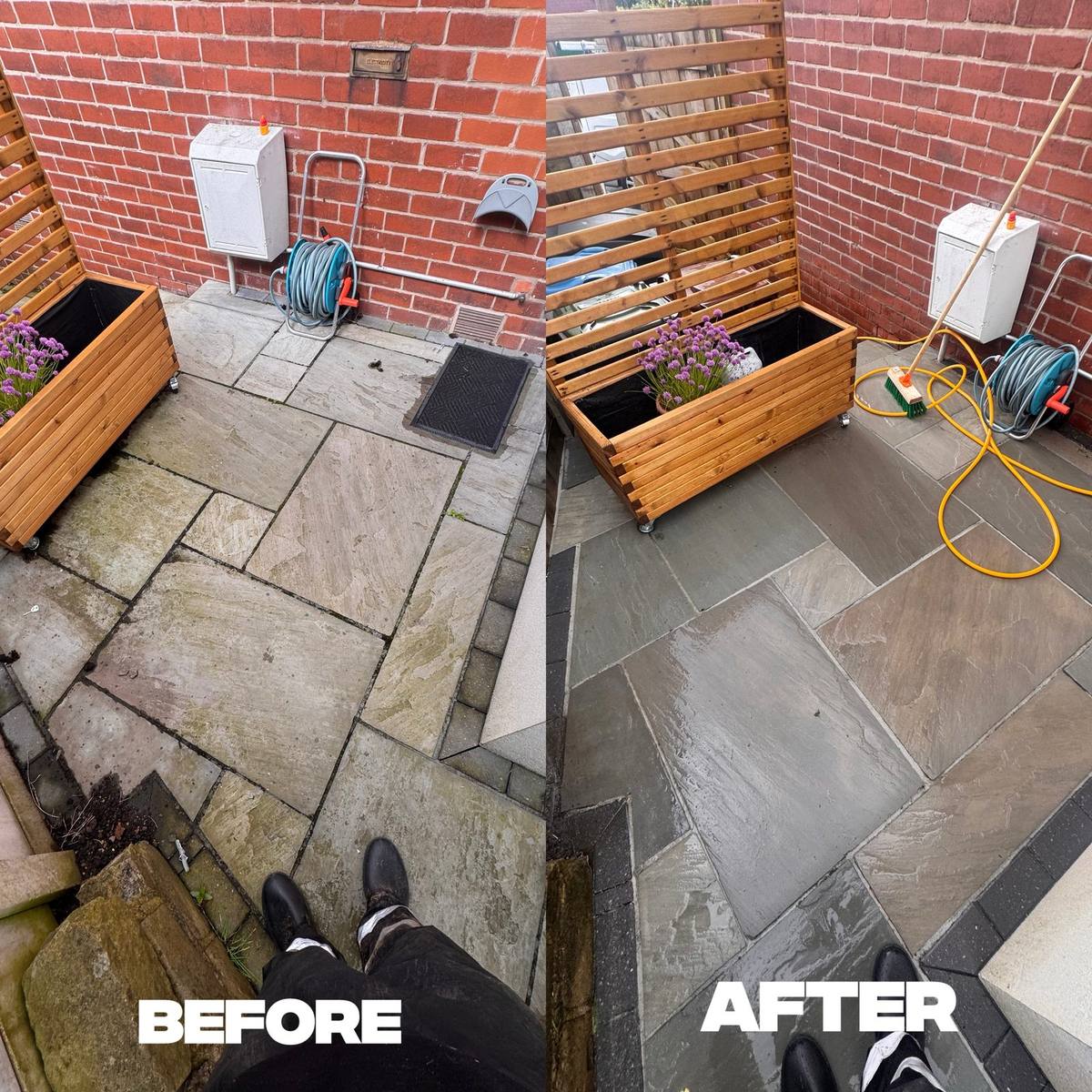
Indian sandstone patio — before and after a full deep clean. Black spot and algae gone.
Quick answer: Patio cleaning in Whitefield typically involves pressure washing to remove algae, moss, and staining from concrete, sandstone, or porcelain slabs. A professional clean restores colour, removes slip hazards, and takes a few hours. Most Whitefield patios cost between £80–£200 depending on size and condition.
Why Whitefield Patios Green Up So Quickly
Whitefield and the surrounding parts of Bury sit in a rainfall corridor that channels moisture off the Pennines and keeps it there. Annual rainfall in Greater Manchester regularly exceeds 800mm, and more importantly, the number of overcast, humid days through autumn and winter means surfaces rarely get the chance to dry out properly. Algae and moss don't need standing water — they need sustained damp, and they get it here reliably.
Black spot lichen is a particular problem on porous surfaces like Indian sandstone and riven concrete. It colonises microscopic pores in the stone and bonds tightly to the surface, which is why a garden hose or a domestic pressure washer often shifts the green slime but leaves dark staining behind. That's not dirt — it's organic material embedded into the surface itself, and it needs chemical pre-treatment to loosen properly.
The practical upshot is that annual or biennial cleaning isn't a luxury for Whitefield homeowners — it's the realistic maintenance cycle. Leaving a patio for three or four years doesn't just mean more cleaning time; it means some staining may have penetrated deeply enough that it lightens rather than fully disappears, even with professional equipment. Earlier intervention genuinely produces better results.
Common Patio Surfaces in Whitefield and How Each One Is Cleaned
Indian sandstone is the most common patio surface across Whitefield and the wider Bury area, and it needs careful handling. It's porous, which makes it prone to black spot and algae, but it's also soft enough to be damaged by excessive pressure. A correct clean starts with a pre-treatment — typically a biodegradable alkaline cleaner or a diluted sodium hypochlorite solution — left to dwell for ten to twenty minutes before any pressure is applied. Rotary surface cleaners work well on sandstone at controlled pressure, followed by careful edging with a lance. On sandstone, it's honest to say that deep black spot staining may lighten significantly rather than vanish entirely, particularly on older slabs.
Concrete flags are more forgiving. They're denser and more resistant to pressure, so a rotary surface cleaner can work at higher settings without risk of surface damage. Algae and general traffic soiling tend to come off well. Porcelain patios are a different matter again — they're non-porous and don't absorb staining in the same way, but they scratch if the wrong nozzle or surface cleaner is used, and they can streak badly if rinsed unevenly. A lower-pressure, wider-fan approach suits porcelain, and results are typically very good given how little actually penetrates the surface.
Block paving is its own category. The cleaning method is straightforward enough — pre-treat, rotary clean, edge — but the process inevitably blows joint sand out from between the blocks. Refilling those joints with kiln-dried sand after cleaning isn't optional; it's part of the job. You can read more about the full process on our block paving cleaning page. Skipping the re-sanding leaves blocks loose and allows weeds to establish themselves faster, which is a false economy.
What Patio Cleaning Actually Involves (Step by Step)
A proper patio clean starts before any water is applied. The pre-treatment stage — applying a cleaning solution and allowing it to dwell — is what separates a genuinely effective clean from a surface rinse. Dwell time varies by product and surface condition: typically ten to twenty minutes for standard algae and moss, longer for heavy black spot accumulation. Rushing this stage means the pressure washer is doing more work than it needs to, and results suffer.
Once the pre-treatment has done its work, a rotary surface cleaner — a spinning head that delivers consistent, even pressure — covers the main patio area. Rotary cleaners produce a far more uniform result than a lance alone, which can leave obvious streaking or track marks on stone. After the main area, edges and tight corners are worked with a lance at a controlled angle. The whole area is then rinsed down thoroughly.
A post-clean biocide application — brushed or sprayed on and left to dry — significantly slows the return of algae and moss. It's not a permanent solution, but in Greater Manchester's climate it can add six to twelve months to the time before visible regrowth appears. It's worth asking about when you book.
The rinse and inspection stage matters too. A good operator will walk the patio after rinsing to check for missed patches, edge lines, and any areas where pre-treatment needs a second pass. The whole process for a standard patio typically takes two to four hours — considerably longer than a quick blast, but the results reflect that additional time.
How Much Does Patio Cleaning Cost in Whitefield?
Patio cleaning Whitefield pricing sits in line with the wider Greater Manchester market. For a straightforward clean on a small to mid-sized patio — say up to 30 square metres — expect to pay in the region of £100 to £150 depending on surface condition and type. Larger patios and those with significant moss accumulation or years of neglect will cost more, and rightfully so: the labour and dwell time involved increases substantially.
For block paving specifically, pricing is generally calculated per square metre. A basic clean runs from around £3.50/m², rising to approximately £4.25/m² if the surface needs chemical treatment for heavier organic growth. A full restoration including pressure cleaning, chemical treatment, and kiln-dried sand re-filling is typically around £5.50/m². If the paving has already been cleaned and only needs the joints refilled, re-sanding alone is around £2.00/m². These figures give a working ballpark, though condition and access will always affect the final number.
The fastest way to get an accurate quote for patio cleaning Whitefield is to send a few photos over WhatsApp. That's enough to give a firm price for the majority of jobs without needing a separate site visit. Photos showing the full area, close-ups of the staining, and any awkward access points give a clear enough picture to quote confidently.
Re-Sanding and Sealing After Cleaning: Is It Worth It?
Re-sanding block paving after pressure washing isn't an upsell — it's a necessary part of the process. Pressure washing clears joint sand along with the algae and dirt, and without refilling those joints the blocks become unstable over time. Kiln-dried sand is the correct material: it's dry enough to brush into joints fully, it compacts well, and it doesn't introduce moisture that could cause problems before it settles. Ordinary building sand is the wrong choice and will cause issues. If you're reading more about this, our guide on why weeds in block paving keep coming back covers how poor jointing is often the root cause.
Sealing is a more nuanced question. On block paving and some sandstone surfaces, a penetrating sealer after cleaning can meaningfully extend the interval before the next clean — it reduces porosity, which slows algae colonisation and makes future cleaning easier. On porcelain, sealing adds very little given the surface is already non-porous. On highly textured or aged sandstone, some sealers can alter the appearance in ways the homeowner may not expect, so it's worth discussing the specific product and finish before committing.
Sealing does add cost, and it isn't always necessary. If a patio is cleaned annually and a post-clean biocide is applied, some surfaces stay in good condition without a sealer. The honest answer is that it depends on the surface type, how quickly the patio greens up, and the homeowner's appetite for maintenance. It's worth a conversation, not a blanket recommendation either way.
When to Call a Professional Rather Than DIY
Hired domestic pressure washers are capable machines for certain jobs, but patios present specific risks. On Indian sandstone and softer concrete, too much pressure at too close a range etches the surface — sometimes visibly, sometimes in ways that only show up later when the stone starts soaking in water unevenly. On block paving, a standard lance without a surface cleaner blows sand aggressively and unevenly from joints, often leaving the edging areas worse than before. The results can be streaky, patchy, or inconsistent in ways that are difficult to correct afterwards. Our guide on why your patio looks patchy after cleaning goes into more detail on what causes this.
There's also a safety consideration that's often underestimated. Algae-covered paving is extremely slippery — working across it while managing a high-pressure hose and a heavy machine is a genuine slip hazard. Professionals work with this risk regularly and adapt their footing accordingly; someone doing it once or twice a year with hired equipment is working in less familiar conditions.
C&C Precision Pressure Washing covers Whitefield and the surrounding areas of Greater Manchester, and a photo sent over WhatsApp is enough to get a clear idea of what a job involves and what it will cost. For more complex surfaces or heavily neglected patios, professional results are difficult to replicate with domestic equipment — not impossible, but the margin for error is significantly narrower.
How to Keep Your Patio Cleaner for Longer After a Professional Clean
The single most effective thing you can do after a professional clean is apply a biocide treatment annually. This doesn't have to be done by a contractor — diluted sodium hypochlorite or a proprietary patio biocide brushed or sprayed on in late autumn, after the worst of the leaf fall, will significantly slow algae and moss regrowth through the damp winter months. This is the same active approach used in softwashing, applied at a maintenance rather than restoration level. Wear appropriate gloves and keep it off planted borders.
Clearing leaf fall promptly matters more than most people expect. Decomposing leaves deposit organic material on paving and create the exactly moist, nutrient-rich conditions that algae thrive in. A quick sweep every week or two through October and November costs very little effort and meaningfully extends the clean. Checking that drainage channels and gullies adjacent to the patio are clear is worth doing at the same time — pooling water accelerates growth considerably.
A realistic maintenance schedule for a Whitefield patio in Greater Manchester's climate is a professional clean every one to two years, with a DIY biocide application in the autumn between professional cleans. North-facing or heavily shaded patios will tend toward the shorter end of that interval; well-drained, open aspects can sometimes stretch to two years comfortably. That kind of honest expectation-setting is more useful than promising results that the local climate simply won't allow.
Frequently asked questions
How long does patio cleaning take in Whitefield?
Most standard patios take between two and four hours from start to finish. Larger or heavily neglected patios, or those needing re-sanding afterwards, can run to a full day. We'll always give you a realistic time estimate when you send your photos across.
Will pressure washing damage my Indian sandstone patio?
Not if it's done correctly. Sandstone needs a lower pressure than concrete, combined with the right pre-treatment to lift black spot and organic staining without etching the surface. High-pressure machines used without care — including most domestic ones — can scour the stone, so technique matters.
Do I need to be home when you clean the patio?
Not necessarily. As long as we have access to the patio and a cold water tap, most jobs can be completed while you're out. We'll confirm the details with you beforehand and send photos when we're done.
How often should a Whitefield patio be professionally cleaned?
In Greater Manchester's climate, most patios benefit from a professional clean every one to two years. A post-clean biocide application slows regrowth significantly and can stretch that interval. Shaded or north-facing patios may need attention more frequently as they stay damp longer.
Want a quick price for your Whitefield patio?
Send a couple of photos on WhatsApp and we'll come back to you with a straight price — no faff, no call needed.