If you've been searching for patio cleaning in Bury, there's a good chance your patio looks worse than it did last year — and the year before that. It's not neglect on your part. The conditions around Bury are genuinely harsh on outdoor surfaces, and what starts as a faint green tinge in October can become a slippery, black-streaked mess by spring. This guide covers why it happens, what actually fixes it, and what to expect from a professional clean.
We work on patios across Bury and the surrounding areas regularly — Ramsbottom, Tottington, Whitefield, Radcliffe, and the neighbourhoods in between. The problems are consistent: algae, black spot, moss, and joint deterioration. Most of it is fixable. Some of it takes more than one approach. We'll be straight with you about which is which.
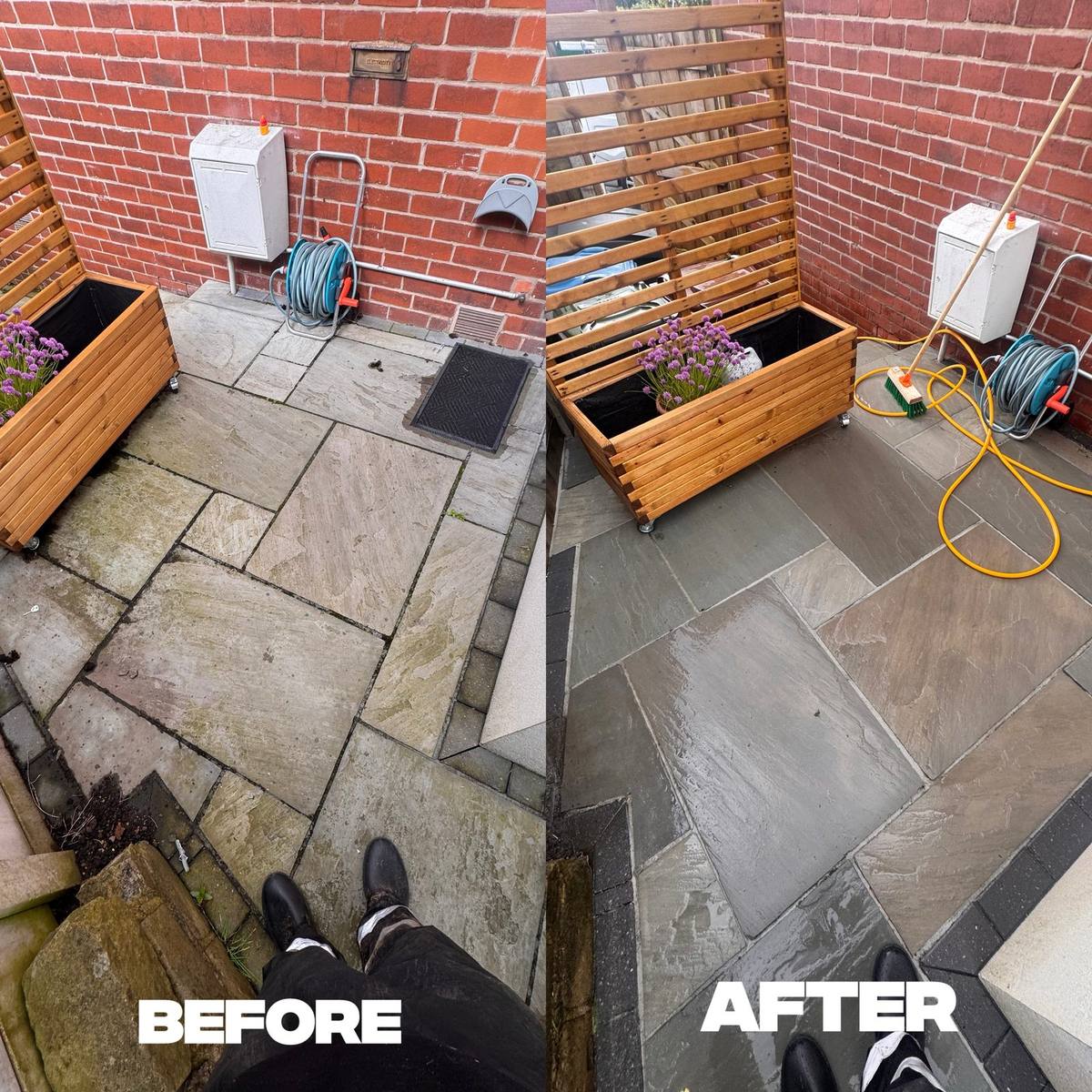
Indian sandstone patio — black spot and algae gone in a single clean.
Quick answer: Patios in Bury accumulate green algae, black spot, moss and organic staining quickly due to the North West's wet climate. Professional patio cleaning using a hot-water pressure washer and rotary surface cleaner removes years of built-up grime safely and restores the surface in a single visit.
Why Bury Patios Get So Dirty So Fast
Bury sits close to the western edge of the Pennines, which means it catches a significant amount of rainfall — more than most people in the south of England would believe. That persistent damp, combined with relatively low winter sun angles, means outdoor surfaces stay wet for long stretches. Algae and moss don't need much: moisture, a surface to grip, and limited direct sunlight. Bury provides all three for the better part of eight months a year.
North-facing gardens are the worst affected. If your patio spends most of the day in shade, it may never fully dry out between October and April. That constant moisture allows biofilms to form on even quite new surfaces. South-facing gardens get more sun but aren't immune — if there's a fence line or a neighbouring property casting shade across part of the patio, you'll typically see a clear line where the algae begins.
Lichen is a slower problem but a more serious one. It takes longer to establish than algae or moss, but once it does, the root-like structures (rhizines) penetrate the surface rather than just sitting on top of it. A patio that hasn't been properly cleaned in five or more years in this climate will almost certainly have lichen present, and that changes the cleaning approach entirely. It also explains why some surfaces lighten after treatment rather than returning to their original colour — some staining is genuinely permanent once lichen has been established long enough.
The Most Common Patio Surfaces in Bury (and Their Specific Problems)
Indian sandstone is probably the most common patio surface we see across Bury. It looks beautiful when it's new, but it's porous, which means it absorbs moisture — and whatever is living in that moisture. Black spot fungus is the signature problem on sandstone, but general greening and tide-mark staining from pooled water are just as common. If your sandstone looks dark and damp even in dry weather, it's likely saturated with biological growth.
Concrete flags are more durable but have their own issues. The surface weathers over time, becoming rougher and more porous, which gives algae more to grip onto. Grout lines crack and allow water ingress, which then freezes and expands in winter — a particular issue in Bury where hard frosts aren't unusual. If you're seeing a green film across the whole surface and dark lines along every joint, that's a classic concrete flag presentation. Professional patio cleaning on concrete usually involves surface cleaning followed by joint inspection, since cracked or missing grout often needs attention once the surface is clear.
Block paving patios tend to suffer from weed ingress and sand loss. Jointing sand gradually washes out over time, leaving gaps that weeds exploit quickly. Moss establishes in those same gaps and accelerates the process. Porcelain patios are less porous and easier to clean, but the joints are often the weak point — grout discolouration and biological growth in the grout lines is the most common complaint. You can find a useful comparison of these two materials in our guide on Indian sandstone vs porcelain: easier to clean?
Black Spot on Indian Sandstone: What It Actually Is
Black spot is one of the most common complaints from Bury homeowners with sandstone patios, and it's also one of the most misunderstood. It looks like a stain — dark, roughly circular patches scattered across the surface — but it's actually a tar-spot fungus. It embeds itself into the pores of the stone rather than sitting on the surface, which is why scrubbing or jet washing alone rarely shifts it properly. You might lighten it temporarily, but without killing the fungal growth, it returns.
The correct approach is chemical pre-treatment before any pressure washing takes place. A suitable fungicidal solution is applied and left to dwell — the dwell time matters, and rushing it produces poor results. The chemical breaks down the biological material within the pore structure rather than just blasting the surface layer off. After dwell time, the surface cleaner can then remove the loosened material far more effectively than a lance would manage on its own.
It's worth being honest here: very old, deep-set black spot on heavily weathered sandstone may lighten significantly rather than disappear completely. The porosity of the stone, its age, and how long the fungus has been present all affect the final result. We'll tell you that upfront rather than after the job is done.
Green Algae and Moss: Slippery, Stubborn and Everywhere
Green algae is the most common complaint from Bury homeowners in autumn and spring — and the most dangerous, because a thin algae film on a patio or path becomes extremely slippery when wet. It forms as a biofilm that bonds directly to the surface rather than sitting loosely on top of it, which is why brushing it or hosing it down rarely has a lasting effect. You're disturbing it rather than killing it, and it re-establishes quickly.
A domestic pressure washer can make things worse rather than better. Used without chemical pre-treatment, a jet wash can spread algae spores across the surface and deposit them in joints and edges where they re-establish even faster. The right sequence is biocide first, dwell time second, mechanical removal third. Softwashing — applying sodium hypochlorite at the correct dilution to kill biological growth at the root — is used on surfaces that can't tolerate high pressure, but on patios, a combination of chemical treatment and a rotary surface cleaner gives the most thorough result.
Moss in joints is a related but slightly different problem. It holds moisture and accelerates joint deterioration, and its root structure can disturb jointing sand. Once the patio is clean, inspecting the joints is worthwhile — if significant sand has been lost, re-sanding will prevent weed and moss regrowth far more effectively than any amount of chemical treatment on its own.
What a Professional Patio Clean Actually Involves
The job starts before any water is involved. Any loose debris is cleared, and the surface is inspected for cracked flags, loose blocks, or damaged joints — things worth knowing about before you start saturating them with water. Chemical pre-treatment is then applied across the whole surface, including edges and joints, and left to dwell. For a standard algae and moss situation, that's typically 15 to 30 minutes. For black spot or lichen, longer. The chemicals need time to work, and cutting that time short is one of the main reasons DIY treatments underperform.
The actual cleaning is done with a rotary surface cleaner rather than a lance. This is an important distinction — a surface cleaner maintains a consistent distance and distributes pressure evenly, which protects the surface and produces a uniform result. A lance at close range creates striping marks, erodes jointing sand, and can pit softer surfaces like sandstone. After the main surface is done, edges and corners are detailed by hand to reach areas the rotary head can't cover. The surface is then blown down to clear debris from joints and edges.
For a typical Bury back garden patio, expect the job to take between one and three hours. Post-treatment biocide is applied at the end to slow regrowth. If the joints need attention after cleaning — and on older block paving patios they often do — block paving re-sanding can be done the same visit or scheduled separately once the surface has dried fully, usually 24 to 48 hours later.
When DIY Isn't Enough: Signs You Need a Professional
A hired pressure washer and a few hours on a Saturday morning is perfectly adequate for a light clean on a patio that gets done every year. If the surface is mildly green and the joints are in reasonable shape, you'll see a reasonable result. But there are situations where it genuinely isn't enough, and doing it yourself can make certain problems worse.
Heavy black spot on sandstone, established lichen, or a patio that hasn't been properly cleaned in five or more years all need chemical treatment that's more targeted than what's available in a garden centre bottle. Lichen in particular requires a specific approach — you can read more about how it's treated on roof tiles in our guide on lichen on roof tiles: causes and proper treatment, and the principles are similar for patio surfaces. If you've hired a machine, done the job yourself, and the green returned within a few weeks, that's a reliable sign the biology wasn't killed properly — it was just disturbed.
Block paving that needs re-sanding after cleaning is another situation where professional work pays for itself. Kiln-dried sand needs to be worked properly into the joints and the surface needs to be dry and stable before it goes down, otherwise it washes straight out. Getting the clean and the re-sanding done as a single job — typically from around £5.50/m² for a full restoration — is more cost-effective than two separate visits and produces a more consistent result.
If your patio has a north-facing aspect or sits beneath trees, factor in a biocide post-treatment as standard rather than optional. In Bury's climate, it makes a material difference to how long the clean lasts — typically extending the interval between professional cleans from one year to closer to two.
Practical Advice to Keep Your Bury Patio Cleaner for Longer
The single most useful thing you can do between professional cleans is keep your gutters clear. Blocked gutters overflow onto patio surfaces and paths directly below, creating the exact conditions algae needs — constant moisture and organic debris. In a damp climate like Greater Manchester's, that drip-feed of dirty water from a blocked gutter can undo a professional clean within a season. It's worth checking downpipes and guttering in September before the autumn leaf fall begins.
Leaves left to rot on a patio surface cause tannin staining that can be difficult to shift, particularly on lighter stones like sandstone or limestone. Brushing them off before they start breaking down takes five minutes and saves considerably more trouble later. Similarly, if you have overhanging branches, trimming them back improves air circulation and allows the surface to dry faster after rain — which directly affects how quickly algae re-establishes.
Realistic expectations about frequency matter. Given the North West climate, most Bury patios benefit from a professional clean every one to two years. Shaded patios or those under heavy tree cover are more likely to need annual attention. If C&C Precision applies a post-clean biocide treatment after your clean, that will slow regrowth meaningfully, but it won't stop it indefinitely — nothing will in this climate. The goal is to manage it sensibly rather than fight it constantly. You can see how customers in similar situations have found the service on our reviews page.
Frequently asked questions
How much does patio cleaning cost in Bury?
Most standard back garden patios in Bury come in between £80 and £180 depending on size, surface type and how long it's been since the last clean. The quickest way to get an accurate price is to send a couple of photos over WhatsApp — we can usually give you a number the same day without needing to visit first.
Will pressure washing damage my sandstone or block paving patio?
Not if it's done correctly. The risk comes from using a lance at close range, which can erode jointing sand and pit softer surfaces. A rotary surface cleaner distributes pressure evenly and at the right distance, which is why professional results look different to a DIY jet wash. Indian sandstone in particular benefits from chemical pre-treatment rather than relying on pressure alone.
How long does patio cleaning take and will I need to stay in?
A typical Bury back garden patio takes between one and three hours depending on size and condition. You don't need to be in — as long as we can access the garden and there's a tap available, we can get the job done. We'll let you know when we're finished and send photos if you're not home.
How often should I get my patio professionally cleaned in Bury?
Given the North West climate, most patios benefit from a professional clean every one to two years. Shaded, north-facing patios or those under trees may need it annually. After a clean we can apply a post-treatment biocide that slows regrowth significantly and extends the time between cleans.
Want a quick price for your Bury patio?
Send a couple of photos on WhatsApp and we'll come back to you with a straight price — no faff, no sales call.