If you're trying to decide between these two materials for a new patio, or you already have one laid and want to understand what you're dealing with, the question of indian sandstone vs porcelain paving maintenance is worth thinking through properly. Both surfaces look great when they're freshly laid. The difference becomes clear after a winter or two in Greater Manchester, when the moss starts creeping in, the grouting discolours, and you're wondering whether you chose the harder option.
This guide covers how each surface behaves in the real world — how quickly they get dirty, what kinds of staining you'll face, whether sealing is worth the effort, and at what point a domestic pressure washer stops being enough. There's no single right answer for everyone, but there is a lot of misinformation out there, and some of it leads homeowners into expensive mistakes.
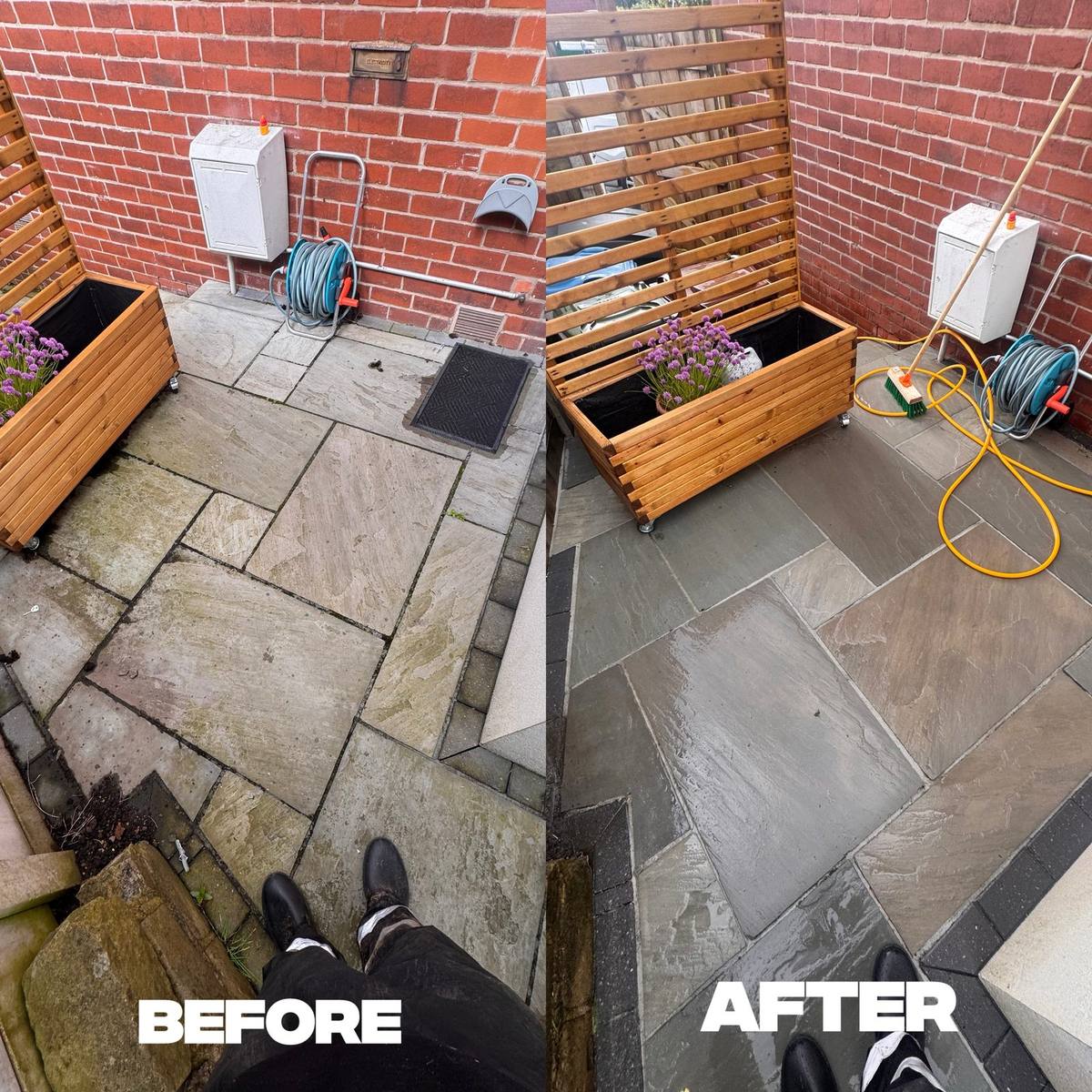
Indian sandstone patio cleaned by C&C Precision. Black spot and algae fully removed.
Quick answer: Porcelain is easier to keep clean day-to-day — its non-porous surface resists staining and moss takes longer to grip. Indian sandstone requires more regular cleaning and occasional sealing, but both surfaces will accumulate algae and black spot in Greater Manchester's damp climate without periodic professional attention.
What Actually Makes These Two Surfaces Different
Indian sandstone is a natural sedimentary rock, formed over millions of years from compressed sand particles. That process leaves it with a cellular, porous structure — tiny channels and voids that absorb water, organic matter, and staining agents. The colour variation and texture that make it attractive are the same qualities that make it absorb things it shouldn't. Porcelain, by contrast, is a manufactured tile fired at extremely high temperatures, which drives out almost all the moisture and creates a near-impervious surface. Porosity — or the lack of it — is the single most important factor in understanding why these two materials behave so differently over time.
On a practical level, this means that when rain hits Indian sandstone, some of it goes in. When rain hits porcelain, almost all of it runs off. That distinction shapes everything: how quickly algae takes hold, how deeply stains penetrate, how the surface responds to cleaning, and whether a sealer makes any meaningful difference. It's not that one material is better made — it's that they are fundamentally different things, and treating them the same way will give you problems with at least one of them.
How Quickly Does Each Surface Get Dirty in Greater Manchester?
Greater Manchester gets around 800mm of rainfall a year, spread across most of the calendar. That consistent damp, combined with the shade cast by terrace housing, close-boarded fencing, and mature garden trees, creates near-ideal conditions for algae, moss, and lichen. Neither Indian sandstone nor porcelain is immune to this. The honest answer is that both surfaces will need cleaning — the question is how often, and how difficult that cleaning becomes.
Porcelain does stay cleaner for longer. Because organic matter can't penetrate the surface, it tends to sit on top rather than staining into the tile. A shaded porcelain patio might show green algae growth within a season, but a good clean restores it close to its original condition. Indian sandstone in the same position accumulates more deeply — the algae and moisture work their way into the surface structure, the colour darkens, and by the time it looks bad it's often been building for longer than you'd realise.
Neither surface is maintenance-free in this climate. Anyone who told you otherwise when you bought the materials was being optimistic. The North West's combination of rainfall, shade, and moderate temperatures is exactly what biological growth needs, and it will find both surfaces eventually.
Indian Sandstone: What to Expect on Maintenance
The most common problems on Indian sandstone in Greater Manchester are algae and green slime (which arrives quickly on shaded patios), black spot lichen (which takes longer to establish but is much harder to remove), efflorescence (white salt deposits that migrate up through the stone — covered in more detail in our guide to efflorescence on block paving, which applies equally to sandstone), and general deep staining from organic matter, leaves, and standing water. Because the surface is porous, all of these penetrate rather than just sitting on top, which means surface-level cleaning alone often doesn't shift them fully.
Sealing Indian sandstone after a professional clean does make a meaningful difference — it reduces the rate at which organic matter and moisture are absorbed, and it makes subsequent cleaning easier. It doesn't make the surface maintenance-free, and it doesn't prevent biological growth from establishing on the surface itself. Sealers need reapplying periodically, typically every two to three years depending on traffic and exposure. A surface that hasn't been properly cleaned before sealing will trap existing staining underneath, so the order of operations matters.
It's also worth being honest about results. Black spot lichen on Indian sandstone — the kind that has been established for more than a year — will often lighten significantly with professional treatment but may not vanish entirely in one clean. A proper biocide application with adequate dwell time does most of the work, but very old lichen colonies leave a shadow. A second treatment a few weeks later usually resolves it. Anyone promising a single-visit perfect result on heavily colonised sandstone is overpromising.
Porcelain Paving: What to Expect on Maintenance
Porcelain's near-impervious surface does resist staining well, but it's not self-cleaning. Textured finishes — the kind specified to improve slip resistance, which is sensible — create microscopic ridges that trap moss spores and algae just as effectively as grout lines do. A smooth-finish porcelain tile in a shaded garden will still go green within a season. The staining sits on the surface rather than in it, which makes it easier to clean, but it still needs cleaning.
The risk with porcelain is in the cleaning process itself. Because the tiles are dense and hard, there's a temptation to use high pressure to blast them clean quickly. The tiles can usually handle this, but the grout joints often can't — particularly sand-filled joints, which can be eroded by direct high-pressure water. Once the jointing fails, weeds establish faster, the whole surface becomes less stable, and you're looking at a re-sanding job. The same principle that applies to block paving cleaning applies here: protecting the joints is as important as cleaning the surface.
Chemical selection also matters. Some alkaline cleaners that work well on sandstone can leave a residue on polished or semi-polished porcelain finishes. Acidic cleaners used on certain porcelain tiles can affect the grout. Getting this wrong doesn't usually cause dramatic damage, but it can leave the surface looking worse than before, and it's one of the more common outcomes of DIY cleaning attempts.
Sealing: Does Either Surface Actually Need It?
For Indian sandstone, sealing is genuinely worthwhile — not essential, but a meaningful upgrade. A penetrating impregnating sealer (rather than a surface film sealer) reduces water and organic matter absorption, makes the surface easier to clean, and can enhance or preserve the stone's colour depending on the product chosen. The "wet look" sealers that darken and intensify the colour are popular but worth thinking about carefully — they require reapplication more frequently and can look patchy as they wear unevenly.
For porcelain, sealing is generally unnecessary and in some cases actively counterproductive. Because the surface already has near-zero porosity, a sealer has nothing to bond with in the stone itself. Film-forming sealers applied to porcelain can reduce the surface's slip resistance, which on an outdoor patio is a genuine safety concern. You may encounter retailers or contractors suggesting porcelain should be sealed — it's worth asking them exactly what they expect the sealer to bond to, and what the slip rating will be afterwards.
If someone recommends sealing your porcelain patio and can't explain what the sealer is actually doing to a near-impervious surface, that's worth probing. The honest answer in most cases is that porcelain doesn't benefit from sealing in the way natural stone does, and some sealers make it more hazardous underfoot.
When to Call in a Professional Pressure Washer
A garden hose and a domestic pressure washer will keep a lightly contaminated surface looking reasonable, but there are clear signs that the job has moved beyond what those tools can properly address. Black spot lichen is the most obvious one — it anchors itself into the surface with root-like structures called rhizines, and surface water pressure doesn't dislodge it. It needs a biocide pre-treatment with adequate dwell time (typically 20 to 30 minutes, longer in cold weather) before mechanical cleaning will do anything useful. If you skip that step and just blast at it, you remove the visible growth but leave the root system intact, and it returns within weeks.
Deep algae staining on Indian sandstone that has been building for more than one season, moss that keeps returning within a few weeks of cleaning, and any situation where DIY pressure washing has already been tried without a lasting result — these are all points where professional equipment and chemical knowledge make a substantial difference. Wrong technique on Indian sandstone in particular can cause permanent damage: too-high pressure applied at close range without pre-treatment will pit and erode the softer layers of the stone, and that's not reversible. For patios and driveways in Greater Manchester, our patio cleaning and stone cleaning services use surface cleaners rather than lance blasting, which gives a more even result and protects the surface.
C&C Precision Pressure Washing covers Oldham, Rochdale, Bury, Bolton, Manchester, Tameside, Stockport and the surrounding towns — quotes are quick, and customers send photos over WhatsApp to get an accurate price without needing a site visit first. If you're unsure what you're dealing with, a photo of the worst area tells us most of what we need to know.
The Honest Verdict: Which Should You Choose?
On pure ease of maintenance, porcelain wins. It stays cleaner longer, staining doesn't penetrate, and when it does need cleaning the job is generally more straightforward. If low maintenance is your priority and you're happy with the manufactured aesthetic, porcelain is the more practical choice for a Greater Manchester garden.
Indian sandstone wins on natural character and initial cost. The variation in tone and texture that comes from a natural material is something no manufactured tile fully replicates, and per square metre it typically costs less to buy and lay. The trade-off is that it needs more attentive maintenance, benefits from sealing, and will show the effects of the local climate faster.
Whichever surface you have or are considering, the realistic expectation in this climate is a professional clean every one to two years. For heavily shaded patios or those with significant tree cover, the shorter end of that range is more honest. That's not a sales pitch — it's what the weather here genuinely requires of both materials. Understanding that upfront, rather than after the surface has been neglected for five years, is what makes the difference between a restoration job and routine maintenance. You might also find our guide on how to prepare your home exterior for winter useful if you're thinking about timing a clean before the colder months set in.
Frequently asked questions
Can I pressure wash Indian sandstone myself?
You can, but it's easy to cause damage. Sandstone is soft and porous — too much pressure, the wrong nozzle angle, or skipping a pre-treatment will pit the surface and drive in more organic matter than you remove. A rotary surface cleaner at the right PSI with a proper pre-soak gives a far better result.
Why does my porcelain patio still go green if it's non-porous?
Algae and moss don't need to penetrate a surface to grow on it — they just need moisture and somewhere to grip. Textured porcelain finishes, grout lines, and shaded areas in typical northern England gardens give them exactly that. Non-porous doesn't mean self-cleaning.
How often should Indian sandstone be professionally cleaned in Greater Manchester?
In most Greater Manchester gardens we'd say every 12 to 18 months is realistic, depending on aspect and tree cover. Shaded patios on the north side of a house can look bad within a single season. Sealing after a clean extends the interval but doesn't replace it.
Does professional cleaning damage the surface of Indian sandstone?
Done properly, no — it should restore it. The risk comes from too-high pressure applied directly without a pre-treatment, which can erode the softer layers of the stone. We always pre-treat and use a surface cleaner rather than blasting at close range, which is what most DIY pressure washing damage comes from.
Not sure what your patio needs?
Send a couple of photos on WhatsApp and we'll give you a straight price — usually within the hour.