If you're looking into driveway cleaning in Bolton, you've probably noticed that not all driveways — or all cleaning companies — are the same. The surface type, the level of moss and algae growth, and whether the job needs re-sanding afterwards all affect the method, the time, and the price. This guide walks through what's actually involved so you can make a sensible decision rather than just go with the cheapest quote you find online.
Bolton's damp climate doesn't help matters. The North West gets consistent rainfall across most of the year, and that sustained moisture means algae, moss, and lichen take hold quickly on driveways that don't see much direct sun. A driveway that looked clean three years ago can be noticeably green and slippery by now, particularly on north-facing properties or those shaded by walls and hedges. That's not a reflection on how well you maintain your home — it's just the reality of the climate here.
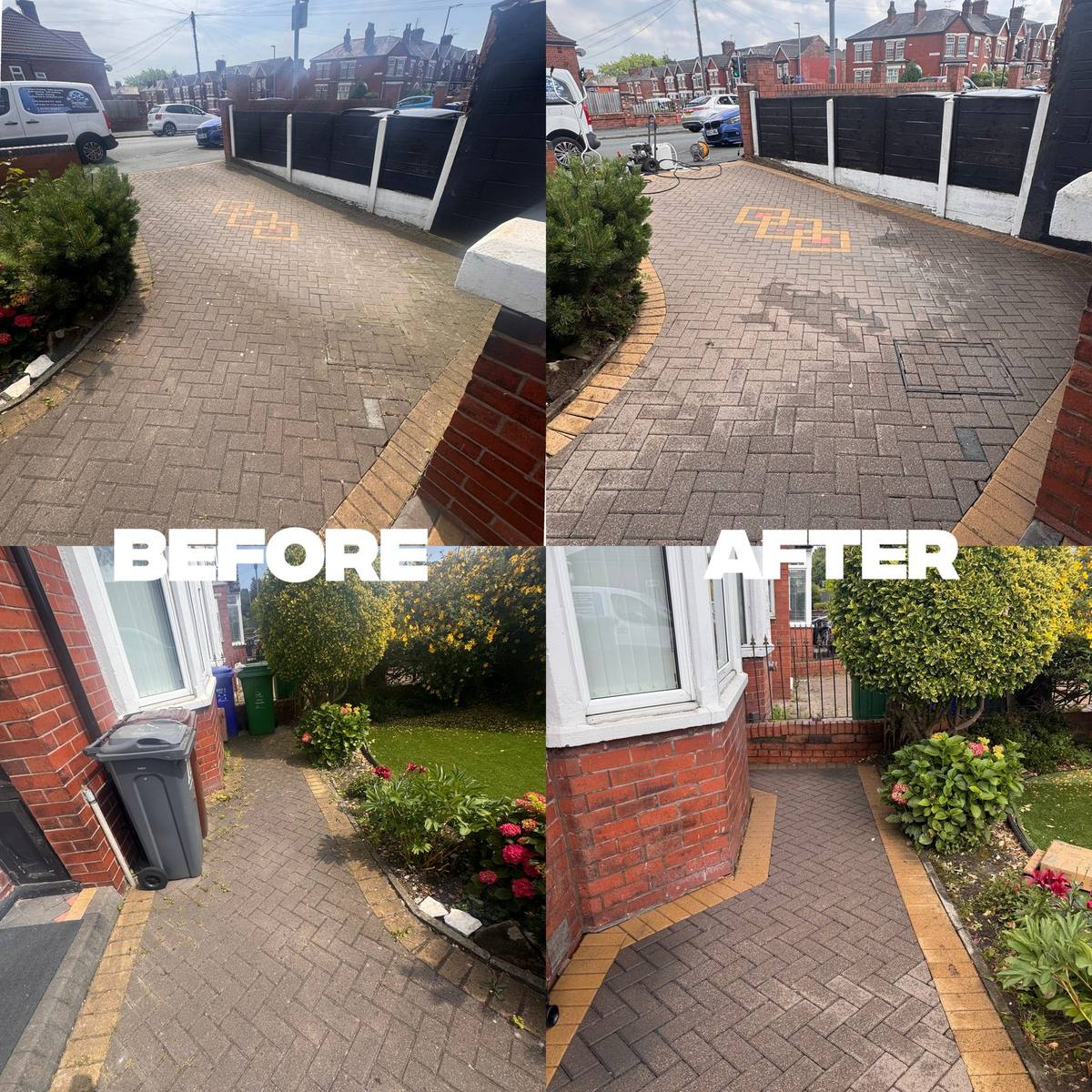
A typical Bolton driveway — before and after a full pressure wash with C&C Precision.
Quick answer: Driveway cleaning in Bolton typically costs £80–£250 depending on size, surface type, and condition. A professional will pressure wash the surface, clear moss and weeds, and leave it looking like new. Most jobs in Bolton are completed in two to four hours with same-week availability.
What Does Driveway Cleaning Actually Involve?
A proper driveway clean isn't just pointing a lance at the surface and hoping for the best. The job starts with a pre-treatment — usually a biocide or alkaline detergent applied to the surface and left to dwell. Dwell time matters. The chemical needs time to break down the organic growth: the algae, moss, and general biological contamination that's bonded itself to the surface. Rushing this step means you're working harder with the pressure washer and getting a worse result.
Once the pre-treatment has done its job, the actual cleaning is carried out with a rotary surface cleaner rather than an open lance. A surface cleaner is a shrouded spinning head that cleans evenly across the full width, pulling the dirty water away rather than blasting it outward. It produces a consistent finish without the tracking lines you get from a standard lance, and it means the pressure is distributed rather than concentrated on one spot. After cleaning, the whole area is thoroughly rinsed down to remove the loosened debris and any remaining chemical residue.
On block paving, there's often a further stage: re-sanding the joints. Pressure washing inevitably removes some or all of the jointing sand, and that needs to be replaced before the job is complete. We'll come back to that in more detail below, because it's a step that's often skipped — and it really shouldn't be.
Driveway Surface Types Common in Bolton — and How They're Cleaned
Block paving is probably the most common driveway surface across Bolton, and it's one of the more involved to clean properly. The paving itself can handle a decent amount of pressure, but the joints need care and the sand will need replacing afterwards. Tarmac is more straightforward — it responds well to a medium-pressure clean with a pre-treatment, though heavily oxidised or cracked tarmac needs a lighter touch to avoid making existing damage worse.
Concrete driveways are generally robust but can have deep-set staining from oil, rust, or years of biological growth that lightens rather than fully disappears. Being honest about that upfront saves everyone time — some staining is chemically bonded into the surface and no amount of pressure washing will completely remove it. Pattern imprinted concrete, which is common on newer builds and some 1990s properties in Bolton, needs more controlled pressure and a chemical pre-treatment to avoid stripping the surface sealant. It's not a surface that responds well to DIY pressure washing, for reasons covered later in this guide.
Gravel driveways are a different matter entirely — pressure washing isn't really the right tool. Resin-bound and resin-bonded surfaces are becoming more common and generally clean up well with lower pressure and the right detergent, though resin-bonded (where the stones are loose on a resin base) can be damaged if the pressure is too high. If you're unsure what surface type you have, a photo sent over WhatsApp is usually enough to tell straight away.
How Much Does Driveway Cleaning Cost in Bolton?
Most residential driveways in Bolton fall somewhere between £80 and £250 for a professional clean, though that range is genuinely wide because the variables are significant. A small terraced house driveway that fits two cars side by side and is in reasonable condition sits at the lower end. A large detached property with block paving, heavy moss growth, and re-sanding required will be at or beyond the higher end. Pricing for block paving cleaning typically runs from around £3.50 per square metre for a straightforward clean, up to £4.25/m² where chemical treatment is needed, and £5.50/m² for a full restoration including re-sanding. Re-sanding alone, if the surface is already clean, is around £2.00/m².
What pushes costs up: heavy organic growth that needs more dwell time and sometimes a second pass; large driveways that simply take more time; re-sanding and jointing work; and any sealing requested after the clean. Sealing is optional and not always necessary, but it does extend the time before the next clean is needed by making the surface less hospitable to algae.
Any quote given without seeing the job is a rough guess at best. A photo of the driveway — ideally showing the full area and any particularly affected spots — gives a much more accurate basis for pricing. It takes thirty seconds to send and means you get a number that actually reflects the work involved.
Block Paving Re-Sanding: Do You Need It After Cleaning?
Pressure washing removes the jointing sand from between block paving. That's not a flaw in the process — it's unavoidable, and it's one reason why block paving cleaning takes longer and costs more than cleaning a plain concrete slab. The jointing sand is what keeps the blocks locked together, prevents lateral movement, and stops weeds getting a foothold. Once it's been washed out, the surface is structurally compromised until it's replaced.
Re-sanding is done with kiln-dried sand, which is fine enough to work down into the joints properly and dry enough not to clump during application. It's brushed in dry, worked into the joints with a plate compactor or stiff brush, and any excess swept off the surface. This is covered in more detail in our guide on what pressure washing does to block paving sand, but the short version is: if someone offers to clean your block paving and doesn't mention re-sanding, ask why.
There are situations where re-sanding isn't needed — if the joints are still well-filled after cleaning, or if the customer is planning to have the driveway sealed with a jointing compound that doubles as a weed suppressant. But these are the exception, not the rule. On most jobs, re-sanding should be part of the scope, and it should be agreed upfront rather than presented as an add-on at the end of the day.
How Long Does a Driveway Clean Take in Bolton?
The honest answer for most Bolton residential driveways is two to four hours. A small, relatively clean driveway with no re-sanding needed can be done in under two hours. A larger drive with significant moss growth, block paving throughout, and re-sanding required could run to five or six hours. These aren't jobs to be rushed — the pre-treatment needs its dwell time, the cleaning needs to be done methodically, and re-sanding needs the surface to be dry enough to accept the sand properly.
In practice, most single-visit driveway cleans in Bolton are completed within one morning or one afternoon. You don't usually need to be home for the whole duration — many customers just leave access and we get on with it. If re-sanding is included, ideally the surface has had some time to dry after cleaning before the sand goes in, which can affect timing on wetter days.
If rain is forecast within a few hours of the job finishing, it's worth rescheduling the re-sanding element. Kiln-dried sand needs to settle into the joints dry — getting it wet before it's properly bedded in means it can wash out or clump rather than fill evenly. A brief shower after cleaning is fine; heavy rain immediately after re-sanding is not ideal.
When Should You Call in a Professional Rather Than DIY?
A hire-gun pressure washer from a tool hire shop isn't the same as professional equipment, and the difference matters more on some surfaces than others. The main risks with DIY pressure washing on driveways: tracking lines on block paving from an uneven lance, dislodging jointing sand unevenly and leaving some joints overfull while others are empty, stripping the decorative seal from imprinted concrete, and — perhaps most commonly — spreading algae spores rather than removing them. Algae treated without a proper biocide often comes back faster than before because the spores have been dispersed across a wider area.
A professional brings the right surface cleaner, the right chemicals at the right dilutions, and the experience to adjust pressure and technique to the surface. For driveway cleaning on block paving or imprinted concrete in particular, the risk of causing surface damage or a poor finish with DIY equipment is real enough to make professional cleaning the more economical choice in the long run. That's not a sales pitch — it's just the honest assessment of what the equipment and the chemistry can and can't do in untrained hands.
For a concrete or tarmac driveway in reasonable condition with no complex surfaces or jointing work, a competent DIY user with decent hire equipment can get an acceptable result. But if you're dealing with block paving, pattern imprinted concrete, or a surface that's heavily colonised with moss and lichen, the gap between a professional result and a DIY one is significant.
How to Get a Quote for Driveway Cleaning in Bolton
The quickest route is to send a few photos over WhatsApp. Take one showing the full driveway from a distance so the size is clear, and one or two closer shots of any particularly mossy or stained areas. If you know the approximate square meterage, mention it — but don't worry if you don't, a photo of a standard driveway is usually enough to estimate. Note the surface type if you know it (block paving, tarmac, concrete, imprinted concrete), and let us know whether you're interested in re-sanding or sealing afterwards.
C&C Precision covers Bolton and the surrounding area as part of its regular Greater Manchester patch, so there's no issue with distance. Quotes come back quickly — usually the same day — and there's no obligation. If the job is straightforward, the price in the quote is the price you pay. If there's something that could affect the final cost (unexpected surface damage, or moss that's significantly heavier than the photos showed), that gets flagged on the day before work starts rather than after.
On the day itself, access to an outdoor tap is helpful but not always essential. We carry water if needed, though it's worth mentioning upfront if there's no tap available. Payment is typically on completion, and we're happy to answer questions about the surface or maintenance before we leave. Most customers find the full range of services covers other areas they hadn't thought to ask about — gutters, render, patios — and it's often efficient to combine jobs in a single visit.
Frequently asked questions
How much does driveway cleaning cost in Bolton?
Most driveways in Bolton cost between £80 and £250 to clean professionally, depending on size, surface type, and how much organic growth or staining needs treating. A small terraced driveway sits at the lower end; a large detached with block paving re-sanding will be higher. Send a photo for an accurate price — ballparks without seeing the job aren't worth much.
How long does a driveway clean take?
The majority of residential driveways in Bolton take between two and four hours from start to finish. Larger driveways, heavily mossy surfaces, or jobs that include re-sanding will take longer. We'll always give you a realistic time estimate when you book so you can plan your day.
Will pressure washing damage my block paving or imprinted concrete?
Done properly with the right equipment, no — but it's a fair question. The wrong pressure or a standard lance on block paving can track the surface and dislodge sand unevenly. We use a rotary surface cleaner which cleans evenly without directing a concentrated jet at one spot. Imprinted concrete needs pre-treatment and controlled pressure to avoid stripping the seal, which is why it's not a great candidate for DIY.
Do you cover my area — I'm in Bolton but near the border with Wigan or Chorley?
We're based in Oldham and cover Greater Manchester broadly, including Bolton and the surrounding towns. If you're on the edge of the area, just drop us a message with your postcode — if it's a bit far, we'll tell you straight rather than waste your time. We don't charge call-out fees.
Want a price for your Bolton driveway?
Send a couple of photos on WhatsApp and we'll come back to you with a straight price — usually within the hour.