If you own a home in Greater Manchester, you've probably looked up at your gutters after a heavy downpour and wondered whether they're actually doing their job. The question of how often to clear gutters comes up a lot, and the honest answer is that it depends on your property — but most people leave it too long. Blocked gutters are one of those maintenance jobs that's easy to put off because nothing looks wrong until something goes very wrong.
This guide covers the practical reality of gutter maintenance for UK homes, with particular attention to conditions in the North West. The climate here is wetter and milder than much of the country, which changes the equation compared to advice written for drier parts of England. If you take one thing from this, let it be that the cost of clearing gutters regularly is small compared to what a blocked gutter can do to a wall, a fascia board, or a foundation over time.
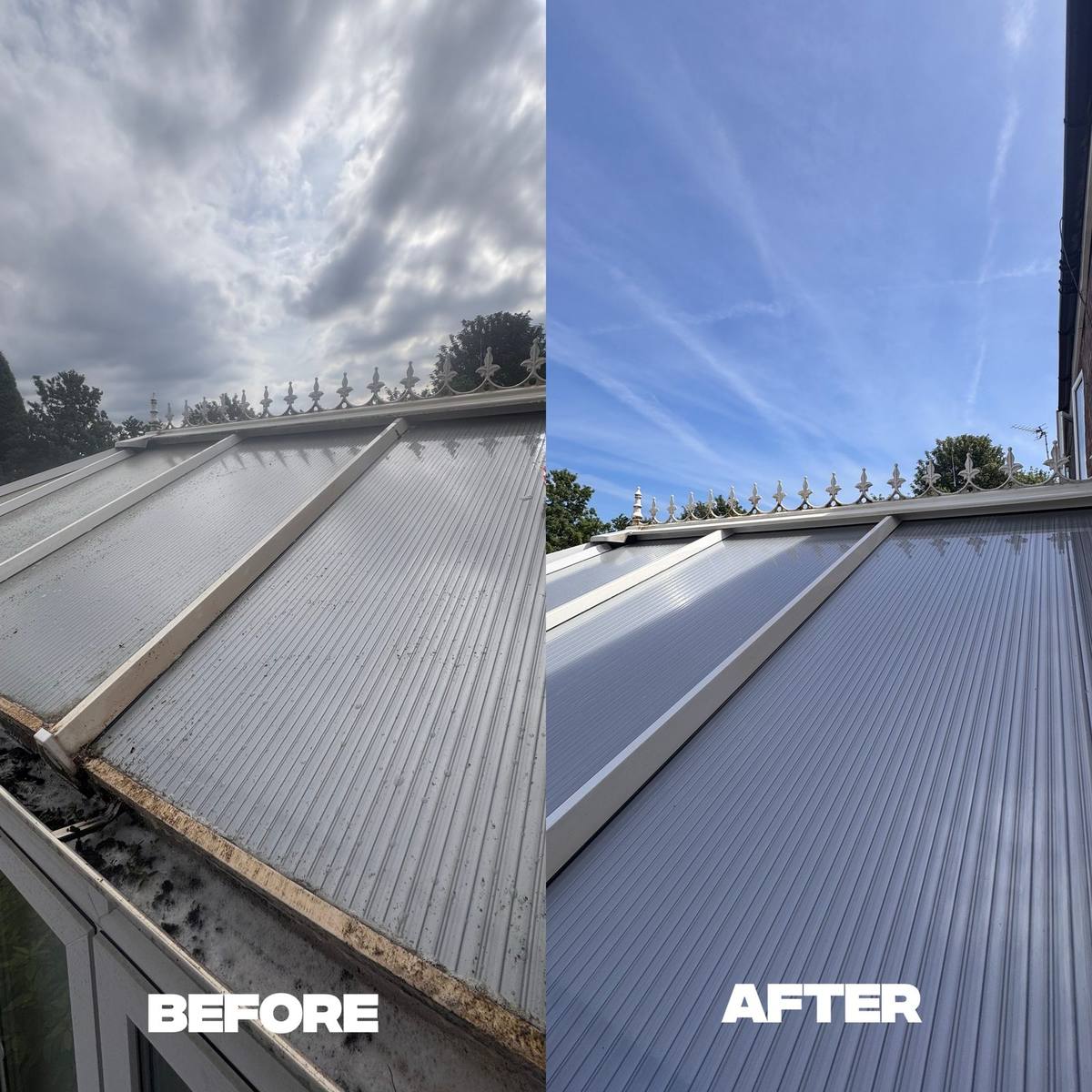
Moss and debris on a conservatory roof in Greater Manchester — a classic sign gutters are overdue a clear.
Quick answer: In the UK, gutters should be cleared at least twice a year — once in late autumn after leaves have fallen, and once in early spring. Properties surrounded by trees, or with moss on the roof, may need clearing three or four times a year to prevent blockages, water damage, and damp.
The Short Answer: Twice a Year for Most UK Homes
The standard recommendation is twice a year — once in late autumn after the bulk of leaf fall is done, and once in early spring after winter has passed. That two-visit rhythm works well for a typical semi-detached property with no major trees immediately overhead and guttering in reasonable condition. It keeps debris from building up long enough to compact into the heavy, silted blockages that are genuinely difficult to shift.
That said, twice a year is a baseline, not a rule that fits every property. A bungalow on an open street with uPVC guttering in good condition might get away with a single thorough clear each autumn. A Victorian terrace in Rochdale with oak trees hanging over the roof and original cast iron gutters is a different matter entirely. Think of twice yearly as the minimum starting point, and then adjust based on what your specific property tells you.
The key thing with the autumn clear is timing. Clear too early — say, September — and you'll find another layer of leaves sitting in the gutters by December. Late November or early December, once the trees are mostly bare, is the right window. The spring check in March or April is less about volume and more about catching anything that's washed in over winter before the wetter months ahead.
Why UK Weather Makes Gutter Maintenance More Important
The UK's climate is mild and persistently wet, which accelerates organic growth in a way that drier countries simply don't experience. Algae, moss, and lichen establish quickly in damp conditions, and once they take hold in a gutter they form a mat that traps debris far more effectively than bare plastic or cast iron would. What might take years to become a serious blockage in a drier climate can become a problem within a single season here.
In the North West specifically, annual rainfall is meaningfully higher than the UK average. Greater Manchester, including towns like Oldham, Rochdale, and Bury sitting at higher elevations on the Pennine fringe, sees consistent wet weather through autumn and winter. That moisture doesn't just fill gutters with water — it feeds the moss and algae that compound the problem year on year. If you have moss on your roof, some of it will be working its way into the gutters every time it rains. The guide on moss on your roof covers this in more detail, but the short version is that roof moss and blocked gutters are closely connected problems.
The combination of persistent damp, organic growth, and leaf fall from urban trees means that knowing how often to clear gutters in the North West really does require a slightly different answer than the national guidance suggests. For many properties here, twice a year is a minimum rather than a comfortable schedule.
Factors That Mean You Need to Clear Gutters More Often
Overhanging trees are the most obvious factor. Pine trees shed needles year-round rather than just in autumn, and those needles compact into a dense, moisture-retaining mulch that blocks downpipes quickly. Oak and sycamore drop large volumes of leaves over a short window, but also produce seeds and seed casings — sycamore keys and acorn cups fill gutters surprisingly fast. If you have any of these within falling distance of your roof, three or four clears a year is not excessive.
Roof moss is another significant driver. A roof with established moss growth is essentially feeding organic material into the guttering continuously, not just in autumn. If you can see green or dark growth on your roof tiles from the street, factor that into how often you plan to clear the gutters below. Addressing the roof moss through professional roof cleaning and moss removal — including a biocide treatment to kill spores at the root — reduces the ongoing burden considerably.
The age and design of the guttering matters too. Older narrow-profile gutters, including original cast iron on Victorian and Edwardian properties, block more quickly than modern wide-profile uPVC. Gutters that are slightly out of alignment and don't drain properly will pool water and encourage moss growth even when they're not technically blocked. Properties in exposed or elevated positions — anything on the Pennine edge from Oldham through to Saddleworth — tend to accumulate more wind-blown debris than sheltered urban streets.
Warning Signs Your Gutters Are Already Blocked
You don't need to climb a ladder to spot most gutter problems. The clearest sign is water pouring over the side of the gutter during rain rather than running cleanly to the downpipe. If you see a curtain of water falling from the gutter edge, there's a blockage somewhere between that point and the outlet. Watch during a moderate rainfall — a light drizzle won't always reveal the problem.
Watermarks or staining on the fascia boards below the gutterline are another reliable indicator. Dark streaking on painted or uPVC fascias shows where water has been overflowing repeatedly, often for longer than the homeowner realises. Damp patches on an external wall — particularly on a gable end or directly below a section of gutter — should be taken seriously, as this is often the first visible sign of penetrating damp beginning to develop.
Plant growth in the gutters is worth mentioning because it's more common than people expect. Grass, weeds, and even small saplings establish readily in a compacted debris mat that retains moisture. If you can see greenery growing out of the gutterline from the pavement, the blockage has likely been there for a while. Sagging sections of guttering, visible from ground level, suggest either a heavy blockage or a bracket failure — either way, it warrants attention before the next heavy rain.
What Happens If You Leave Gutters Blocked Too Long
Penetrating damp is the most common consequence. When a gutter overflows consistently, water tracks down the external face of the wall instead of being directed away from the building. On brick, this saturates the mortar joints over time. On rendered properties, it finds its way behind the render coat — and once water gets behind render, you're looking at cracking, staining, and eventually sections lifting away from the wall. Render repairs are significantly more expensive than gutter clearing, as anyone who has had to deal with failed render on a pebbledash property will know. The guide on how to clean pebbledash render safely touches on how surface water management affects render condition.
Fascia boards take a sustained hit from overflowing gutters too. Timber fascias in particular absorb water when gutters overflow onto them repeatedly, leading to rot that can spread to the rafter ends behind. Replacing fascia boards and soffits is a job that runs into hundreds of pounds per elevation — and it's entirely avoidable with regular gutter maintenance.
At the more serious end, consistently saturated ground against the building's foundation — caused by years of unmanaged overflow — can contribute to foundation movement in clay-heavy soils. That's not a common outcome, but it does happen, and the repair costs are not comparable to anything else on this list. The practical point is simply that blocked gutters are not a cosmetic problem. They're a structural one that develops slowly and announces itself only when significant damage has already occurred.
When to Call in a Professional Instead of DIY
For a single-storey extension or a low conservatory roof, DIY gutter clearing is entirely reasonable if you have a stable ladder and can work safely. A pair of rubber gloves, a trowel or gutter scoop, and a bucket will handle most straightforward blockages. Be honest with yourself about ladder confidence — working at height on an uneven surface with your hands full is not the moment to discover you're not comfortable at height.
For two-storey properties, the risk calculus changes. Falls from ladders are a significant cause of serious injury in the UK, and a full two-storey clear requires working at height repeatedly around the whole perimeter of the building. Professionals use purpose-built equipment — van-mounted vacuum systems, gutter cameras, and appropriate access equipment — that makes the job faster and safer. They can also spot cracked joints, separated union pieces, and loose brackets while they're working, which a ground-level inspection won't reveal.
If your gutters have heavy moss dropping in from the roof, scooping it out is only part of the answer. The moss on the roof tiles needs treating with a biocide to stop it regenerating and continuing to feed the gutters. A professional who clears gutters and also handles roof treatments can deal with both in one visit, which is more cost-effective than addressing them separately.
Where gutters are heavily silted — compacted debris that's been in place for several years — a professional with vacuum extraction equipment will clear them more thoroughly than hand-scooping allows. C&C Precision Precision Washing covers gutter clearing as part of the exterior maintenance work carried out across Greater Manchester, and quotes are straightforward to arrange by sending photos over WhatsApp.
A Simple Gutter Maintenance Schedule for Greater Manchester Homes
Late October to early December is the critical window for the main annual clear. Wait until the majority of leaves have fallen — clearing in September only to have October and November fill the gutters again is wasted effort. Once the trees are mostly bare and before the heavy winter rainfall sets in properly, clear all gutters and check that downpipes are running freely. This is also a good time to look at the condition of the roof while attention is on the exterior — if there's visible moss growth on the tiles, that's worth addressing rather than leaving to feed the gutters again next year.
March or April suits a follow-up inspection well. This doesn't need to be a full clear in most cases — more of a check that winter hasn't washed significant debris in and that joints and brackets are still sound after frost. If the autumn clear was thorough and trees aren't immediately overhead, this visit might amount to flushing the downpipes and checking the outlets are clear.
For properties with pine trees, dense tree cover, or visible roof moss, add a midsummer check in June or July. Pine needles and seed debris accumulate through spring and summer in a way that deciduous leaf fall doesn't, and catching a partial blockage in summer is considerably easier than dealing with a full one in November. The overall cost of two or three clears a year is modest — far less than the first round of repairs to fascias, render, or internal plasterwork that a years-long blockage will eventually demand. How often to clear gutters ultimately comes down to what's cheaper: a regular maintenance schedule, or the repairs that follow from skipping it.
Frequently asked questions
How often should gutters be cleared in the UK?
Twice a year is the standard recommendation for most UK homes — once in late autumn after leaves have fallen, and once in early spring. If your property has trees nearby or visible moss on the roof, you may need clearing three to four times a year to stay on top of blockages.
What time of year is best to clear gutters?
Late November or early December is the most important time — after the bulk of leaf fall but before the worst winter rain. A follow-up check in March or April catches any debris washed in over winter. Don't clear too early in autumn or you'll just have to do it again.
Can blocked gutters cause damp inside the house?
Yes, and it's one of the most common causes of penetrating damp in UK homes. When gutters overflow, water runs down the external wall rather than away from the building, saturating brickwork, render, and mortar. Left long enough, this works its way through to internal walls and ceilings.
Is it worth paying someone to clear gutters, or can I do it myself?
For a single-storey extension or conservatory, DIY is reasonable if you have a stable ladder and the confidence to use it safely. For anything two storeys or above, or where gutters are heavily silted or have moss dropping in from the roof, a professional is safer and often quicker. A proper clear also gives you the chance to spot cracked joints or sagging sections before they cause damage.
Not sure if your gutters need clearing?
Send a photo on WhatsApp and we'll give you a straight answer and a fast quote — no fuss.